The Signal Hang-Up Bug: CVE-2026-113380 Could Keep Your Microphone Active After You End a Call
A remote call participant could flood the call's internal event queue, delaying the local user's hang-up request so that audio and possibly video tracks remained active after the user believed the call had ended. The vulnerability did not break encryption but could expose private conversations to the malicious peer.
White Arrow Cybersecurity Follow
 Published on medium.com
Cybersecurity
The full write-up lives on its author's site
It belongs to its author, so we link to it rather than copy it. The other two tabs are our own rewrites, checked against it.
Context: what RingRTC is and what a hang-up is supposed to do
Signal's calling features are built on RingRTC, an open-source library that handles real-time voice and video communication and is built around WebRTC technology. The vulnerability discussed here, tracked as CVE-2026-113380, affected versions of RingRTC before version 2.72.0 and received a CVSS 4.0 severity score of 9.3 (Critical). It was publicly documented on 20 October 2026.
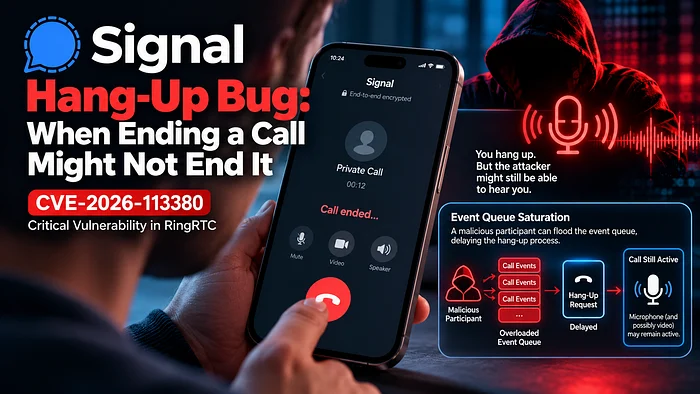
The interesting part is that this was not a traditional encryption-breaking vulnerability. It concerned something much more fundamental: how an application processes events and manages the lifecycle of an active call.
When a user presses the hang-up button, the application has to do much more than switch the screen from an active-call interface to an idle screen. It needs to coordinate several operations:
- Stop audio capture.
- Stop video capture, where applicable.
- Terminate media tracks.
- Update the call state.
- Notify the remote participant.
- Close the relevant connections.
- Release associated resources.
- Remove the active call session.
These operations need to happen reliably, even when the application is processing a large number of events. RingRTC uses finite state machines (FSMs) to manage call and connection states. An FSM processes events and transitions between defined states according to application logic, for example:
Incoming Call → Connected → Active Communication → Terminating → Terminated
The problem identified in this vulnerability was related to how the termination request was handled within the event-processing architecture.
Setup: accounts, roles, tools and preconditions
The scenario involves a malicious peer participating in a call with a user whose Signal uses a vulnerable version of RingRTC. The attacker does not need to be an unrelated stranger: the whole scenario depends on being a participant in the call. No specific tooling, accounts or configuration steps are described beyond that.
Finding it: a hang-up that does not complete
The question that frames the finding is simple: what happens when you press the hang-up button, but the application does not actually terminate the call?
Imagine having a private conversation over Signal. You finish speaking, press the red hang-up button and put your phone down. You assume the call has ended. But what if the application has received your request to terminate the call without actually completing the shutdown process?
That is the privacy concern behind the vulnerability. According to the vulnerability description, a remote peer participating in a call could saturate the call's internal FSM event queue. This could interfere with the local user's ability to terminate the call properly. In practical terms, a user could press the hang-up button while the application failed to complete the teardown of the call, potentially leaving audio and possibly video tracks active.
Exploitation: saturating the event queue
Step 1: understand the queue
The vulnerability involved event queue saturation. Think of an event queue as a waiting line: every event that needs processing enters the queue, and the application processes those events according to its state machine logic.
Step 2: note where the hang-up request is handled
In the vulnerable implementation, the hang-up request was also handled through this event-processing mechanism. That is the design decision the attack relies on.
Step 3: flood the queue from the peer side
A malicious participant could generate enough peer-originated events to saturate the queue. Consequently, the local termination request could remain delayed behind other queued events.
Step 4: observe the result
The application might receive the user's instruction to end the call, but the state machine could fail to process the request and complete the teardown as expected. The potential result is that the user believes the call has ended, while audio and potentially video communication may remain active.
There is an important limitation: this scenario involves a malicious peer participating in the call. It does not mean that an unrelated stranger could remotely activate the microphone of any Signal user.
Root cause: three weaknesses in the design
1. Event queue saturation
The first issue involved the handling of incoming events. The attacker could generate enough events to interfere with the processing of the call's state machine. A secure event-processing architecture should consider:
- Queue capacity.
- Event prioritisation.
- Rate limiting.
- Input validation.
- Backpressure mechanisms.
- Handling of unexpected event volumes.
A remote participant should not be able to indefinitely delay a critical local security operation by generating excessive events.
2. No independent priority for call termination
This is arguably the most interesting design issue. A termination request is not an ordinary application event. When a user decides to end a call, the application should prioritise that decision over routine processing. If termination depends entirely on a queue that can be influenced by a remote participant, the application introduces an unnecessary dependency into a security-critical operation. The hang-up operation should have a reliable mechanism to proceed independently of the normal event backlog.
3. Incomplete teardown handling
Another important aspect addressed in the corrective changes was error handling during termination. A shutdown process may involve multiple operations. If one operation fails, the application should not necessarily abandon all subsequent cleanup. For example, an error while notifying the application layer should not automatically prevent other necessary teardown operations from proceeding. Security-sensitive cleanup should be designed to continue as safely as possible, even when individual steps encounter errors.
Impact: what a malicious peer could get
The primary concern was the possibility of continued audio transmission after the user believed the call had ended. The vulnerability description also mentions potential continued video activity. However, the available reporting does not establish that continued video transmission was independently demonstrated in a real-world attack.
The potential impact can be understood in three areas:
- Privacy: audio could potentially remain available to the malicious participant after the victim attempted to hang up.
- Confidentiality: private conversations could be exposed beyond the point at which the user believed communication had stopped.
- Application integrity: the application could fail to honour an important user-initiated state transition.
This is particularly concerning because users generally rely on the hang-up action as an explicit privacy boundary.
This did not break Signal's end-to-end encryption
No demonstrated encryption break was involved. End-to-end encryption protects communication from unauthorised interception while information is transmitted between participants. However, encryption does not automatically protect against application-level failures. Consider this sequence:
- Your device captures microphone audio.
- The application processes that audio.
- The communication library handles the media stream.
- The encrypted communication is transmitted to the other participant.
If the application fails to terminate the media session, encryption alone does not prevent the intended call participant from continuing to receive audio. In other words, the encryption mechanism can work correctly while the application mishandles the lifecycle of the communication session. Secure application development therefore requires more than strong cryptographic algorithms: it also requires correct state management, permission handling, resource cleanup and secure communication logic.
Fix: what changed in RingRTC 2.72.0
Signal addressed the vulnerability in RingRTC version 2.72.0, released on 4 September 2026. The corrective changes are documented in Signal's public RingRTC repository and introduced several improvements.
- Independent termination flag. A separate termination flag was introduced so that the application could recognise a termination request independently of the normal event queue. The user's request no longer has to wait indefinitely behind queued events.
- Bounded termination waiting. The updated implementation introduced a five-second timeout for waiting for the state machine to become inactive before proceeding with teardown, which helps prevent shutdown from waiting indefinitely.
- Bounded event queue. The implementation defines a bounded event queue capacity of 256 events, providing an explicit limit rather than allowing the queue to grow without a defined bound.
- More resilient cleanup. The updated termination process handles individual cleanup errors more carefully. Instead of stopping the entire cleanup sequence when one operation fails, the implementation logs errors and continues with subsequent termination steps where possible.
- Regression testing. The corrective changes included tests designed to simulate conditions where the state machine is delayed and verify that termination can still complete.
For users, the fix lives at the library level, so the practical recommendation is to update Signal on Android, iOS and desktop to the latest available release, and not to rely on an older installation simply because it continues to function normally. It is also worth reviewing microphone and camera permissions at the operating-system level and paying attention to activity indicators after ending calls. If an indicator remains active unexpectedly, investigate which application is using the microphone or camera, and avoid assuming that every unusual microphone indicator is related to this specific vulnerability. The exact first Signal application releases containing the fix were not consistently established in the initial reporting, so updating to the latest available release is the safest recommendation.
Variants to test
- Other WebRTC-based calling stacks. Look for hang-up or teardown paths that are dispatched through the same queue as peer-originated events. A positive result is a termination request that stays pending while the peer floods the connection with events, with media capture still running afterwards.
- Unbounded or loosely bounded event queues. Check whether the queue has an explicit capacity and what happens when it is reached. A positive result is a queue that grows without a defined bound, or one whose limit is high enough that a peer can keep it full for the duration of a call.
- Cleanup sequences that abort on first error. Inspect teardown code for early returns when a single step fails, for example a failure notifying the application layer. A positive result is a media track or session that survives because an earlier, unrelated cleanup step threw.
- Other real-time collaboration and remote desktop tools. The same architectural concern can appear in WebRTC conferencing platforms, video streaming applications, remote desktop software, multiplayer communication systems, real-time collaboration tools and IoT communication services. Wherever a remote participant can influence the event-processing pipeline, test what happens when that pipeline is overloaded and whether a local privacy action still completes.
One particularly important lesson is that security-critical operations should not depend entirely on resources that an untrusted remote participant can influence. A security feature is only as reliable as the implementation behind it, and a hang-up button should do more than change the user interface: it should reliably terminate the communication session. When users press that button, they are making a privacy decision, and the software must respect it.
What happened, in plain words
Signal is a messaging app that people use for private conversations, including voice and video calls. When you finish a call, you press the red hang-up button and put your phone down. You assume the call is over.
This article is about a bug where that assumption could be wrong. In certain versions of the software that Signal uses to run calls, a person on the other end of the call could flood the app with so many small internal messages that your hang-up request got stuck in a queue behind them. Audio, and possibly video, could in principle have stayed active after you thought you had hung up.
The bug is tracked as CVE-2026-113380. A CVE is a public catalogue number given to a known security flaw so that everyone can refer to the same thing. The affected component is called RingRTC, a piece of software that Signal uses to handle real-time voice and video. Versions before 2.72.0 were affected, and the flaw received a CVSS 4.0 severity score of 9.3 (Critical). CVSS is a standard scoring system for how serious a security flaw is, where higher numbers mean more serious. The vulnerability was publicly documented on 20 October 2026.
What makes this interesting is that nothing about Signal's encryption was broken. The problem was much more ordinary: how the app keeps track of what state a call is in, and how it handles the moment you ask for the call to stop.
The pieces involved, explained from zero
Before the details make sense, here are the main building blocks.
Signal is a messaging and calling application for phones and computers. Its selling point is privacy: messages and calls are encrypted so that only the people in the conversation can read or hear them.
RingRTC is a library. A library is a bundle of ready-made code that an app uses to do a hard job instead of writing it from scratch. RingRTC is the open-source library responsible for handling real-time voice and video communication in Signal. "Open-source" means its code is published publicly, so anyone can read it. It is built around WebRTC, which is a set of standards that lets browsers and apps send live audio and video directly between two devices.
A call lifecycle is the sequence of stages a call goes through, from ringing to finished. RingRTC uses finite state machines to manage call and connection states. A finite state machine (FSM) is a simple model: the software is always in exactly one state, and events move it from one state to another according to fixed rules. A traffic light is a good everyday comparison: it is red, then green, then amber, and it only changes when its timer fires. It cannot be red and green at once, and it cannot skip to a state that does not exist.
For a call, the states look like this:
Incoming Call → Connected → Active Communication → Terminating → Terminated
An event is any small thing that happens and needs a reaction: the call starts ringing, the other person's connection changes, audio data arrives, you press a button. Each of these is an event that the software has to process.
An event queue is a waiting line for those events. Think of a supermarket till: customers join one queue and are served in order. Every event that needs processing enters the queue, and the application processes those events according to its state machine logic. If the queue gets very long, whatever is at the back waits a long time.
Teardown is the process of properly closing a call down. It is not one action but a checklist of several.
What a hang-up is supposed to do
When a user presses the hang-up button, the application has to do much more than switch the screen from an active-call interface to an idle screen. It needs to coordinate several operations:
- Stop audio capture.
- Stop video capture, where applicable.
- Terminate media tracks.
- Update the call state.
- Notify the remote participant.
- Close the relevant connections.
- Release associated resources.
- Remove the active call session.
In plain words: the microphone has to stop recording, the camera has to stop recording, the streams of audio and video (the "media tracks") have to be shut down, the app's internal record of the call has to move to the finished state, the other person's app has to be told the call is over, the network connections have to be closed, memory and other resources have to be handed back, and the call session has to be removed from the app.
These operations need to happen reliably, even when the application is processing a large number of events. The problem identified in this vulnerability was related to how the termination request was handled within the event-processing architecture.
Who could do this, and what they needed
The scenario involves a malicious peer participating in a call with a user whose Signal uses a vulnerable version of RingRTC. A "peer" here simply means the other person in the call.
The attacker does not need to be an unrelated stranger: the whole scenario depends on being a participant in the call. No specific tooling, accounts or configuration steps are described beyond that. In other words, this is not a bug where someone on the other side of the world could switch on your microphone out of nowhere. They had to already be talking to you.
Finding it: a hang-up that does not complete
The question that frames the finding is simple: what happens when you press the hang-up button, but the application does not actually terminate the call?
Imagine having a private conversation over Signal. You finish speaking, press the red hang-up button and put your phone down. You assume the call has ended. But what if the application has received your request to terminate the call without actually completing the shutdown process?
That is the privacy concern behind the vulnerability. According to the vulnerability description, a remote peer participating in a call could saturate the call's internal FSM event queue. "Saturate" means filling the queue so completely that nothing else can get through in reasonable time. This could interfere with the local user's ability to terminate the call properly. In practical terms, a user could press the hang-up button while the application failed to complete the teardown of the call, potentially leaving audio and possibly video tracks active.
How the attack worked, step by step
Step 1: understand the queue
The vulnerability involved event queue saturation. Think of an event queue as a waiting line: every event that needs processing enters the queue, and the application processes those events according to its state machine logic. If the line is short, everything is handled quickly. If the line is enormous, the last item waits.
Step 2: note where the hang-up request is handled
In the vulnerable implementation, the hang-up request was also handled through this event-processing mechanism. That is the design decision the attack relies on. Your request to end the call was not treated specially: it joined the same queue as everything else, including events coming from the other person's app.
Step 3: flood the queue from the peer side
A malicious participant could generate enough peer-originated events to saturate the queue. Consequently, the local termination request could remain delayed behind other queued events. The attacker is not breaking any lock or guessing any password; they are simply making the app so busy that your own instruction has to wait its turn.
Step 4: observe the result
The application might receive the user's instruction to end the call, but the state machine could fail to process the request and complete the teardown as expected. The potential result is that the user believes the call has ended, while audio and potentially video communication may remain active.
There is an important limitation: this scenario involves a malicious peer participating in the call. It does not mean that an unrelated stranger could remotely activate the microphone of any Signal user.
Why it happened: three weaknesses in the design
1. Event queue saturation
The first issue involved the handling of incoming events. The attacker could generate enough events to interfere with the processing of the call's state machine. A secure event-processing architecture should consider:
- Queue capacity.
- Event prioritisation.
- Rate limiting.
- Input validation.
- Backpressure mechanisms.
- Handling of unexpected event volumes.
Each of those deserves a plain explanation. Queue capacity means deciding in advance how many items the queue may hold. Event prioritisation means letting important events jump ahead of routine ones. Rate limiting means capping how many events a single source may send in a given time. Input validation means checking that incoming events are well formed and expected. Backpressure is a way of telling a fast sender to slow down, like a busy restaurant asking new arrivals to wait before seating them. Handling of unexpected event volumes means having a plan for what happens when far more arrives than usual.
A remote participant should not be able to indefinitely delay a critical local security operation by generating excessive events.
2. No independent priority for call termination
This is arguably the most interesting design issue. A termination request is not an ordinary application event. When a user decides to end a call, the application should prioritise that decision over routine processing. If termination depends entirely on a queue that can be influenced by a remote participant, the application introduces an unnecessary dependency into a security-critical operation. The hang-up operation should have a reliable mechanism to proceed independently of the normal event backlog.
In everyday terms: if the fire alarm had to wait in the same queue as everyone's coffee order, you would not trust the fire alarm. A hang-up is a privacy decision, and it should not be stuck behind traffic that someone else controls.
3. Incomplete teardown handling
Another important aspect addressed in the corrective changes was error handling during termination. A shutdown process may involve multiple operations. If one operation fails, the application should not necessarily abandon all subsequent cleanup. For example, an error while notifying the application layer should not automatically prevent other necessary teardown operations from proceeding. Security-sensitive cleanup should be designed to continue as safely as possible, even when individual steps encounter errors.
Think of a pilot's shutdown checklist: if one item cannot be completed, the crew does not walk away and leave the engines running. They note the problem and carry on with the remaining items.
What the impact actually was
The primary concern was the possibility of continued audio transmission after the user believed the call had ended. The vulnerability description also mentions potential continued video activity. However, the available reporting does not establish that continued video transmission was independently demonstrated in a real-world attack.
The potential impact can be understood in three areas:
- Privacy: audio could potentially remain available to the malicious participant after the victim attempted to hang up.
- Confidentiality: private conversations could be exposed beyond the point at which the user believed communication had stopped.
- Application integrity: the application could fail to honour an important user-initiated state transition.
Privacy means control over who can hear or see you. Confidentiality means information staying limited to the people it was meant for. Integrity, in security, means the software doing what it is supposed to do and not being talked out of it. This is particularly concerning because users generally rely on the hang-up action as an explicit privacy boundary.
This did not break Signal's end-to-end encryption
No demonstrated encryption break was involved. End-to-end encryption means the data is scrambled on your device and only unscrambled on the other person's device, so nobody in between can read it. It protects communication from unauthorised interception while information is transmitted between participants. However, encryption does not automatically protect against application-level failures. Consider this sequence:
- Your device captures microphone audio.
- The application processes that audio.
- The communication library handles the media stream.
- The encrypted communication is transmitted to the other participant.
If the application fails to terminate the media session, encryption alone does not prevent the intended call participant from continuing to receive audio. In other words, the encryption mechanism can work correctly while the application mishandles the lifecycle of the communication session.
A useful comparison is a sealed, tamper-proof envelope. The envelope guarantees that nobody in the postal system can read the letter. It does not stop you from accidentally leaving the letter in the envelope and handing it to the wrong person. Secure application development therefore requires more than strong cryptographic algorithms: it also requires correct state management, permission handling, resource cleanup and secure communication logic.
How it was fixed
Signal addressed the vulnerability in RingRTC version 2.72.0, released on 4 September 2026. The corrective changes are documented in Signal's public RingRTC repository and introduced several improvements.
- Independent termination flag. A separate termination flag was introduced so that the application could recognise a termination request independently of the normal event queue. A "flag" here is simply a marker the software checks. The user's request no longer has to wait indefinitely behind queued events.
- Bounded termination waiting. The updated implementation introduced a five-second timeout for waiting for the state machine to become inactive before proceeding with teardown, which helps prevent shutdown from waiting indefinitely. A timeout is a deadline: if the expected state is not reached in time, the software stops waiting and moves on.
- Bounded event queue. The implementation defines a bounded event queue capacity of 256 events, providing an explicit limit rather than allowing the queue to grow without a defined bound. "Bounded" means there is a fixed maximum. Once the limit is reached, the software has to deal with the overflow rather than letting the line grow forever.
- More resilient cleanup. The updated termination process handles individual cleanup errors more carefully. Instead of stopping the entire cleanup sequence when one operation fails, the implementation logs errors and continues with subsequent termination steps where possible. Logging means writing a record of what went wrong so developers can inspect it later.
- Regression testing. The corrective changes included tests designed to simulate conditions where the state machine is delayed and verify that termination can still complete. A regression test is an automated check that a bug, once fixed, stays fixed.
What you should do as a user
The fix lives at the library level, so the practical recommendation is to update Signal on Android, iOS and desktop to the latest available release, and not to rely on an older installation simply because it continues to function normally. An app that still opens and makes calls is not proof that it contains the fix.
It is also worth reviewing microphone and camera permissions at the operating-system level. Permissions are the phone or computer's own switches that decide which apps may use the microphone and camera. Pay attention to activity indicators after ending calls: modern phones and computers show a small dot or icon when the microphone or camera is in use. If an indicator remains active unexpectedly, investigate which application is using the microphone or camera, and avoid assuming that every unusual microphone indicator is related to this specific vulnerability. Many apps legitimately use the microphone for short periods.
The exact first Signal application releases containing the fix were not consistently established in the initial reporting, so updating to the latest available release is the safest recommendation.
The wider lesson for software builders
One particularly important lesson is that security-critical operations should not depend entirely on resources that an untrusted remote participant can influence. The same architectural concern can appear in WebRTC conferencing platforms, video streaming applications, remote desktop software, multiplayer communication systems, real-time collaboration tools and IoT communication services. IoT means everyday devices with network connections, such as smart speakers or connected cameras.
Wherever a remote participant can influence the event-processing pipeline, developers need to consider what happens when that pipeline is overloaded, and whether a local privacy action still completes.
A security feature is only as reliable as the implementation behind it, and a hang-up button should do more than change the user interface: it should reliably terminate the communication session. When users press that button, they are making a privacy decision, and the software must respect it.
Glossary
- API: a defined way for one piece of software to ask another piece of software to do something, like a service counter with fixed rules about what you can request.
- Backpressure: a mechanism that tells a fast sender to slow down when the receiver cannot keep up.
- Bounded queue: a waiting line with a fixed maximum number of items.
- Confidentiality: keeping information limited to the people it was meant for.
- CVE: a public catalogue number assigned to a known security vulnerability so everyone can refer to the same flaw.
- CVSS: a standard scoring system for the severity of a security vulnerability; higher numbers mean more serious.
- End-to-end encryption: scrambling data on the sender's device so that only the recipient's device can unscramble it, with nobody in between able to read it.
- Event: any small occurrence the software must react to, such as a button press or incoming audio data.
- Event queue: a waiting line in which events wait their turn to be processed.
- Finite state machine (FSM): a model in which software is always in exactly one state and moves between states according to fixed rules, like a traffic light.
- Flag: a marker in software that records whether some condition is true.
- Integrity (application integrity): the property of software doing what it is supposed to do and honouring the user's instructions.
- IoT: everyday physical devices with network connections, such as smart speakers or connected cameras.
- Library: a bundle of ready-made code that an application uses to perform a task instead of writing it from scratch.
- Media track: a single stream of audio or video inside a call.
- Open-source: software whose source code is published publicly for anyone to read.
- Peer: the other participant in a call or connection.
- Permissions: operating-system settings that decide which apps may use hardware such as the microphone or camera.
- Privacy: a person's control over who can see or hear them and when.
- Rate limiting: capping how many actions or events a single source may produce in a given period.
- Regression test: an automated check that a fixed bug stays fixed.
- RingRTC: the open-source library Signal uses to handle real-time voice and video communication.
- Saturate: to fill something so completely that nothing else can get through in reasonable time.
- Teardown: the process of properly closing down a call, including stopping capture, closing connections and releasing resources.
- Timeout: a deadline after which software stops waiting and takes another course of action.
- WebRTC: a set of standards that lets browsers and apps send live audio and video directly between devices.


