The WAF Was Never the Wall
The target's origin servers were directly reachable from the internet, bypassing the WAF. An attacker could reach a native admin login with default credentials and a case-management API that trusted a client-supplied user ID, allowing unauthenticated case creation, a privacy oracle, suppression poisoning and state tampering.

medium.com
Published on medium.com
Infosec
The full write-up lives on its author's site
It belongs to its author, so we link to it rather than copy it. The other two tabs are our own rewrites, checked against it.
Context
The target in this story is a large data and analytics company with dozens of customer-facing applications. Every application sits behind a commercial WAF. The security model is one layer deep: the WAF challenges bots, blocks attack patterns, enforces reputation and geo rules, and everything behind it is assumed protected. The author's framing is that the WAF is not a wall but a curtain, and that the origins behind it are where the real attack surface lives.
The applications involved include an API gateway, an SSO login gateway, an administration portal, an audit service, and a consumer-facing portal whose case pipeline processes requests from real consumers. The case pipeline is described as a regulated system.
Setup
Every step of the pipeline was filtered against the program's scope list so that the wide net never touched anything out of bounds.
The tooling was a mix of custom and public sources:
- Certificate transparency logs, to find every certificate ever issued for the estate's domains. A certificate issued for
app.target.comhas to be presented by something, and that something has an IP. - Passive DNS and engine pools (Shodan, with a key, plus public data sets), to supply candidate IPs around those certificates.
- VoidOrigin, the author's own open source tool, to automate the origin discovery and verification described below.
- Standard recon and injection tooling for the rest of the pipeline: crawling, archive and public URL sets, directory brute force, JavaScript analysis, CORS and CRLF checks, blind SSRF and open-redirect spraying, and injection tooling for LFI, SQLi and XSS.
The full recon, from enumeration through to the demonstrated critical, took about twelve days. The author is explicit that this duration is the point: a one-hour scanner run finds nothing new.
Finding it
The starting assumption is that CDNs and WAFs hide origin servers, but the internet keeps records of them. VoidOrigin's concept is to join those records and then verify the result.
Verification separates real origins from noise. A candidate IP has to pass three checks:
- Does it present the application's own certificate when you connect with the right SNI?
- Does it serve a page byte-identical to the CDN's?
- Does the title match?
A real origin passes all three. Run against an estate's apex domains, the origins fall out: bare servers serving the real applications with no WAF in the path.
The engagement's workflow, with scope filtering after every step, was:
- Enumeration, wide on purpose. Passive sources and certificate transparency for every subdomain, then permutation scanning on the names already found.
- Probing. Everything that resolved was probed for live web servers: ports, titles, tech stack. Dead names stayed in the pool for takeover checks.
- URL and parameter mining. Crawling, archive and public URL sets, deduplicated down to unique parameters, then hidden-parameter discovery that learns a normal response and reports what changes it.
- Directory brute force with soft-404 cleanup, so thousands of identical fake-404 pages do not bury the real paths.
- JavaScript analysis. Every in-scope script downloaded, scanned for secrets and DOM sinks, source maps rebuilt, then read by hand.
- Specialised passes. CORS and CRLF checks, blind SSRF and open-redirect spraying, injection tooling for LFI, SQLi and XSS, each with its own confirmation step, because scanners lie.
- The infrastructure layer. Port scans, VPN-gateway discovery, and then VoidOrigin on the estate's apex domains: candidate IPs from certificate transparency and passive pools, each verified against a live baseline of the real site.
After the automated passes came the manual part: reading the source the origins exposed, and following the naming pattern it revealed to the twins nobody had put a WAF in front of.
Exploitation
Step 1: Resolve the origins
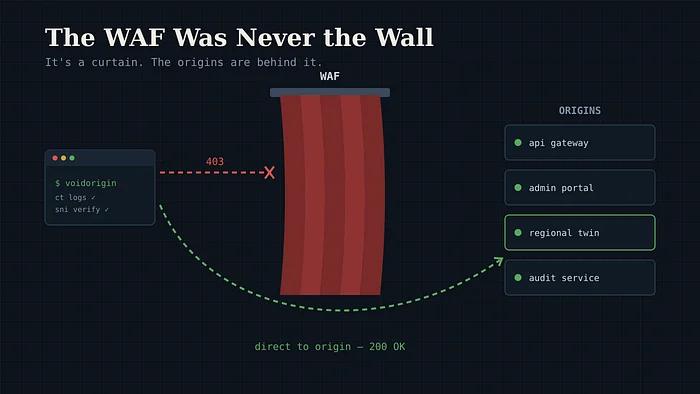
VoidOrigin resolved the real origins for the API gateway, the SSO login gateway, the administration portal, and the audit service. These were AWS instances and Tomcat servers with their own certificates, directly addressable from the public internet.
Step 2: Exploit the differential
The same attack payload that returns 403 at the edge is processed by the application at the origin. The token service that the WAF intercepts evaluates credentials when addressed directly. Every protection the WAF provides becomes optional, because the request never touches the WAF.
Step 3: Use the hidden login channel
The administration portal's native login form, the one the WAF redirects away from because users are supposed to authenticate through SSO, exists and works at the origin. There, a default vendor credential pair was accepted and an authenticated session was issued. This is a High-severity finding that exists only because the origin was reachable.
Step 4: Follow the naming pattern to the regional twins
Origin discovery established the estate's infrastructure naming, and the naming exposed the regional twins: production load balancers with predictable region suffixes, deployed with no WAF in front of them at all. One of those twins served a consumer-facing portal's entire API naked, including its raw, unminified client source code, sitting in a public directory.
Step 5: Read the source and find the gate
The source code revealed that the portal's entire case pipeline enforces its one and only operator check with a client-supplied user ID field, which the public configuration sets to a fixed value. One field is the whole gate.
Step 6: Create cases unauthenticated
A POST with that fixed user ID and a well-formed case object returns a real case number from the production system. This was demonstrated repeatedly, including requests tied to one of the company's paid products, with attacker-supplied identifiers and addresses.
Step 7: Query the privacy oracle
The duplicate-check endpoint answers whether any submitted identifying data matches an existing case, and returns that case's identity. Anyone can query whether a person's data matches an existing case.
Step 8: Poison suppression end to end
Create a case, re-query the same data, and the injected case now answers the oracle as a duplicate. That flag is the mechanism the system uses to enforce per-consumer limits, so attacker-injected cases make legitimate consumer requests look like duplicates and get suppressed.
Step 9: Tamper with state on arbitrary cases
The update endpoint accepts any client-supplied case identity with no ownership check.
Step 10: Abuse the mailing model
Because the application's own model includes the mailing address and report-request fields, a fabricated case requests a disclosure report for attacker-chosen identifiers to be mailed to an attacker-chosen address.
No account, no captcha and no rate limit in the path were needed. The critical was demonstrated in the real runtime, through the public WAF path and through the naked twin alike.
Root cause
The chain rests on several mistakes that compound each other.
- The origin is directly reachable. The AWS instances and Tomcat servers have their own certificates and are addressable from the public internet, so the WAF is bypassed by simply not using it. The author's view is that origins get left on default security groups because someone believed the curtain was enough.
- Native login channels stay alive. The administration portal's native login form still works at the origin even though users are supposed to authenticate through SSO. It is left alive because nobody can reach it, until someone can.
- The operator check is client-supplied. The case pipeline's only operator check is a user ID field supplied by the client, and the public configuration sets it to a fixed value. The server trusts a value the caller controls.
- The source is served unminified. The code that documents every one of those mistakes is served, unminified, from the very host you were never supposed to find.
Existing defences did not stop the chain because every protection the WAF provides is optional once the request never touches the WAF. The update endpoint accepts any client-supplied case identity with no ownership check, so the application layer does not compensate for the missing edge layer.
Impact
An attacker with no account can, under the conditions described:
- create real cases in the production system, including cases tied to one of the company's paid products, with attacker-supplied identifiers and addresses;
- use the duplicate-check endpoint as a live privacy oracle, learning whether any submitted identifying data matches an existing case and obtaining that case's identity;
- poison suppression, so that attacker-injected cases make legitimate consumer requests look like duplicates and get suppressed;
- tamper with state on arbitrary cases through the update endpoint, which accepts any client-supplied case identity with no ownership check;
- cause a fabricated case to request a disclosure report for attacker-chosen identifiers to be mailed to an attacker-chosen address.
The administration portal also yields an authenticated session through a default vendor credential pair, a High-severity finding that exists only because the origin was reachable. The author notes that the critical was demonstrated in the real runtime, through the public WAF path and through the naked twin alike.
Fix
The report does not describe any remediation that was applied.
- Put the origins behind the WAF, or restrict them so they are not directly addressable from the public internet, and review default security groups on the AWS instances and Tomcat servers.
- Remove or disable the administration portal's native login form at the origin, so SSO is the only authentication path, and remove default vendor credentials.
- Enforce the operator check server-side rather than trusting a client-supplied user ID field, and stop shipping a fixed value in the public configuration.
- Add authentication and ownership checks to the duplicate-check and update endpoints.
- Stop serving raw, unminified client source code from public directories.
Variants to test
- Certificate transparency plus SNI verification. Enumerate certificates for the target's apex domains, collect candidate IPs from passive DNS and engine pools, and connect with the right SNI. A positive result is a candidate that presents the application's own certificate, serves a page byte-identical to the CDN's, and has a matching title.
- Differential testing at the origin. Send the same payload to the edge and to a verified origin. A positive result is a 403 at the edge and a processed request at the origin.
- Native login forms at origins. Look for login forms the WAF redirects away from, and try default vendor credential pairs. A positive result is an authenticated session issued by the origin.
- Regional twins. Follow the estate's infrastructure naming to production load balancers with predictable region suffixes, and check whether they have a WAF in front. A positive result is a twin serving the full API, including raw client source, with no WAF in the path.
- Client-supplied operator fields. Read the client source for fields that gate operator functions, and try the fixed value from the public configuration. A positive result is a POST that returns a real case number from production without authentication.
- Duplicate-check oracles. Submit identifying data to duplicate-check endpoints. A positive result is an answer about whether the data matches an existing record, plus that record's identity.
- Suppression poisoning. Create a record, re-query the same data, and check whether the injected record now answers as a duplicate. A positive result is that legitimate requests are suppressed as duplicates.
- Ownership checks on update endpoints. Send an update with a client-supplied record identity that you do not own. A positive result is a state change on an arbitrary record.
What happened, in plain words
A security researcher spent about twelve days testing a large company that runs data and analytics services, with dozens of applications used by customers. Every one of those applications sat behind a commercial WAF. A WAF, or web application firewall, is a piece of software that sits in front of a website and inspects incoming traffic, blocking bots, attack patterns, bad reputation addresses and traffic from regions the company does not serve. Most companies treat it as the front door lock: everything behind it is assumed safe.
The researcher's argument is that this is the wrong mental model. A WAF is not a wall, it is a curtain. Behind the curtain sit the real servers that run the applications, called origin servers. If you can find those servers and talk to them directly, you skip the curtain entirely, and every protection it offered becomes optional.
So the researcher built a tool called VoidOrigin to find origin servers. The tool uses public records that the internet keeps about certificates and about which addresses have hosted which names, then checks each candidate to see whether it really is the company's own server. Running it against the company's main domains produced direct addresses for the API gateway, the SSO login gateway, the administration portal and the audit service.
From there the chain grew. The origins accepted a default vendor username and password on an administration login form that the WAF redirects away from. The naming pattern of the infrastructure revealed regional copies of production load balancers with no WAF in front of them at all. One of those copies served a consumer portal's entire API, including its raw, unminified source code, from a public directory. Reading that code showed that the portal's whole case pipeline, a regulated system that processes requests from real consumers, protected its operator functions with a single user ID field supplied by the client, set to a fixed value in the public configuration. That one field was the whole gate.
With that field, an attacker with no account could create real cases in production, ask whether any person's data matched an existing case and get that case's identity back, poison the duplicate-suppression mechanism so that legitimate consumer requests looked like duplicates and were suppressed, change state on arbitrary cases, and cause a fabricated case to request a disclosure report for chosen identifiers to be mailed to a chosen address. No captcha, no account, no rate limit in the path.
The researcher demonstrated all of this in the real running system, both through the public WAF path and through the naked twin. The lesson is that the wall was never the WAF. The wall was an assumption, and the assumption had a naming convention.
The assumption
The company in the story runs a large data and analytics estate with dozens of customer-facing applications. Every application sits behind a commercial WAF. The security model is one layer deep: the WAF challenges bots, blocks attack patterns, enforces reputation and geo rules, and everything behind it is assumed protected.
To unpack that: a bot is an automated program that sends requests far faster than a person could. An attack pattern is a request shaped like a known exploit, for example one containing database commands or script tags. Reputation rules block addresses known for abuse, and geo rules block or allow traffic by country. All of these checks happen at the edge, meaning at the WAF, before the request reaches the application.
The entire defensive posture is the curtain. If a request can reach the application without passing the WAF, none of those checks happen.
The tool
The researcher built VoidOrigin to pull the curtain back. The concept is simple: CDNs and WAFs hide origin servers, but the internet keeps records of them. A CDN, or content delivery network, is a network of servers around the world that cache and serve a site's content close to the visitor; it also hides the real server behind it. The origin server is the machine that actually runs the application.
Three kinds of records are used:
- Certificate transparency logs show every certificate ever issued for the estate's domains. A certificate issued for
app.target.comhas to be presented by something, and that something has an IP. A certificate is the digital document a server shows to prove it owns a name when you connect over HTTPS, the encrypted version of the web. Certificate transparency is a public, append-only log of every certificate issued, so anyone can read it. An IP is the numeric address of a machine on the internet, like a street address for a computer. - Passive DNS and engine pools (Shodan, with a key, plus public data sets) supply candidate IPs around those certificates. Passive DNS is a historical record of which domain names resolved to which IP addresses. Shodan is a search engine for internet-connected devices and services; with an API key you can query it programmatically.
- Verification separates real origins from noise: does the candidate IP present the application's own certificate when you connect with the right SNI? Does it serve a page byte-identical to the CDN's? Does the title match? A real origin passes all three. SNI, or Server Name Indication, is the part of the HTTPS handshake where the browser tells the server which site name it wants, so the server can pick the right certificate. Connecting with the right SNI means asking for the same name the real site uses.
The tool is open source, meaning its code is published for anyone to read and use.
Run that against an estate's apex domains and the origins fall out: bare servers, serving the real applications, with no WAF in the path. An apex domain is the base name itself, such as target.com, as opposed to a subdomain like app.target.com.
How the run actually worked
A tool is only as good as the pipeline feeding it. This is the engagement's actual workflow, with every step filtered against the program's scope list so the wide net never touches anything out of bounds. The scope list says exactly which systems are fair game; anything outside it is off limits, and testing it can be illegal.
- Enumeration, wide on purpose. Passive sources and certificate transparency for every subdomain, then permutation scanning on the names already found, with scope filtering after every step. Enumeration means listing everything that exists. A subdomain is a name under the main domain, like
admin.target.com. Permutation scanning means generating variations of names already found, for exampleadmin-devoradmin-staging, because companies often create near-copies. - Probing. Everything that resolved got probed for live web servers: ports, titles, tech stack. Dead names stayed in the pool for takeover checks. Resolving means the name turned into an IP. A port is a numbered channel on a machine, like a door number, with 443 the usual one for HTTPS. The title is the text shown in the browser tab. The tech stack is what software the server runs. A takeover check looks for names that point at services nobody owns any more, which someone else could claim.
- URL and parameter mining. Crawling, archive and public URL sets, deduplicated down to unique parameters, then hidden-parameter discovery that learns a normal response and reports what changes it. Crawling means following links automatically. A parameter is the part of a URL after the question mark that carries a value, like
?id=42. Hidden-parameter discovery sends names the page does not visibly use and watches whether the response changes, which hints that the server reacts to them. - Directory brute force with soft-404 cleanup, so thousands of identical fake-404 pages do not bury the real paths. A directory is a folder-like path on a web server, such as
/admin/. Brute force means trying a long list of likely names. A soft-404 is a page that says "not found" in its content but still returns a success status code, which fools tools into reporting thousands of false hits. - JavaScript analysis. Every in-scope script downloaded, scanned for secrets and DOM sinks, source maps rebuilt, then read by hand. JavaScript is the code that runs in your browser. A secret here means an API key, token or password left in the code. A DOM sink is a place in the page where data gets inserted in a way that can execute code. A source map is a file that maps minified code back to the original readable source.
- Specialised passes. CORS and CRLF checks, blind SSRF and open-redirect spraying, injection tooling for LFI, SQLi and XSS, each with its own confirmation step, because scanners lie. These are families of bugs: CORS misconfiguration lets other sites read responses they should not; CRLF injection sneaks line breaks into headers; SSRF makes the server fetch a URL of the attacker's choosing; open redirect sends users to another site via a trusted link; LFI makes the server include a local file; SQLi injects database commands; XSS injects script into pages other users view. A scanner is an automated tool that guesses at bugs, and it produces false positives, so each hit needs manual confirmation.
- The infrastructure layer. Port scans, VPN-gateway discovery, and then VoidOrigin on the estate's apex domains: candidate IPs from certificate transparency and passive pools, each one verified against a live baseline of the real site. A VPN gateway is the entry point for a company's private network. A baseline is a saved copy of what the real site looks like, used for comparison.
Then the manual part, which no list covers: reading the source the origins exposed, and following the naming pattern it revealed to the twins nobody had put a WAF in front of. Twins here means parallel deployments, for example one per region.
None of that is fast. This engagement's full recon, from enumeration through to the demonstrated critical, took about twelve days. In those twelve days, the origin line turned one medium-class finding into a Critical, and surfaced a High that existed purely because an origin was reachable. Severity labels like medium, high and critical are how bounty programs rank impact. A one-hour scanner run finds nothing new. The twelve days are the finding. Good recon takes a while; that is the point, not the problem.
What the origins unlocked
The target's estate is a textbook case. VoidOrigin resolved the real origins for the API gateway, the SSO login gateway, the administration portal, and the audit service: AWS instances and Tomcat servers with their own certificates, directly addressable from the public internet. An API is the machine-facing interface an application exposes so other software can talk to it, like a service counter rather than a shop front. A gateway is the single entry point in front of several services. SSO, single sign-on, is the scheme where one login works across many applications. AWS is Amazon's cloud platform, an instance is a virtual server there, and Tomcat is a common Java web server.
The first thing origins give you is the differential. The same attack payload that returns 403 at the edge is processed by the application at the origin. A payload is the malicious part of a request. A 403 is the HTTP status code for "forbidden". The token service that the WAF intercepts evaluates credentials when you address it directly. A token is a short string that proves who you are or grants access, like a wristband at an event. Every protection the WAF provides becomes optional, because the request never touches the WAF.
The second thing is the hidden channels. The administration portal's native login form, the one the WAF redirects away from because users are supposed to authenticate through SSO, exists and works at the origin. A native login form is the application's own username and password page, as opposed to the central SSO page. And there, a default vendor credential pair was accepted. A default vendor credential pair is the factory username and password that ships with a product and is often never changed. Authenticated session, issued. A session is the state of being logged in, usually held in a cookie, which is a small piece of data the browser stores and sends back with each request. This is a High-severity finding that exists only because the origin was reachable.
The third thing is the pattern. Origin discovery establishes the estate's infrastructure naming, and the naming exposed the regional twins: production load balancers with predictable region suffixes, deployed with no WAF in front of them at all. A load balancer spreads incoming traffic across several servers. A region suffix is a naming habit such as -eu or -us, which makes the twins guessable. One of those twins served a consumer-facing portal's entire API naked, including its raw, unminified client source code, sitting in a public directory. Unminified means the code is in its original readable form, with comments and full names, rather than compressed for delivery.
The critical
That source code was the end of the chain. It revealed that the portal's entire case pipeline, a regulated system that processes requests from real consumers, enforces its one and only operator check with a client-supplied user ID field, which the public configuration sets to a fixed value. A case pipeline is the workflow that receives, tracks and resolves consumer requests. An operator check is the test that decides whether the caller is allowed to act as staff. Client-supplied means the value comes from the person making the request, so the caller controls it. A fixed value in the public configuration means the same number is used for everyone and is visible in the shipped code.
One field. That is the whole gate.
With it:
- Case creation, unauthenticated. A POST with that fixed user ID and a well-formed case object returns a real case number from the production system. POST is the HTTP method used to submit data. A case object is the structured data describing the case. Demonstrated repeatedly, including requests tied to one of the company's paid products, with attacker-supplied identifiers and addresses.
- A live privacy oracle. The duplicate-check endpoint answers whether any submitted identifying data matches an existing case, and returns that case's identity. An endpoint is one specific address an API answers on. An oracle here means a service that answers a yes or no question about secret data, which leaks that data one question at a time. Anyone can query whether a person's data matches an existing case.
- Suppression poisoning, proven end to end. Create a case, re-query the same data, and the injected case now answers the oracle as a duplicate. That flag is the mechanism the system uses to enforce per-consumer limits, so attacker-injected cases make legitimate consumer requests look like duplicates and get suppressed. A flag is a stored yes or no marker. Suppression means the system refuses or discards a request.
- State tampering on arbitrary cases. The update endpoint accepts any client-supplied case identity with no ownership check. State is the stored data of a record, and tampering means changing it without permission. An ownership check confirms the caller actually owns the record.
And because the application's own model includes the mailing address and report-request fields, a fabricated case requests a disclosure report for attacker-chosen identifiers to be mailed to an attacker-chosen address. The data model is the set of fields the application stores for each case.
No account. No captcha. No rate limit in the path. A captcha is the puzzle meant to prove a human is present, and a rate limit caps how many requests one source may send. The critical was demonstrated in the real runtime, through the public WAF path and through the naked twin alike. Runtime means the live running system, not a test copy.
The lesson
None of that was reachable from the estate's marketing page. The chain started at the origin, and the origin was found by certificate transparency and verification, the exact work VoidOrigin automates.
The WAF was never the wall. Origins get left on default security groups because someone believed the curtain was enough. A security group is the cloud firewall rule set around an instance; the default one often allows more than intended. Native login channels get left alive because nobody can reach them, until someone can. And the code that documents every one of those mistakes is usually served, unminified, from the very host you were never supposed to find.
If you run a bug bounty program or a security team, test your own estate the same way: find your origins, hit them directly, and see how much of your security model was actually deployed at the edge. If you are a researcher, origin discovery belongs in every engagement, and it is not quick. VoidOrigin can take a while to run, and recon as a whole should never be a one-day job. The tool is open source, with the full workflow from this engagement documented in a companion repository.
The curtain does not protect anything. It just tells attackers where to look.
Glossary
- 403: the HTTP status code meaning the server refused the request as forbidden.
- API: the machine-facing interface an application exposes so other software can exchange data with it.
- API gateway: a single entry point that routes requests to several backend services.
- Apex domain: the base domain name itself, such as
target.com, without a subdomain prefix. - Attack pattern: a request shaped like a known exploit, which a WAF is configured to block.
- Audit service: a system that records actions taken in an environment for later review.
- Authentication: proving who you are, usually with a username and password.
- AWS: Amazon Web Services, a cloud platform that rents virtual servers and other infrastructure.
- Baseline: a saved copy of a known-good response, used to compare against candidates.
- Blind SSRF: server-side request forgery where the attacker cannot see the response directly and must infer it.
- Bot: an automated program that sends requests without a human driving a browser.
- Brute force: trying a long list of guesses automatically until something works.
- Bug bounty program: a scheme where a company invites outside researchers to test its systems and pays for valid findings.
- Captcha: a puzzle meant to prove a human, not a program, is making the request.
- Case pipeline: the workflow that receives, tracks and resolves consumer requests.
- CDN: content delivery network, a set of servers worldwide that cache and serve a site close to visitors and hide the origin.
- Certificate: the digital document a server presents to prove it owns a domain name over HTTPS.
- Certificate transparency: a public, append-only log of every certificate issued, readable by anyone.
- Client-supplied: a value that comes from the person making the request, so the caller controls it.
- Cookie: a small piece of data a site stores in the browser and the browser sends back with later requests.
- CORS: cross-origin resource sharing, the browser rule set that decides whether one site may read another site's responses.
- CRLF injection: inserting carriage-return and line-feed characters into a request so the server treats part of the input as a new header or line.
- Crawling: automatically following links on a site to discover pages and parameters.
- Critical: the highest severity label a bounty program uses for a finding.
- Data model: the set of fields an application stores for each record.
- Default security group: the cloud firewall rule set applied to an instance when nobody customises it, often allowing more than intended.
- Default vendor credential pair: the factory username and password shipped with a product, often never changed.
- Differential: comparing the same request sent to the edge and to the origin to see whether the origin behaves differently.
- Directory: a folder-like path on a web server, such as
/admin/. - DOM sink: a place in a web page where data is inserted in a way that can execute code.
- Duplicate-check endpoint: the API address that answers whether submitted data matches an existing record.
- Edge: the outer layer of a site, typically the CDN or WAF, that sees requests before the application does.
- Endpoint: one specific address an API answers on.
- Enumeration: listing everything that exists, such as every subdomain of a domain.
- Flag: a stored yes or no marker in a system.
- Geo rules: WAF rules that allow or block traffic by country or region.
- High: a severity label for a serious finding, below critical.
- Hidden-parameter discovery: sending parameter names a page does not visibly use and watching whether the response changes.
- HTTP status code: the three-digit number a server returns to say how a request went, such as 403 for forbidden.
- Instance: a virtual server rented from a cloud provider such as AWS.
- IP address: the numeric address of a machine on the internet.
- JavaScript: the programming language that runs in the browser and makes pages interactive.
- LFI: local file inclusion, a bug where the server is made to include a file from its own disk.
- Load balancer: a server that spreads incoming traffic across several backend servers.
- Medium: a severity label for a moderate finding, below high.
- Minified: code compressed for delivery by removing spaces, comments and full names.
- Native login form: an application's own username and password page, as opposed to a central SSO page.
- Open redirect: a bug where a trusted link sends the user to another site chosen by the attacker.
- Operator check: the test that decides whether the caller is allowed to act as staff.
- Oracle: a service that answers a yes or no question about secret data, leaking it one question at a time.
- Origin server: the machine that actually runs the application, behind the CDN and WAF.
- Ownership check: a check that the caller actually owns the record they are acting on.
- Parameter: the part of a URL after the question mark that carries a value, such as
?id=42. - Passive DNS: a historical record of which domain names resolved to which IP addresses.
- Payload: the malicious part of a request.
- Permutation scanning: generating variations of names already found, such as
admin-dev, and testing them. - Port: a numbered channel on a machine, like a door number, with 443 the usual one for HTTPS.
- POST: the HTTP method used to submit data to a server.
- Probing: checking which discovered hosts are live and what software they run.
- Rate limit: a cap on how many requests one source may send in a period.
- Recon: reconnaissance, the information-gathering phase before exploitation.
- Region suffix: a naming habit such as
-euor-usthat marks which region a deployment serves. - Reputation rules: WAF rules that block addresses known for abuse.
- Resolving: turning a domain name into an IP address.
- Runtime: the live running system, as opposed to a test copy.
- Scope list: the list of systems a bounty program allows researchers to test.
- Scanner: an automated tool that guesses at bugs and produces false positives.
- Secret: an API key, token or password left somewhere it can be read.
- Security group: the cloud firewall rule set around an instance.
- Session: the state of being logged in, usually held in a cookie.
- Severity: how a bounty program ranks the impact of a finding, such as medium, high or critical.
- Shodan: a search engine for internet-connected devices and services, queryable with an API key.
- SNI: Server Name Indication, the part of the HTTPS handshake where the client says which site name it wants.
- Soft-404: a page that says not found in its content but still returns a success status code.
- Source map: a file that maps minified code back to the original readable source.
- SQLi: SQL injection, a bug where attacker input is treated as database commands.
- SSO: single sign-on, a scheme where one login works across many applications.
- SSRF: server-side request forgery, a bug where the server is made to fetch a URL of the attacker's choosing.
- State: the stored data of a record.
- State tampering: changing stored data without permission.
- Subdomain: a name under the main domain, such as
admin.target.com. - Suppression: the system refusing or discarding a request.
- Suppression poisoning: injecting records so that legitimate requests are treated as duplicates and suppressed.
- Takeover check: looking for names that point at services nobody owns any more, which someone else could claim.
- Tech stack: the software a server runs, such as a web server and a framework.
- Title: the text shown in the browser tab for a page.
- Token: a short string that proves who you are or grants access, like a wristband at an event.
- Tomcat: a common Java web server.
- Twins: parallel deployments of the same system, for example one per region.
- Unminified: code in its original readable form, with comments and full names.
- VPN gateway: the entry point for a company's private network.
- WAF: web application firewall, software in front of a site that inspects traffic and blocks bots, attack patterns, bad reputation and disallowed regions.
- XSS: cross-site scripting, a bug where attacker script runs in another user's browser.


