Liferay revisited: A tale of 20k$
The researchers found a path traversal bypass using encoded semicolons to reach a Liferay JSON web service endpoint, then exploited a deserialisation vulnerability (CVE-2020-7961) to achieve pre-authentication remote code execution. An attacker could execute arbitrary commands on the server.
 Published on vsrc.vng.com.vn
At the beginning of this year, we found an interesting exploit chain to achieve pre-auth RCE on an asset of a big Fintech company. Due to their disclosure policy, we have to redact some sensitive information related to that company and only focus on the technical details of this case.
The full write-up lives on its author's site
It belongs to its author, so we link to it rather than copy it. The other two tabs are our own rewrites, checked against it.
Context
At the beginning of the year, the VNG Security Response Center team found an exploit chain that achieves pre-authentication remote code execution on an asset belonging to a large Fintech company. Because of that company's disclosure policy, sensitive details are redacted and the domain is referred to throughout as foo.bar.
The chain starts on a Tomcat-based reverse-proxy setup, moves through an Apache LoadBalancer that routes requests to internal services, and ends on a Liferay instance. The interesting part is not a single CVE but the combination of parser differences between three layers: the Akamai WAF in front, the Apache LoadBalancer in the middle, and Tomcat/Liferay at the back.
Setup
The work was done against a subdomain of foo.bar. The asset sits behind Akamai WAF, then an Apache LoadBalancer with 84 defined URI maps, then internal services including a Liferay instance. No accounts or credentials are involved: the whole chain is pre-authentication.
Finding it
After a quick reconnaissance, one endpoint on a subdomain stood out:
https://sub.foo.bar/jkstatus;
The trailing ; is a well-known trick to bypass reverse-proxy handling in Tomcat. It was first presented at BlackHat USA 2018 by Orange Tsai in the talk on breaking parser logic and path normalisation.
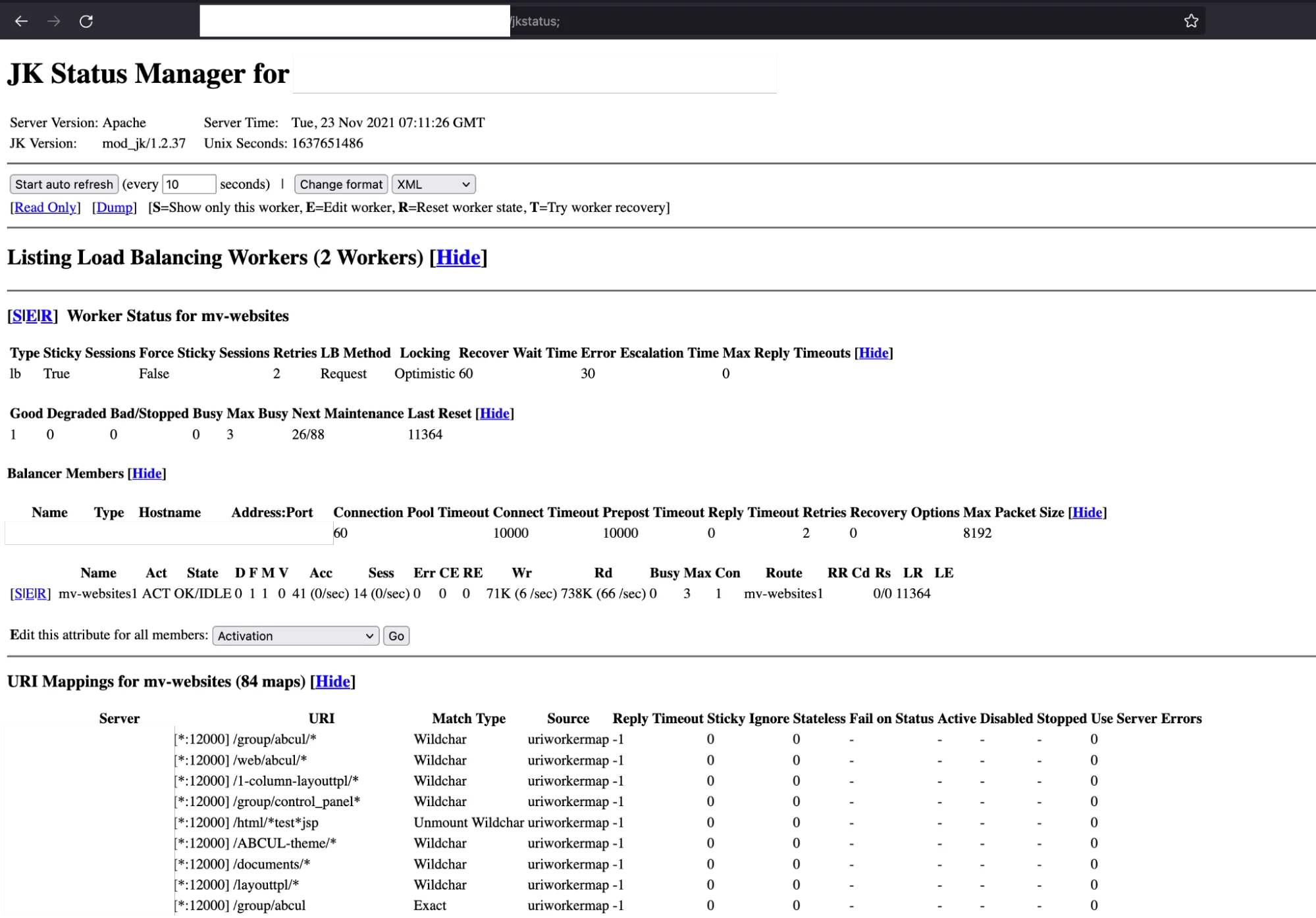
The screenshot is captioned JK Status Manager. This is a low-severity information disclosure: it exposes sensitive information about the internal services. The obvious move would be to write it up and submit it to the bug bounty program, but the team kept going.
Exploitation
Step 1: from jkstatus to a Liferay route
The Apache LoadBalancer has a lot of defined rules (84 maps) that route requests to each internal endpoint. Among them, one route sends requests to a Liferay instance:
https://sub.foo.bar/web/aviva
Exploiting a Liferay CVE from there looks easy, but requests do not go straight to Liferay. They pass through several layers first.

The image is captioned as the flow of an HTTP request to the Liferay instance. The goal becomes finding a payload that traverses back to the base context of Liferay instead of /web/aviva, and then reaches a vulnerable endpoint such as /api/liferay or /api/jsonws/.
Step 2: Akamai blocks the obvious bypasses
The asset is protected by Akamai WAF, which blocks common bypasses such as:
/o/..;/api/liferay
/o/..;/api/jsonws/invoke
/api;/liferay
/api;/jsonws/invoke
Because of the ; and .. sequences, Akamai blocked these before they could reach the Apache LoadBalancer. At this point the team almost gave up, but decided to review the LoadBalancer rules one last time.
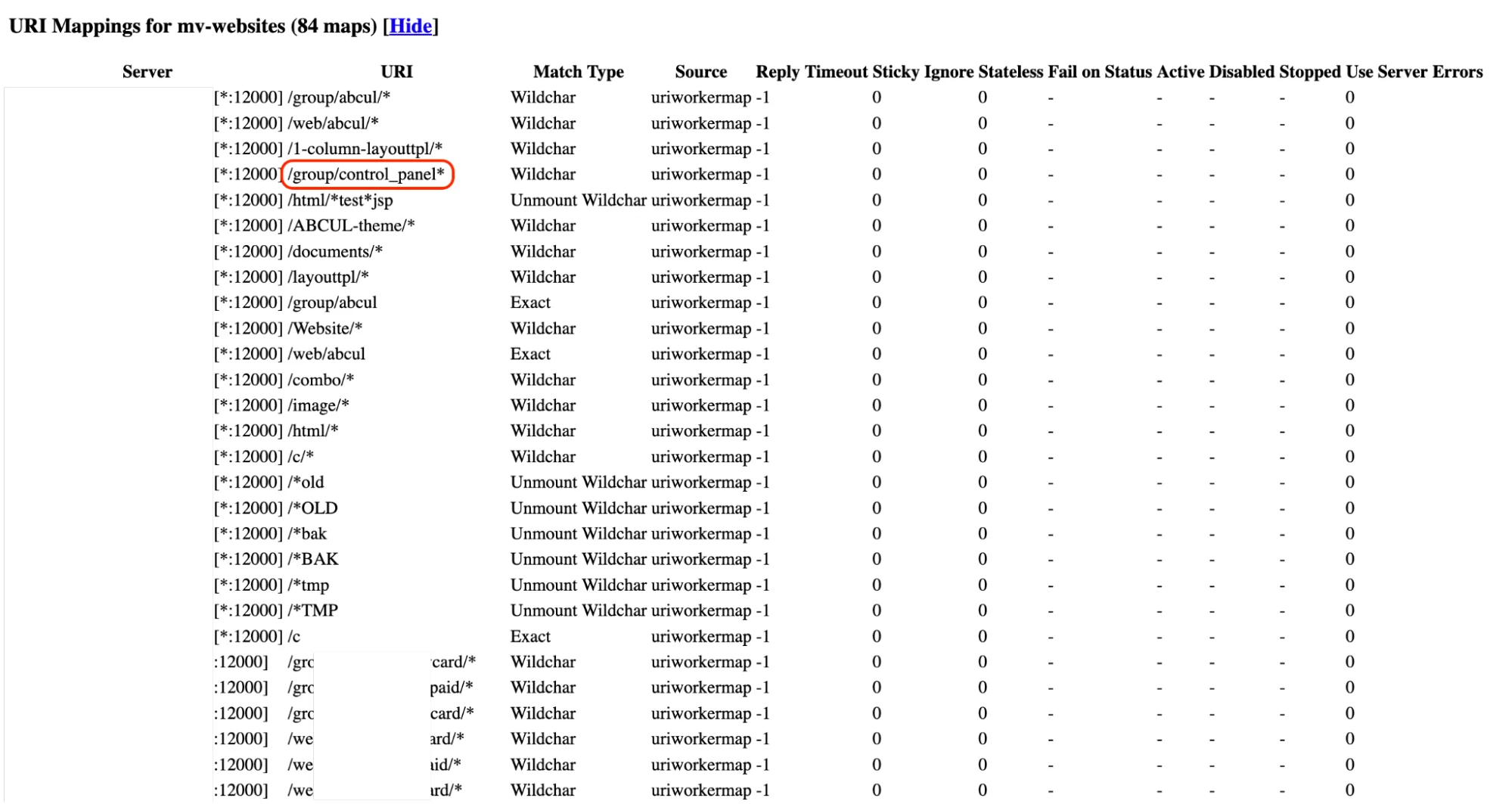
The image is captioned URI Mappings of Apache LoadBalancer. One rule stands out: /group/control_panel*. It matches the wildcard when a request starts with /group/control_panel, and then passes the request to the workers. That gives three facts to work with:
- There is a way to reach the Liferay instance with an arbitrary suffix payload.
- The payload needs to traverse back to the Liferay context and then reach
/api/jsonws. ..;cannot be sent literally because of Akamai WAF, but it can be encoded.
Step 3: encoding the traversal
The payload tried was:
/group/control_panel/%2e%2e%3b/%2e%2e%3b/api/jsonws/
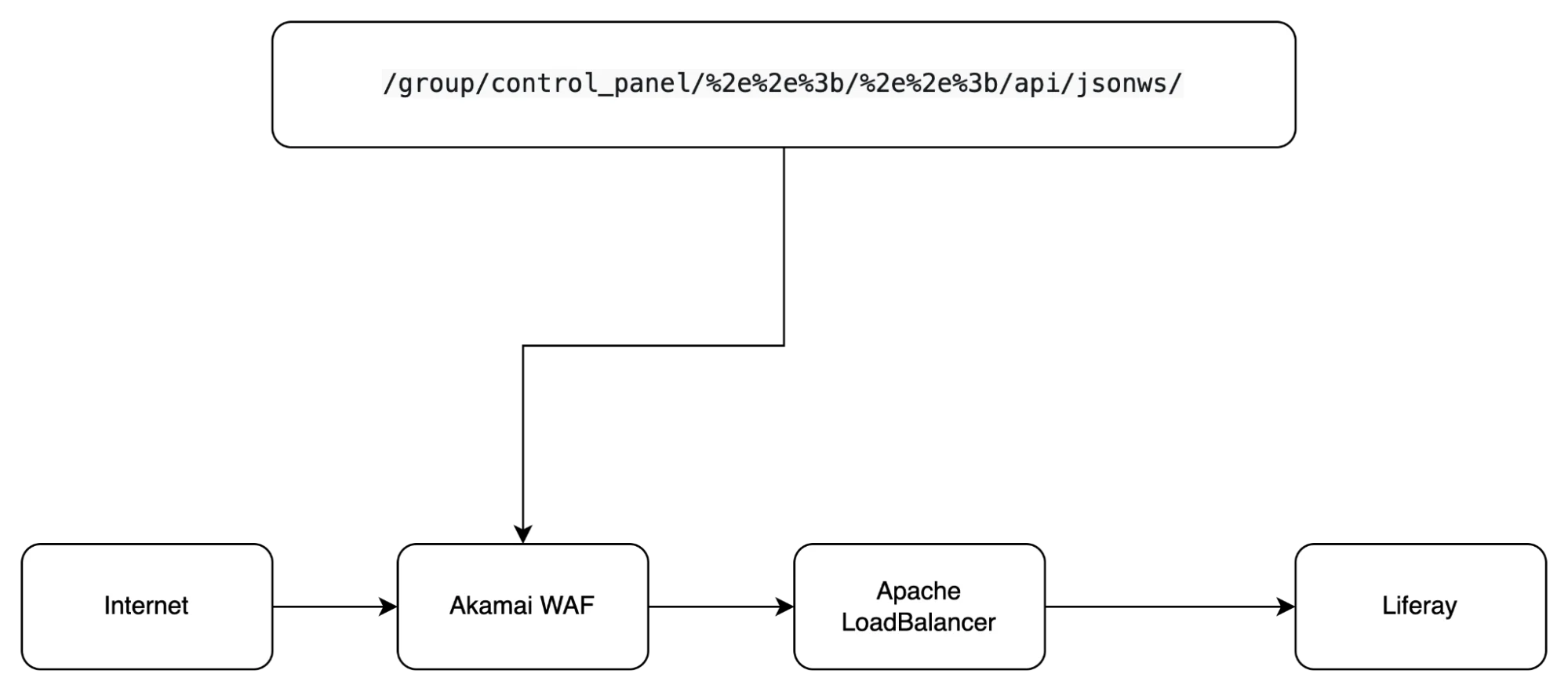
The image is captioned as the bypass payload process by Akamai WAF. Akamai lets the payload through because it does not perform URL decoding. The payload then reaches the Apache LoadBalancer, which does perform URL decoding and routes it to the internal services according to the defined URI mappings.
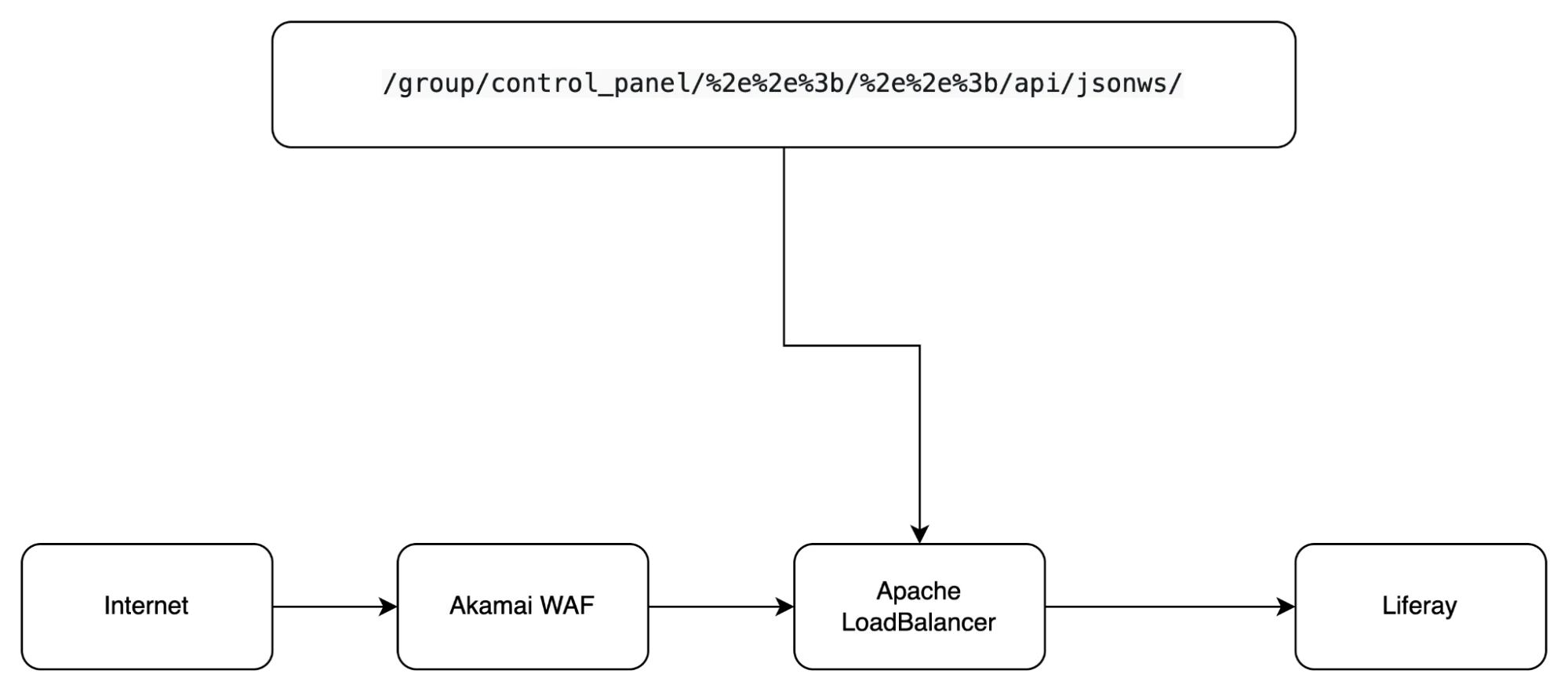
The image is captioned as the bypass payload process by Apache LoadBalancer. After decoding, the payload is:
/group/control_panel/..;/..;/api/jsonws/
At this stage the payload matches the rule /group/control_panel*, so the LoadBalancer routes it to Liferay. Liferay is based on Tomcat, and Tomcat treats ; as a path parameter and strips it from the URL. The payload becomes /group/control_panel/../../api/jsonws/, which normalises to /api/jsonws/.
Step 4: working around the WAF on the POST body
The Liferay instance is vulnerable to CVE-2020-7961, exploited with the Last-Modified trick. Most public POCs for CVE-2020-7961 have content like this:

The image is captioned as a common public POC for CVE-2020-7961. Those payloads do not work here because Akamai WAF blocks some special characters in the POST body:
These characters are needed in the JSON payload for CVE-2020-7961, so another way to exploit it was needed. A blog post by codewhitesec, the author of CVE-2020-7961, points out that JSON Web Services can be invoked in GET requests like this:
/api/jsonws/service-class-name/service-method-name/arg1/val1/arg2/val2/
One limitation remains: the GET URL must not be too long. The Liferay documentation describes several ways to call the JSON WebService, which allows the limitation of the JSON payload to be overcome. That matters here because JSON cannot be used at all, since Akamai WAF blocks { and }.
Step 5: the final URL
Combining all of the above, the final payload URL is:
/group/control_panel/..%3b/..%3b/api/jsonws/expandocolumn/add-column/-p_auth/-tableId/-name/-type/-defaultData:com.mchange.v2.c3p0.WrapperConnectionPoolDataSource/
Two details matter in this URL:
-p_auth, -tableId, -name, -type, ...: assign a null value to these parameters.-defaultData:com.mchange.v2.c3p0.WrapperConnectionPoolDataSource: initialises the objectdefaultDatawith the typecom.mchange.v2.c3p0.WrapperConnectionPoolDataSource.
In the POST body, defaultData.userOverridesAsString is used to trigger the setter of defaultData, which sets the payload when C3P0ImplUtils.parseUserOverridesAsString() is called, and the serialised payload is deserialised.
To summarise the chain:
- Parameters such as
-p_auth,-tableId,-nameand-typeare set on the URL of the request, because Akamai WAF allows the:character in the URL. - The exploit chain is hex-encoded, so it can be placed in the POST body.
The last piece is a handy deserialisation payload that returns the output of the commands in the HTTP response, since the target has no outbound connection.
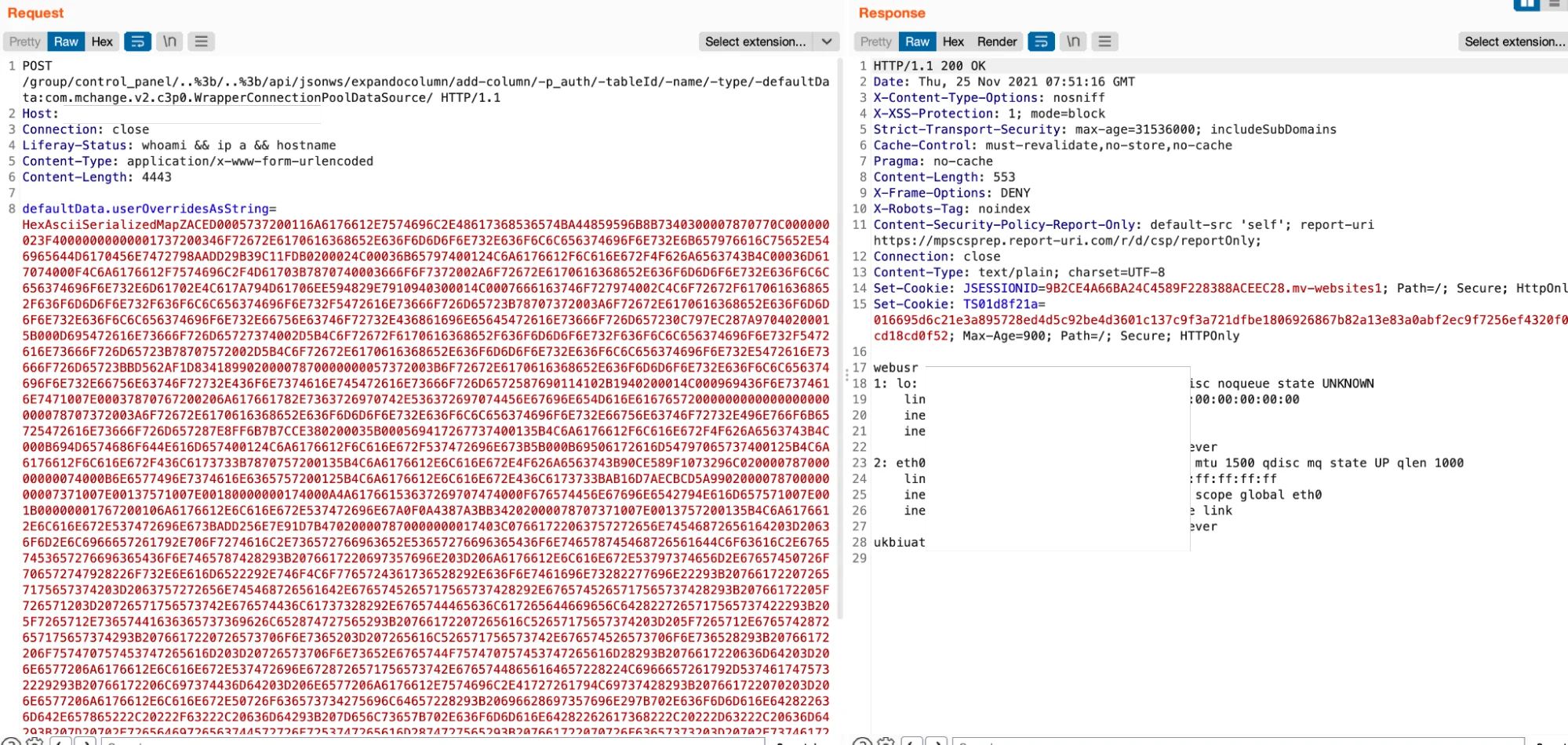
The image is captioned as the final payload to achieve pre-auth RCE on the target.
Root cause
Three parser differences line up, and each layer trusts that the next one sees the same string it saw:
- Akamai WAF does not URL-decode, so
%2e%2e%3bpasses as harmless text. - The Apache LoadBalancer does URL-decode and then matches the decoded path against its URI maps. The wildcard rule
/group/control_panel*matches on the prefix, so an arbitrary suffix is forwarded to Liferay. - Tomcat treats
;as a path parameter and strips it, so..;/..;/becomes../../and the path normalises to/api/jsonws/.
The final URL calls expandocolumn/add-column with -defaultData:com.mchange.v2.c3p0.WrapperConnectionPoolDataSource, and the POST body uses defaultData.userOverridesAsString to trigger the setter. The GET-style invocation avoids JSON, and the exploit chain is hex-encoded so it can go in the POST body.
Impact
An unauthenticated attacker can achieve remote code execution on the Liferay instance. Because the target has no outbound connection, the payload is built to return command output in the HTTP response. The write-up does not describe what data or systems sit behind the Liferay instance beyond the internal services exposed through the LoadBalancer maps.
Fix
That idea became the TetCTF 2022 challenge, available at https://vsrc.vng.com.vn/download/tetctf2022.zip. The write-up does not describe which changes were made on the target side.
Variants to test
- Trailing semicolon on Tomcat management endpoints. Request paths such as
/jkstatus;or/manager;on Tomcat-fronted hosts. A positive result is a management or status page that the reverse proxy was meant to hide. - Encoded traversal against prefix-matched LoadBalancer rules. Take any wildcard rule that forwards a prefix to an internal service and append
%2e%2e%3b/%2e%2e%3b/followed by a sensitive path. A positive result is a response from the internal service rather than a 403 or 404 from the WAF. - WAF versus backend decoding mismatch. Send encoded characters (
%2e,%3b,%2f) that the WAF does not decode but the backend does. A positive result is the backend acting on the decoded path while the WAF logs the request as clean. - GET-style JSON Web Service invocation. On Liferay instances, try
/api/jsonws/<service>/<method>/<arg>/<value>/with typed parameters such as-name:com.example.Class. A positive result is the service accepting the typed argument without a JSON body. - C3P0 deserialisation sink. Where
expandocolumn/add-columnis reachable, supplydefaultData:com.mchange.v2.c3p0.WrapperConnectionPoolDataSourceand a hex-encodeddefaultData.userOverridesAsStringin the POST body. A positive result is deserialisation on the server, visible through command output in the response if the payload is built for it.
Credit: k0nv0y@VSRC.
What happened, in plain words
A security research team found a way to take control of a server belonging to a large financial technology (fintech) company, without ever logging in. Taking control of a server like this is called remote code execution, usually shortened to RCE: it means the attacker can make the server run commands of their choosing, as if they were sitting at its keyboard.
The company asked that identifying details be kept private, so the domain is written as foo.bar throughout. Everything below is about the technique, not about the company.
The interesting part is not one single flaw. It is that three separate pieces of software in a row each read the same web address slightly differently, and each one trusted that the next one would see exactly what it saw. By crafting a web address that looks harmless to the first layer but means something dangerous to the last one, the team slipped past every guard.
To follow along you only need to know what a web browser does: it asks a server for a page by sending a request to a web address (a URL), and the server sends back a response. Everything else is explained as it comes up.
The setup: three layers in a row
The target was a subdomain of foo.bar. A subdomain is simply a smaller name under a main domain, like shop.example.com under example.com.
When a request arrives at this asset, it does not go straight to the application. It passes through three layers, one after another:
- Akamai WAF. A WAF, or Web Application Firewall, is a filter that sits in front of a website and inspects incoming requests, blocking ones that look like attacks. Akamai is a company that provides this filtering service. Think of it as a security guard at the front door who reads the label on every parcel and refuses the suspicious ones.
- Apache LoadBalancer. A load balancer is a traffic director: it receives requests and forwards each one to one of several internal servers, so no single server is overwhelmed. Apache is the software providing it here. Think of it as a receptionist who reads the address on each parcel and sends it to the right department.
- Internal services, including a Liferay instance. Liferay is a product for building websites and portals, often used by companies for internal and customer-facing pages. It runs on top of Tomcat, which is a program that serves web pages written in the Java language. Think of Tomcat as the building's mailroom and Liferay as one of the offices inside.
No accounts or passwords were involved at any point. The whole chain works before logging in, which is why it is called pre-authentication: the attacker never needs to prove who they are.
Deserialisation is explained later; for now, think of it as a parcel packed in a special format that the receiving program unpacks and acts on.
Finding it: the trailing semicolon
After a quick look around (reconnaissance, meaning exploring what a target exposes before attacking), one address on a subdomain stood out:
https://sub.foo.bar/jkstatus;
Why this address? The word jkstatus refers to the JK Status Manager, a status page belonging to a Tomcat connector. Such pages are meant for administrators and should not be reachable from the internet. The odd part is the semicolon ; stuck on the end.
That trailing semicolon is a well-known trick for slipping past reverse proxies in front of Tomcat. A reverse proxy is a server that stands in front of another and forwards requests to it; the WAF and the load balancer are both, in effect, reverse proxies. The trick was first presented at the BlackHat USA 2018 conference by Orange Tsai, in a talk about how different programs disagree when they clean up (normalise) a web address.
The idea is simple. The proxy checks the address and sees /jkstatus;, which does not match the protected page /jkstatus, so it lets the request through. Tomcat, however, treats everything after a semicolon as an extra parameter attached to the path and ignores it, so it serves /jkstatus anyway. Two programs, one address, two different readings.
The screenshot is captioned JK Status Manager. This is a low-severity information disclosure: the page reveals sensitive information about the internal services, but on its own it does not let anyone in. The obvious move would be to write it up and submit it to the company's bug bounty program (a scheme that pays researchers for reporting flaws), but the team kept going.
From jkstatus to a Liferay instance
The Apache LoadBalancer is configured with a lot of rules (84 maps) that decide which internal endpoint each request goes to. An endpoint is simply a specific address inside a service that accepts requests. Among those rules, one route sends requests to a Liferay instance:
https://sub.foo.bar/web/aviva
At first this looks like easy money: find a known Liferay flaw, exploit it, collect the bounty. But requests do not go straight to Liferay. They pass through the layers described above first.
The image is captioned as the flow of an HTTP request to the Liferay instance. Seeing this, the team set a concrete goal: find a payload (the crafted part of a request that does the damage) that walks back up from /web/aviva to the base of Liferay, and from there reaches a vulnerable endpoint such as /api/liferay or /api/jsonws/.
An API is an address that a program exposes so other programs can ask it to do things, rather than showing a page to a human. /api/jsonws/ is Liferay's JSON Web Services endpoint, a feature that lets callers invoke Liferay's internal Java methods over the web. That feature is exactly what the team wanted to reach.
Akamai blocks the obvious bypasses
The asset is protected by Akamai WAF, and it is good enough to block the common tricks people use to walk up a path:
/o/..;/api/liferay
/o/..;/api/jsonws/invoke
/api;/liferay
/api;/jsonws/invoke
Line by line:
/o/..;/api/liferayand/o/..;/api/jsonws/invokeuse.., which means "go up one folder" in a web address, just as it does in a file path on your computer. Combined with the semicolon trick, the idea is to climb out of/o/and land on/api/..../api;/liferayand/api;/jsonws/invokeuse the semicolon to confuse the proxy about where one part of the path ends and the next begins.
Because of the ; and .. sequences, Akamai blocked all four before they could reach the Apache LoadBalancer. At this point the team almost gave up, but decided to review the LoadBalancer rules one last time.
The image is captioned URI Mappings of Apache LoadBalancer. A URI mapping is a rule that says "if the address starts like this, send it there". One rule stands out: /group/control_panel*. The asterisk is a wildcard, meaning "anything can follow". So any request whose address starts with /group/control_panel is forwarded to the workers (the internal servers behind the load balancer), no matter what comes after.
That single rule gives the team three facts to work with:
- There is a way to reach the Liferay instance with an arbitrary suffix payload, because the wildcard accepts anything after the prefix.
- The payload needs to walk back to the Liferay base and then reach
/api/jsonws. ..;cannot be sent literally because Akamai WAF blocks it, but it can be encoded.
Encoding here means writing characters in a different form. In a URL, a character can be written as a percent sign followed by two hexadecimal digits (hex is just a number system using 0 to 9 and A to F). For example, a full stop . can be written as %2e, and a semicolon ; as %3b. To a human reader, %2e%2e%3b looks like harmless gibberish; to a program that decodes it, it is ..;.
Encoding the traversal
The payload the team tried was:
/group/control_panel/%2e%2e%3b/%2e%2e%3b/api/jsonws/
Piece by piece:
/group/control_panel/is the prefix that matches the LoadBalancer's wildcard rule, so the request is allowed through to the internal servers.%2e%2e%3bis the encoded form of..;. It appears twice, so the decoded result is..;/..;/./api/jsonws/is the Liferay endpoint the team wants to reach.
The image is captioned as the bypass payload process by Akamai WAF. Akamai lets the payload through because it does not perform URL decoding: it compares the raw text against its blocklist, sees no .. and no ;, and waves it on. The payload then reaches the Apache LoadBalancer, which does perform URL decoding and routes it to the internal services according to the defined URI mappings.
The image is captioned as the bypass payload process by Apache LoadBalancer. After decoding, the payload is:
/group/control_panel/..;/..;/api/jsonws/
At this stage the payload matches the rule /group/control_panel*, so the LoadBalancer routes it to Liferay. Liferay is based on Tomcat, and Tomcat treats ; as a path parameter and strips it from the URL. The payload becomes /group/control_panel/../../api/jsonws/, which normalises to /api/jsonws/.
Normalising means tidying up a path: .. means "go up one level", so /group/control_panel/../../ climbs out of control_panel and then out of group, leaving /api/jsonws/. In everyday terms, it is like writing "leave the office, go up two floors, enter the server room" on a visitor form: each guard reads only part of the instruction and each one thinks it is fine.
Working around the WAF on the POST body
The Liferay instance is vulnerable to CVE-2020-7961, exploited with the Last-Modified trick. A CVE is a public catalogue number for a known security flaw, so CVE-2020-7961 is a specific documented weakness in Liferay. The Last-Modified trick is a technique the team used alongside it; the write-up names it but does not explain it further.
Most public POCs for CVE-2020-7961 have content like this:
A POC, or proof of concept, is a small demonstration that a flaw can be exploited. The image is captioned as a common public POC for CVE-2020-7961. Those payloads do not work here because Akamai WAF blocks some special characters in the POST body:
A POST body is the part of a request that carries data to the server, as opposed to the address itself; think of the address as the envelope and the body as the letter inside. The four blocked characters are:
{and}are curly braces, which mark the start and end of a JSON object. JSON is a simple text format for structured data, and it is what Liferay's JSON Web Services normally expect.;is the semicolon already seen.:is the colon that separates a name from its value in JSON, as in"name": "value".
These characters are needed in the JSON payload for CVE-2020-7961, so another way to exploit it was needed. A blog post by codewhitesec, the author of CVE-2020-7961, points out that JSON Web Services can be invoked in GET requests like this:
/api/jsonws/service-class-name/service-method-name/arg1/val1/arg2/val2/
A GET request is the ordinary kind a browser sends when you open a page: all the information travels in the address itself, with no body. The pattern above shows that instead of sending a JSON document, you can put the service name, the method name (the action you want performed), and each argument with its value directly into the address, separated by slashes. It is like ordering at a counter by saying the item and the quantity out loud, instead of filling in a form.
One limitation remains: the GET URL must not be too long. Web addresses have practical length limits, and a long list of arguments can exceed them. The Liferay documentation describes several ways to call the JSON WebService, which allows the limitation of the JSON payload to be overcome. That matters here because JSON cannot be used at all, since Akamai WAF blocks { and }.
The final URL
Combining all of the above, the final payload URL is:
/group/control_panel/..%3b/..%3b/api/jsonws/expandocolumn/add-column/-p_auth/-tableId/-name/-type/-defaultData:com.mchange.v2.c3p0.WrapperConnectionPoolDataSource/
Reading it from left to right:
/group/control_panel/matches the LoadBalancer wildcard, so the request is forwarded...%3b/..%3b/is the encoded..;/..;/, which Tomcat later turns into../../and which normalises away, leaving the base of Liferay./api/jsonws/expandocolumn/add-column/is the Liferay service and method being called.expandocolumnis the service,add-columnis the method.-p_auth/-tableId/-name/-type/are arguments with no value after them.-defaultData:com.mchange.v2.c3p0.WrapperConnectionPoolDataSource/is an argument nameddefaultDatawhose value is given a specific Java type, written after the colon.
Two details matter in this URL:
-p_auth, -tableId, -name, -type, ...: assign a null value to these parameters. A parameter is a named input to a request; null means empty. The leading minus sign is Liferay's way of saying "this argument is present but has no value".-defaultData:com.mchange.v2.c3p0.WrapperConnectionPoolDataSource: initialises the objectdefaultDatawith the typecom.mchange.v2.c3p0.WrapperConnectionPoolDataSource. An object, in programming, is a bundle of data plus the actions (methods) that can be performed on it. The long dotted name is a Java class, a blueprint for such an object. C3P0 is a Java library for managing database connections, and this particular class is known to be dangerous when fed attacker-controlled data.
In the POST body, defaultData.userOverridesAsString is used to trigger the setter of defaultData, which sets the payload when C3P0ImplUtils.parseUserOverridesAsString() is called, and the serialised payload is deserialised.
That sentence is dense, so slowly: a setter is a method that assigns a value to a field of an object. userOverridesAsString is a field of the C3P0 object. When Liferay fills in that field, C3P0's own code runs C3P0ImplUtils.parseUserOverridesAsString() to read the string. That parsing step takes the attacker's text, turns it back into a Java object (deserialisation), and in doing so runs code hidden inside it. Serialisation is the act of turning an object into a stream of bytes so it can be stored or sent; deserialisation is turning those bytes back into a live object. If the bytes come from an attacker, the attacker effectively chooses what object gets created, and some objects do things when created.
To summarise the chain:
- Parameters such as
-p_auth,-tableId,-nameand-typeare set on the URL of the request, because Akamai WAF allows the:character in the URL. The blocklist only covers the POST body, so moving data into the address sidesteps it. - The exploit chain is hex-encoded, so it can be placed in the POST body. Hex encoding writes each byte as two hexadecimal digits, which produces only ordinary letters and numbers, none of the blocked characters.
The last piece is a handy deserialisation payload that returns the output of the commands in the HTTP response, since the target has no outbound connection. In other words, the server cannot phone home to the attacker, so the results have to come back in the reply to the request itself.
The image is captioned as the final payload to achieve pre-auth RCE on the target.
Why it worked
Three parser differences line up, and each layer trusts that the next one sees the same string it saw. A parser is the part of a program that reads text and decides what it means.
- Akamai WAF does not URL-decode, so
%2e%2e%3bpasses as harmless text. - The Apache LoadBalancer does URL-decode and then matches the decoded path against its URI maps. The wildcard rule
/group/control_panel*matches on the prefix, so an arbitrary suffix is forwarded to Liferay. - Tomcat treats
;as a path parameter and strips it, so..;/..;/becomes../../and the path normalises to/api/jsonws/.
The final URL calls expandocolumn/add-column with -defaultData:com.mchange.v2.c3p0.WrapperConnectionPoolDataSource, and the POST body uses defaultData.userOverridesAsString to trigger the setter. A sink, in security terms, is the place where dangerous data finally gets used; everything before it is just plumbing that carries the data there. The GET-style invocation avoids JSON, and the exploit chain is hex-encoded so it can go in the POST body.
What it means
An unauthenticated attacker can achieve remote code execution on the Liferay instance. Unauthenticated means no login is required. Because the target has no outbound connection, the payload is built to return command output in the HTTP response. The write-up does not describe what data or systems sit behind the Liferay instance beyond the internal services exposed through the LoadBalancer maps.
What came next
The webroot is the folder from which the web server serves pages, so writing there means the output can simply be fetched like any other page. That idea became the TetCTF 2022 challenge, available at https://vsrc.vng.com.vn/download/tetctf2022.zip. A CTF, or capture the flag, is a practice competition where participants solve security puzzles.
Things worth testing elsewhere
These are the general lessons, phrased as things to try on systems you are authorised to test:
- Trailing semicolon on Tomcat management endpoints. Request paths such as
/jkstatus;or/manager;on Tomcat-fronted hosts. A positive result is a management or status page that the reverse proxy was meant to hide. - Encoded traversal against prefix-matched LoadBalancer rules. Take any wildcard rule that forwards a prefix to an internal service and append
%2e%2e%3b/%2e%2e%3b/followed by a sensitive path. A positive result is a response from the internal service rather than a 403 or 404 from the WAF. Those two numbers are HTTP status codes: 403 means forbidden, 404 means not found. - WAF versus backend decoding mismatch. Send encoded characters (
%2e,%3b,%2f) that the WAF does not decode but the backend does. A positive result is the backend acting on the decoded path while the WAF logs the request as clean. - GET-style JSON Web Service invocation. On Liferay instances, try
/api/jsonws/<service>/<method>/<arg>/<value>/with typed parameters such as-name:com.example.Class. A positive result is the service accepting the typed argument without a JSON body. - C3P0 deserialisation sink. Where
expandocolumn/add-columnis reachable, supplydefaultData:com.mchange.v2.c3p0.WrapperConnectionPoolDataSourceand a hex-encodeddefaultData.userOverridesAsStringin the POST body. A positive result is deserialisation on the server, visible through command output in the response if the payload is built for it.
Credit: k0nv0y@VSRC.
Glossary
- API: an address a program exposes so other programs can ask it to perform actions, rather than showing a page to a person.
- Akamai WAF: a commercial web application firewall service that inspects incoming requests and blocks suspicious ones.
- Apache LoadBalancer: software that receives requests and forwards each one to one of several internal servers according to configured rules.
- Bug bounty program: a scheme in which an organisation pays researchers for reporting security flaws responsibly.
- C3P0: a Java library for managing database connections, one of whose classes can be abused during deserialisation.
- Class: in Java, a blueprint that describes what an object contains and what it can do.
- CVE: a public catalogue number for a documented security vulnerability, such as CVE-2020-7961.
- Deserialisation: turning a stream of bytes back into a live object; if the bytes are attacker-controlled, this can run code.
- Endpoint: a specific address inside a service that accepts requests.
- GET request: the ordinary kind of web request where all information travels in the address, with no body.
- Hex encoding: writing each byte as two characters from 0 to 9 and A to F, producing only ordinary letters and digits.
- HTTP status code: a number in a response saying what happened, such as 403 (forbidden) or 404 (not found).
- Information disclosure: a flaw that reveals information which should not be visible, without directly letting an attacker in.
- JK Status Manager: a status page belonging to a Tomcat connector, meant for administrators.
- JSON: a simple text format for structured data, using curly braces, colons and commas.
- JSON Web Services: a Liferay feature that lets callers invoke its internal Java methods over the web.
- Liferay: a product for building websites and portals, running on top of Tomcat.
- Load balancer: a traffic director that spreads requests across several internal servers.
- Method: an action that an object or service can perform.
- Normalisation: tidying up a path so that
..segments are resolved and the result is a single clean path. - Null value: an empty value, meaning the parameter is present but carries nothing.
- Object: in programming, a bundle of data plus the actions that can be performed on it.
- Parameter: a named input to a request.
- Parser: the part of a program that reads text and decides what it means.
- Payload: the crafted part of a request that carries out the attack.
- POC (proof of concept): a small demonstration that a flaw can be exploited.
- POST body: the part of a request that carries data to the server, separate from the address.
- Pre-authentication: happening before any login, so no account or password is needed.
- Remote code execution (RCE): making a server run commands of the attacker's choosing.
- Reverse proxy: a server that stands in front of another and forwards requests to it.
- Serialisation: turning an object into a stream of bytes so it can be stored or sent.
- Setter: a method that assigns a value to a field of an object.
- Sink: the place in a program where dangerous data is finally used.
- Subdomain: a smaller name under a main domain, such as
shop.example.comunderexample.com. - Tomcat: a program that serves web pages written in the Java language.
- URI mapping: a rule that says which internal server a request should go to, based on how its address starts.
- URL: a web address.
- URL decoding: turning percent-encoded text such as
%2eback into the character it stands for, such as.. - WAF (web application firewall): a filter in front of a website that inspects requests and blocks ones that look like attacks.
- Webroot: the folder from which a web server serves pages.
- Wildcard: a symbol such as
*that stands for "anything can follow".


