IDOR when editing users leads to Account Takeover without User Interaction at CrowdSignal
The user editing endpoint used a sequential user ID without checking ownership, so changing the ID showed another user's email. Clicking the update button then logged the attacker directly into the victim's account.

- Triaged in 3 days
- Fixed in 5 days
- Paid in 6 days
- Disclosed after 5 months
Summary:
Hi team,
If you click Edit button on any user of your team at https://app.crowdsignal.com/users/list-users.php, you will send a GET request to https://app.crowdsignal.com/users/invite-user.php?id=(userid)&popup=1
In this endpoint, id parameter is vulnerable for IDOR. When you change the user ID, you will see victim's email in response like that :
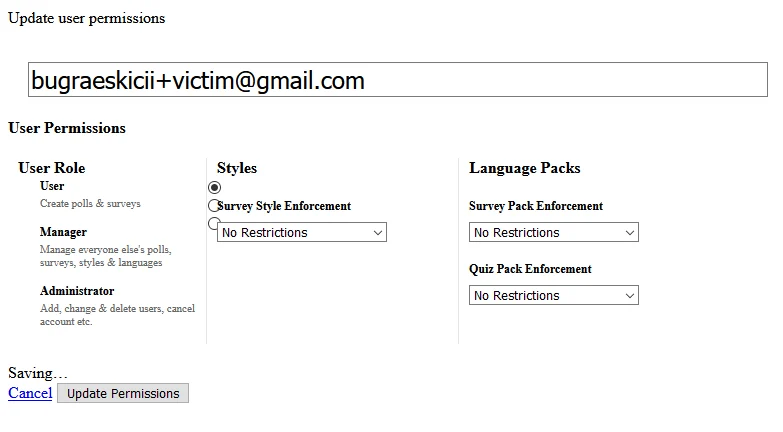
And if you click Update Permissions button, you will log-in to victim's account directly.
Also, user IDs are sequential. And they have a simple range with 00010006 to 19920500+
Steps To Reproduce:
- Log-in to your team account at CrowdSignal
- Go to https://app.crowdsignal.com/users/invite-user.php?id=19920465&popup=1
- You will see my email, and if you click
Update Permissions, you will takeover my account. - You can change the user ID to random number with
00010006-19920500range.
Impact
IDOR leads to account takeover without user interaction
Thanks, Bugra
Not written yet. The AI write-up for this report has not been written yet. The Original tab links to the source.
How it worked
Root cause
Likely the endpoint trusted the user-supplied id parameter and did not verify that the requester belonged to the same team or had permission to edit that user.
Impact
An attacker could take over any user's account without the victim doing anything, because the IDs are sequential and easy to guess.
What the attacker needed
A team account on CrowdSignal; knowledge of a target user ID
How it was found
- Log in to a team account on CrowdSignal.
- Open the invite-user endpoint with a chosen user ID and the popup parameter.
- Observe the victim's email in the response.
- Click the update permissions button to be logged in as the victim.
- Try other sequential IDs within the stated range.
Explained by bugbounty.wiki with AI from the original and checked against quotes from it; it can still be wrong. Read the original before relying on a detail.
Not written yet. The AI write-up for this report has not been written yet. The Original tab links to the source.
A web app often puts an identifier in the address, like a user number. If the server does not check that the logged-in person is allowed to see that number, anyone can change it and peek at someone else's data. Here the same weak check also let an attacker press a button and become the other user.
What is IDOR?
One user can read or change another user's data, usually by changing an identifier the server trusts without checking who is asking. One of the most paid bug classes on web programs.