User Enumeration and Guessable User Account Attack on WORDPRESS
The password reset page on wordpress.com revealed whether an email address or username belonged to a registered account, because the response differed for known and unknown accounts. An attacker could use this to enumerate valid users and then guess or target their accounts.

- Disclosed after 3 months
Hello,
I found another bug on https://wordpress.com.
Here any hacker can find out all registered users on wordpress.com. Here are the details of the same.
How is wordpress.com is working?
- You have Reset Password Page --> https://en.wordpress.com/wp-login.php?action=lostpassword
- When user enter correct registered email-id, a reset password link is sent to user's email and a message 'Check your e-mail for the confirmation link.' is shown.
- When user enter incorrect unregistered email-id, a message 'I'm sorry, but we weren't able to find a user with that login information.' is shown.
Now, this is how it is working.
Proof of concept :
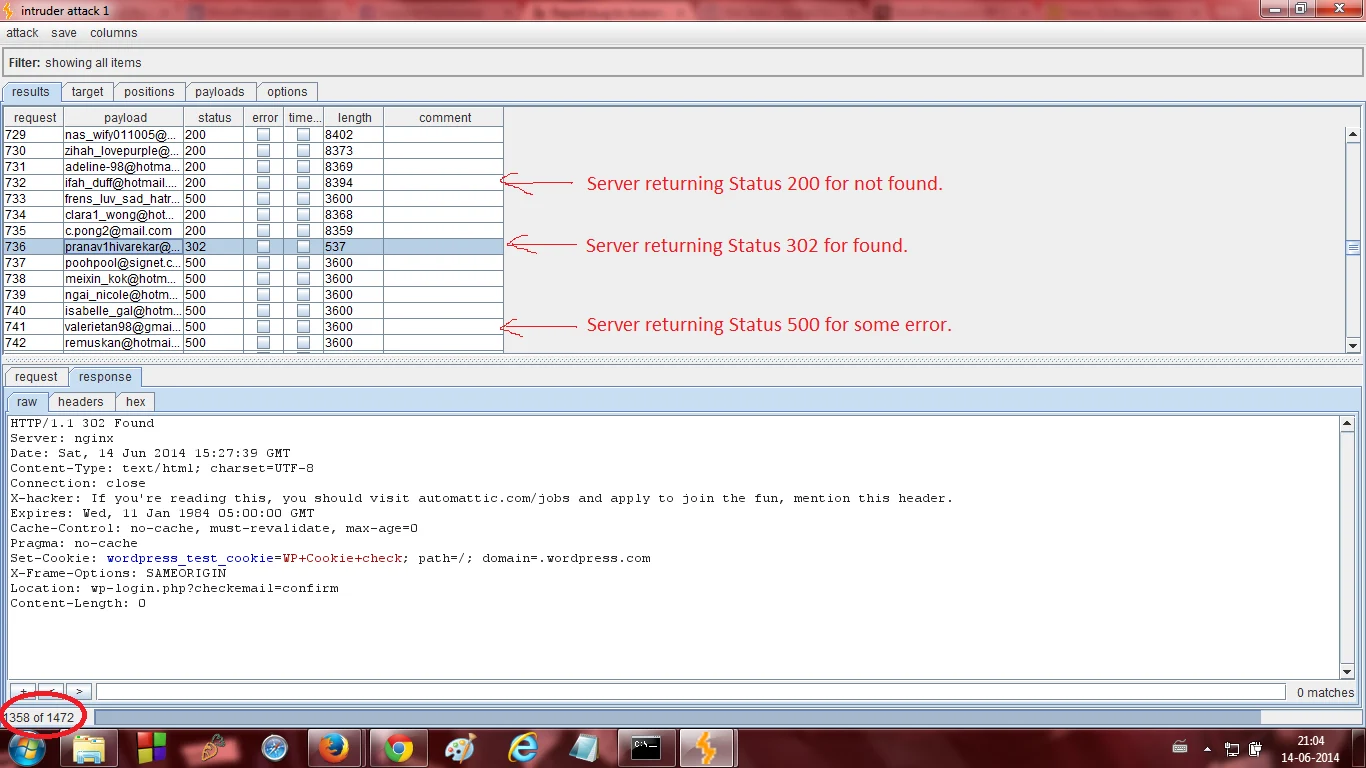
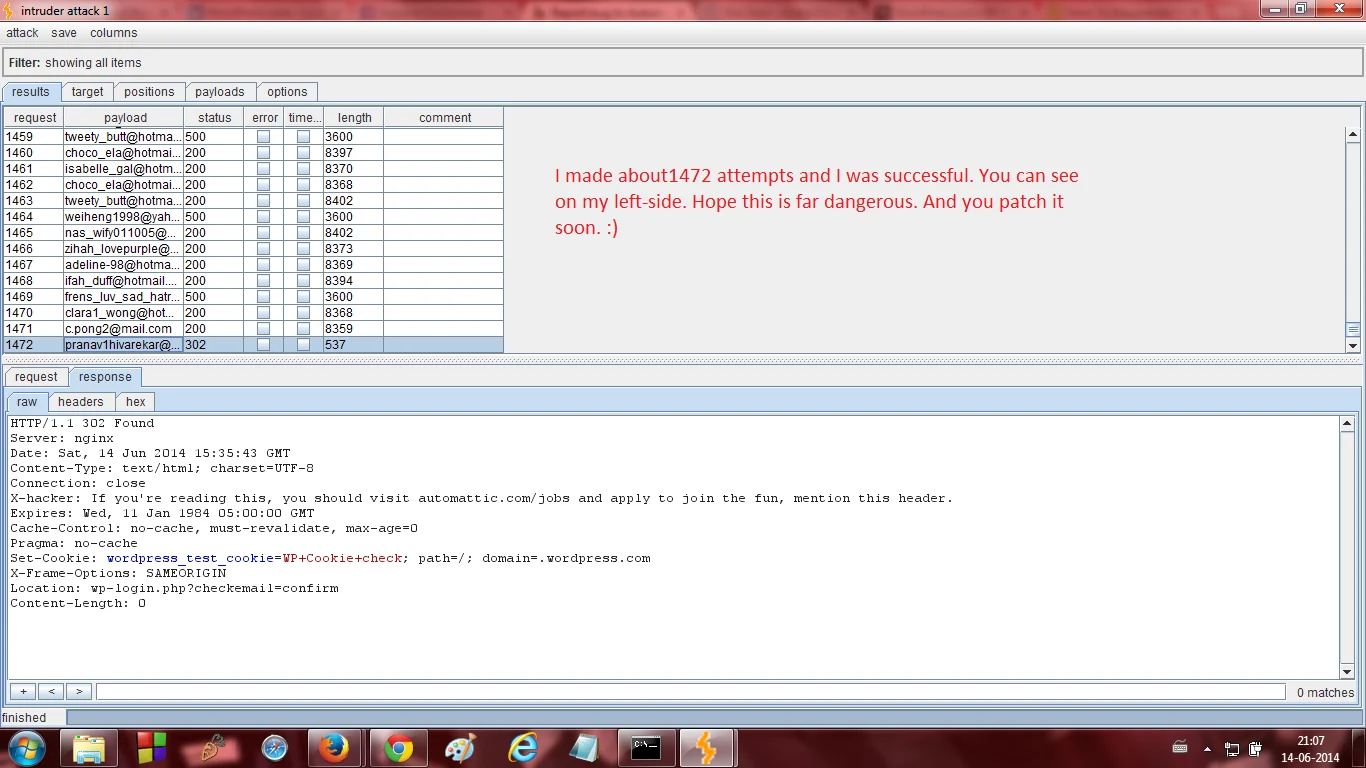
Server returns Status 200 ---> Not found. Server returns Status 302 ----> Found. Server returns Status 500 -----> Internal server error.
Now, server returns Status 500 only when same email-id / username is entered again and again to spam the user. But, it works. I have attached POC screen shots. Please have a look.
Possible fixes :
- Regardless of what email-id is entered, server should always return a Status=Found - 302.
- Then redirect to other page.
- Error message should be changed to something like 'If user exists, email will be sent.'
Hope, this is sufficient for proving this vulnerability.
You may feel free to ask any questions you may have. I will be happy explaining it to the depth. :)
Thank You, Pranav
Attachments
Not written yet. The AI write-up for this report has not been written yet. The Original tab links to the source.
How it worked
Root cause
Likely the password reset endpoint returned different HTTP status codes and messages depending on whether the submitted email or username existed.
What the attacker needed
No account needed; access to the public reset page
The fix
The reset endpoint should always return the same response and message regardless of whether the account exists, for example by always redirecting and saying an email will be sent if the user exists.
How it was found
- Open the password reset page.
- Submit an email address that is registered and observe the confirmation message.
- Submit an email address that is not registered and observe the different error message.
- Compare the HTTP status codes returned for each case.
Explained by bugbounty.wiki with AI from the original and checked against quotes from it; it can still be wrong. Read the original before relying on a detail.
Not written yet. The AI write-up for this report has not been written yet. The Original tab links to the source.
When you ask a website to reset your password, it should not tell you whether an email address is registered. Here the site replied differently for real and fake addresses, so someone could check many addresses and learn which ones have accounts.
What is Info disclosure?
Data the application should keep private (personal data, internal details, other users' records) reaches someone it should not.





