Bypass Tracking Blocker Protection Using Slashes Without Protocol On The Image Source.
The image rewriting function on HeyMail could be bypassed using a URL with extra slashes, allowing external images to load directly. An attacker could use this to track users by collecting their IP addresses when they open an email.

- Triaged in 7 hours
- Fixed in 13 days
- Paid in 5 hours
- Disclosed after 13 days
Summary:
- Some Way Has Been Discovered To Bypass Image Rewriting On HeyMail Using Slashes Without Protocol
\/\www.evil.comThat Allows Bypassing Tracking Blocker And Collect Users Information Via Emails.
Description:
-
While Searching I Found That The Image Rewriting Function On Heymail Could Be Bypass Using Slashes Since It Seems To Be Depending On A Blacklist. In The Normal Users Are Able To Request External URLs From Images, JS Imports , CSS Imports, ..etc Using Two Slashes Before The Domain. In This Case Users Wasn't Able To Do That Since When The Image Rewriting Function Is Detecting Two Slashes On The First Two Chars Of The URL Source It Creates An External URL For It On gopher.hey.com. But Due To Some Lack On This Validation Users Are Able To Bypass The Images Rewriting By Inserting Another Slash Between The Two Slashes That Won't Change The URL. In This Case I Used
\/\. -
I Created A Simple Image Tag With This Payload:
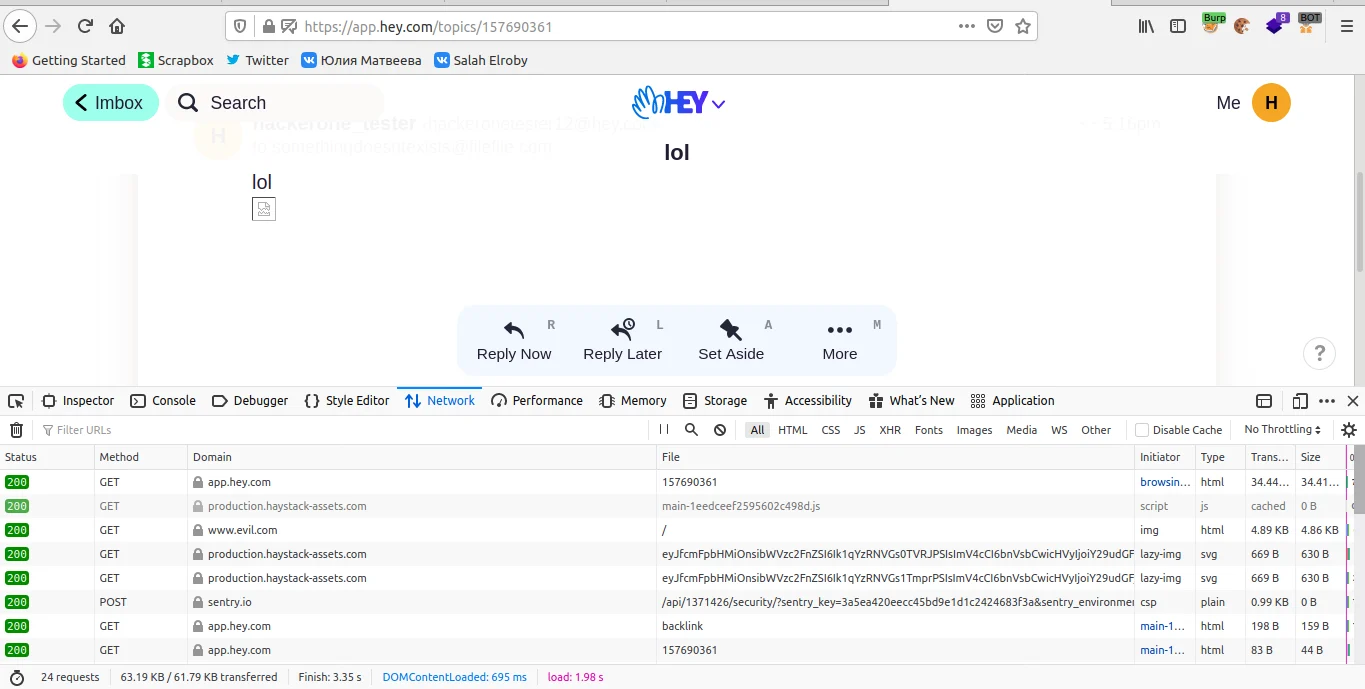
{{media:1}}And I Sended It Into My Testing HeyMail Email And I Got That The Web Browser Sent A GET Request Intowww.evil.comDirectly.
Proof Of Concept:
- There Isn't Much Stuff Here. But, Here's A Simple Exploit HTML Code You Can Use To Trigger This Issue.
<h1>Hello World</h1>
{{media:2}}
<h3>Open The Network Tab</h3>
Best Regards.
Impact
Bypassing Image Rewriting Function Witch Allows Trackers To Collect Users IPs Using Images.
Not written yet. The AI write-up for this report has not been written yet. The Original tab links to the source.
How it worked
Root cause
Likely the image rewriting function relies on a blacklist that checks only the first two characters for two slashes, so inserting an extra slash bypasses the check.
Impact
Bypassing the image rewriting function allows trackers to collect users' IP addresses using images.
What the attacker needed
Victim opens the email
How it was found
- Create an image tag with a URL that uses slashes without a protocol, such as a backslash-slash-backslash pattern.
- Send an email containing that image tag to a test HeyMail email.
- Open the email and observe that the browser sends a GET request directly to the external domain.
Explained by bugbounty.wiki with AI from the original and checked against quotes from it; it can still be wrong. Read the original before relying on a detail.
Not written yet. The AI write-up for this report has not been written yet. The Original tab links to the source.
HeyMail tries to protect users by rewriting image links in emails so that external images don't load directly. This report shows that by adding an extra slash to the image address, the rewriting can be avoided, letting the image load from an attacker's server. That means the attacker can see when you open the email and learn your IP address.
What is Info disclosure?
Data the application should keep private (personal data, internal details, other users' records) reaches someone it should not.






