Premium Email Address Check Bypass - Hey
The sign-up form for Hey email addresses allowed a user to register a premium short address by adding spaces to the desired name. The spaces were counted as characters during validation, bypassing the premium price check, but were later stripped, resulting in a premium address being obtained at the non-premium price.
 Originally disclosed on HackerOne
- Fixed in under an hour
- Paid in 14 days
- Disclosed after 4 months
Hello, I reported a bug to [email protected] a couple weeks ago, not realizing that I was a member of the private bug bounty program. It was fixed quickly (Less than 1 hour) which was awesome to see. Being that this was reported through a seperate channel, and it is for Hey, I'm not even sure it would eligible here. Either way, it was a pretty neat bug becuase of its simplicity and clear impact (loss of revenue).
Anyways, here it is:
There appears to be a bypass for the premium email address sign up.
When signing up for Hey, I tried to obtain [email protected], which prompted a Premium alert box that stated it would cost $999 per year. Since that wouldn't work for me, I tried 'jp @hey.com' (two spaces), this worked without prompting me to accept that it was a premium email address.
It appears that the spaces are registered as characters, so it's not considered a premium domain (at 4 chars), but the spaces are stripped at a later step and I am given a two character premium email address for the same cost as a non-premium email address.
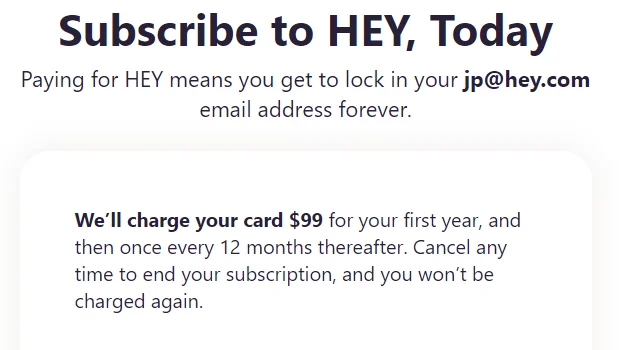
Now, it appears I can lock this email address in for $99 per year just like a typical email address on the Hey platform.
Impact
At the time, the impact was that an premium account (less than 4 chars) could be registered for the non-premium price of $99, which is substantially cheaper than the $999 price tag.
Attachments
Not written yet. The AI write-up for this report has not been written yet. The Original tab links to the source.
How it worked
Root cause
Likely the application validated the email address length before stripping whitespace, so the premium check was performed on the unnormalised input.
Impact
A premium email address (fewer than four characters) could be registered for the non-premium price of $99 per year instead of $999, resulting in a loss of revenue for the service.
What the attacker needed
Ability to sign up for a new email address
The fix
The issue was fixed quickly, as stated in the report.
How it was found
- Attempt to sign up for a premium short email address (e.g., [redacted]) and observe the premium price prompt.
- Modify the desired email address by adding two spaces before the @ symbol (e.g., 'jp @hey.com').
- Complete the sign-up process without receiving the premium price prompt.
- Observe that the spaces are stripped and the short premium email address is registered at the non-premium price.
Explained by bugbounty.wiki with AI from the original and checked against quotes from it; it can still be wrong. Read the original before relying on a detail.
Not written yet. The AI write-up for this report has not been written yet. The Original tab links to the source.
Hey charges more for very short email addresses (like two letters) because they are desirable. The sign-up form checked the length of the name you typed, including any spaces. By adding spaces, the name looked longer than it really was, so the form did not ask for the higher price. Later, the system removed the spaces and gave the short address anyway, but only charged the lower price.
What is Business logic?
The application works as coded but not as intended: a negative price, a skipped payment step, a limit that can be crossed.





