Subdomain Takeover uptime
A subdomain was pointed at a third-party uptime monitoring service and had not been claimed, so the reporter signed up and claimed it. An attacker could then host content on the legitimate subdomain, enabling phishing, malware distribution, or other abuse.
 Originally disclosed on HackerOne
- Fixed in 5 days
- Paid in 5 days
- Disclosed after 47 days
Hello Team:
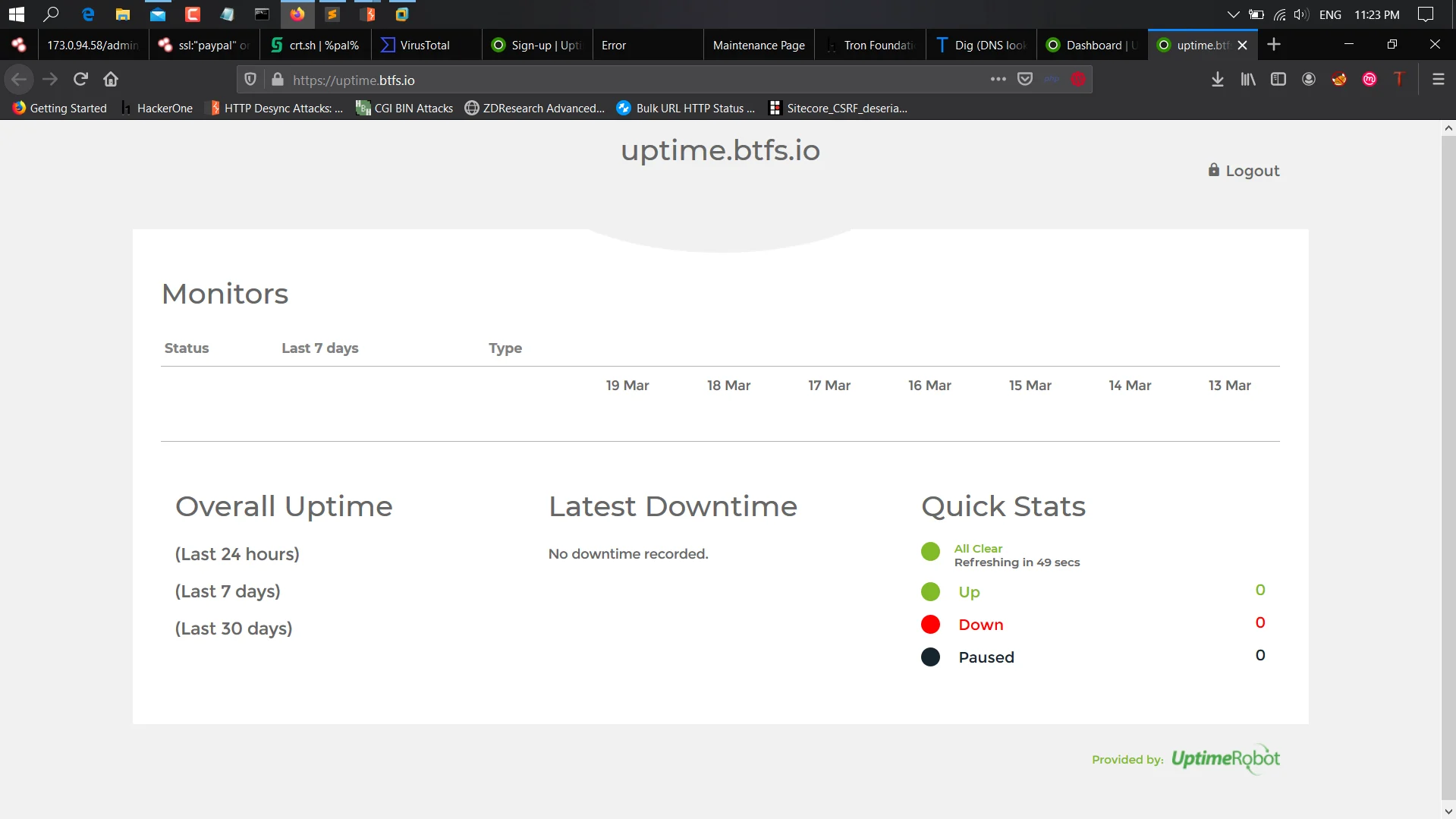
i can't report it to the company so i hope to accept it as a valid bug , i found subdomain takeover in your subdomain uptime.btfs.io , i found this subdomain pointed to uptimerobot and not claimed so i signedup in uptimerobot and claimed it.
POC:
1 - open https://uptime.btfs.io/
2 - you need a password to login A123456789
3 -
Impact
- Subdomain takeover can be abused to do several things like :
Malware distribution Phishing / Spear phishing XSS Authentication bypass Legitimate mail sending and receiving on behalf of ford subdomain
What the report shows
The target is the BTFS program, and the asset in question is the subdomain uptime.btfs.io. The researcher found that this subdomain was pointed at UptimeRobot, a third-party uptime monitoring service, and that the corresponding resource on that service had not been claimed by anyone. Because the DNS record delegated the name to a service that did not yet have an owner, the researcher was able to register an UptimeRobot account and claim the name for themselves.
The report notes that the researcher could not submit it through the company's own channel, and asked for it to be accepted as a valid bug on the platform instead.
The proof of concept is short and consists of two steps:
- Open the subdomain in a browser:
https://uptime.btfs.io/
- Log in with the password given in the report:
A123456789
The report includes a screenshot alongside the proof of concept steps.
The report was rated high severity with a weakness classified as privilege escalation, and a bounty of 100.00 USD was paid. It was disclosed on 2020-05-05.
Root cause
The likely root cause is a dangling DNS record: uptime.btfs.io was pointed at UptimeRobot, but the name on UptimeRobot had not been claimed. In this case, signing up for an UptimeRobot account was enough to claim the name. When the DNS record still resolves to the provider and the provider is willing to serve whoever claims the name, the organisation's subdomain ends up under a stranger's control. The report does not describe the exact DNS record type or the claim flow beyond signing up and claiming the name.
Impact
The report lists the following ways a subdomain takeover can be abused:
- Malware distribution
- Phishing / Spear phishing
- XSS
- Authentication bypass
- Legitimate mail sending and receiving on behalf of ford subdomain
These are the general consequences of controlling a name inside the organisation's domain. Because the content is served from a trusted subdomain, users and filters are more likely to trust it. The report presents these as possibilities rather than demonstrating each one.
How this kind of bug works
Many organisations point subdomains at third-party services: status pages, uptime monitors, marketing pages, documentation hosts, object storage buckets, and so on. The DNS record is a delegation: it says "ask this provider what to serve for this name". The provider, in turn, decides what to serve based on a name or identifier that a customer registers in its dashboard.
A takeover happens when those two halves get out of sync. The DNS record survives, but the provider-side registration is gone or was never made. The provider has no record of an owner, so when someone else registers the same name, the provider starts serving that person's content on the organisation's subdomain. Nothing on the organisation's own infrastructure has to be broken for this to work; the trust comes from the DNS name alone.
The usual defences are process and hygiene rather than code: keeping an inventory of third-party DNS records, removing records when a service is decommissioned, preferring providers that verify domain ownership before serving a name, and monitoring for provider error pages that indicate an unclaimed resource.
How to test for it
- Enumerate subdomains for the target using certificate transparency logs, passive DNS sources and brute force, then resolve each one.
- For each subdomain, look at where it points. For each subdomain, look at where it points: a known SaaS provider is a strong signal.
- Request the subdomain and read the response. Provider-specific "not found", "no such app", "repository not found" or "claim this domain" pages indicate a resource that may be unclaimed.
- Confirm by attempting to claim the name on the provider with your own account, following the provider's normal signup flow. A successful claim that makes the subdomain serve your content is the proof.
- Record the claim and the page now served under the target's domain.
A positive result is a subdomain that resolves to a provider and whose name you can register without any verification from the domain owner.
How it is fixed
- Remove the dangling DNS record, or repoint it to a resource the organisation controls.
- Re-register the name on the provider if the service is still needed, and keep the registration active.
- Where the provider supports it, enable domain ownership verification so names cannot be claimed by third parties.
- Audit other subdomains for the same pattern, since takeovers rarely occur in isolation.
- Add monitoring that alerts when a subdomain starts serving a provider error or claim page.
Hunting notes
This bug class tends to hide in forgotten infrastructure: subdomains created for a short-lived campaign, a status page set up during an incident, a demo environment, or a service that was migrated and whose DNS record was left behind. Recon signals worth watching are CNAMEs to SaaS providers, subdomains that return provider-branded error pages, and names that appear in certificate transparency but not in the organisation's current documentation.
To get a report accepted, show the unclaimed state, the registration you performed, and the content now served from the target's domain. Keep the claimed resource minimal and non-harmful, and avoid using the position for anything beyond demonstrating control.
What happened, in plain words
A website is made of many smaller addresses called subdomains. If the main site is btfs.io, then uptime.btfs.io is one of its subdomains. Organisations often do not run every subdomain themselves. Instead they point it at an outside company that provides a service, a bit like putting a sign on your door that says "deliveries go to the shop next door". The subdomain still carries the organisation's name, but the actual content is served by the outside company.
In this report, the researcher found that uptime.btfs.io was pointed at UptimeRobot, a service that checks whether websites are up and shows status pages. The important part: on UptimeRobot, nobody had claimed the name that this subdomain was pointed at. It was like a mailbox at the post office with no owner. The researcher signed up for an UptimeRobot account, claimed the name, and from then on the subdomain showed content the researcher controlled.
The researcher explains that they could not submit the finding through the company's own channel, and asked for it to be accepted as a valid bug on the platform instead.
The proof of concept is only two steps:
- Open the subdomain in a browser:
https://uptime.btfs.io/
This is just the address of the subdomain. Opening it in a browser sends a request to whatever server the name points at, and the browser displays whatever comes back.
- Log in with the password given in the report:
A123456789
The report gives this password for logging in to the page.
The report includes a screenshot alongside the proof of concept steps.
The report was rated high severity, with the weakness classified as privilege escalation, and a bounty of 100.00 USD was paid. It was disclosed on 2020-05-05.
Why this happens
The cause is a DNS record pointing at UptimeRobot while the name there was unclaimed. DNS is the system that turns a name like uptime.btfs.io into the address of a server, like a phone book for the internet. A record that points at an outside provider is a delegation: it tells the browser "ask this provider what to show for this name". The provider then decides what to show based on a name or identifier that a customer registers in its dashboard.
A takeover happens when those two halves get out of sync. The DNS record still exists, but the registration on the provider side is not held by the organisation. The provider has no record of an owner, so when someone else registers the same name, the provider starts serving that person's content on the organisation's subdomain. Nothing on the organisation's own servers has to be broken for this to work; the trust comes from the name alone. The report does not describe the exact DNS record type or the claim flow beyond signing up and claiming the name.
Impact
The report lists the following ways a subdomain takeover can be abused:
- Malware distribution
- Phishing / Spear phishing
- XSS
- Authentication bypass
- Legitimate mail sending and receiving on behalf of ford subdomain
These are the general consequences of controlling a name inside the organisation's domain. Because the content is served from a trusted subdomain, users and filters are more likely to trust it. The report presents these as possibilities rather than demonstrating each one.
In general, how this kind of bug works
Many organisations point subdomains at third-party services: status pages, uptime monitors, marketing pages, documentation hosts, object storage buckets, and so on. The DNS record is a delegation: it says "ask this provider what to serve for this name". The provider, in turn, decides what to serve based on a name or identifier that a customer registers in its dashboard.
The DNS record survives, but the provider-side registration is gone or was never made. Nothing on the organisation's own infrastructure has to be broken for this to work; the trust comes from the DNS name alone.
The usual defences are process and hygiene rather than code: keeping an inventory of third-party DNS records, removing records when a service is decommissioned, preferring providers that verify domain ownership before serving a name, and monitoring for provider error pages that indicate an unclaimed resource.
In general, how to test for it
- Enumerate subdomains for the target using certificate transparency logs, passive DNS sources and brute force, then resolve each one.
- For each subdomain, look at where it points. For each subdomain, look at where it points: a known SaaS provider is a strong signal.
- Request the subdomain and read the response. Provider-specific "not found", "no such app", "repository not found" or "claim this domain" pages indicate a resource that may be unclaimed.
- Confirm by attempting to claim the name on the provider with your own account, following the provider's normal signup flow. A successful claim that makes the subdomain serve your content is the proof.
- Record the claim and the page now served under the target's domain.
A positive result is a subdomain that resolves to a provider and whose name you can register without any verification from the domain owner.
In general, how it is fixed
- Remove the dangling DNS record, or repoint it to a resource the organisation controls.
- Re-register the name on the provider if the service is still needed, and keep the registration active.
- Where the provider supports it, enable domain ownership verification so names cannot be claimed by third parties.
- Audit other subdomains for the same pattern, since takeovers rarely occur in isolation.
- Add monitoring that alerts when a subdomain starts serving a provider error or claim page.
In general, hunting notes
This bug class tends to hide in forgotten infrastructure: subdomains created for a short-lived campaign, a status page set up during an incident, a demo environment, or a service that was migrated and whose DNS record was left behind. Recon signals worth watching are CNAMEs to SaaS providers, subdomains that return provider-branded error pages, and names that appear in certificate transparency but not in the organisation's current documentation.
To get a report accepted, show the unclaimed state, the registration you performed, and the content now served from the target's domain. Keep the claimed resource minimal and non-harmful, and avoid using the position for anything beyond demonstrating control.
Glossary
- Subdomain: A name that sits under a main domain, such as
uptime.btfs.iounderbtfs.io. - DNS: The system that turns names into server addresses, like a phone book for the internet.
- DNS record: An entry in DNS that says where a name should point.
- Dangling DNS record: A DNS record that still points at an outside service, even though the matching registration on that service is gone or was never made.
- CNAME: A type of DNS record that points one name at another name.
- Subdomain takeover: Taking control of a subdomain by claiming an unclaimed resource on the outside service it points at.
- UptimeRobot: A third-party service that monitors whether websites are up and shows status pages.
- SaaS: Software as a Service, an outside company that runs software for you over the internet.
- Provider: The outside company whose service a subdomain is pointed at.
- Claim: Registering a name or resource in a provider's dashboard so that the provider serves your content for it.
- Proof of concept (POC): The short set of steps that demonstrates a bug is real.
- Request: A message a browser sends to a server asking for a page or other content.
- Cookie: A small piece of data a site stores in your browser, often used to remember who you are.
- Token: A value used to prove identity or permission, similar to a ticket.
- Privilege escalation: Gaining access or control you were not meant to have.
- XSS (Cross-Site Scripting): A bug where an attacker gets their own code to run inside a trusted website in a victim's browser.
- Phishing: Tricking people into trusting a fake page or message so they hand over information.
- Spear phishing: Phishing aimed at a specific person or group.
- Authentication bypass: Getting past a login or identity check without the correct credentials.
- Allowlist: A list of names or addresses that are automatically trusted.
- Certificate transparency logs: Public records of security certificates issued for websites, useful for discovering subdomain names.
- Passive DNS: Collected historical data about which names pointed where.
- Brute force: Trying many possible names or values automatically until one works.
- False positive: A finding that looks like a bug but is not actually exploitable.
- TXT verification: A check where a provider asks you to add a special DNS text record to prove you own the domain.
- Severity: A rating of how serious a bug is.
- Bounty: A reward paid for reporting a valid bug.