Unvalidated redirect on team.badoo.com
The team subdomain reflected a carriage-return/line-feed sequence from the URL into the Location response header, allowing header injection. Because the server blocked external redirects and response splitting, the reporter used a data URI to turn the injected header into reflected cross-site scripting in Firefox.

- Triaged in 25 hours
- Fixed in 2 days
- Paid in 2 days
- Disclosed after 41 days
#Domain affected: https://team.badoo.com/ (corp.badoo.com)
#PoC (Tested on Firefox): https://team.badoo.com/%0d%0adata:text/html;text,%3Csvg%2fonload%3Dprompt%281%29%3E
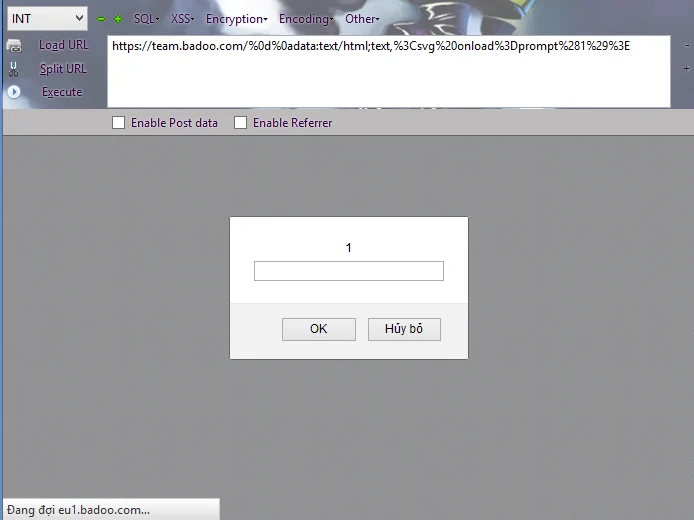
#Describe: team.badoo.com may vulnerable to CRLF injection, when we inject %0d%0a into url, the Location header, entire content after %0d%0a and '/' will appear in Response header:
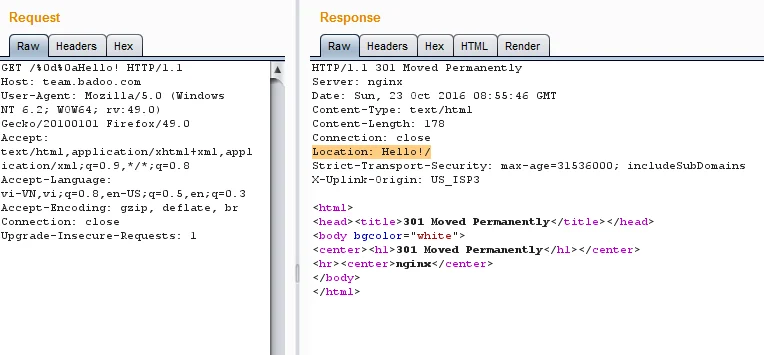
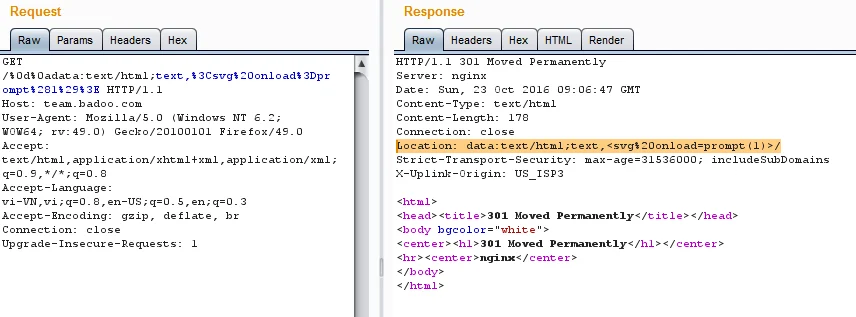
Since your server is configured pretty good that i can't do attack like HTTP response splitting or redirect to external url, i decided to test XSS on it.
Using Data URI scheme which is a uniform resource identifier (URI) scheme that provides a way to include data in-line in web pages as if they were external resources can bypass it and triggered XSS:
Not written yet. The AI write-up for this report has not been written yet. The Original tab links to the source.
How it worked
Root cause
Likely the application placed user-controlled URL input into the Location header without stripping carriage-return and line-feed characters, permitting header injection.
Impact
An attacker could run script in the context of the affected subdomain for a victim who opens the crafted link, though the report notes the server configuration blocked external redirects and response splitting, and the proof of concept was only shown in Firefox.
What the attacker needed
Victim opens a crafted link; Firefox browser
How it was found
- Open the crafted URL containing an encoded carriage-return/line-feed sequence followed by a data URI in Firefox.
- Observe that the injected content appears in the response headers after the Location header.
- The browser follows the injected data URI and executes the embedded SVG onload handler, showing a prompt.
Explained by bugbounty.wiki with AI from the original and checked against quotes from it; it can still be wrong. Read the original before relying on a detail.
Not written yet. The AI write-up for this report has not been written yet. The Original tab links to the source.
When a site redirects, it puts the destination in a Location header. If it copies URL input into that header without cleaning it, an attacker can inject extra characters. Here the attacker added a data URI, which carries a page inside it, so the browser rendered attacker content and ran script.
What is XSS?
Script an attacker supplies runs in another user's browser, on the target's origin, with that user's session.





