Account/Repository Takeover via Abandoned GitHub Username in curl's href_extractor.c
The curl example file href_extractor.c links to an external HTML parser hosted under a GitHub username that was abandoned, allowing the reporter to register that username and host a repository with the same name. An attacker could then distribute malicious code to developers who download the library from that link.
 Originally disclosed on HackerOne
- Disclosed after 1 hour
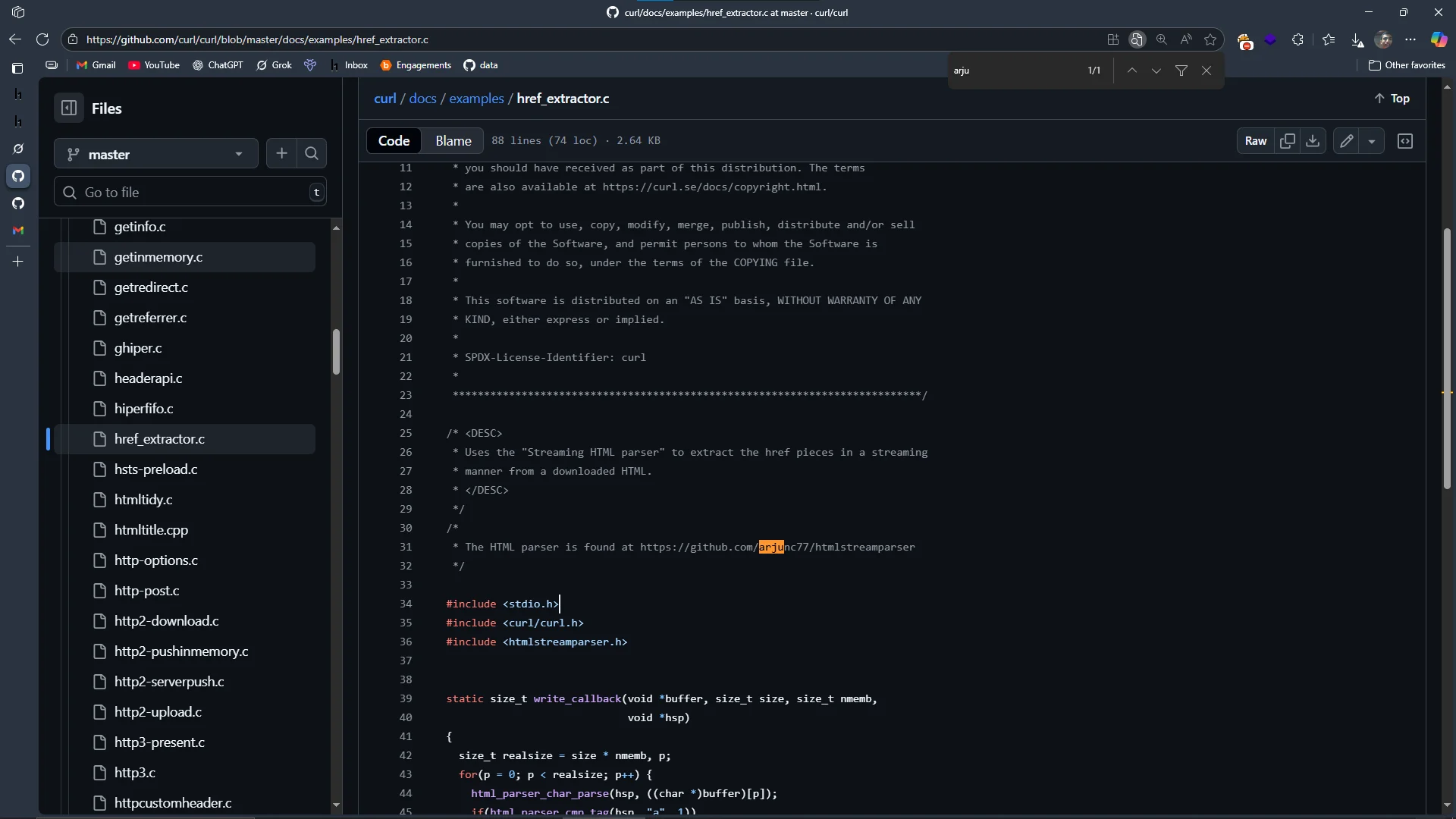
Summary: The href_extractor.c example in the curl repository (https://github.com/curl/curl/blob/master/docs/examples/href_extractor.c) references an external HTML parser library hosted at https://github.com/arjunc77/htmlstreamparser. The referenced GitHub username (arjunc77) or repository (htmlstreamparser) appears to be abandoned or deleted, allowing me to register the same username and host a repository with the same name. This enables a potential supply chain attack, where malicious code could be distributed to users relying on the referenced library, impacting the security of applications built using this example. Description: The href_extractor.c file, part of the curl project's example code, uses the HTML streaming parser from https://github.com/arjunc77/htmlstreamparser. I discovered that the GitHub username arjunc77 or the repository htmlstreamparser was abandoned or deleted, as I was able to register the same username and create a repository under the same name. By hosting a malicious version of the HTML parser in this repository, an attacker could compromise systems that download and use the library based on the link provided in the curl documentation. This is particularly concerning because the curl project is widely trusted, and developers may not verify the ownership or integrity of the referenced repository. Steps to Reproduce:
Visit the href_extractor.c file in the curl repository: https://github.com/curl/curl/blob/master/docs/examples/href_extractor.c. Note the reference to the HTML parser at https://github.com/arjunc77/htmlstreamparser in the file's comments. Verify that the arjunc77/htmlstreamparser repository is no longer active or has been deleted (as I was able to register the username arjunc77). Create a new GitHub account with the username arjunc77 and a repository named htmlstreamparser. Host a proof-of-concept (PoC) repository with malicious or modified code at https://github.com/arjunc77/htmlstreamparser. Developers cloning or downloading the library from this link, as referenced in href_extractor.c, would inadvertently use the malicious code.
Proof of Concept: I registered the GitHub username arjunc77 and created a repository named htmlstreamparser at https://github.com/arjunc77/htmlstreamparser. I hosted a PoC version of the HTML parser with a simple modification (e.g., adding a print statement to demonstrate control over the code). When compiled and run with href_extractor.c, the modified code executes, confirming the potential for malicious code injection. The PoC repository remains available for verification but does not contain harmful code.
References:
Vulnerable file: https://github.com/curl/curl/blob/master/docs/examples/href_extractor.c PoC repository: https://github.com/arjunc77/htmlstreamparser (created for demonstration purposes)
location of the issue :
Impact
The impact of this vulnerability is significant due to the potential for a supply chain attack:
Code Execution Risk: Developers who follow the curl example and download the HTML parser from the referenced GitHub link could unknowingly integrate malicious code into their applications. This could lead to arbitrary code execution, data theft, or further compromise of systems where the application is deployed. Trust Exploitation: The curl project is a widely used and trusted library, and its documentation is considered authoritative. A malicious repository hosted under the same username could exploit this trust, leading to widespread adoption of compromised code. Scalability: Since the curl repository is publicly accessible and used by millions of developers, a single compromised link could affect numerous projects, especially those automatically pulling dependencies without manual verification. Reputation Damage: A successful attack leveraging this vulnerability could harm the reputation of the curl project, as users may perceive the inclusion of an unverified link as a security oversight.
Not written yet. The AI write-up for this report has not been written yet. The Original tab links to the source.
How it worked
Root cause
Likely the curl example documentation referenced an external GitHub repository without verifying that the owner still controls it, leaving the username open to re-registration.
Impact
Developers who follow the curl example and download the parser from the referenced link could unknowingly integrate malicious code, potentially leading to code execution or data theft, though the reporter's proof of concept only added a print statement and did not contain harmful code.
What the attacker needed
Curl example references abandoned GitHub repo; attacker registers the free username; developer downloads from the link
The fix
The example could be updated to point to a verified source or drop the external link.
How it was found
- Open the href_extractor.c example in the curl repository.
- Note the link to the external HTML parser in the file's comments.
- Check that the original GitHub username or repository is no longer active.
- Register the same GitHub username and create a repository with the same name.
- Host a modified version of the parser in the new repository.
- Developers who download the library from the link would get the modified code.
Explained by bugbounty.wiki with AI from the original and checked against quotes from it; it can still be wrong. Read the original before relying on a detail.
Not written yet. The AI write-up for this report has not been written yet. The Original tab links to the source.
A file in the curl project's examples points to a helper library on GitHub. The person who owned that GitHub account left, so the name became free. The reporter took the name and could put harmful code there, which someone might download by following the link.
What is Subdomain takeover?
A company's DNS still points at a cloud service it no longer uses, so anyone can claim it and serve content on the company's domain.




