CURLOPT_UNRESTRICTED_AUTH Dangerous Default Documentation Gap
The report claims that libcurl strips the Authorization and Cookie headers on redirects but forwards any other custom header, such as a custom API key or token header, to every redirect destination. An attacker who controls a redirect target could therefore receive credentials that applications send in custom authentication headers.

- Disclosed after 2 hours
Summary:
CURLOPT_UNRESTRICTED_AUTH=1 instructs libcurl to send credentials to ALL hosts during redirect chains, 'possibly again and again as the following hosts can keep redirecting to new hosts.' The documentation explicitly warns this is dangerous, but the default behavior is also risky: curl only protects Authorization and Cookie headers by default — ANY other custom header (including custom auth headers like X-API-Key, X-Auth-Token) is forwarded to ALL redirect destinations with NO protection at all. This is confirmed in the source docs: 'for all other headers than the two mentioned above, there is no protection from this happening when libcurl is told to follow redirects.
Affected version
All versions (by design) docs/libcurl/opts/CURLOPT_UNRESTRICTED_AUTH.md + lib/http.c
Steps To Reproduce:
Step 1 — Save the PoC file Save poc_unrestricted_auth.py to your machine.
Step 2 — Run it bashpython3 poc_unrestricted_auth.py --vector 1
---

### Step 3 — Watch the output
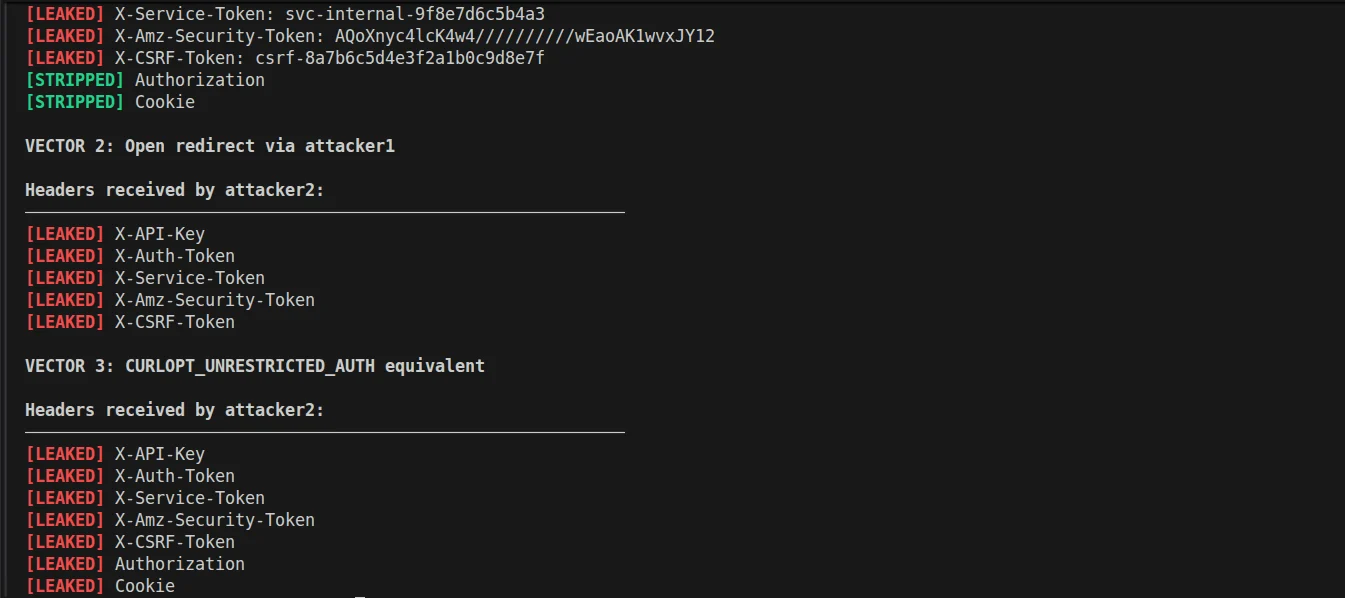
You'll see two servers start — an **origin** and an **attacker**. curl sends your headers to the origin, which redirects to the attacker.

Look for this section:
[LEAKED] X-API-Key: sk-prod-a1b2c3d4e5f6g7h8i9j0 [LEAKED] X-Auth-Token: eyJhbGciOiJIUzI1NiJ9... [LEAKED] X-Service-Token: svc-internal-9f8e7d6c5b4a3 [STRIPPED] Authorization ← curl correctly stripped this [STRIPPED] Cookie ← curl correctly stripped this
Step 4 — That's the bug Authorization and Cookie were stripped by curl. Your X-API-Key, X-Auth-Token, and every other custom header went straight to the attacker's server.
Impact
impact:
Applications that set custom authorization headers (X-API-Key, X-Auth-Token, X-Service-Token, etc.) via CURLOPT_HTTPHEADER and also enable CURLOPT_FOLLOWLOCATION unknowingly leak those credentials to any redirect destination. No CVE will be assigned — it is by design — but it affects a very wide range of real applications
##Recommended: Do not combine CURLOPT_FOLLOWLOCATION with custom authentication headers. Implement redirect handling manually: disable FOLLOWLOCATION, check CURLINFO_REDIRECT_URL, strip custom auth headers, then re-issue the request. Document this risk explicitly in application-level security reviews.
Attachments
Not written yet. The AI write-up for this report has not been written yet. The Original tab links to the source.
How it worked
Root cause
Likely by design, libcurl only strips the Authorization and Cookie headers on cross-host redirects and forwards all other caller-supplied headers unchanged.
Impact
Applications that send custom authentication headers and enable redirect following could leak those credentials to any redirect destination; the author states this is by design and no CVE will be assigned.
What the attacker needed
Application uses libcurl; custom auth header set via CURLOPT_HTTPHEADER; redirect following enabled; redirect target controlled by attacker
The fix
Applications should not combine redirect following with custom authentication headers, and should instead handle redirects manually by checking the redirect URL, stripping custom auth headers and re-issuing the request.
How it was found
- Save the proof-of-concept script to the local machine.
- Run the script with the first vector option.
- Observe the origin and attacker servers start and curl send its headers to the origin, which redirects to the attacker.
- Check the output showing custom headers leaked while Authorization and Cookie were stripped.
Explained by bugbounty.wiki with AI from the original and checked against quotes from it; it can still be wrong. Read the original before relying on a detail.
Not written yet. The AI write-up for this report has not been written yet. The Original tab links to the source.
When a web request gets a redirect, the client follows it to a new address. libcurl removes the standard login and cookie headers before following, but it keeps every other custom header you added. If an application puts its secret key in a custom header, that key travels to whatever server the redirect points at, including one an attacker controls.
What is Info disclosure?
Data the application should keep private (personal data, internal details, other users' records) reaches someone it should not.




