Application Level DoS - Large Markdown Payload in Reply Section Leading to Resource Exhaustion
The reply section of a Discourse forum accepted an extremely large Markdown payload, causing the server to take about 30 seconds to respond and then return a 502 error. An attacker could send many such requests in parallel to exhaust backend resources and disrupt availability.
 Originally disclosed on HackerOne
- Triaged in 27 days
- Fixed in 3 months
- Paid in 51 days
- Disclosed after 7 months
Summary:
An application level Denial of Service (DoS) vulnerability was identified in the reply section on https://try.discourse.org
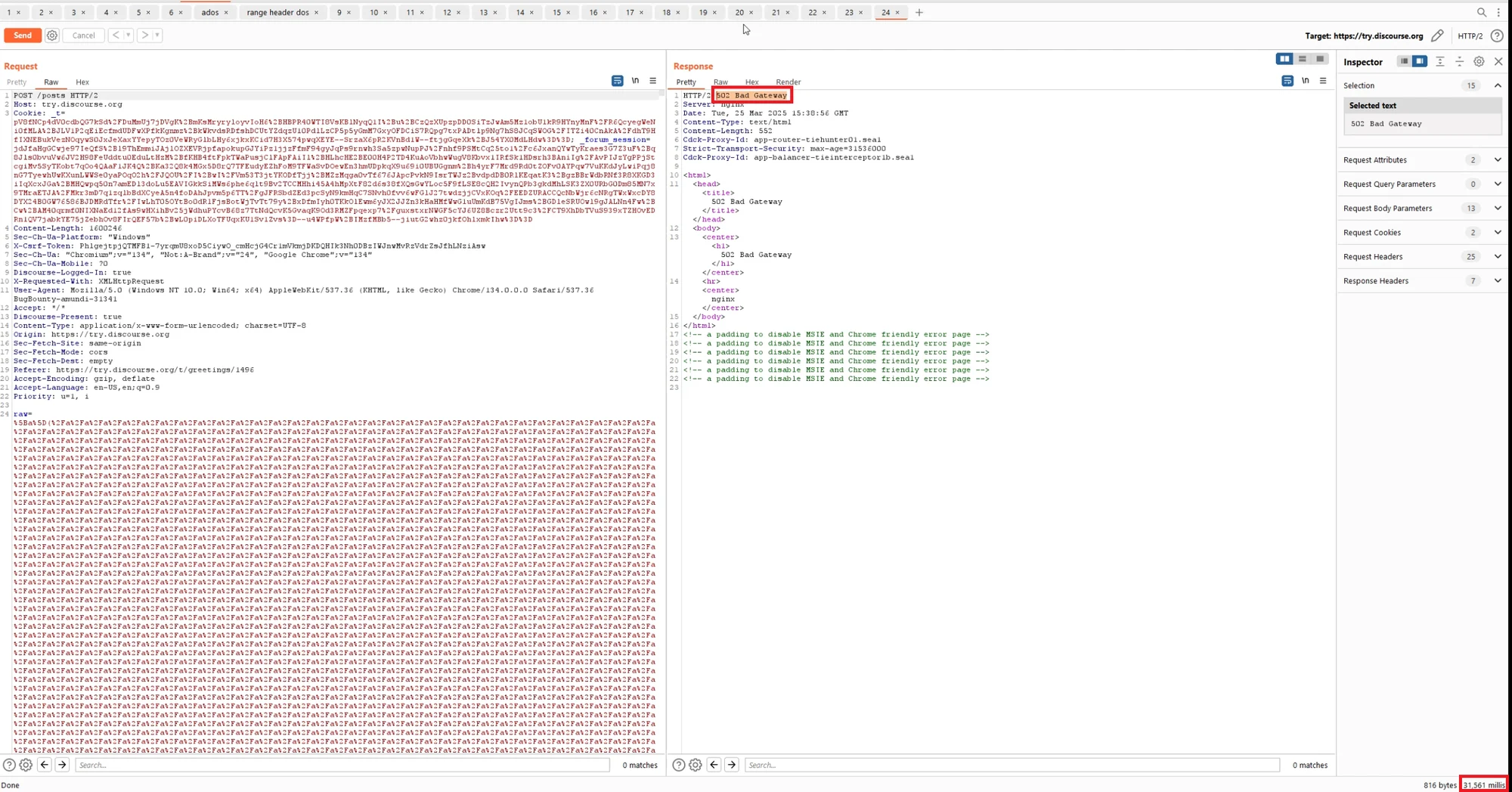
By submitting an excessively large markup payload (~800,000 characters), the server takes 30 seconds to respond before returning an HTTP/2 502 Bad Gateway error. This indicates potential resource exhaustion or backend service failure, which could be exploited to degrade or disrupt website availability.
Attack Scenario:
If an attacker automates this request using multiple parallel requests (e.g., via Burp Intruder, Python scripts, or a botnet), it can cause severe resource exhaustion.
The backend service will be overwhelmed, leading to widespread downtime, preventing legitimate users from accessing the forum.
Steps To Reproduce:
-
Login with valid credentials on
https://try.discourse.org -
Navigate to the default discobot grettings message.
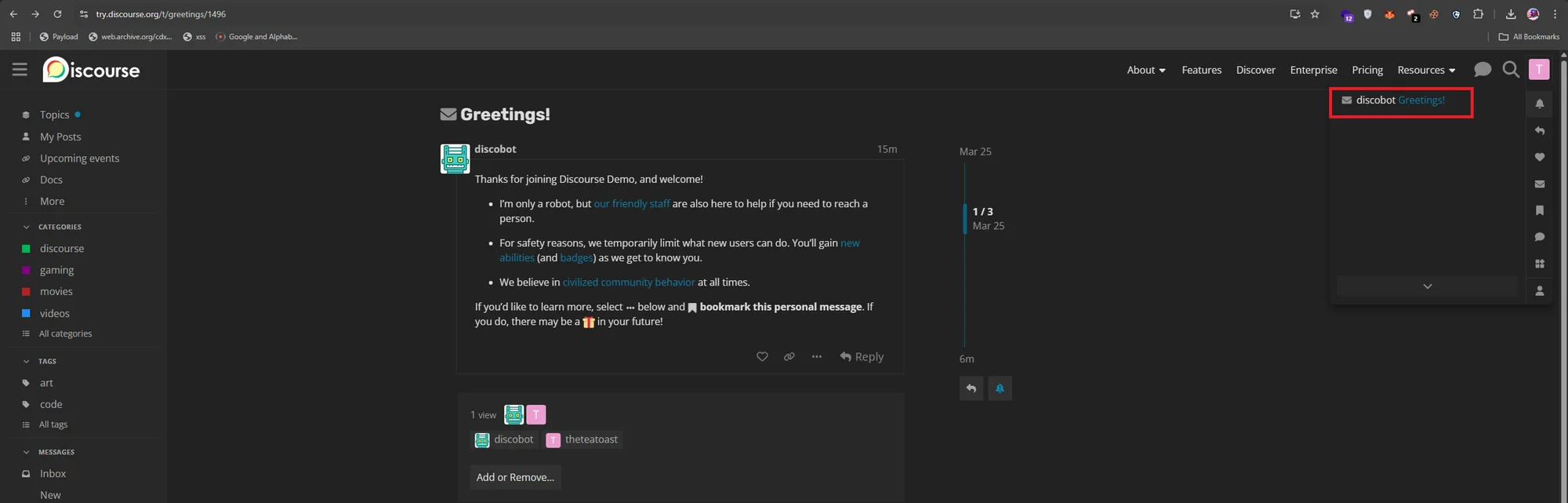
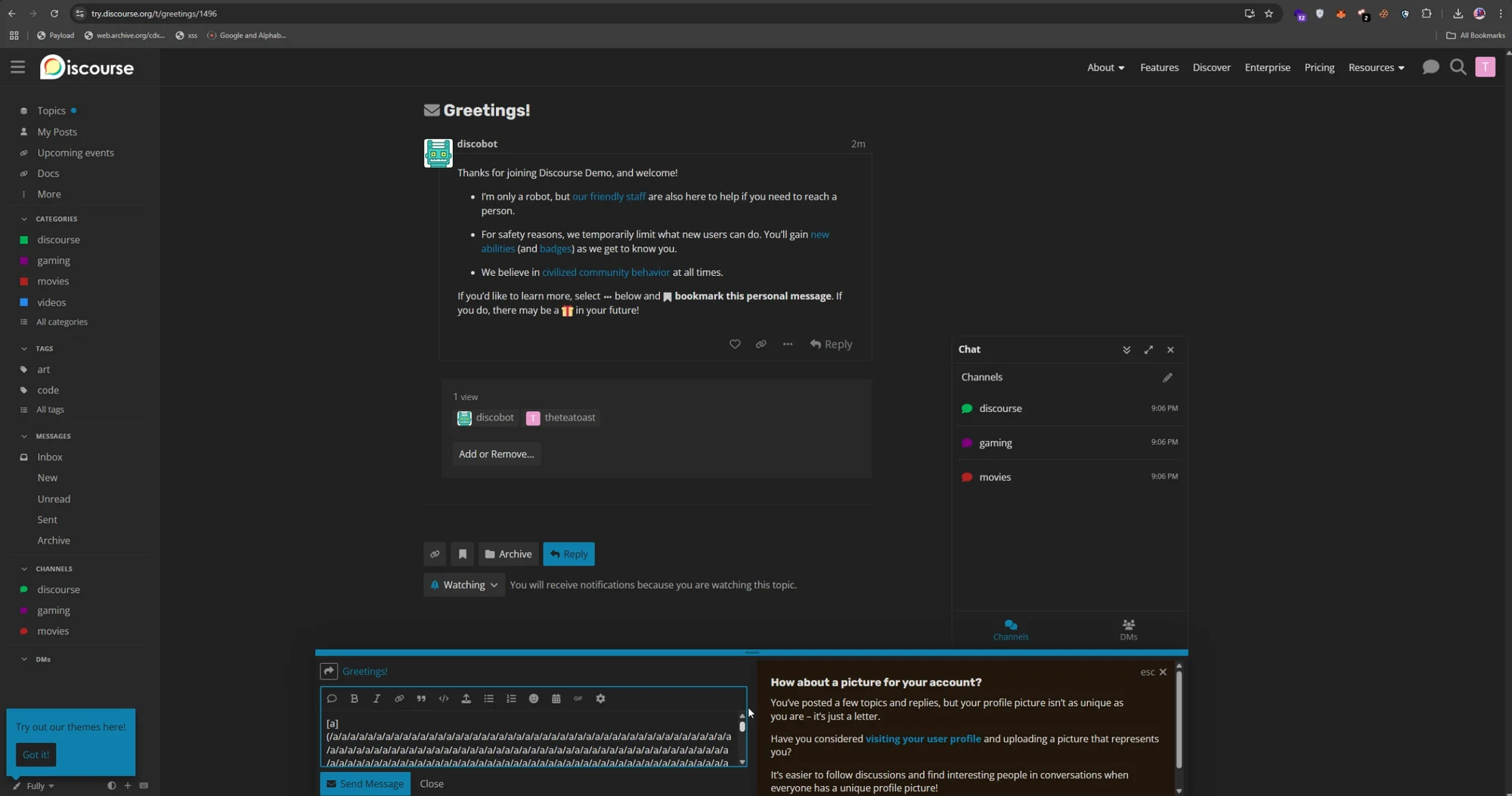
- Reply the message with the following paylod while intercepting the request:
https://github.com/theteatoast/theteatoast.github.io/blob/main/payload.txt
- Repeat the request and observe that the server takes ~30 seconds before responding with 502.
##Video POC:
##Suggested Mitigation:
-
Implement input length restrictions on replies to prevent excessive payload sizes.
-
Introduce rate-limiting and request throttling to mitigate automated abuse.
-
Optimize backend request handling to reject large payloads early before processing.
##Note:
This Proof of Concept (PoC) was performed solely for demonstration purposes, with no intent to harm the system. I ensured minimal impact while testing.
Impact
-
Attackers can exploit this to cause severe delays and temporary or prolonged service disruption.
-
The lack of input validation allows attackers to send multiple large requests in parallel, leading to backend resource exhaustion.
-
If automated, this attack could render the forum completely inaccessible.
Not written yet. The AI write-up for this report has not been written yet. The Original tab links to the source.
How it worked
Root cause
Likely the application does not enforce a reasonable maximum length on reply content and processes the entire large payload before rejecting it, leading to resource exhaustion.
Impact
An attacker could cause severe delays and temporary or prolonged service disruption, and if automated, render the forum completely inaccessible.
What the attacker needed
A valid account on the forum; ability to intercept HTTP requests
The fix
The application should enforce input length restrictions on replies, add rate-limiting and request throttling, and reject large payloads early before processing.
How it was found
- Log in to the target forum with valid credentials.
- Open the default discobot greeting message.
- Intercept a reply request and replace the body with a very large Markdown payload.
- Send the request repeatedly and observe the server taking about 30 seconds before returning a 502 error.
Explained by bugbounty.wiki with AI from the original and checked against quotes from it; it can still be wrong. Read the original before relying on a detail.
Not written yet. The AI write-up for this report has not been written yet. The Original tab links to the source.
A denial-of-service (DoS) attack tries to make a website unavailable by overwhelming it with work. Here, sending a very long reply made the server spend a long time processing it and then fail with an error. If many of these are sent at once, the site could become slow or unreachable for normal users.
What is DoS?
A request that exhausts resources or crashes a component. Many programs forbid testing it; reports usually show it from code, not by attacking.


