Oauth flow on the comments widget login can lead to the access code leakage
The OAuth redirect_uri validation was insufficient, allowing an attacker to use arbitrary paths on the whitelisted domain. This could leak the OAuth authorization code to external sites via the Referer header when a user clicked an external link on a page without the comments widget.

- Fixed in under an hour
- Disclosed after under an hour
Summary by the program
This report broke the record for the fastest time to resolution and then public disclosure. I would like to thank @sp1d3rs again for their fantastic report.
Summary by the researcher
I discovered an issue, when valid oauth code could be leaked to the various external hosts under some circumstances due to insufficient redirect_uri validation, and ability to use Referer header for code leakage.
The issue was caused by the fact, that using redirect_uri with an arbitrary path to the some page without comments widget enabled, and containing some insecure external links, we can prevent the code exchange (when i wrote 'stripped' in the report, i meant exchange), and leak it to the several external hosts with some user interaction.
The code exchange happened only on the pages with enabled comments widget (so flow should not be exploitable on such pages, since widget script exchanges and strips the code - and it become no more valid, so even if we leak such code somehow before it's stripping, it will be useless).
Thanks to the Ed for the fastest response in my experience!
The report
##Description
Hello. Here is a keyword: frog
I discovered an little Oauth flow in the comments widget authentication process using redirect_uri manipulations.
The widget located on the all blogposts, which have URL
https://edoverflow.com/2017/[post-title]/
Upon authentication, it appeared that code parameter gets stripped from the URL after successful authentication, so there was no visible way to do the leakage thorugh, for example, Referer header upon clicking some external link in the blogpost.
At this time, i noticed the only one code leakage to the
https://fonts.googleapis.com/css?family=Inconsolata
upon code verification (since it returned 200 OK) but it appeared not very serious issue for me, and i digged deeper.
I discovered, that it was possible to manipulate the redirect_uri parameter, using the arbitrary directories, since it looked like whole https://edoverflow.com URL was whitelisted.
So, i tried next URL, to non-existent path /1:
https://github.com/login?client_id=5f45cc999f7812d0b6d2&return_to=%2Flogin%2Foauth%2Fauthorize%3Fclient_id%3D5f45cc999f7812d0b6d2%26redirect_uri%3Dhttps%253A%252F%252Fedoverflow.com%252F1%26scope%3Dpublic_repo
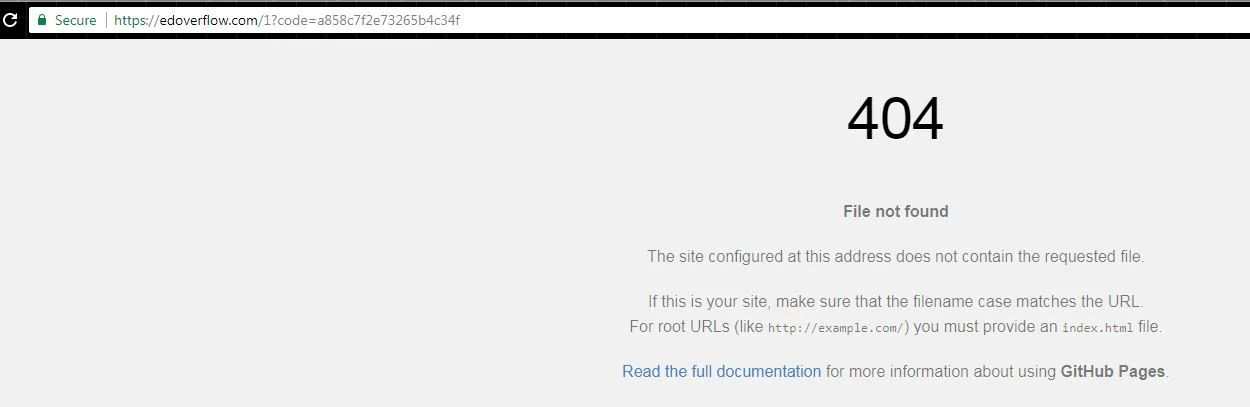
and... code was not stripped. So it became clear for me, that the code strips only on pages with a comment widget.
Next, i tried to find some place, where i can post arbitrary content (like images), with controlled src, to leak the code through Referer. Unfortunately (or fortunately) site used content proxying through GitHub - so my dream about High impact had not came true:)
So my last hope was at least leak the code to the some external sites, and i came across this link:
https://edoverflow.com/about/
and
https://edoverflow.com/metadata
Using
https://github.com/login?client_id=5f45cc999f7812d0b6d2&return_to=%2Flogin%2Foauth%2Fauthorize%3Fclient_id%3D5f45cc999f7812d0b6d2%26redirect_uri%3Dhttps%253A%252F%252Fedoverflow.com%252Fabout%252f%26scope%3Dpublic_repo
and same link with /metadata path,
i was able to leak the access code with user interaction to the several sites in the Referer header, like keybase.io, liberapay.com, hackerone.com, crypto101.io, twitter.com, youtube.com and several Press sites like Bloomberg.
##Suggested Fix
I suggest to restrict the redirect_uri only to the blogposts path, to prevent code leakage in the other parts of the site, and secure external links from possible Referer leakage, just in case.
Impact
The severity was set as low, because attacker can't directly conduct the authentication bypass against victim, in case attacker is not an admin of the one of the external sites=). Still, there was some risks, so issue was reported in several minutes after discovery
Not written yet. The AI write-up for this report has not been written yet. The Original tab links to the source.
How it worked
Root cause
Likely the OAuth redirect_uri validation only checked the domain, not the exact path, allowing any path on the domain to be used as a redirect target.
Impact
The OAuth authorization code could be leaked to external sites via the Referer header, but the severity was low because the attacker cannot directly conduct an authentication bypass without being an admin of one of those external sites.
What the attacker needed
Victim clicks a crafted OAuth link; victim clicks an external link on the page
The fix
The redirect_uri should be restricted to only the blogposts path to prevent code leakage in other parts of the site, and external links should be secured against Referer leakage.
How it was found
- Craft an OAuth authorization URL with a redirect_uri pointing to a path on the site that does not have the comments widget enabled.
- Ensure that path contains an external link.
- Send the crafted URL to a victim; after authentication, the code is not stripped because the widget is absent.
- The victim clicks the external link, causing the code to be sent in the Referer header to the external site.
Explained by bugbounty.wiki with AI from the original and checked against quotes from it; it can still be wrong. Read the original before relying on a detail.
Not written yet. The AI write-up for this report has not been written yet. The Original tab links to the source.
When you log in with an external service like GitHub, the service sends a temporary code back to the website. The website must check that the code is sent to a safe place. Here, the check was too loose, so the code could end up being sent to other websites if the user clicked a link, potentially letting someone else use that code.
What is OAuth / SSO?
Mistakes in OAuth, OpenID Connect, SAML or token handling that leak codes and tokens or link an attacker's identity to a victim's account.




