CVE-2017-8779 exploit on open rpcbind port could lead to remote DoS
An open rpcbind port was exposed on the target host, allowing an attacker to use a known Metasploit module to trigger large unfreed memory allocations for XDR strings. This could exhaust system memory and cause a remote denial of service.
b039f6018eb9056011859b0 Follow
 Originally disclosed on HackerOne
- Disclosed after 2 days
Summary by the program
An open port that was not discovered during our regular scan would have allowed users to abuse rpcbind and perform certain remote commands including excessive usage of system resources.
The report
Summary:
An open rpcbind port on https://da.theendlessweb.com allows for possible exploitation by an existing Metasploit module. This could lead to large and unfreed memory allocations for XDR strings.
Description:
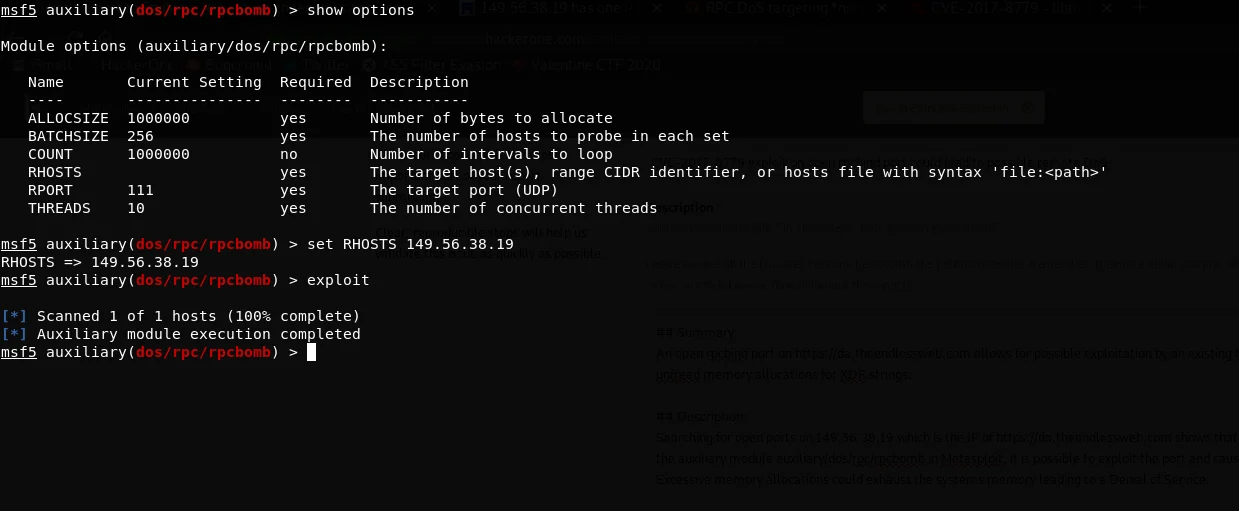
Port scanning on 149.56.38.19 which is the IP of https://da.theendlessweb.com shows open port 111 which runs 'rpcbind'. By using the auxiliary module auxiliary/dos/rpc/rpcbomb in Metasploit, it is possible to exploit the port and cause large memory allocations for XDR strings. Excessive memory allocations could exhaust the systems memory leading to a Denial of Service.
As can be seen in the following screenshot: (please note that I did not expect the module to work therefore I continued the test, I am aware that causing a DoS is a serious offense and do not intend to do any damage)
F711567
The exploit was completed successfully. I did not continue any further out of fear of unintended damage to the site.
Steps To Reproduce:
- Open the Metasploit framework and type 'use auxiliary/dos/rpc/rpcbomb'
- set RHOSTS to 149.56.38.19 and RPORT to 111
- Type 'exploit'
Supporting Material/References:
Some reference sites:
https://www.rapid7.com/db/modules/auxiliary/dos/rpc/rpcbomb https://access.redhat.com/solutions/3025811
##Solution/ Mitigation Close or filter port 111
Impact
An attacker could use this vulnerability to trigger large unfreed memory allocations on the system leading to a remote Denial of Service.
Attachments
Not written yet. The AI write-up for this report has not been written yet. The Original tab links to the source.
How it worked
Root cause
Likely the rpcbind service was exposed to the internet without filtering, allowing a known denial-of-service technique that causes large unfreed memory allocations.
Impact
An attacker could trigger large unfreed memory allocations, potentially exhausting system memory and causing a remote denial of service; the reporter stopped after the module completed successfully to avoid unintended damage.
What the attacker needed
Rpcbind port 111 reachable from the internet; Metasploit framework available
The fix
The port should be closed or filtered to prevent external access to rpcbind.
How it was found
- Open the Metasploit framework and select the rpcbomb denial-of-service module.
- Set the target host and port to the exposed rpcbind service.
- Run the exploit.
Explained by bugbounty.wiki with AI from the original and checked against quotes from it; it can still be wrong. Read the original before relying on a detail.
Not written yet. The AI write-up for this report has not been written yet. The Original tab links to the source.
rpcbind is a service that helps programs find other services on a network. If it is left open to the internet, an attacker can send it special requests that make it use up a lot of memory and never free it, which can crash the server. The fix is to block or close that port so outsiders cannot reach it.
What is DoS?
A request that exhausts resources or crashes a component. Many programs forbid testing it; reports usually show it from code, not by attacking.


