Cache Deception Allows Account Takeover
A search page reflected the user's session token and could be cached by the caching server when the URL ended in a .jpeg extension. An attacker could request the same URL and read the cached session token, then use it to access the victim's profile and account.

- Triaged in 21 days
- Fixed in 51 days
- Paid in 30 days
- Disclosed after 7 months
Summary by the researcher
I was able to Takeover Accounts via Cache Deception
This was possible due to:
-
The Session Token was reflected on https://www.abritel.fr/search/keywords:soissons-france-(xss)/minNightlyPrice/{anything} and the server was responding with a 200 Ok (200 Ok responses allows the cache to last a lot longer than any other response)
-
The Caching Server sees https://www.abritel.fr/search/keywords:soissons-france-(xss)/minNightlyPrice/cached.jpeg as a "cacheable" response, due to
jpegextension at the end of the URL, the server will save it
Team fixed this by removing the Session Token from all pages, which is what I now recommend for all programs.
The report
Summary:
I'm able to extract user's session (HASESSIONV3) as it is disclosed in a cacheable page, allowing me to access the ha.crumb token located in /traveler/profile/edit
GET /traveler/profile/edit HTTP/2
Host: www.abritel.fr
Cookie: HASESSIONV3=<use the token here>
User-Agent: Mozilla/5.0 (X11; Linux x86_64; rv:78.0) Gecko/20100101 Firefox/78.0
Accept: text/html,application/xhtml+xml,application/xml;q=0.9,image/webp,*/*;q=0.8
Accept-Language: en-US,en;q=0.5
Accept-Encoding: gzip, deflate
Referer: https://www.abritel.fr/search/keywords:soissons-france-(xss)/minNightlyPrice/0?petIncluded=false&filterByTotalPrice=true&ssr=true
Upgrade-Insecure-Requests: 1
Te: trailers
Steps To Reproduce:
Victim Steps:
1->Visit https://www.abritel.fr/search/keywords:soissons-france-(xss)/minNightlyPrice/x.jpeg?triagethis
Attacker Steps:
1->Visit the same URL using any other browser or do
curl 'https://www.abritel.fr/search/keywords:soissons-france-(xss)/minNightlyPrice/x.jpeg?triagethis' --compressed | grep -i 'HASESSIONV3'
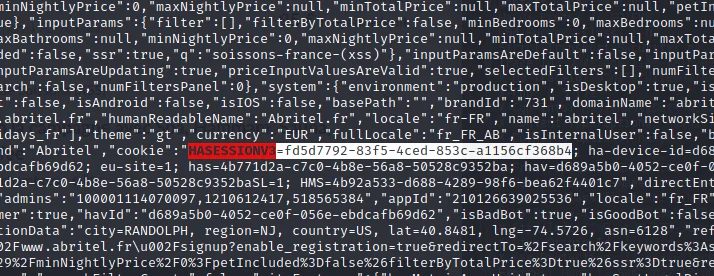
2-> use the token
GET /traveler/profile/edit HTTP/2
Host: www.abritel.fr
Cookie: HASESSIONV3=<use the token here>
User-Agent: Mozilla/5.0 (X11; Linux x86_64; rv:78.0) Gecko/20100101 Firefox/78.0
Accept: text/html,application/xhtml+xml,application/xml;q=0.9,image/webp,*/*;q=0.8
Accept-Language: en-US,en;q=0.5
Accept-Encoding: gzip, deflate
Referer: https://www.abritel.fr/search/keywords:soissons-france-(xss)/minNightlyPrice/0?petIncluded=false&filterByTotalPrice=true&ssr=true
Upgrade-Insecure-Requests: 1
Te: trailers
and look for the ha.crumb variable in the response
Recommended Remediation Steps
- Add cache rules for certain all cacheable extensions
Impact
Account Takeover
Not written yet. The AI write-up for this report has not been written yet. The Original tab links to the source.
How it worked
Root cause
Likely the application reflected the session token in a page body and the cache treated URLs ending in an image extension as cacheable, so a victim's token was stored and served to others.
Impact
An attacker could take over a victim's account by reusing the leaked session token.
What the attacker needed
Victim visits a crafted URL; attacker requests the same URL
The fix
The team fixed it by removing the session token from all pages, and the reporter also recommends adding cache rules for cacheable extensions.
How it was found
- Victim visits the search URL ending in an image extension with a query string.
- Attacker requests the same URL from another browser or with curl and greps the response for the session token.
- Attacker reuses the captured session token in a request to the profile edit page.
- Attacker looks for the ha.crumb variable in the response.
Explained by bugbounty.wiki with AI from the original and checked against quotes from it; it can still be wrong. Read the original before relying on a detail.
Not written yet. The AI write-up for this report has not been written yet. The Original tab links to the source.
A website's cache is a shared copy of a page kept so it loads faster for everyone. Here the page included the visitor's secret login token, and the cache was tricked into storing it because the address ended in .jpeg. Anyone who then asked for that address got the stored copy, including the victim's login token, which let them act as the victim.
What is Cache bugs?
A cache and the origin disagree about a request, so a poisoned response is served to everyone or a private page is stored as public.