Specific Payload makes a Users Posts unavailable
A crafted markdown link containing HTML character references caused the server to return a 500 error when rendering a user's posts page. An attacker could post such content to make that user's posts unavailable to everyone, including the user themselves.

- Triaged in 10 hours
- Fixed in 6 days
- Paid in 6 days
- Disclosed after 9 months
Good Morning,
Like we talked about in the email, I'm reporting an issue that I've found that is possible, by crafting a specific payload, other users that try to access /posts of a user will face the 500 Internal Server Error issue, not only when they access the specific crafted post. With this, the posts of the user will be blocked for other users. This could cause other problems like people possibly doing this on other's accounts and blocking all their posts for other users or it could be chained with some other vulnerability in the future.
I found this issue when I was fuzzing with the markdown as I saw you guys were using Links, so trying some HTML encodings led me to the following payload: [PoC](()).
decoded will endup a invalid character)decoded will endup a).
With this, we can see that the markdown doesn't take our encoding very well which then causes a 500 Internal Server Error and blocks the Posts of any user to other users.
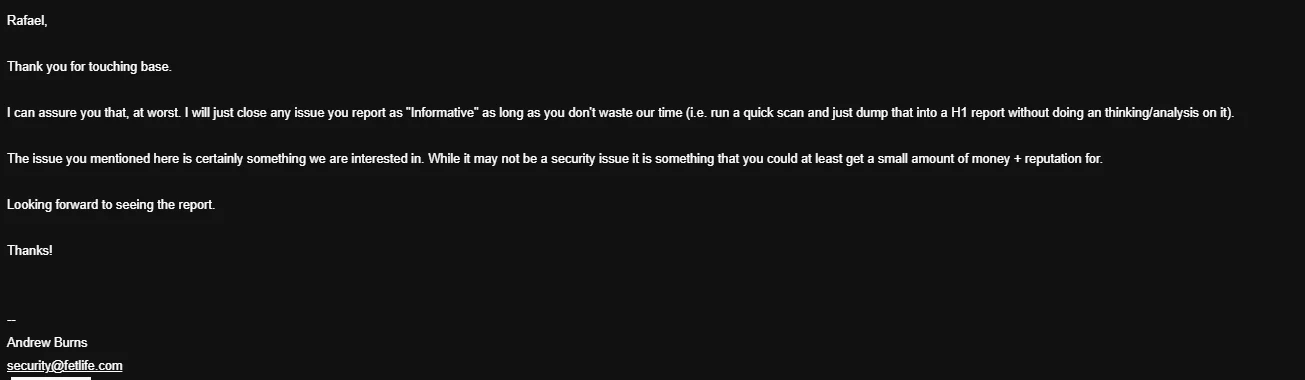
Proof that the Fetlife Security Team gave me the go-ahead to report this issue.
Steps to Reproduce
- Go to Write Post
- On the Body insert the following payload
[PoC](())
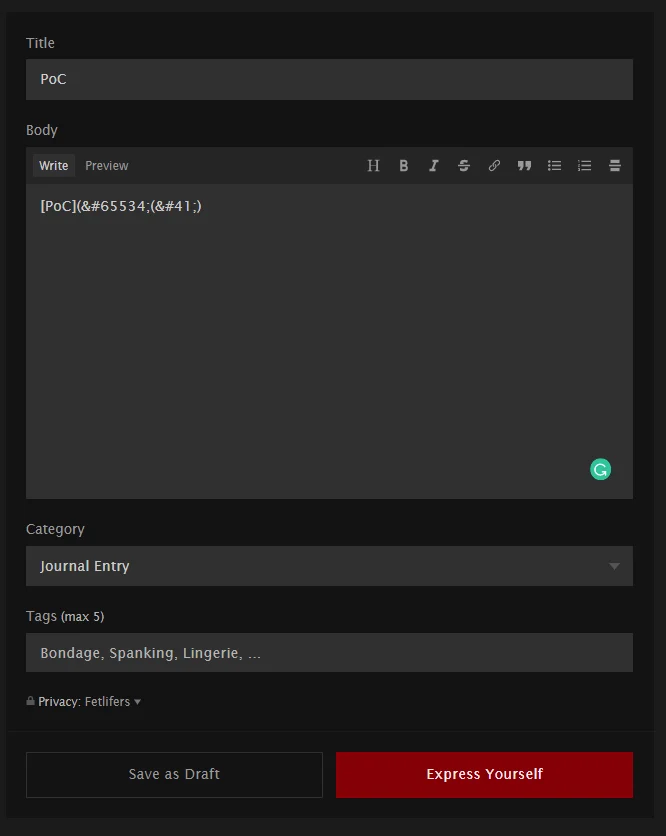
- Click on Express Yourself
- We are now faced with the 500 Internal Server Error and if we try to access https://fetlife.com/users/OUR_USER_ID/posts, we can see that our posts are completely blocked for us and everyone and that we're still faced with a 500 Internal Server Error.
Final
Thank you for your time, best regards, Rafael Castilho
Impact
This could cause other problems like people possibly doing this on other's accounts and blocking all their posts for other users or it could be chained with some other vulnerability in the future.
Context
FetLife is a social network, and the report concerns its post-writing feature. Users write posts through a Write Post form, with a Body field that accepts Markdown, and publish them with a button labelled Express Yourself. Published posts are reachable under a per-user path, https://fetlife.com/users/OUR_USER_ID/posts, where OUR_USER_ID is the numeric identifier of the account. The report treats that listing as the place where a user's posts are shown to other users.
The bug is that a single crafted post body can make that listing return 500 Internal Server Error for everyone, including the author, so the user's posts become unreachable.
Setup
The researcher was able to write posts. The only precondition for the attack is the ability to publish a post whose body contains the payload; no special role, tool or version is mentioned. The researcher had already discussed the issue with the FetLife Security Team by email and received permission to report it, and the report includes a screenshot of that authorisation.
The screenshot shows the email exchange in which the FetLife Security Team gave the go-ahead to report the issue.
Finding it
The researcher was fuzzing the Markdown handling after noticing that the platform uses Links in posts. Trying HTML encodings inside the Markdown link syntax led to a payload that breaks the rendering:
[PoC](())
Two numeric character references are involved:
decodes to U+FFFE, a noncharacter that the researcher links to as an invalid character.)decodes to).
The Markdown parser does not cope with these encodings in the link destination, and the result is a 500 Internal Server Error rather than a rendered post. The important part is that the failure is not confined to the crafted post: the whole /posts listing of the author goes down with it.
Exploitation
Step 1: open the post editor
Go to Write Post.
Step 2: insert the payload in the body
In the Body field, enter:
[PoC](())
The screenshot shows the post editor with the payload placed in the body field.
Step 3: publish
Click Express Yourself.
Step 4: observe the failure
The response is the 500 Internal Server Error. Visiting https://fetlife.com/users/OUR_USER_ID/posts then also returns a 500 Internal Server Error, for the author and for everyone else, so none of that user's posts can be reached through the listing.
Root cause
The report attributes the failure to the Markdown implementation not handling the HTML-encoded characters well: the numeric references  and ) are decoded inside the link destination, and the resulting input is not handled gracefully. The exact code path is not shown, and the report does not explain why the listing endpoint fails rather than only the single post.
Impact
A user who publishes this payload makes their own posts unavailable to other users, and to themselves, because the /posts page returns a server error. The researcher notes that the same technique could be used against other people's accounts, blocking all of their posts for other users, and that it could be chained with another vulnerability in the future. Both of those are stated as possibilities rather than demonstrated.
Fix
The report does not describe the change that was made.
Variants to test
Hunting notes
This kind of bug hides in user-generated content that is rendered as Markdown, especially where a link destination is parsed and decoded. The researcher showed impact by demonstrating that the author's entire /posts page returned a 500 for everyone, not just the crafted post, which is what turns a rendering error into a denial of the user's content.
What happened, in plain words
FetLife is a social network: a website where people create accounts and share things with each other. One of its features lets you write a post and publish it so that other people can read it. When you write a post, you type into a form called Write Post, and the main text box in that form is called the Body. The Body accepts a formatting language called Markdown, which is a simple way of writing text so that it comes out with links, bold words and so on. When you are ready, you press a button labelled Express Yourself to publish.
Every account has a page that lists all of that person's posts. The address of that page looks like https://fetlife.com/users/OUR_USER_ID/posts, where OUR_USER_ID is the number that identifies the account. Think of it like a shelf where all of someone's posts are lined up for visitors to browse.
The bug in this report is that one specially written post can break that shelf. If a user publishes a post whose Body contains a particular short piece of text, then the page that lists that user's posts stops working. Instead of showing the posts, it shows an error page called 500 Internal Server Error. That error means the web server tried to do its job and something went wrong on its side. The important part is that the error is not limited to the one strange post: the whole listing page fails, for the author and for everyone else, so none of that user's posts can be reached through it.
The setup
The researcher had an account that could write posts. Nothing else was needed: no special role, no special tool, no particular version of anything. The only precondition for the attack is being able to publish a post whose Body contains the payload.
Before writing the report, the researcher had already talked about the issue with the FetLife Security Team by email and had been given permission to report it. The report includes a screenshot of that authorisation.
The screenshot shows the email exchange in which the FetLife Security Team gave the go-ahead to report the issue.
How it was found
To understand the finding, it helps to know two ideas.
The first is fuzzing. Fuzzing means feeding a program lots of odd, unexpected or malformed input on purpose, to see whether any of it makes the program behave badly. It is a bit like trying random keys on a locked door to see if one of them jams the lock.
The second is HTML encoding, also called numeric character references. In HTML, the language web pages are written in, you can write a character either directly or as a code number. For example, ) is a way of writing the closing bracket ). The &# says "here comes a number", the number is the character's code, and the ; ends it. Browsers and other software decode these references, turning the number back into the character it stands for.
The researcher was fuzzing the Markdown handling after noticing that the platform uses Links in posts. Trying HTML encodings inside the Markdown link syntax led to a payload that breaks the rendering:
[PoC](())
Line by line, in plain words:
[PoC]is the visible text of a Markdown link. In Markdown, the words in square brackets are what the reader sees and clicks.(opens the part of a Markdown link that holds the destination, meaning the address the link points to.is a numeric character reference. Decoded, it becomes U+FFFE, a code point that the researcher links to as an invalid character. In other words, it is a number that does not correspond to a real, printable character.(is an ordinary opening bracket, written directly.)is another numeric character reference. Decoded, it becomes), a closing bracket.)closes the destination part of the Markdown link.
So the payload is a Markdown link whose destination contains encoded characters, one of which decodes to something that is not a valid character at all. The Markdown parser, the piece of software that turns Markdown into a finished web page, does not cope with these encodings in the link destination. Instead of producing a rendered post, it fails, and the result is a 500 Internal Server Error.
The crucial detail is that the failure is not confined to the crafted post. The whole /posts listing of the author goes down with it.
Walking through the attack
Step 1: open the post editor
Go to Write Post. This is the normal form any user uses to start a new post. The researcher starts here because the goal is to get the payload into a post that the platform will render.
Step 2: insert the payload in the body
In the Body field, enter:
[PoC](())
This is the same payload explained above. It goes in the Body because that is the field whose contents are treated as Markdown and rendered into a web page.
The screenshot shows the post editor with the payload placed in the body field.
Step 3: publish
Click Express Yourself. This is the button that submits the post and makes it visible. The researcher clicks it because the bug only shows up once the platform tries to render the post for display.
Step 4: observe the failure
The response is the 500 Internal Server Error. Visiting https://fetlife.com/users/OUR_USER_ID/posts then also returns a 500 Internal Server Error, for the author and for everyone else, so none of that user's posts can be reached through the listing.
In other words, the shelf that should show all of the user's posts now shows an error page instead. The author cannot see their own posts there, and neither can anyone else.
Why it happens
The report attributes the failure to the Markdown implementation not handling the HTML-encoded characters well. The numeric references  and ) are decoded inside the link destination, and the resulting input is not handled gracefully. The exact code path is not shown in the report, so the precise reason the listing endpoint fails rather than only the single post is not stated. A likely explanation is that the posts page renders the affected post as part of building the listing, and the rendering error propagates to the whole page, but that is an inference rather than something the report demonstrates.
What it means in practice
A user who publishes this payload makes their own posts unavailable to other users, and to themselves, because the /posts page returns a server error. The researcher notes that the same technique could be used against other people's accounts, blocking all of their posts for other users, and that it could be chained with another vulnerability in the future. Both of those are stated as possibilities rather than demonstrated.
How it could be fixed
The report does not describe the change that was made.
Other things worth trying
Where to look for bugs like this
This kind of bug hides in user-generated content that is rendered as Markdown, especially where a link destination is parsed and decoded. The researcher showed impact by demonstrating that the author's entire /posts page returned a 500 for everyone, not just the crafted post, which is what turns a rendering error into a denial of the user's content.
Glossary
-
Markdown: a simple way of writing text with light formatting symbols, such as square brackets for links, which software then turns into a formatted web page.
-
Payload: the specific piece of input, here a short piece of text, that triggers the bug.
-
Fuzzing: feeding a program lots of odd or malformed input on purpose to see whether any of it makes the program misbehave.
-
HTML encoding / numeric character reference: a way of writing a character in HTML as a code number, such as
)for), which software decodes back into the character. -
Parser: the piece of software that reads a format such as Markdown and works out what it means.
-
Rendering: turning stored text and formatting into the finished page a browser displays.
-
500 Internal Server Error: an error page meaning the web server tried to handle the request and something went wrong on its side.
-
Endpoint: a specific address or feature on a server that a request can be sent to, such as the posts listing page.
-
/postslisting: the page athttps://fetlife.com/users/OUR_USER_ID/poststhat shows all of a user's posts. -
OUR_USER_ID: the number that identifies a particular account in the address of its pages. -
Chained vulnerability: using one bug together with another to achieve something worse than either alone.
-
Recon: the early stage of exploring a target to understand what features and pages it has.


