Cross Site Scripting In Profile Statement
The profile statement field allowed a media placeholder that, when converted to HTML, produced an image tag whose source was not sanitised, so a data URL containing a script could be inserted. The program found that no browser executed the script while rendering the page; it only ran if a user right-clicked the element and chose to open it in a new tab, in a different origin, so cookies and same-origin requests were not exposed.

- Disclosed after 21 hours
Summary by the program
The researcher @muhaddimu found that during the conversion of {{media:0}} to HTML by misaka, the src field of the generated img tag is not sanitized. It allows the usage of sources like data:text/html;base64,PHNjcmlwdD5hbGVydCgnWFNTJyk8L3NjcmlwdD4K. While we were not able to find any browser interpreting this attribute while rendering the page (no alert windows is shown), it can be only triggered by doing a right click on the element and then choosing "Open in a new tab". By doing so, the browser interprets the javascript code in another context than gratipay.com—it's impossible to get user's cookies (in addition of the HttpOnly flag) or to make any XHR request to gratipay.com.
Since we can't find any direct security implication of this behaviour, this issue was not considered to be a security risk.
The report
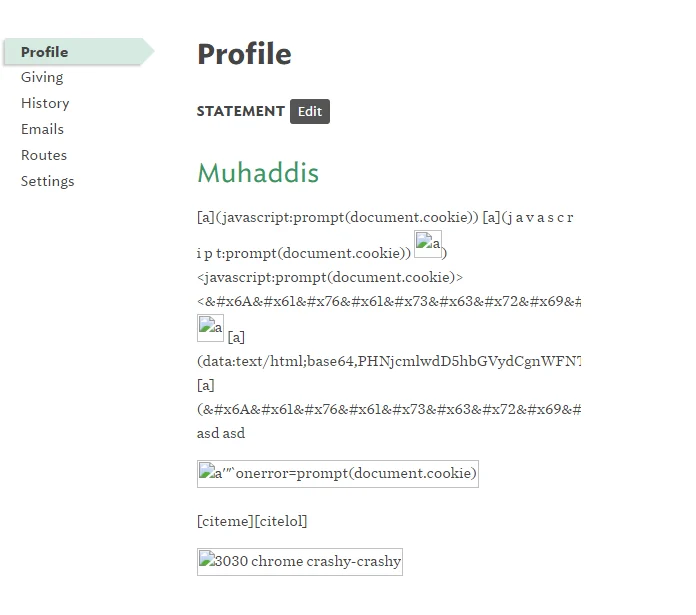
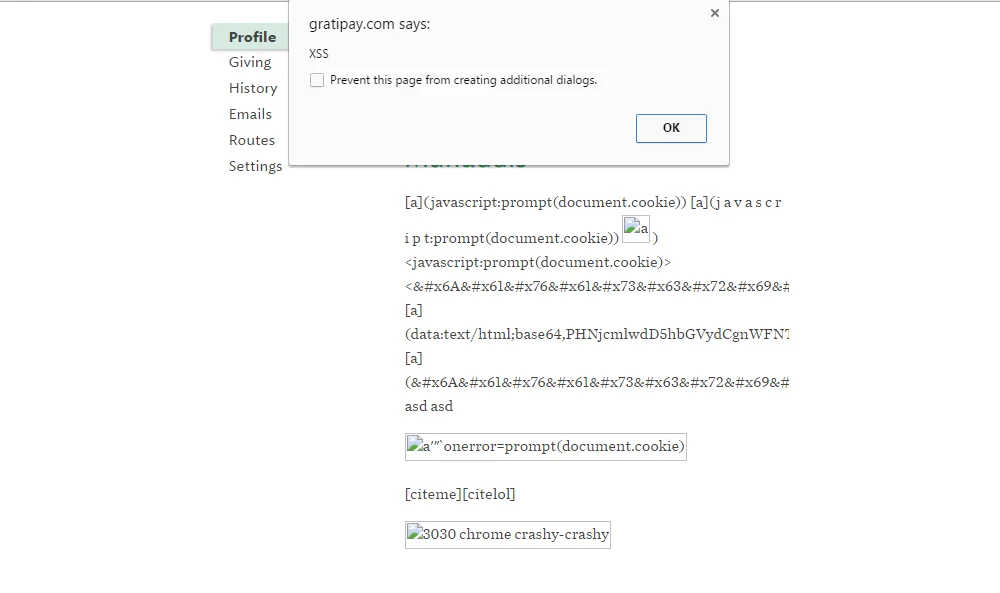
Hey Sir, I Have found Cross Site Scripting(XSS) Vulnerabilities in updating profile statement, This is Advance XSS Script, You can see it XSS-Gratipay.txt You can also see it live here: https://gratipay.com/~MuhaddiMu/
Steps to produce:
- Login To Your Account.
- Click on Edit Statement
- Copy and Paste the script I provided to you. 'F113916'
- Save Statement & see it again.
See Screenshots I uploaded. 'F113918' 'F113919'
User Agent: Chrome and some others Patching: Use Advance XSS Security
Thanks! Regards: Muhammad Muhaddis (Cyber Security Researcher)
Attachments
Not written yet. The AI write-up for this report has not been written yet. The Original tab links to the source.
How it worked
Impact
The script did not run while the page rendered; it could only be triggered by right-clicking the element and opening it in a new tab, where it ran in a different context and could not read cookies or make same-origin requests, so the program did not consider it a security risk.
What the attacker needed
A user account; victim right-clicks and opens in new tab
How it was found
- Log in to your account.
- Click on Edit Statement.
- Paste the provided script into the statement.
- Save the statement and view it again.
Explained by bugbounty.wiki with AI from the original and checked against quotes from it; it can still be wrong. Read the original before relying on a detail.
Not written yet. The AI write-up for this report has not been written yet. The Original tab links to the source.
A profile statement lets you add media, and the site turns a placeholder into an image tag. The address of that image was not checked, so someone could put a data URL that contains a script instead of a normal image link. The site owners found that browsers did not run that script on the page itself; it only ran if you right-clicked and opened the image in a new tab, which is a separate context and cannot read the site's cookies.
What is XSS?
Script an attacker supplies runs in another user's browser, on the target's origin, with that user's session.






