Open Redirect in <customer>.greenhouse.io
The job application form allowed the resume and cover letter URL parameters to be changed to any external site. An attacker could submit an application with a link to a phishing or malware site, which the hiring manager would then access when trying to download the file.

- Triaged in 8 hours
- Fixed in 4 months
- Paid in 4 months
- Disclosed after 5 months
Open Redirect in scout24.greenhouse.io
The Scout24 Security Team did a penetration test against scout24.greenhouse.io in order to verify how Scout24 relevant data is protected against common attack vectors. Basically we have tested the (web) application against OWASP Top 10 using industry common metholodogies.
Reproduction steps
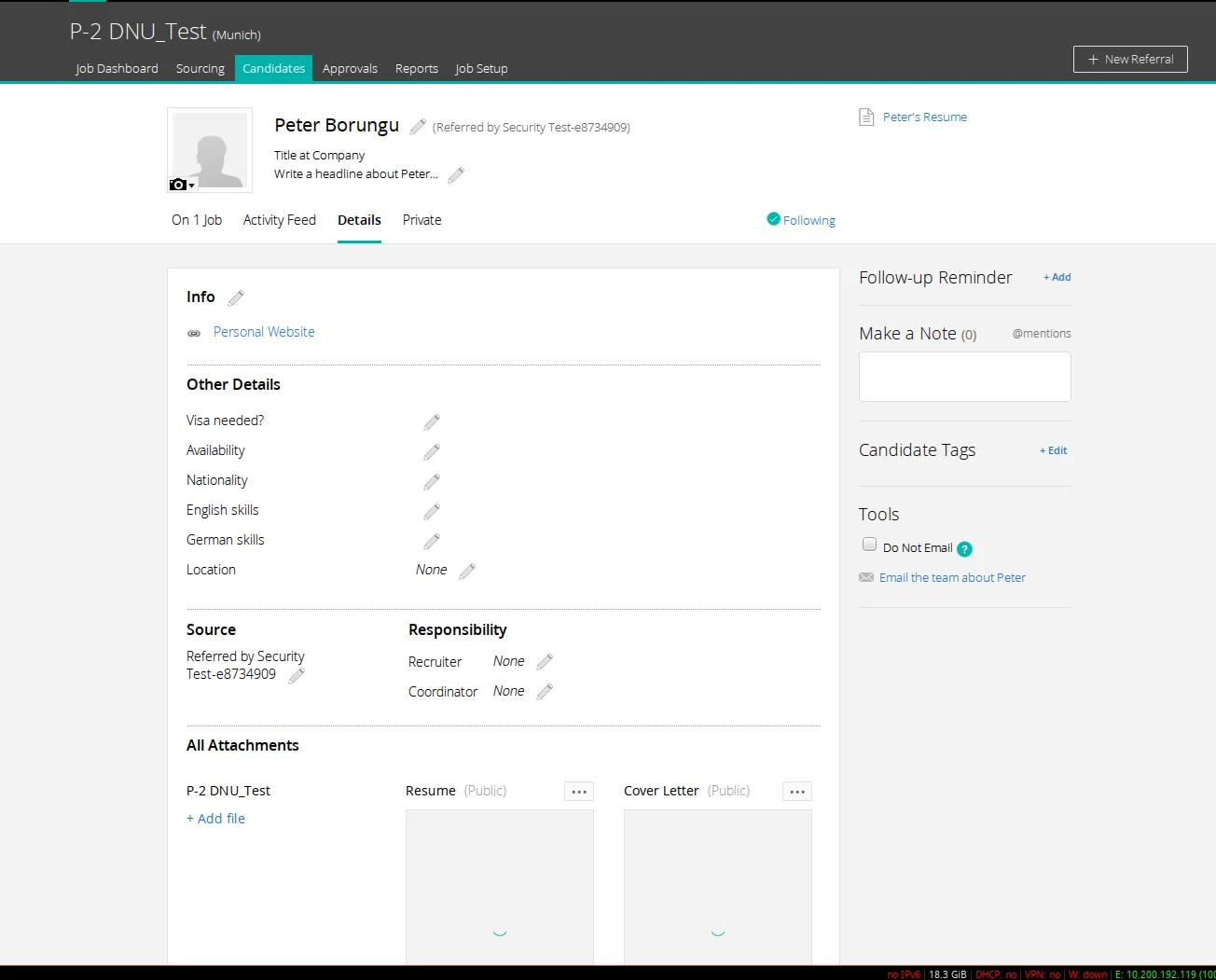
- Visit https://boards.greenhouse.io/scout24 and click on some job offer (I chosed this one)
- After completing your personal information, you can upload some documents
- Click
Attachboth under Resume/CV and Cover Letter - Upload some PDF files from your local host (in my case the file uwas called
neu.pdf)
- Click
- In the end you send your application by clicking on
Submit Application
Using a HTTP proxy (in my case that was Burp) I was able to intercept the POST request made by the browser before being sent to the greenhouse.io API. This is some sample request:
Proof-of-Concept (PoC)
POST /scout24/jobs/503488 HTTP/1.1
Host: boards.greenhouse.io
User-Agent: Mozilla/5.0 (X11; Ubuntu; Linux x86_64; rv:47.0) Gecko/20100101 Firefox/47.0
Accept: text/html, */*; q=0.01
Accept-Language: en-US,en;q=0.5
Accept-Encoding: gzip, deflate, br
X-NewRelic-ID: VQ4PWFNbGwIFU1dbAgcB
X-CSRF-Token: zF19Ky8GR0J/ZP7aLfFiN+p8Udc+X8ikPyk0cX7LlzgS0i4wWFIchmqcmsR3aXA0T1XSNrXSWdrVb47bGjGrEg==
X-Requested-With: XMLHttpRequest
Referer: https://boards.greenhouse.io/scout24/jobs/503488
Content-Length: 4086
Content-Type: multipart/form-data; boundary=---------------------------844282227400113298508475861
Cookie: __utma=44269810.1998188318.1484665255.1484837763.1484901247.18; __utmz=44269810.1484837763.17.11.utmcsr=scout24.eu.auth0.com|utmccn=(referral)|utmcmd=referral|utmcct=/login/callback; __zlcmid=edg9prI9rr6P3K; __utmc=44269810; __utmb=44269810.15.9.1484902626060; __atuvc=4%7C3; __atuvs=5881cd5b6c1ca704003; _jbs=7897bb31a3e984da1f15ec3b3f0e8129; __utmt=1
Connection: close

[...]
-----------------------------844282227400113298508475861
Content-Disposition: form-data; name="job_application[resume_url]"

https://grnhse-prod-jben-us-east-1.s3.amazonaws.com/applications%2Fresumes%2F1484902660983-1663bnwl7dt-b044057e6364840cde6c41d55de3a1e1%2Fneu.pdf
-----------------------------844282227400113298508475861
Content-Disposition: form-data; name="job_application[resume_url_filename]"

neu.pdf
-----------------------------844282227400113298508475861
Content-Disposition: form-data; name="job_application[cover_letter_url]"

https://grnhse-prod-jben-us-east-1.s3.amazonaws.com/applications%2Fresumes%2F1484902672335-lpk5xur1na-67346266367805828242f31b3887e539%2Fneu.pdf
-----------------------------844282227400113298508475861
Content-Disposition: form-data; name="job_application[cover_letter_url_filename]"

neu.pdf
-----------------------------844282227400113298508475861--
As you can notice the files have been already uploaded to AWS and therfore a S3 bucket links are
used within the requests.
Exploitability
Using a browser and a HTTP proxy the request can be easily intercepted. In the original request the Content-Disposition parameter job_application[cover_letter_url] in the POST request contains a S3 bucket link. However, after tampering the request, the parameters values can be changed. In our specific case the value (basically an URL) could be changed to:
- a phishing site
- a site containing some malware
After intercepting the request, the parameter was modified like this:
POST /scout24/jobs/503488 HTTP/1.1
Host: boards.greenhouse.io
User-Agent: Mozilla/5.0 (X11; Ubuntu; Linux x86_64; rv:47.0) Gecko/20100101 Firefox/47.0
Accept: text/html, */*; q=0.01
Accept-Language: en-US,en;q=0.5
Accept-Encoding: gzip, deflate, br
X-NewRelic-ID: VQ4PWFNbGwIFU1dbAgcB
X-CSRF-Token: zF19Ky8GR0J/ZP7aLfFiN+p8Udc+X8ikPyk0cX7LlzgS0i4wWFIchmqcmsR3aXA0T1XSNrXSWdrVb47bGjGrEg==
X-Requested-With: XMLHttpRequest
Referer: https://boards.greenhouse.io/scout24/jobs/503488
Content-Length: 4086
Content-Type: multipart/form-data; boundary=---------------------------844282227400113298508475861
Cookie: __utma=44269810.1998188318.1484665255.1484837763.1484901247.18; __utmz=44269810.1484837763.17.11.utmcsr=scout24.eu.auth0.com|utmccn=(referral)|utmcmd=referral|utmcct=/login/callback; __zlcmid=edg9prI9rr6P3K; __utmc=44269810; __utmb=44269810.15.9.1484902626060; __atuvc=4%7C3; __atuvs=5881cd5b6c1ca704003; _jbs=7897bb31a3e984da1f15ec3b3f0e8129; __utmt=1
Connection: close
[...]

-----------------------------844282227400113298508475861
Content-Disposition: form-data; name="job_application[resume_url]"

https://google.com
-----------------------------844282227400113298508475861
Content-Disposition: form-data; name="job_application[resume_url_filename]"

neu.pdf
-----------------------------844282227400113298508475861
Content-Disposition: form-data; name="job_application[cover_letter_url]"

http://google.com
-----------------------------844282227400113298508475861
Content-Disposition: form-data; name="job_application[cover_letter_url_filename]"
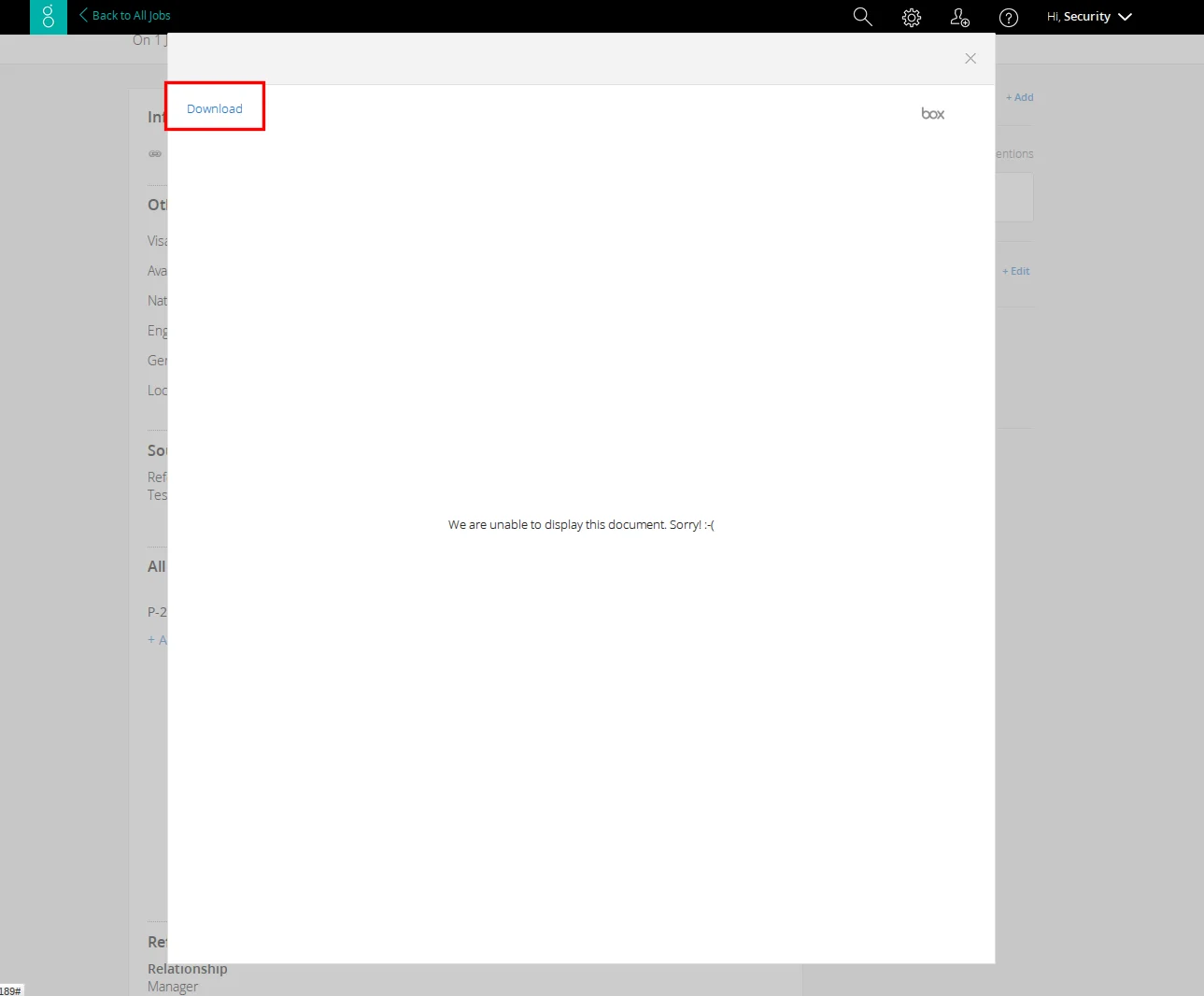
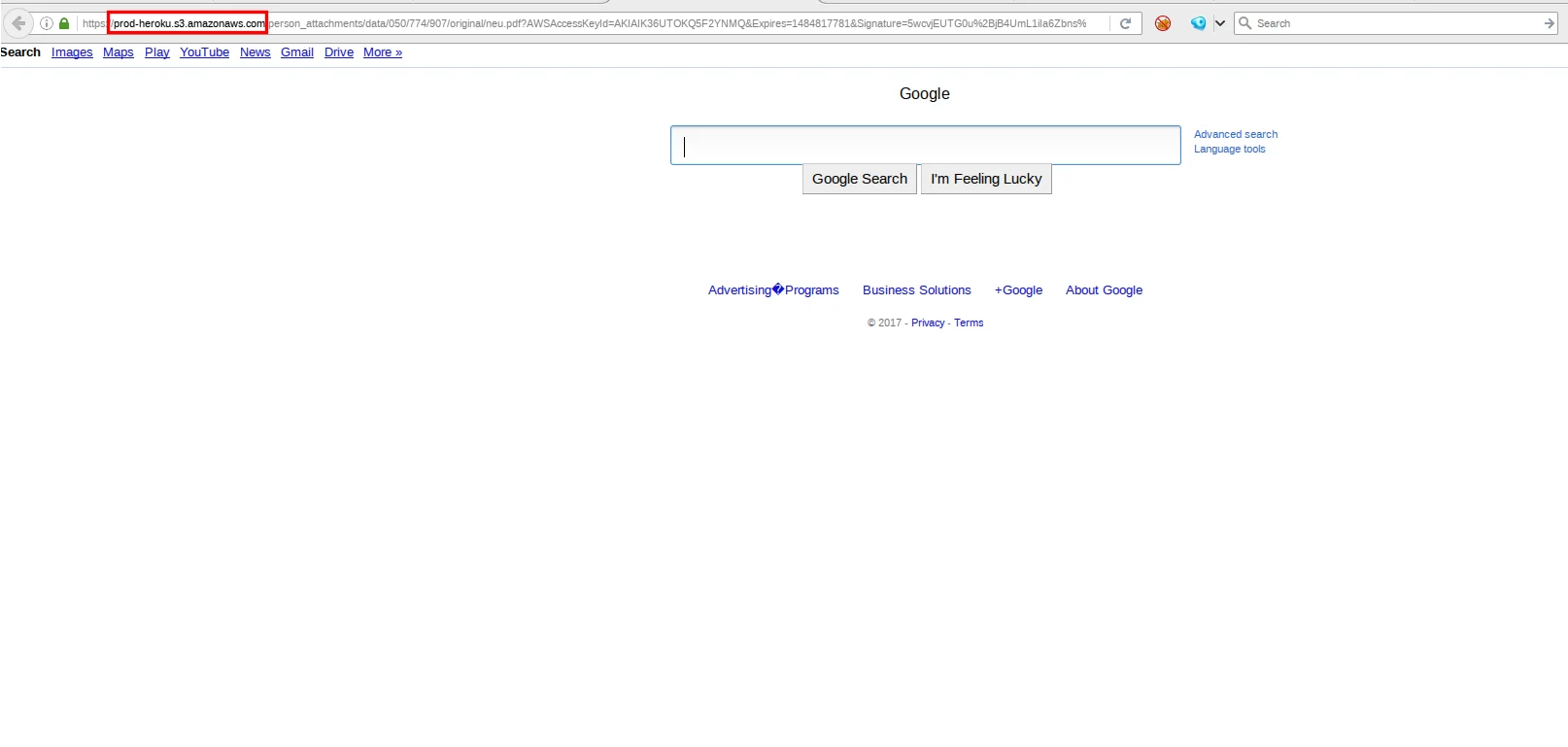
Whenever the hiring manager will try to view the uploaded content, the application will not be able to render the content. Instead the person will then try to download the file by clicking on Download (left upper corner). Although the browser shows that the URL points to some specific AWS domain, the content is actually loaded from somewhere else (in this case from https://google.com).
Again, an attacker could then submit some URL containing malicious content or some phishing site. Only for the purpose of this report, something unspectacular like https://google.com has been chosen.
Impact
The attack can be conducted in multiple scenarios:
- anonymous person applies for some jobs and manipulates the parameters (like described above)
- internal employee adds referal for some person and also manipulates the parameters
In both cases the hiring manager would then unknowingly access the manipulated links which could then lead to:
- installation of trojan horses / ransomeware (in general malicious content)
- a phishing site where e.g. AD credentials are claimed to be required
- CSRF (Cross-Site Request Forgery) attacks
Remediation
The affected parameter should be first validated against some regular expression (e.g. allow only links that point to grnhse-prod-jben-*.s3.amazonaws.com).
Attachments
Not written yet. The AI write-up for this report has not been written yet. The Original tab links to the source.
How it worked
Root cause
Likely the application accepted user-supplied URLs for uploaded files without validating that they pointed to the expected storage service.
Impact
A hiring manager could be tricked into visiting a phishing site or downloading malware, and the report also mentions possible CSRF attacks.
What the attacker needed
Ability to intercept HTTP requests; submit a job application
The fix
The affected parameter should be validated against a regular expression that only allows links to the expected S3 bucket domain.
How it was found
- Visit the job board and start an application for a job.
- Fill in personal information and upload PDF files for resume and cover letter.
- Submit the application while intercepting the request with a proxy.
- Modify the resume_url and cover_letter_url parameters to point to an external site.
- The modified request is sent on.
- When the hiring manager clicks download, the browser loads content from the external site.
Explained by bugbounty.wiki with AI from the original and checked against quotes from it; it can still be wrong. Read the original before relying on a detail.
Not written yet. The AI write-up for this report has not been written yet. The Original tab links to the source.
When you apply for a job online, you upload files like your CV. The website stores these files and gives them a link. This report found that the link could be swapped for a link to a bad website. So when the person reviewing your application clicked to download your CV, they were sent to the bad site instead.
What is Open redirect?
A trusted site forwards users to any address an attacker picks; rarely paid alone, often the missing link in a chain.




