3 Step IDOR in HackerResume
Several API endpoints on HackerResume trusted identifiers supplied by the client, so a user could read and modify other users' resumes and ATS boards. An attacker who knew a victim's shared resume link could recover the victim's user id, obtain a token for that user, and then read job-board data and add, move or delete stages.
 Published on medium.com
So to begin with, the story started when I was asked to test HackerResume since new features were being added on to see if there’s any security issues which can hamper the user data. So after going through the whole application it seemed most of the data we consider PII is already being public via the shared public…
The full write-up lives on its author's site
It belongs to its author, so we link to it rather than copy it. The other two tabs are our own rewrites, checked against it.
Context
HackerResume is a resume-building product at hackerresume.com. When a user creates a resume, the application offers two options: share it through a public link, or download it. The public link is served from a per-user subdomain and contains a unique hexadecimal path, for example:
https://username.hackerresume.io/1acf1368-2467-4d81-6216-50bce103bc8a
The application also has an ATS Board feature, where a candidate arranges the jobs they have applied to into stages and tracks their current status. The board supports CRUD operations: creating and deleting a stage, and adding a job into a particular stage.
The researcher was asked to test HackerResume because new features were being added, to see whether any security issue could affect user data. Going through the application, most of the data considered PII already appeared to be public through the shared public resume. The share/unshare feature is what prompted a deeper look.
The login page at https://hackerresume.com/auth/login, the starting point of the tested workflow.
Setup
The report does not describe the test accounts, roles or tool versions used. The work was done by following the application workflow and analysing all requests, with HTTP history reviewed in Burp Suite and request replay and brute-forcing done with Burp Intruder (the report refers to Intruder and shows a valid board number obtained from it).
Finding it
While going through the HTTP history tab in Burp, the researcher repeated requests with other users' ids in a trial-and-error manner. After quite a few trials, multiple endpoints were found that exposed other users' data. The remaining question was how to arrange the modified requests into a step-by-step exploit scenario.
The key observation was that the uid parameter value is what unlocks all the requests, and it is tricky to leak. The shareable resume link turned out to be the ladder: the hexadecimal value in the shared URL can be used in the vulnerable PUT request that updates the user's resume, and that request dumps the uid in the response. In other words, if a user's public resume link leaks, it can lead to a compromise of the user's account.
Exploitation
Step 1: leak the uid through the resume update request
Using the victim's hexadecimal value from the shared URL in the vulnerable PUT request that updates the user's resume returns the uid in the response.
PUT /api/user/attacker_id/resumes/victims_hex_value
The response discloses the victim's uid.
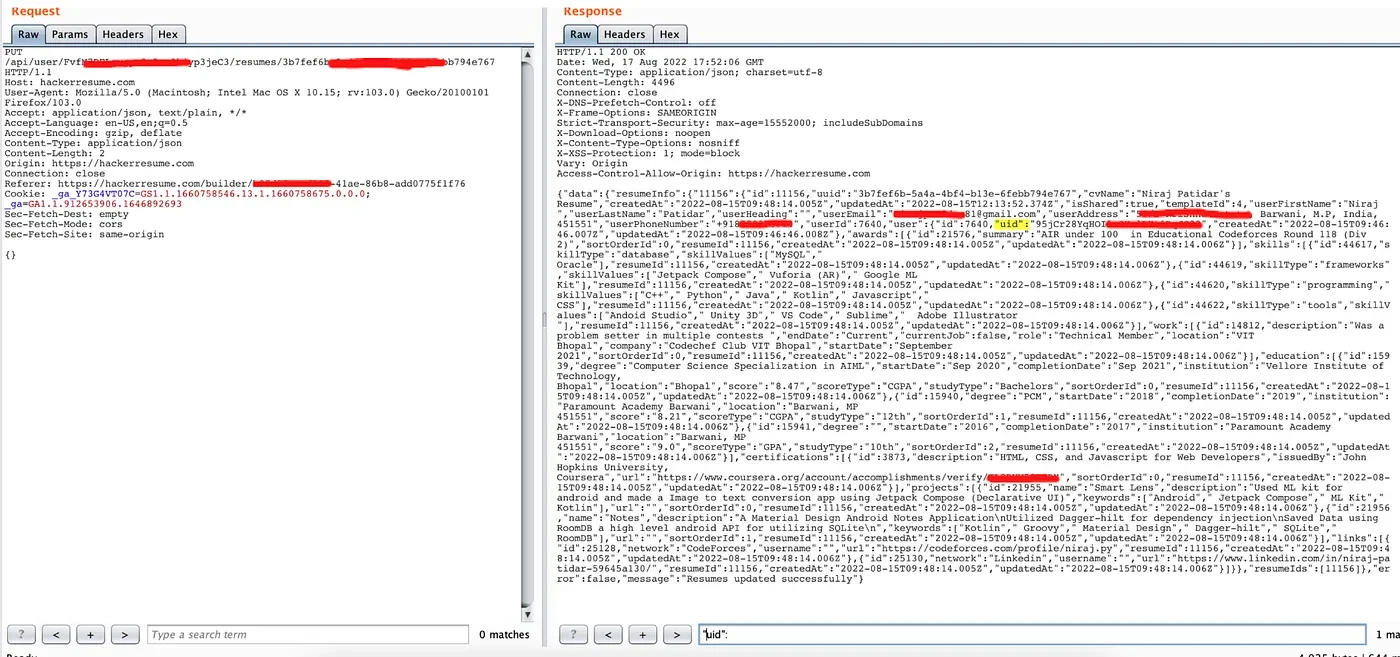
The vulnerable PUT request as captured, showing the request that dumps the uid in the response.
Step 2: obtain an Authorization header value
The ATS Board holds all the candidate's details, including the jobs they have arranged and their current status. Accessing it has one more barrier: the request carries an Authorization header. The researcher had already analysed requests across all features and found an auth token generation request that produces the value for that header.
POST /api/token HTTP/1.1Host: hackerresume.comCookie: pamaram=value{"uid":"RUsn78di7V6TCdbUB5878snBH"}
With the output of this request, the board request could be replayed for the victim user. To guess the victim's board, the request only needs to be brute-forced until a valid board number is returned.
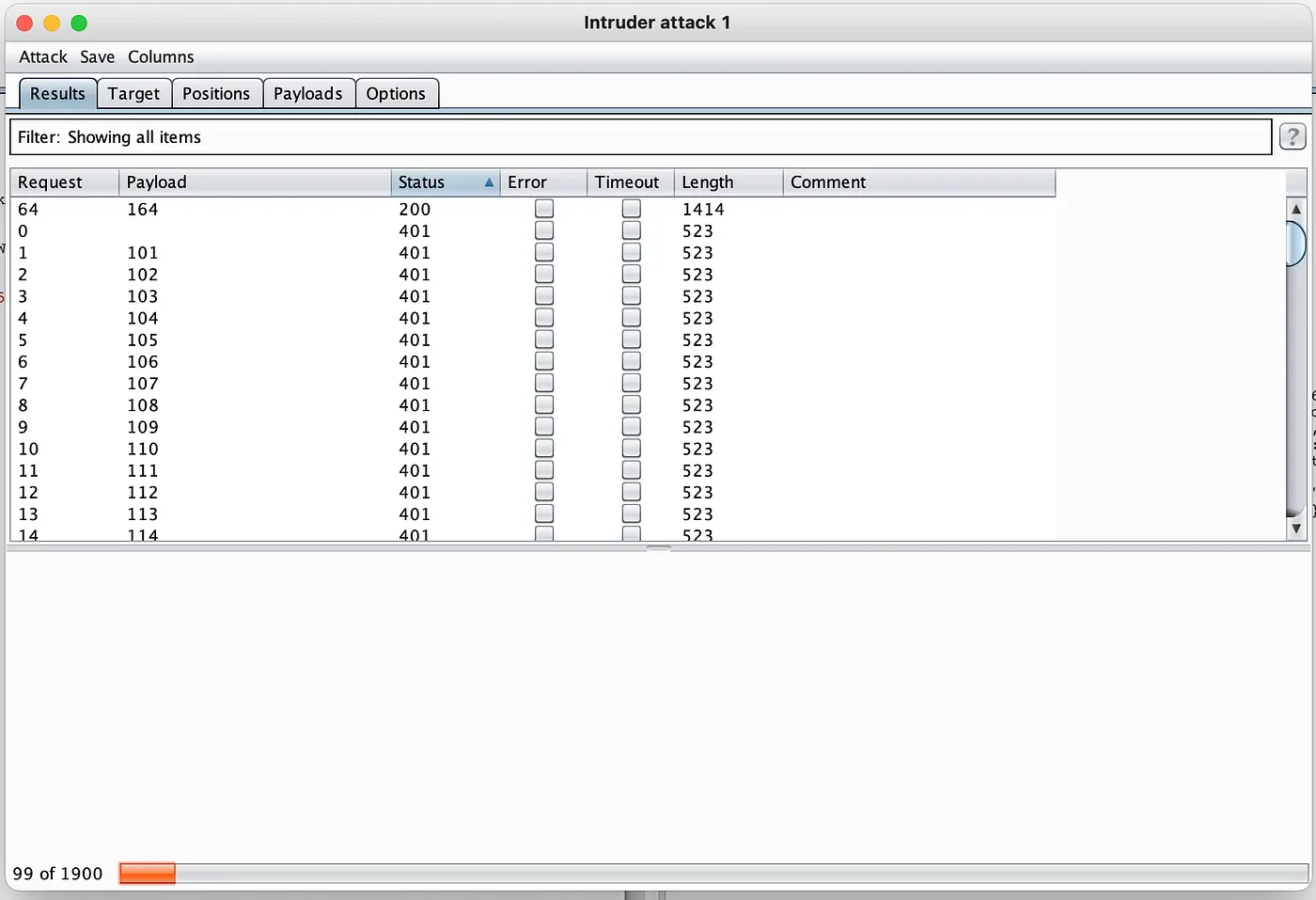
A valid board number obtained from Intruder during the brute-force.
Step 3: read the victim's ATS Board
Replaying the request with the victim's board number returns the victim's ATS Board data, including the signup email used to create the HackerResume account.
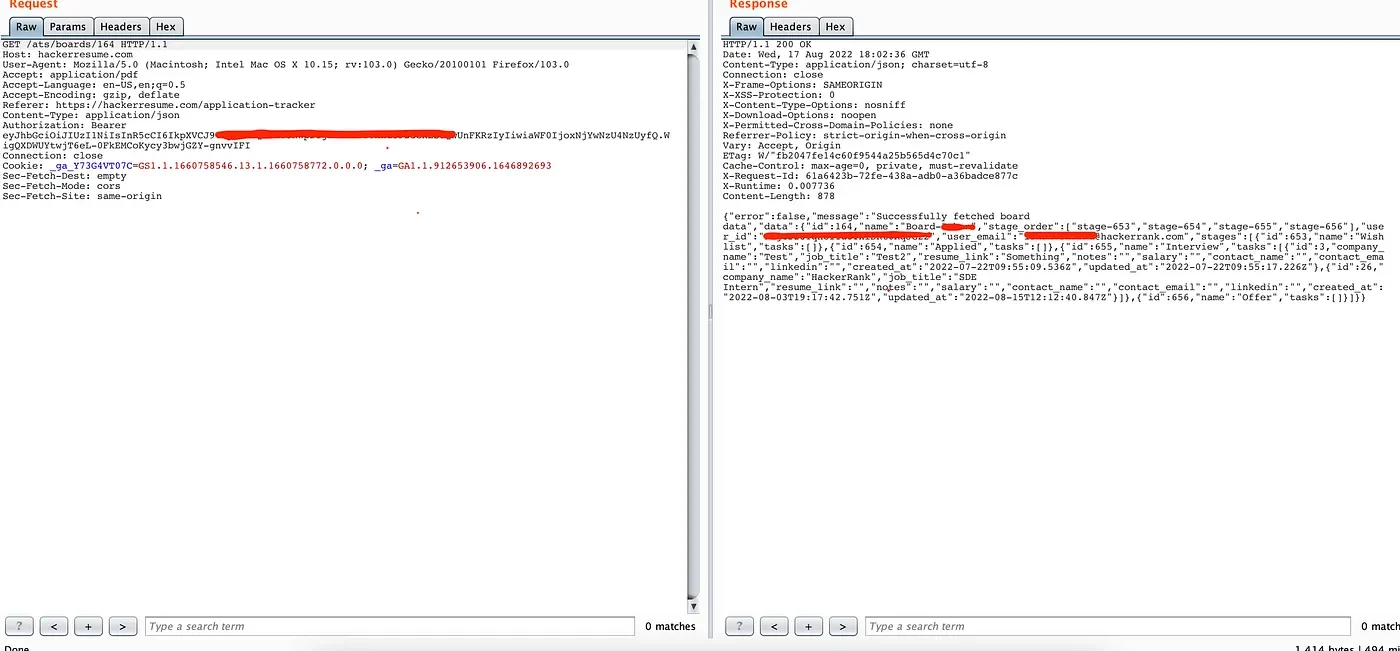
The victim's ATS Board data together with the signup email used for the HackerResume account.
Step 4: IDOR in the ATS Board to move jobs
With the board reachable, the researcher moved on to its CRUD operations and asked how the same actions could be performed on a victim's board remotely. The same trial-and-error method was applied, tampering with parameters in all PUT, POST and DELETE requests, and within a few attempts the vulnerable parameters were identified.
The first is stage_id: an attacker was able to move their own job (task) from their own ATS board to the victim's ATS board.
PUT /ats/tasks/283 HTTP/1.1Host: hackerresume.comAuthorization: Bearer JWT{"company_name":"Facebook","job_title":"Data Scientist","resume_link":"ufivie","notes":"evievievk bso3o","salary":"","contact_name":"","contact_email":"","linkedin":"","board_id":"1926","stage_id":"70666"}
Step 5: IDOR to add a new stage
An attacker was able to replay the following request with the board_id changed to the victim's id and publish a new stage named hacked in the victim's ATS Board. The user_id and user_email parameters were not validated while the request was processed in the back end.
POST /ats/stages HTTP/1.1Host: hackerresume.comAuthorization: Bearer JWT{"name":"hacked","board_id":"1026","user_id":"RUbkHekbYC26vGlSf7L","user_email":"[redacted]"}
Step 6: IDOR to delete a stage
An attacker was able to delete another user's stage by using a valid stage id. Because the stage id is numeric, it was easy to brute-force and delete all the existing stages.
DELETE /ats/stages/1234 HTTP/1.1Host: hackerresume.comAuthorization: Bearer JWT
Root cause
The chain rests on identifiers being accepted from the client without being tied to the authenticated user. The resume update request takes a resume identifier from the path and returns the owner's uid; the token request accepts a uid in the body; the token request accepts a uid in the body; and the ATS stage and task requests accept board_id, stage_id, user_id and user_email from the request body without checking that they belong to the caller. The developer's fix confirms this reading for the resume request: a check for user_id against the resume_id was added so that the request is validated as coming from the intended user only. The report does not describe any other defence that was in place.
Impact
Under the condition that a user's public resume link leaks to an attacker, the hexadecimal path in that URL allows the attacker to obtain the victim's uid and then, using a token generated for that uid, read the victim's ATS Board data, including the signup email. Beyond reading, an attacker could move their own job onto a victim's board, publish a new stage named hacked on a victim's board, and, because stage ids are numeric, brute-force and delete all of a victim's existing stages. The report does not assign a severity or CVSS score.
Fix
The issue was reported to the developer, who understood the root cause and applied a fix that reached production within an hour. The pull request was a two-line code change: a check for user_id together with the resume_id, validating that the request comes from the intended user only.
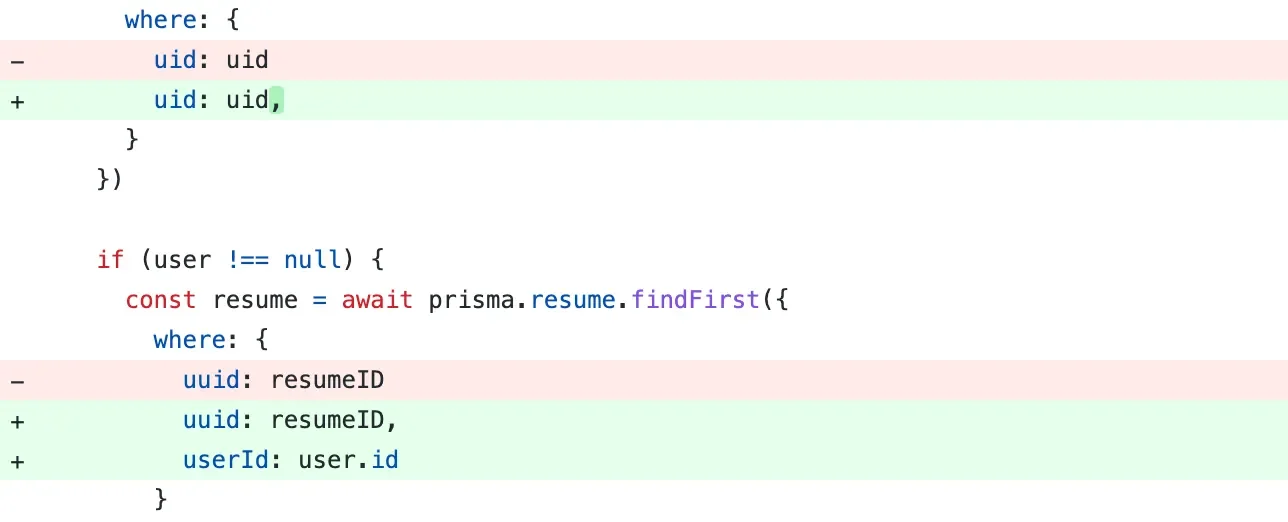
The fixed code, showing the check of user_id against resume_id.
Variants to test
- Public share links as an identifier source. Take any feature that publishes content under a random path and try that path's identifier in API calls that update or fetch the same object. A positive result is a response containing internal identifiers such as a uid or data belonging to another account.
- Token endpoints that accept a user identifier. Send the token request with another user's identifier in the body and see whether a usable token comes back. A positive result is a token that authenticates requests as that user.
- Numeric board or collection ids. Replay a read request while iterating the numeric id. A positive result is another user's board data, including profile details such as the signup email.
- Body parameters that name an owner. In create and update requests, change board_id, stage_id, user_id or user_email to another user's values. A positive result is a new or modified object appearing on the other user's board.
- Numeric child ids on DELETE. Iterate numeric stage or task ids in DELETE requests. A positive result is the removal of objects belonging to other accounts.
What happened, in plain words
HackerResume is a website that helps people build a CV (a resume). You sign up, fill in your details, and the site produces a resume for you. It also has a second feature called an ATS Board. ATS stands for Applicant Tracking System: it is the kind of software companies use to keep track of job applications. On HackerResume, the ATS Board lets a candidate arrange the jobs they have applied for into columns called stages (for example "applied", "interview", "offer") and move each job between those stages as it progresses.
A security researcher was asked to test HackerResume because new features were being added, and the team wanted to know whether any of them could put user data at risk. While exploring the site, the researcher noticed that most of the information people would consider private (their personal data, or PII, meaning personally identifiable information) was already visible through the public resume feature. That feature lets you share your resume through a public link, or download it instead. The share link is what made the researcher look more closely.
What the researcher found is a chain of bugs of a type called IDOR, which stands for Insecure Direct Object Reference. The idea is simple. Imagine a hotel where every room key is just a number written on a card, and the front desk never checks whether the card belongs to you. If your key says room 12, you can write 13 on it and walk into room 13. Nothing stops you, because the door only looks at the number, not at who you are. In a web application, an IDOR works the same way: the site takes an identifier (a number or code naming some object, like a resume, a board or a stage) straight from the request and acts on it without checking that the object belongs to the person making the request. Change the identifier, and you are acting on someone else's data.
In this case the chain started with a leaked public resume link, which gave the researcher a code that unlocked the victim's internal user id. A token generation request then produced a token for that user id. With the token, the researcher could read the victim's ATS Board, including the email address the victim signed up with, and could also add, move and delete things on the victim's board. The developer fixed the core issue within an hour of being told, with a two-line code change.
The login page at https://hackerresume.com/auth/login, where the tested workflow begins.
Some background before we start
A few everyday ideas will make the rest of this article much easier to follow.
What a web page really is. When you open a site in your browser, the browser sends a request to a server (a computer somewhere that runs the site) and the server sends back a response. The visible page is only part of it. Behind the page, the browser and the server exchange many smaller requests, mostly in a format called HTTP. Each request has a method (a verb saying what you want to do), a path (which thing you are talking about) and sometimes a body (extra data you are sending).
API. An API is the set of these behind-the-scenes requests that a website's own pages use to talk to its server. You never see them as a normal user, but your browser makes them constantly: loading your profile, saving a form, fetching a list. Think of the visible page as the shop counter and the API as the back corridor the staff use. If the corridor doors are not locked properly, a visitor who wanders back there can do things the counter would never allow.
HTTP methods. The common ones here are GET (fetch something), POST (create something), PUT (update something) and DELETE (remove something).
Cookie. A cookie is a small piece of text that a website asks your browser to store and send back with every request to that site. It is how a site remembers who you are between page loads, so you do not have to log in again on every click. Think of it as a wristband you get at the entrance of an event: you show it at every door and you are let through without re-checking your ticket.
Token. A token is similar in spirit but usually travels in a request header rather than a cookie. A header is a labelled line of extra information attached to a request, such as Authorization: Bearer JWT. The word Bearer means "whoever carries this token is treated as the logged-in user". A JWT is a JSON Web Token, a signed string that the server can check without looking anything up. If you can obtain a valid token for another person, the server will treat your requests as coming from that person.
Identifier. An identifier (often called an id) is the name a system gives to an object so it can find it again: a resume id, a board id, a stage id, a user id. Some are long random strings (hard to guess), some are short numbers (easy to guess by simply trying 1, 2, 3 and so on).
Brute-force. Brute-forcing means trying many values in a row automatically until one works, like trying every combination on a luggage lock. A tool called Burp Suite is commonly used for this: its Intruder feature sends the same request over and over with one part changed each time. Burp also keeps an HTTP history, a log of every request and response that passed through it, which is where the researcher in this story spotted the interesting requests.
PII. Personally identifiable information: data that identifies a real person, such as a name, an email address or a phone number.
CRUD. Create, Read, Update, Delete: the four basic things you can do to stored data. The ATS Board supports all four for stages and jobs.
With that in place, here is how the chain unfolded.
The starting point: the public share link
When a user creates a resume on HackerResume, they get two options: share it through a public link, or download it. The public link looks like this:
https://username.hackerresume.io/1acf1368-2467-4d81-6216-50bce103bc8a
Line by line, in plain words:
https://is the normal secure web protocol.username.hackerresume.iois a subdomain: a per-user address under the main site. The wordusernamestands for the account's own name./1acf1368-2467-4d81-6216-50bce103bc8ais a long random-looking code, written in hexadecimal (base 16, using the digits 0 to 9 and the letters a to f). It identifies this particular shared resume.
The researcher's reasoning was this: if a user's public link ever leaks (posted in a chat, indexed by a search engine, forwarded by mistake), an attacker holds that hexadecimal code. And because the code names the resume directly, it may be usable not only to view the resume but also in other requests that refer to the same resume. That is why the report calls the shared URL a ladder: it is the first rung that lets an attacker climb into the account.
Finding the chain
Going through the HTTP history in Burp, the researcher repeated requests with other users' ids, in a trial-and-error way. After quite a few trials, several endpoints (individual API addresses) turned out to expose other users' data. The remaining problem was not finding bugs but arranging the modified requests into a sensible step-by-step exploit: which request first, which next, and how one feeds the other.
The key observation was that a parameter called uid (the user id) is what unlocks all the requests, and it is tricky to obtain. The shareable resume link solved that: the hexadecimal value from the shared URL can be placed in the vulnerable PUT request that updates a user's resume, and that request returns the uid in its response. So a leaked public resume link is enough to start a chain that ends in a compromised account.
Step 1: leak the uid through the resume update request
The first request uses the victim's hexadecimal value from the shared URL in the PUT request that updates the user's resume. The response discloses the victim's uid.
PUT /api/user/attacker_id/resumes/victims_hex_value
Line by line:
PUTsays "update the thing named below"./api/is the prefix for the site's behind-the-scenes API.user/attacker_id/is the attacker's own user id. The attacker is logged in as themselves, so this part is legitimate.resumes/victims_hex_valueis the victim's resume, named by the hexadecimal code taken from the public share link.
The trick is the mismatch: the request is authenticated as the attacker, but the object it names belongs to the victim. The server should have checked that the resume in the path belongs to the logged-in user. It did not, and instead of simply updating, it returned the owner's uid in the response. That uid is the key to everything that follows.
The vulnerable PUT request as captured, showing the request that dumps the uid in the response.
Step 2: obtain an Authorization header value
The ATS Board holds all of the candidate's details: the jobs they have arranged and their current status. Reading it has one more barrier: the request must carry an Authorization header. The researcher had already looked through the requests used by every feature and found a token generation request that produces exactly that header value.
POST /api/token HTTP/1.1Host: hackerresume.comCookie: pamaram=value{"uid":"RUsn78di7V6TCdbUB5878snBH"}
Line by line:
POST /api/token HTTP/1.1asks the token endpoint to create a token.HTTP/1.1is the version of the protocol.Host: hackerresume.comsays which site the request is for. One server can host many sites, so the request names the one it wants.Cookie: pamaram=valueis the cookie the browser would send.pamaramis the cookie's name andvaluestands for its contents; the report shows it in that placeholder form.{"uid":"RUsn78di7V6TCdbUB5878snBH"}is the body: a small piece of JSON (a text format for structured data) naming a user id.
The important part is that the token endpoint accepts a uid in the body and issues a token for it. So once the attacker has the victim's uid from step 1, they can ask for a token that represents the victim. That token is what goes into the Authorization header of the next requests.
With that token, the board request could be replayed for the victim. To find the victim's board, the request only needs to be brute-forced until a valid board number comes back.
A valid board number obtained from Intruder during the brute-force.
Step 3: read the victim's ATS Board
Replaying the board request with the victim's board number returns the victim's ATS Board data, including the email address used to sign up for the HackerResume account.
The victim's ATS Board data together with the signup email used for the HackerResume account.
At this point the attacker can read the victim's job search: which companies they applied to, in what roles, and where each application stands.
Step 4: IDOR in the ATS Board to move jobs
With the board reachable, the researcher moved on to its CRUD operations and asked a natural next question: if I can read a victim's board, can I also perform the same actions on it remotely? The same trial-and-error method was applied, tampering with parameters in all PUT, POST and DELETE requests, and within a few attempts the vulnerable parameters were identified.
The first is stage_id. An attacker was able to move their own job (task) from their own ATS board onto the victim's ATS board.
PUT /ats/tasks/283 HTTP/1.1Host: hackerresume.comAuthorization: Bearer JWT{"company_name":"Facebook","job_title":"Data Scientist","resume_link":"ufivie","notes":"evievievk bso3o","salary":"","contact_name":"","contact_email":"","linkedin":"","board_id":"1926","stage_id":"70666"}
Line by line:
PUT /ats/tasks/283 HTTP/1.1updates task number 283. The number in the path names the task.Host: hackerresume.comnames the site.Authorization: Bearer JWTis the header carrying the token.JWTstands for the token value; the report shows it in that placeholder form.- The body is JSON describing the job:
company_name,job_title,resume_link,notes,salary,contact_name,contact_emailandlinkedinare the job's details. board_idsays which board the task belongs to, andstage_idsays which column on that board it sits in.
By changing stage_id, the attacker was able to move their own task onto the victim's board.
Step 5: IDOR to add a new stage
An attacker was able to replay the following request with the board_id changed to the victim's id and publish a new stage named hacked on the victim's ATS Board. The user_id and user_email parameters were not validated while the request was processed in the back end.
POST /ats/stages HTTP/1.1Host: hackerresume.comAuthorization: Bearer JWT{"name":"hacked","board_id":"1026","user_id":"RUbkHekbYC26vGlSf7L","user_email":"[redacted]"}
Line by line:
POST /ats/stages HTTP/1.1creates a new stage.Host: hackerresume.comnames the site.Authorization: Bearer JWTcarries the token."name":"hacked"is the name the new stage will have."board_id":"1026"says which board the stage goes on. Changing this to the victim's board id puts the stage on the victim's board."user_id"and"user_email"name the owner. They were not checked against the logged-in user, so the attacker could supply whatever values they liked.
The result is a new column called hacked appearing on someone else's board, which is both a data integrity problem and a visible sign to the victim that something is wrong.
Step 6: IDOR to delete a stage
An attacker was able to delete another user's stage by using a valid stage id. Because the stage id is numeric, it was easy to brute-force and delete all the existing stages.
DELETE /ats/stages/1234 HTTP/1.1Host: hackerresume.comAuthorization: Bearer JWT
Line by line:
DELETE /ats/stages/1234 HTTP/1.1deletes stage number 1234. The number is the only thing naming the target.Host: hackerresume.comnames the site.
There is no body at all: the whole request is the method, the path and the headers. Since stage ids are plain numbers, an attacker can simply walk through 1, 2, 3 and so on and delete every stage they find, including stages on other people's boards. This is the most destructive step of the chain.
Why it worked
The chain rests on identifiers being accepted from the client without being tied to the logged-in user. The resume update request takes a resume identifier from the path and returns the owner's uid. The token request accepts a uid in the body. The board request accepts a board number that can be guessed. The ATS stage and task requests accept board_id, stage_id, user_id and user_email from the body without checking that they belong to the caller. The developer's fix confirms this reading for the resume request: a check for user_id against the resume_id was added so that the request is validated as coming from the intended user only. The report does not describe any other defence that was in place.
What an attacker could do
If a user's public resume link leaks to an attacker, the hexadecimal path in that URL lets the attacker obtain the victim's uid. With a token generated for that uid, the attacker can read the victim's ATS Board data, including the signup email. Beyond reading, an attacker could move their own job onto a victim's board, publish a new stage named hacked on a victim's board, and, because stage ids are numeric, brute-force and delete all of a victim's existing stages. The report does not assign a severity or CVSS score.
The fix
The issue was reported to the developer, who understood the root cause and applied a fix that reached production within an hour. The pull request was a two-line code change: a check for user_id together with the resume_id, validating that the request comes from the intended user only.
The fixed code, showing the check of user_id against resume_id.
Things to try on other sites
These are the same patterns, written so you can recognise them elsewhere.
- Public share links as an identifier source. Take any feature that publishes content under a random path and try that path's identifier in API calls that update or fetch the same object. A positive result is a response containing internal identifiers such as a uid or data belonging to another account.
- Token endpoints that accept a user identifier. Send the token request with another user's identifier in the body and see whether a usable token comes back. A positive result is a token that authenticates requests as that user.
- Numeric board or collection ids. Replay a read request while iterating the numeric id. A positive result is another user's board data, including profile details such as the signup email.
- Body parameters that name an owner. In create and update requests, change board_id, stage_id, user_id or user_email to another user's values. A positive result is a new or modified object appearing on the other user's board.
- Numeric child ids on DELETE. Iterate numeric stage or task ids in DELETE requests. A positive result is the removal of objects belonging to other accounts.
Glossary
- API: the set of behind-the-scenes requests a website's pages use to talk to its server.
- ATS Board: Applicant Tracking System board, the feature where a candidate arranges applied-for jobs into stages and tracks their status.
- Authorization header: a labelled line attached to a request that carries proof of who is making it, here a token.
- Bearer: a word in the Authorization header meaning whoever carries the token is treated as the logged-in user.
- Brute-force: trying many values automatically in a row until one works.
- Burp Suite: a tool for intercepting, logging and replaying web requests; its Intruder feature automates repeated requests with one part changed.
- Cookie: a small piece of text a site asks your browser to store and send back with each request, used to remember who you are.
- CRUD: Create, Read, Update, Delete, the four basic operations on stored data.
- CVSS: a standard scoring system for the severity of a security issue.
- Endpoint: one specific API address that performs one action.
- Header: a labelled line of extra information attached to an HTTP request or response.
- Hexadecimal: base 16 numbering, using 0 to 9 and a to f, often used for random-looking identifiers.
- HTTP: the protocol browsers and servers use to exchange requests and responses.
- HTTP history: a log of requests and responses kept by an intercepting tool such as Burp.
- IDOR: Insecure Direct Object Reference, a bug where a site acts on an identifier supplied by the client without checking that the object belongs to that client.
- JSON: a text format for structured data, made of names and values in curly braces.
- JWT: JSON Web Token, a signed string a server can check without looking anything up.
- Parameter: a named value sent in a request, either in the path, the query string or the body.
- PII: Personally Identifiable Information, data that identifies a real person, such as a name or email address.
- Pull request (PR): a proposed code change submitted for review before it is merged.
- Response: what the server sends back after a request.
- Stage: a column on an ATS Board representing a step in the job application process.
- Subdomain: an address under a main site, such as
username.hackerresume.iounderhackerresume.io. - Token: a string that proves who you are to a server, usually sent in a header.
- uid: user id, the identifier a system uses for an account.
- Vulnerable: open to being misused by an attacker.



