Blockstack Browser For Mac leaks "Core API Password" to 3rd parties
The Blockstack Browser for Mac included the Core API Password in URL parameters, which leaked to third-party sites via the Referer header. An attacker who controls or can read logs from those sites could obtain the password and compromise Blockstack users.
 Originally disclosed on HackerOne
- Disclosed after 6.5 years
Hi Blockstack! 😃 I noticed that BlockStack Browser for Mac version is leaking the CoreAPIPassword via Referer Header to several websites:
- appco.imgix.net (a third party site!) F471236
- api.app.co (seems to have some blockstack affiliation?) F471235
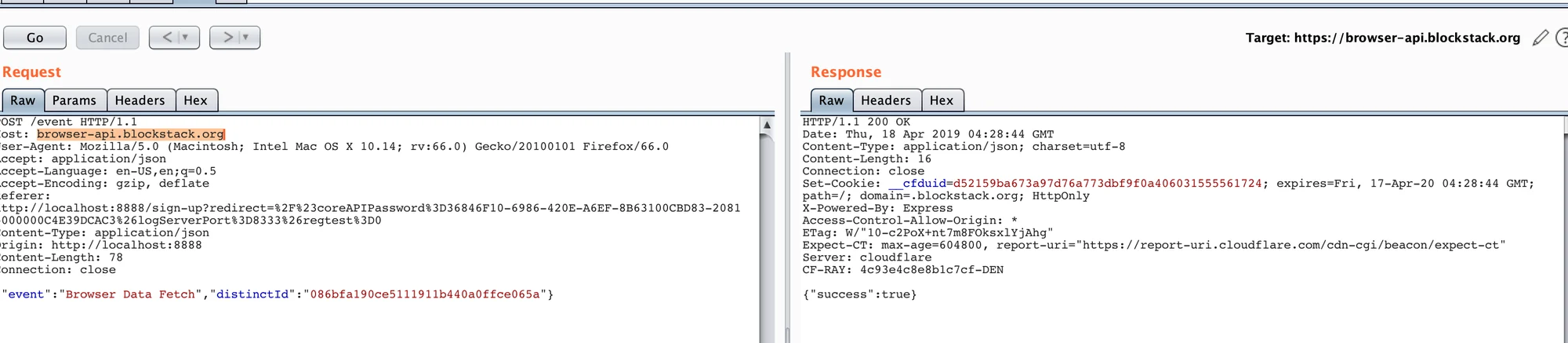
- browser-api.blockstack.org F471237
Steps to Reproduce:
- Download https://github.com/blockstack/blockstack-browser/releases/download/v0.36.1/Blockstack-for-macOS-v0.36.1.dmg
- Install the dmg
- Fire up a Proxy like BurpSuite
- Configure your browser to use Burpsuite as it's Proxy and remove the localhost/127.0.0.1 proxy exception so that ALL traffic destined for localhost is also passed through the proxy.
- launch the blockstack app. Visit http://localhost:8888/sign-up in your browser of choice (I tested with FireFox 66.0.3 64 bit) on Mac OS 10.14.4
- observe outbound connections to the 3 sites listed above.
To Resolve:
- Include a Referer-Policy header in BlockStack Browser to not leak the CoreAPIPassword. https://www.owasp.org/index.php/OWASP_Secure_Headers_Project#rp
- Better to Not pass sensitive data in URL params at all: full URL's are usually logged in plaintext LoadBalancer logs (you can confirm this by checking your Cloudflare or the access logs for browser-api.blockstack.org), Analytics and tracking services and sometimes in other unexpected places.
References:
- https://www.owasp.org/index.php/Information_exposure_through_query_strings_in_url
- https://www.owasp.org/index.php/OWASP_Secure_Headers_Project#rp
Impact
- compromise or accidental exposure of any of the sites, loadbalancer logs, or tracking services used on the listed sites would expose BlockStack users' CoreAPIPasswords.
- This leakage of the CoreAPIPassword contradicts public statements by a BlockStack Engineer regarding the CoreAPIPassword (https://forum.blockstack.org/t/seriously-blockstack-core-api-password-is-plaintext-in-api-settings/2272)
Attachments


Not written yet. The AI write-up for this report has not been written yet. The Original tab links to the source.
How it worked
Root cause
Likely the application passed the Core API Password as a URL parameter and did not set a Referrer-Policy header, so the password was included in the Referer header sent to third-party sites.
Impact
Exposure of the Core API Password could allow compromise of Blockstack users if any of the third-party sites, load balancer logs, or tracking services are breached or accidentally expose the data.
What the attacker needed
Blockstack Browser for Mac installed; User visits the sign-up page; Network traffic can be observed
The fix
The application should set a Referrer-Policy header and avoid passing sensitive data in URL parameters.
How it was found
- Download and install the Blockstack Browser for Mac.
- Set up a proxy such as Burp Suite and configure the browser to send all traffic, including localhost, through it.
- Launch the Blockstack app and visit the sign-up page at localhost:8888.
- Observe outbound connections to the listed third-party sites.
Explained by bugbounty.wiki with AI from the original and checked against quotes from it; it can still be wrong. Read the original before relying on a detail.
Not written yet. The AI write-up for this report has not been written yet. The Original tab links to the source.
The Blockstack Browser put a secret password in the web address (URL) it used. When the browser loaded content from other websites, it sent that full web address in a header called Referer, so those other sites could see the password. Anyone who could see those sites' logs or data could then use the password.
What is Info disclosure?
Data the application should keep private (personal data, internal details, other users' records) reaches someone it should not.



