Apache Airflow Fab Provider: Application does not invalidate session after password change via Airflow cli
When a user's password was changed through the Airflow command-line tool, the application did not clear that user's existing sessions. An attacker holding a stolen session could therefore stay logged in even after the password was reset.

- Fixed in 25 days
- Paid in 25 days
- Disclosed after 57 days
Summary by the program
nsufficient Session Expiration vulnerability in Apache Airflow Fab Provider.
This issue affects Apache Airflow Fab Provider: before 1.5.2.
When user password has been changed with admin CLI, the sessions for that user have not been cleared, leading to insufficient session expiration, thus logged users could continue to be logged in even after the password was changed. This only happened when the password was changed with CLI. The problem does not happen in case change was done with webserver thus this is different from CVE-2023-40273 which was addressed in Apache-Airflow 2.7.0
Users are recommended to upgrade to version 1.5.2, which fixes the issue.
https://github.com/advisories/GHSA-8863-4qmg-fr45
The report
When a user changes his password by visiting /resetmypassword form, the application terminates all the existing sessions. This is to defend against the attack scenario when a user believes his account is hacked and so changes the password to ensure that he/she is the only one knowing the password in case the old password was compromised or session-id was compromised let us say using an XSS attack and then the application logs out all users making sure the attacker is also logged out and the legitimate user can safely log back in using the new password. However it has been observed that the application fails to terminate existing sessions if the password change was done by airflow cli tool.
Allocated CVE: CVE-2024-45033
Advisory: https://github.com/advisories/GHSA-8863-4qmg-fr45
Pull request that fix the issue: https://github.com/apache/airflow/pull/45139
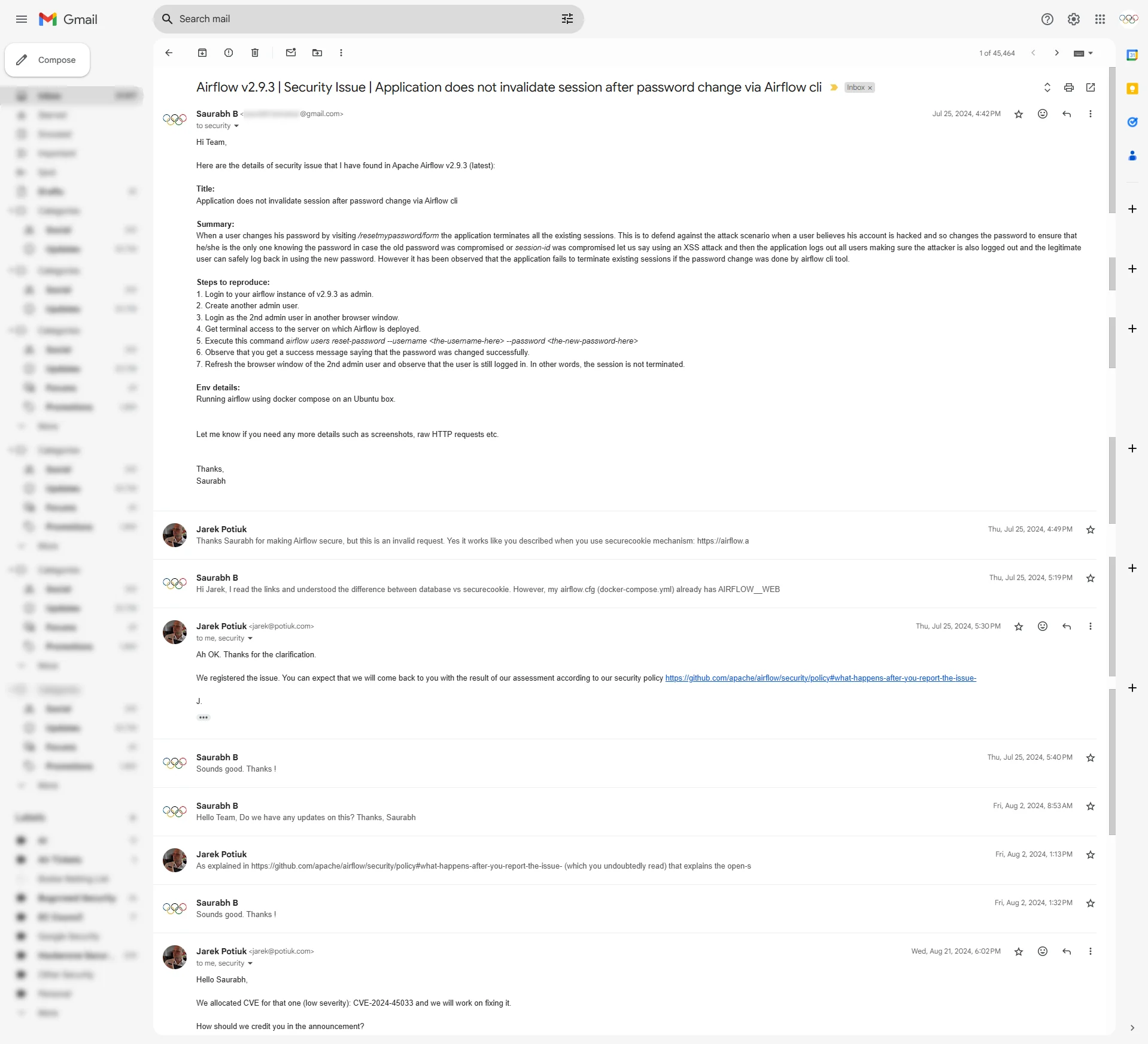
Email communication between me (reporter) and the security team of Apache Airflow:
Impact
Account takeover possibility due to insufficient session expiration vulnerability in Apache Airflow Fab Provider.
Context
Apache Airflow is a workflow orchestration platform, and the Fab Provider is the package that supplies its Flask AppBuilder (FAB) authentication layer: the login form, the user database, session handling and the password reset flow. The feature at the centre of this report is password change. When a user changes their password through the web form at /resetmypassword, the application is expected to terminate every existing session belonging to that user. The reasoning is straightforward: if a user suspects their account is compromised, either because the old password leaked or because a session identifier was stolen (for example through an XSS attack), changing the password should log the attacker out as well, so that only the legitimate user, holding the new password, can get back in.
The report shows that this termination does not happen when the password is changed through the Airflow CLI instead of the web form. The affected package is Apache Airflow Fab Provider before version 1.5.2. The issue was assigned CVE-2024-45033 and tracked in advisory GHSA-8863-4qmg-fr45.
Setup
The report does not describe a lab setup, test accounts, tooling or a specific Airflow version beyond the affected range.
- A user account exists in Airflow with at least one active session (a logged-in browser).
- The password for that account is changed using the Airflow CLI rather than the web interface.
- The previously established session is then reused.
The comparison case is the web flow: a password change submitted through /resetmypassword does clear sessions, and that behaviour is the baseline the researcher measured the CLI path against.
Finding it
The researcher started from the intended behaviour. Changing a password via the /resetmypassword form terminates all existing sessions for that user. This is a deliberate defence: it covers the scenario where the old password or the session identifier was compromised, and it guarantees that the attacker is logged out while the legitimate user can safely log back in with the new password.
Against that baseline, the researcher observed that the application fails to terminate existing sessions when the password change is performed with the Airflow CLI tool. The same security-relevant action, changing the password, produces two different session outcomes depending on which interface performed it. That inconsistency is what made the behaviour look wrong: the CLI path leaves sessions alive that the web path would have destroyed.
The report is explicit that this is distinct from CVE-2023-40273, which was addressed in Apache Airflow 2.7.0. That earlier problem concerned password changes made through the webserver; here the gap exists only on the CLI path, which is why the earlier fix does not cover it.
Exploitation
Step 1: Establish a session
A user logs in to Airflow normally and holds an active session. The report does not include the login request or any captured cookie, so there is nothing further to reproduce here beyond the fact that a valid session exists.
Step 2: Change the password through the CLI
The account's password is changed using the Airflow CLI. The report does not reproduce the exact command, so the precise invocation is not available from the text.
Step 3: Reuse the old session
After the CLI password change, the previously established session is still valid. The application has not cleared it, so whoever holds that session, whether the legitimate user or an attacker who captured the session identifier earlier, remains logged in. The report does not include a request or response demonstrating this reuse; the observation is stated as the finding itself.
Step 4: Compare with the web flow
For contrast, a password change submitted through the /resetmypassword form terminates all existing sessions for that user. The CLI path does not, and that difference is the vulnerability.
Root cause
The report frames the cause at the level of behaviour rather than code: the session invalidation logic that runs on the web password-change path is not triggered when the password is changed via the CLI. The existing defence, clearing sessions on password change, therefore only covers one of the two ways a password can be changed. The earlier fix for CVE-2023-40273 addressed the webserver path, and because the CLI path was not part of that fix, the gap remained until it was reported separately. The report does not show the code responsible, so the exact mechanism by which the CLI bypasses the invalidation is not stated.
Impact
Insufficient session expiration in Apache Airflow Fab Provider, with account takeover possibility as the stated impact. The condition is narrow: it applies only when the password is changed with the CLI, and not when the change is made through the webserver. Within that condition, a session established before the password change continues to be accepted afterwards, so a party holding that session keeps access to the account even though the password has been rotated. The platform records the severity as low.
Fix
Users are recommended to upgrade to Apache Airflow Fab Provider 1.5.2, which fixes the issue. The report links the pull request that implements the fix: https://github.com/apache/airflow/pull/45139. The advisory is GHSA-8863-4qmg-fr45, and the CVE is CVE-2024-45033.
Variants to test
- Change a password through every administrative interface a product exposes (CLI, management API, admin panel, database migration script) and then replay a session captured before the change. A positive result is that the old session still authenticates.
- Repeat the same test after a password reset performed by an administrator on behalf of another user, rather than by the user themselves. A positive result is that the target user's existing sessions survive the reset.
- Where a product has previously fixed session invalidation on one path (as with CVE-2023-40273 here), test the remaining paths specifically. A positive result is that the fix covers only the path named in the original advisory.
- Test session invalidation after other credential-affecting events, such as account disablement or role changes performed out of band. A positive result is that sessions outlive the change.
Hunting notes
This class of bug tends to hide wherever a security-relevant state change can be triggered from more than one entry point. The web handler is usually the one that was written with session hygiene in mind; CLI commands, background jobs, admin scripts and internal APIs are the ones that mutate the user record without going through the same code. During recon, look for products that document both a web password reset and a command-line user management tool, and for advisories that fixed session invalidation on one interface only, since those are strong signals that sibling paths were left open. The report contrasts the two paths directly: the web flow clears sessions, the CLI flow does not. That contrast, tied to a named CVE and a concrete affected version range, is what the report rests on.
The image shows the email exchange between the reporter and the Apache Airflow security team.
What happened, in plain words
Apache Airflow is a tool that runs and schedules automated jobs (called workflows). It has a web interface where people log in, and it also has a command-line tool (CLI) that administrators can use from a terminal. The Fab Provider is the part of Airflow that handles logging in: the login form, the list of users, the browser sessions and the password reset page.
When you log in to a website, the site gives your browser a small piece of data called a session. Think of it like a cloakroom ticket: the ticket itself is not your coat, but whoever holds the ticket can collect the coat. If someone steals your ticket, they can act as you without knowing your password. That is why a well-built site destroys all existing tickets when you change your password: if an attacker had stolen a ticket, changing the password makes the stolen ticket useless.
This report shows that Airflow did destroy sessions when the password was changed through the web form at /resetmypassword, but did not destroy them when the password was changed with the Airflow CLI. So an attacker who had stolen a session could keep using it even after the real user changed their password through the command line. The affected package is Apache Airflow Fab Provider before version 1.5.2. The issue was given the identifier CVE-2024-45033 and is described in advisory GHSA-8863-4qmg-fr45.
Context
The product and the feature
Apache Airflow is a workflow orchestration platform: it runs jobs on a schedule and lets people watch and manage them. The Fab Provider is the package that supplies its Flask AppBuilder (FAB) authentication layer. In plain terms, that package provides:
- the login form,
- the user database,
- session handling (the cloakroom tickets),
- the password reset flow.
The feature at the centre of the report is password change. When a user changes their password through the web form at /resetmypassword, the application is expected to terminate every existing session belonging to that user.
The reasoning is simple. If a user suspects their account is compromised, either because the old password leaked or because a session identifier was stolen (for example through an XSS attack), changing the password should log the attacker out as well. Only the legitimate user, who knows the new password, should be able to get back in.
What the report found
The report shows that this termination does not happen when the password is changed through the Airflow CLI instead of the web form. The issue was assigned CVE-2024-45033 and tracked in advisory GHSA-8863-4qmg-fr45.
Setup
The report does not describe a lab setup, test accounts, tooling or a specific Airflow version beyond the affected range.
- A user account exists in Airflow with at least one active session (a logged-in browser).
- The password for that account is changed using the Airflow CLI rather than the web interface.
- The previously established session is then reused.
The comparison case is the web flow: a password change submitted through /resetmypassword does clear sessions, and that behaviour is the baseline the researcher measured the CLI path against.
Finding it
The researcher started from the intended behaviour. Changing a password via the /resetmypassword form terminates all existing sessions for that user. This is a deliberate defence: it covers the scenario where the old password or the session identifier was compromised, and it guarantees that the attacker is logged out while the legitimate user can safely log back in with the new password.
Against that baseline, the researcher observed that the application fails to terminate existing sessions when the password change is performed with the Airflow CLI tool. The same security-relevant action, changing the password, produces two different session outcomes depending on which interface performed it. That inconsistency is what made the behaviour look wrong: the CLI path leaves sessions alive that the web path would have destroyed.
The report is explicit that this is distinct from CVE-2023-40273, which was addressed in Apache Airflow 2.7.0. That earlier problem concerned password changes made through the webserver; here the gap exists only on the CLI path, which is why the earlier fix does not cover it.
Exploitation
Step 1: Establish a session
A user logs in to Airflow normally and holds an active session. The report does not include the login request or any captured cookie, so there is nothing further to reproduce here beyond the fact that a valid session exists.
Step 2: Change the password through the CLI
The account's password is changed using the Airflow CLI. The report does not reproduce the exact command, so the precise invocation is not available from the text.
Step 3: Reuse the old session
After the CLI password change, the previously established session is still valid. The application has not cleared it, so whoever holds that session, whether the legitimate user or an attacker who captured the session identifier earlier, remains logged in. The report does not include a request or response demonstrating this reuse; the observation is stated as the finding itself.
Step 4: Compare with the web flow
For contrast, a password change submitted through the /resetmypassword form terminates all existing sessions for that user. The CLI path does not, and that difference is the vulnerability.
Root cause
The report frames the cause at the level of behaviour rather than code: the session invalidation logic that runs on the web password-change path is not triggered when the password is changed via the CLI. The existing defence, clearing sessions on password change, therefore only covers one of the two ways a password can be changed. The earlier fix for CVE-2023-40273 addressed the webserver path, and because the CLI path was not part of that fix, the gap remained until it was reported separately. The report does not show the code responsible, so the exact mechanism by which the CLI bypasses the invalidation is not stated.
Impact
Insufficient session expiration in Apache Airflow Fab Provider, with account takeover possibility as the stated impact. The condition is narrow: it applies only when the password is changed with the CLI, and not when the change is made through the webserver. Within that condition, a session established before the password change continues to be accepted afterwards, so a party holding that session keeps access to the account even though the password has been rotated. The platform records the severity as low.
Fix
Users are recommended to upgrade to Apache Airflow Fab Provider 1.5.2, which fixes the issue. The report links the pull request that implements the fix: https://github.com/apache/airflow/pull/45139. The advisory is GHSA-8863-4qmg-fr45, and the CVE is CVE-2024-45033.
Variants to test
- Change a password through every administrative interface a product exposes (CLI, management API, admin panel, database migration script) and then replay a session captured before the change. A positive result is that the old session still authenticates.
- Repeat the same test after a password reset performed by an administrator on behalf of another user, rather than by the user themselves. A positive result is that the target user's existing sessions survive the reset.
- Where a product has previously fixed session invalidation on one path (as with CVE-2023-40273 here), test the remaining paths specifically. A positive result is that the fix covers only the path named in the original advisory.
- Test session invalidation after other credential-affecting events, such as account disablement or role changes performed out of band. A positive result is that sessions outlive the change.
Hunting notes
This class of bug tends to hide wherever a security-relevant state change can be triggered from more than one entry point. The web handler is usually the one that was written with session hygiene in mind; CLI commands, background jobs, admin scripts and internal APIs are the ones that mutate the user record without going through the same code. During recon, look for products that document both a web password reset and a command-line user management tool, and for advisories that fixed session invalidation on one interface only, since those are strong signals that sibling paths were left open. The report contrasts the two paths directly: the web flow clears sessions, the CLI flow does not. That contrast, tied to a named CVE and a concrete affected version range, is what the report rests on.
The image shows the email exchange between the reporter and the Apache Airflow security team.
Glossary
- Apache Airflow: a workflow orchestration platform that runs and schedules automated jobs.
- Fab Provider: the package that supplies Airflow's Flask AppBuilder (FAB) authentication layer, including the login form, user database, session handling and password reset flow.
- Flask AppBuilder (FAB): a framework used by Airflow to build its web interface and handle authentication.
- Session: a small piece of data a website gives your browser after you log in, so the site can recognise you on later requests. Like a cloakroom ticket.
- Session identifier: the value inside a session that identifies you; if stolen, it can be used to act as you.
- Session expiration: the process of ending a session so it can no longer be used.
- Insufficient session expiration: a vulnerability where a session is not ended when it should be, for example after a password change.
- Password change: the act of replacing an account's password with a new one.
- CLI (command-line interface): a way to run commands by typing them in a terminal, as opposed to clicking in a web page.
- Web form: the part of a web page where you type information and submit it, such as the
/resetmypasswordpage. /resetmypassword: the web address of the password reset form in Airflow.- XSS attack: cross-site scripting, a way for an attacker to run their own code in another user's browser, sometimes used to steal session identifiers.
- CVE: Common Vulnerabilities and Exposures, a public identifier for a known security flaw.
- Advisory: a public notice describing a security flaw and how to fix it.
- GHSA: GitHub Security Advisory, an identifier for advisories published on GitHub.
- Account takeover: when an attacker gains control of another person's account.
- Severity: a rating of how serious a vulnerability is; here it is recorded as low.
- Pull request: a proposed change to a codebase that can be reviewed and merged.
- Recon: the information-gathering phase of security testing, where you learn how a product works before trying to break it.
- Management API: a programmatic interface for administering a product, often used by scripts rather than people.
- Admin panel: a web page for administrators to manage users and settings.
- Database migration script: a script that changes the structure or contents of a database.
- Out of band: through a different channel than the usual one, for example a script rather than the web interface.





