Let's Dance in the Cache - Destabilizing Hash Table on Microsoft IIS!
Three flaws were found in Microsoft IIS: a hash-flooding denial of service that could make a default server unresponsive, a cache poisoning issue caused by inconsistent query string parsing between IIS and ASP.NET, and an authentication bypass where a key-comparison function compared the username twice instead of the password. The bypass let an attacker reuse another user's cached token with a random password, though a hash collision was needed.
 Published on blog.orange.tw
Hi, this is my fifth time speaking at Black Hat USA and DEFCON. You can get the slide copy and video there:
The full write-up lives on its author's site
It belongs to its author, so we link to it rather than copy it. The other two tabs are our own rewrites, checked against it.
Context
This research looks at the hash table implementation inside Microsoft IIS and at how IIS uses hash tables in its caching mechanisms. Hash tables are everywhere in computer infrastructure, in operating systems, programming languages, databases and web servers, and Microsoft has shipped its own hash table algorithm since a very early stage, applying it heavily in IIS. Because IIS does not release its source code, the implementation details of that algorithm are a largely unexplored area, which is where this work focuses: the hash table itself and its usage, with particular attention to the cache, since most of the hash table usages in IIS are cache-related.
The research produced three vulnerabilities, all reported responsibly to Microsoft and patched in July 2022:
| CVE | Description |
|---|---|
| CVE-2022-22025 | Microsoft IIS Hash-Flooding DoS |
| CVE-2022-22040 | Microsoft IIS Cache Poisoning Attack |
| CVE-2022-30209 | Microsoft IIS Authentication Bypass |
The full technical detail lives in the Black Hat USA and DEFCON talk slides and video; this write-up is deliberately brief.
Setup
For the authentication bypass, the smallest reproduction needs a testing account and Basic Authentication configured on your IIS. Basic Authentication is one of the password-based authentication methods whose tokens IIS caches by default, because a logon is an expensive operation and caching improves performance. The attacker side needs nothing more than a terminal from which to send login attempts.
Finding it
Hash-flooding in 2022
Seeing a classic algorithmic complexity attack such as hash flooding against IIS in 2022 is surprising. Microsoft had configured a thread that deletes outdated records every 30 seconds to mitigate the attack. Even so, the researchers found a key-splitting bug in the implementation that amplifies the attacker's power by more than 10 times, enough to defeat that guardian by zero hashes. With it, a default installed IIS server can be made unresponsive with about 30 connections per second.
The Output Caching parser
Compared with other cache poisoning research, this bug is relatively plain. It sits in the Output Caching component, the module responsible for caching dynamic responses to reduce expensive database or filesystem access on web stacks. Output Caching uses a bad query string parser that only takes the first occurrence as the cache key when query string keys are duplicated. On its own that behaviour is not a problem. It becomes one in the context of the whole architecture with the backend, ASP.NET: the backend concatenates the value of all repeated keys together, which creates an inconsistency between the two parser behaviours. A classic HTTP parameter pollution therefore makes IIS cache the wrong result.
The key-comparing function
LKRHash is a hash table algorithm designed and patented by Microsoft in 1997. It is based on linear hashing and was created by Paul Larson of Microsoft Research, Murali Krishnan and George Reilly of the IIS team. It aims to build a scalable, highly concurrent hash table in multithreaded and multicore environments, and its creators made the implementation portable, flexible and customisable so it could adapt to multiple products across Microsoft. An application can define its own table-related functions, such as the hash function, the key extracting function and the key comparing function. That extensibility creates opportunities for vulnerability mining, so the research cares about the relationship between the records, the keys and the functions.
Because a logon is expensive, IIS caches all tokens for password-based authentications, such as Basic Authentication, by default. The bug is in the logic of the key-comparing function when a collision occurs. If a login attempt whose hash hits a key already in the cache, LKRHash enters the application-specific pfnEqualKeys function to decide whether the key is correct. The application-specific logic of TokenCacheModule compares several parts to make that decision, and it is strange that IIS compares the username twice. The likely explanation is that the original intent was to compare the password, but the developer copy-and-pasted the code and forgot to replace the variable name.
Exploitation
Step 1: Prepare a target account
Create a testing account and configure Basic Authentication on your IIS. The attacker can then log in as the user orange with a different password whose hash is the same as the original one.
Step 2: Reuse a cached token with a random password
Because the key-comparing function checks the username twice instead of checking the password, an attacker can reuse another user's logged-in token with random passwords.
Step 3: Deal with the collision probability
The catch is that colliding the hash is not easy. Each attempt has a probability of only 1/2^32, because the hash is a 32-bit integer and the attacker has no way to know the hash of existing cache keys. That is a ridiculous number, making exploitation like playing the lottery. The one advantage is that an attempt costs nothing and you have unlimited tries.
To make the bug more practical, the researchers proposed several ways to win the lottery:
- Increase the odds of the collision. LKRHash combines LCGs to scramble the result and make the hash more random. However, the key space can be lowered because the LCG is not a one-to-one mapping under the 32-bit integer. Some results will never appear, so a dictionary can be pre-computed that excludes passwords whose hash is not in the results, increasing the success rate by at least 13%.
- Regain the initiative. By understanding the root cause, several use cases were brainstormed that can cache the token in memory forever and no longer wait for user interaction, such as the IIS feature Connect As or leveraging software design patterns.
Step 4: Apply it to Exchange
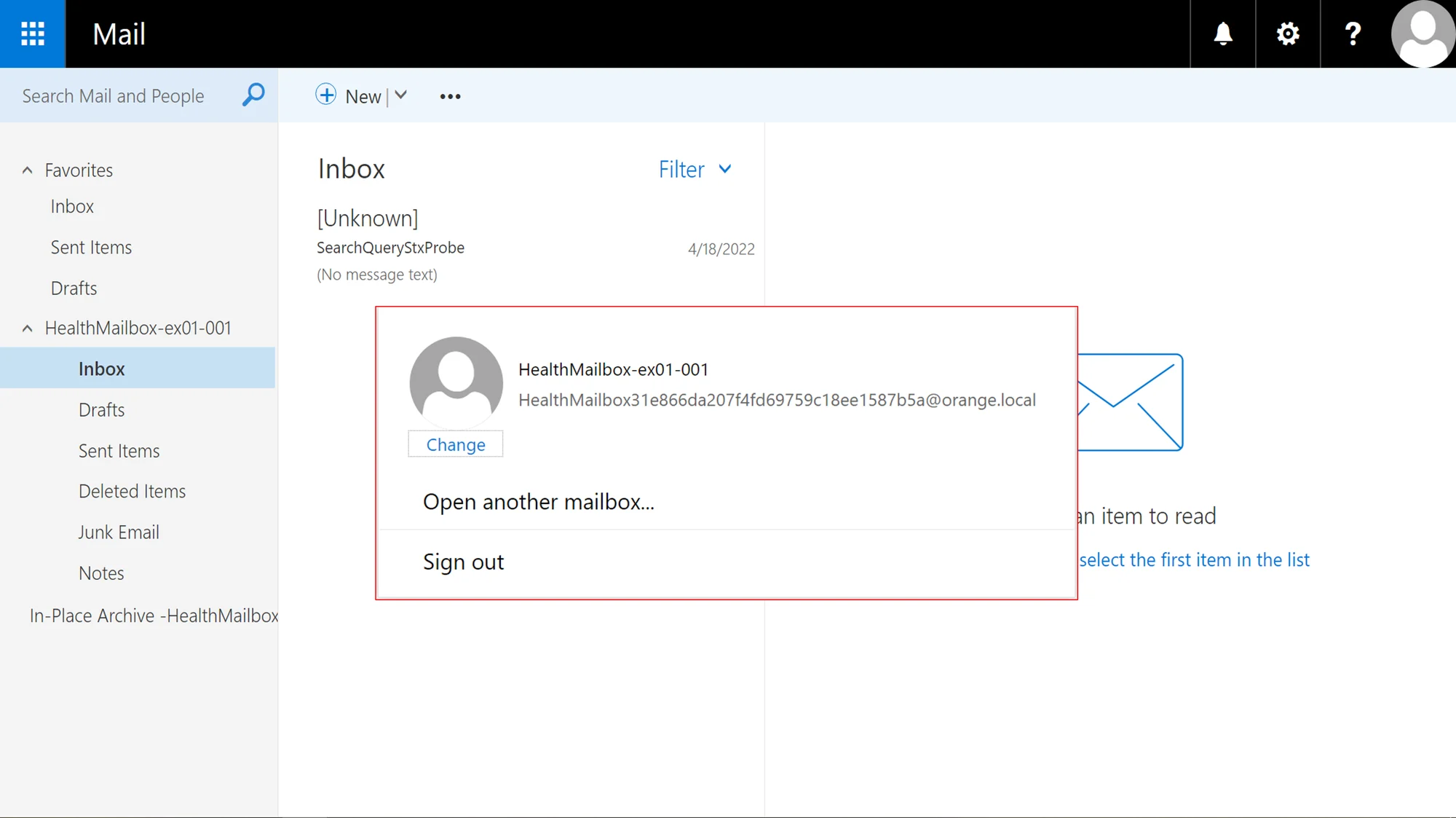
The attack was also proved to work naturally on Microsoft Exchange Server. By leveraging the default activated Exchange Active Monitoring service, it is possible to enter HealthMailbox's mailbox without passwords. This authentication-less account hijacking is useful for further exploitation, such as phishing or chaining another post-auth RCE together.
Root cause
The three findings have these causes.
- Hash flooding. The hash table is vulnerable to an algorithmic complexity attack, and the 30-second cleanup thread that deletes outdated records is not sufficient mitigation. A key-splitting bug in the implementation amplifies the attack by more than 10 times, defeating the guardian by zero hashes.
- Cache poisoning. Output Caching's query string parser takes only the first occurrence of a duplicated key as the cache key, while ASP.NET concatenates the values of all repeated keys. The two parsers disagree, so HTTP parameter pollution makes IIS cache the wrong result.
- Authentication bypass. In
TokenCacheModule'spfnEqualKeys, the username is compared twice; the likely intent was to compare the password. The likely cause is a copy-and-paste error where the variable name was not replaced. The 32-bit hash limits each blind attempt to a 1/2^32 chance, but attempts are free and unlimited.
Impact
- CVE-2022-22025 (hash-flooding DoS). A default installed IIS server can be made unresponsive with about 30 connections per second. The bug qualified for the Windows Insider Preview Bounty Program and was rewarded $30,000, the maximum bounty for the Denial-of-Service category.
- CVE-2022-22040 (cache poisoning). IIS caches the wrong result when query string keys are duplicated, because of the parser inconsistency with ASP.NET.
- CVE-2022-30209 (authentication bypass). An attacker can reuse another user's logged-in token with random passwords. On Microsoft Exchange Server, the default activated
Exchange Active Monitoringservice allows enteringHealthMailbox's mailbox without passwords, which is useful for phishing or chaining another post-auth RCE together.
Fix
Microsoft fixed everything at July's Patch Tuesday, on 12 July 2022.
Variants to test
- Duplicate query string keys against Output Caching. Send a request with the same query string key repeated with different values and observe whether the cached response reflects the first value while the backend concatenates all of them. A positive result is a cached response that differs from what the backend would produce for the concatenated value.
- Basic Authentication token cache collisions. With a testing account and Basic Authentication enabled, send login attempts with random passwords and watch for a successful login as the target user. A positive result is a login that succeeds with a password that is not the account's real one.
- Pre-computed password dictionaries. Build a dictionary that excludes passwords whose hash cannot appear because the LCG is not one-to-one under the 32-bit integer, and use it to raise the collision success rate. A positive result is a higher hit rate than blind guessing.
- Long-lived cached tokens. Look for features such as Connect As or software design patterns that cache the token in memory forever, removing the need to wait for user interaction. A positive result is a token that stays in the cache without user activity.
- Exchange Active Monitoring. On an Exchange Server with the default activated
Exchange Active Monitoringservice, attempt to enterHealthMailbox's mailbox without a password. A positive result is access to the mailbox without authentication.
What happened, in plain words
A security researcher spent time looking at a piece of software that almost every company with a Windows server runs: Microsoft IIS. IIS is Microsoft's web server. A web server is the program that sits on a computer and answers requests from browsers: when you type an address and a page appears, some web server somewhere handled that request and sent the page back.
IIS is old, widely used, and closed: Microsoft does not publish the source code, the human-readable instructions that make the program work. That makes its internals a good place to hunt for mistakes, because fewer people have looked inside. The researcher focused on one particular building block used all over IIS: the hash table. A hash table is a way of storing and finding things very quickly, and IIS uses it heavily for caching. A cache is a short-term memory: instead of doing expensive work again and again, the server keeps the result and reuses it.
The work produced three separate security bugs, all reported to Microsoft and all fixed in July 2022:
| CVE | Description |
|---|---|
| CVE-2022-22025 | Microsoft IIS Hash-Flooding DoS |
| CVE-2022-22040 | Microsoft IIS Cache Poisoning Attack |
| CVE-2022-30209 | Microsoft IIS Authentication Bypass |
A CVE is a public catalogue number for a known vulnerability, so people can talk about a specific bug unambiguously. The full technical detail is in the researcher's Black Hat USA and DEFCON conference talks; the written report is deliberately short and points to the slides and video.
Before going further, two ideas that come back constantly below.
A hash table is like a cloakroom with numbered hooks. When you hand over a coat, the attendant computes a number from something about the coat (its colour, its size, a label) and hangs it on that hook. Later, to fetch the coat, you compute the same number and go straight to the hook instead of searching the whole room. The number is called a hash, and the function that turns an item into a number is the hash function. Hashing is fast because it skips the search. The catch is that two different items can produce the same number, which is called a collision: two coats want the same hook. Real hash tables have rules for handling collisions, and those rules are where bugs hide.
A token in this context is a small piece of data that proves you have already logged in. When you type a username and password, the server checks them once, then hands your browser a token so it does not have to check the password on every single request. If someone else can get hold of a valid token, they can act as you without knowing your password. That is exactly what the third bug is about.
Context
This research looks at the hash table implementation inside Microsoft IIS and at how IIS uses hash tables in its caching mechanisms. Hash tables are everywhere in computer infrastructure, in operating systems, programming languages, databases and web servers, and Microsoft has shipped its own hash table algorithm since a very early stage, applying it heavily in IIS. Because IIS does not release its source code, the implementation details of that algorithm are a largely unexplored area, which is where this work focuses: the hash table itself and its usage, with particular attention to the cache, since most of the hash table usages in IIS are cache-related.
The research produced three vulnerabilities, all reported responsibly to Microsoft and patched in July 2022:
| CVE | Description |
|---|---|
| CVE-2022-22025 | Microsoft IIS Hash-Flooding DoS |
| CVE-2022-22040 | Microsoft IIS Cache Poisoning Attack |
| CVE-2022-30209 | Microsoft IIS Authentication Bypass |
The full technical detail lives in the Black Hat USA and DEFCON talk slides and video; this write-up is deliberately brief.
"Reported responsibly" means telling the vendor privately first and giving them time to fix the problem before publishing details, so that customers are not exposed while the bug is still open.
Setup
For the authentication bypass, the smallest reproduction needs a testing account and Basic Authentication configured on your IIS. Basic Authentication is one of the password-based authentication methods whose tokens IIS caches by default, because a logon is an expensive operation and caching improves performance. The attacker side needs nothing more than a terminal from which to send login attempts.
A few words on those terms. Authentication is simply proving who you are, usually with a username and password. Basic Authentication is one specific, very simple way of doing it: the browser sends the username and password with each request, encoded but not encrypted, which is why it is normally used together with an encrypted connection. A terminal is a text window where you type commands instead of clicking buttons; it is enough to send login attempts by hand.
Why does IIS cache tokens at all? Because checking a password is slow: it involves work that the server would rather not repeat for every request. So after a successful login, IIS keeps the resulting token in memory, keyed by a hash, and looks it up on later requests. That is the performance optimisation, and it is also the surface the researcher attacked.
Finding it
Hash-flooding in 2022
Seeing a classic algorithmic complexity attack such as hash flooding against IIS in 2022 is surprising. Microsoft had configured a thread that deletes outdated records every 30 seconds to mitigate the attack. Even so, the researchers found a key-splitting bug in the implementation that amplifies the attacker's power by more than 10 times, enough to defeat that guardian by zero hashes. With it, a default installed IIS server can be made unresponsive with about 30 connections per second.
Unpacking that. A denial-of-service (DoS) attack does not steal data; it makes a service unusable for legitimate users. An algorithmic complexity attack is a clever kind of DoS: you do not send huge amounts of traffic, you send input crafted so that the program's own algorithm does far more work than usual. Hash flooding is the classic example. Remember the cloakroom: if an attacker can deliberately produce many items that all hash to the same hook, the attendant has to deal with one enormous pile instead of many small ones, and the queue backs up. The server slows to a crawl while doing perfectly normal-looking work.
Microsoft's defence was a background thread, a task running inside the server, that deletes outdated records every 30 seconds, so the pile cannot grow forever. The researchers found a key-splitting bug: a flaw that lets one piece of attacker input be treated as several keys, multiplying the effect. That is the "amplify by more than 10 times", and it was enough to overwhelm the cleanup. The result: a default installed IIS server can be made unresponsive with about 30 connections per second, which is a very small amount of traffic.
The Output Caching parser
Compared with other cache poisoning research, this bug is relatively plain. It sits in the Output Caching component, the module responsible for caching dynamic responses to reduce expensive database or filesystem access on web stacks. Output Caching uses a bad query string parser that only takes the first occurrence as the cache key when query string keys are duplicated. On its own that behaviour is not a problem. It becomes one in the context of the whole architecture with the backend, ASP.NET: the backend concatenates the value of all repeated keys together, which creates an inconsistency between the two parser behaviours. A classic HTTP parameter pollution therefore makes IIS cache the wrong result.
This paragraph is dense, so let us go slowly.
A query string is the part of a web address after the question mark. In https://example.com/search?colour=red, the query string is colour=red. It is a list of key and value pairs: the key is colour, the value is red. A parser is the piece of software that reads such a string and turns it into something the program can use. Parsers are boring until two of them disagree about the same input.
Output Caching is an IIS feature that stores the finished response to a request so that the next identical request can be answered from memory. To know whether a request is "identical", it needs a cache key: a fingerprint of the request. Here the cache key is built from the query string. The bug: when the same key appears twice, IIS's parser takes only the first occurrence as the cache key.
ASP.NET is Microsoft's framework for building the actual web application that runs behind IIS. It also reads the query string, and when a key is repeated it concatenates the values, gluing them together. So the two programs look at the same request and see different things. That disagreement is the vulnerability.
HTTP parameter pollution is the name for sending the same parameter more than once with different values, precisely to exploit such disagreements. Cache poisoning means getting the cache to store a wrong or attacker-chosen response, which is then served to other users. Here, because IIS and ASP.NET disagree, a request crafted with duplicate keys makes IIS cache the wrong result.
The key-comparing function
LKRHash is a hash table algorithm designed and patented by Microsoft in 1997. It is based on linear hashing and was created by Paul Larson of Microsoft Research, Murali Krishnan and George Reilly of the IIS team. It aims to build a scalable, highly concurrent hash table in multithreaded and multicore environments, and its creators made the implementation portable, flexible and customisable so it could adapt to multiple products across Microsoft. An application can define its own table-related functions, such as the hash function, the key extracting function and the key comparing function. That extensibility creates opportunities for vulnerability mining, so the research cares about the relationship between the records, the keys and the functions.
LKRHash is Microsoft's own hash table, built for servers with many processors doing many things at once. Multithreaded and multicore mean the program runs several tasks in parallel, and a hash table used that way must be careful not to trip over itself. Linear hashing is a technique for letting a hash table grow gradually instead of rebuilding itself all at once.
The important design choice is extensibility: the generic hash table lets each application plug in its own small functions. The hash function turns a key into a number. The key extracting function decides which part of a record is the key. The key comparing function decides whether two keys are the same. When you let every product write its own version of these, you get a lot of code written by many hands, and that is fertile ground for mistakes.
Because a logon is expensive, IIS caches all tokens for password-based authentications, such as Basic Authentication, by default. The bug is in the logic of the key-comparing function when a collision occurs. If a login attempt whose hash hits a key already in the cache, LKRHash enters the application-specific pfnEqualKeys function to decide whether the key is correct. The application-specific logic of TokenCacheModule compares several parts to make that decision, and it is strange that IIS compares the username twice. The likely explanation is that the original intent was to compare the password, but the developer copy-and-pasted the code and forgot to replace the variable name.
Here is the heart of it. When you log in, IIS stores your token in the cache. Later, when a login attempt arrives, IIS hashes it. If the hash matches an entry already in the cache, that is a collision, and IIS calls pfnEqualKeys to check whether the two keys really are the same. TokenCacheModule is the IIS component that does this for tokens. Its comparison checks the username twice and never checks the password. The likely cause is a copy-and-paste slip: the developer duplicated a line and forgot to change the variable name from the username to the password. The consequence is that an attacker can reuse another user's logged-in token with random passwords, as long as the hash collides.
Exploitation
Step 1: Prepare a target account
Create a testing account and configure Basic Authentication on your IIS. The attacker can then log in as the user orange with a different password whose hash is the same as the original one.
This step is about setting up a lab: a test account and Basic Authentication switched on. The attacker's goal is to log in as orange without knowing orange's password, by producing a password whose hash lands on the same cache entry.
Step 2: Reuse a cached token with a random password
Because the key-comparing function checks the username twice instead of checking the password, an attacker can reuse another user's logged-in token with random passwords.
In plain terms: the attacker sends login attempts as orange with made-up passwords. Most fail, because the hash does not match the cached entry. But when a made-up password happens to hash to the same value as the real one, the comparison runs, sees the username twice, and lets the attempt through. The attacker is then using orange's cached token, not orange's password.
Step 3: Deal with the collision probability
The catch is that colliding the hash is not easy. Each attempt has a probability of only 1/2^32, because the hash is a 32-bit integer and the attacker has no way to know the hash of existing cache keys. That is a ridiculous number, making exploitation like playing the lottery. The one advantage is that an attempt costs nothing and you have unlimited tries.
A 32-bit integer is a number stored in 32 binary digits, so it can take about four billion different values. Guessing one specific value blind is therefore a one-in-four-billion shot per attempt. The attacker cannot see the cache, so they cannot aim. The saving grace is that failed attempts are free and unlimited, so a script can simply keep trying.
To make the bug more practical, the researchers proposed several ways to win the lottery:
- Increase the odds of the collision. LKRHash combines LCGs to scramble the result and make the hash more random. However, the key space can be lowered because the LCG is not a one-to-one mapping under the 32-bit integer. Some results will never appear, so a dictionary can be pre-computed that excludes passwords whose hash is not in the results, increasing the success rate by at least 13%.
- Regain the initiative. By understanding the root cause, several use cases were brainstormed that can cache the token in memory forever and no longer wait for user interaction, such as the IIS feature Connect As or leveraging software design patterns.
An LCG, short for linear congruential generator, is a simple recipe for producing a stream of pseudo-random numbers. LKRHash mixes several of them to spread hashes out. The subtlety is that an LCG is not one-to-one: different inputs can map to the same output, and some outputs never occur at all. That shrinks the set of reachable hashes, the key space. If you know which hashes are impossible, you can throw away passwords that would produce them and only try the ones that can hit. That is the pre-computed dictionary, and it raises the success rate by at least 13%.
The second idea is about timing. Normally the attacker has to wait for the victim to log in so a token lands in the cache. Features such as Connect As, which lets IIS use stored credentials to reach another resource, can put a token in memory and keep it there, so the attacker no longer depends on the victim's activity.
Step 4: Apply it to Exchange
The attack was also proved to work naturally on Microsoft Exchange Server. By leveraging the default activated Exchange Active Monitoring service, it is possible to enter HealthMailbox's mailbox without passwords. This authentication-less account hijacking is useful for further exploitation, such as phishing or chaining another post-auth RCE together.
Microsoft Exchange Server is Microsoft's mail and calendar server, and it runs on top of IIS. Exchange Active Monitoring is a built-in service that keeps an eye on the health of the mail system, and it is switched on by default. It uses special accounts called HealthMailbox accounts. That is exactly the situation the bug needs, and it lets an attacker get into HealthMailbox's mailbox without a password.
Account hijacking means taking over someone's account. Phishing is tricking a person into handing over information or clicking something harmful, and a hijacked mailbox is an ideal place to send convincing phishing mail from. RCE, remote code execution, is the ability to run your own commands on someone else's machine; a post-auth RCE is one that requires you to be logged in first, so an authentication bypass can be the first link in a chain that ends in RCE.
Root cause
The three findings have these causes.
- Hash flooding. The hash table is vulnerable to an algorithmic complexity attack, and the 30-second cleanup thread that deletes outdated records is not sufficient mitigation. A key-splitting bug in the implementation amplifies the attack by more than 10 times, defeating the guardian by zero hashes.
- Cache poisoning. Output Caching's query string parser takes only the first occurrence of a duplicated key as the cache key, while ASP.NET concatenates the values of all repeated keys. The two parsers disagree, so HTTP parameter pollution makes IIS cache the wrong result.
- Authentication bypass. In
TokenCacheModule'spfnEqualKeys, the username is compared twice; the likely intent was to compare the password. The likely cause is a copy-and-paste error where the variable name was not replaced. The 32-bit hash limits each blind attempt to a 1/2^32 chance, but attempts are free and unlimited.
An authentication bypass is any flaw that lets you get past a login check without the correct credentials. Here it is a logic error rather than a broken password: the check itself is wrong.
Impact
- CVE-2022-22025 (hash-flooding DoS). A default installed IIS server can be made unresponsive with about 30 connections per second. The bug qualified for the Windows Insider Preview Bounty Program and was rewarded $30,000, the maximum bounty for the Denial-of-Service category.
A bug bounty is a programme where a company pays researchers for reporting vulnerabilities. The Windows Insider Preview Bounty Program is one such programme, and this DoS earned the maximum payout for its category.
- CVE-2022-22040 (cache poisoning). IIS caches the wrong result when query string keys are duplicated, because of the parser inconsistency with ASP.NET.
- CVE-2022-30209 (authentication bypass). An attacker can reuse another user's logged-in token with random passwords. On Microsoft Exchange Server, the default activated
Exchange Active Monitoringservice allows enteringHealthMailbox's mailbox without passwords, which is useful for phishing or chaining another post-auth RCE together.
Fix
Microsoft fixed everything at July's Patch Tuesday, on 12 July 2022.
Patch Tuesday is Microsoft's monthly day for releasing security updates. The practical lesson for anyone running IIS: keep the server patched, because these three bugs were all closed in that one update.
Variants to test
Each is described with what to send and what counts as a positive result.
- Duplicate query string keys against Output Caching. Send a request with the same query string key repeated with different values and observe whether the cached response reflects the first value while the backend concatenates all of them. A positive result is a cached response that differs from what the backend would produce for the concatenated value.
- Basic Authentication token cache collisions. With a testing account and Basic Authentication enabled, send login attempts with random passwords and watch for a successful login as the target user. A positive result is a login that succeeds with a password that is not the account's real one.
- Pre-computed password dictionaries. Build a dictionary that excludes passwords whose hash cannot appear because the LCG is not one-to-one under the 32-bit integer, and use it to raise the collision success rate. A positive result is a higher hit rate than blind guessing.
- Long-lived cached tokens. Look for features such as Connect As or software design patterns that cache the token in memory forever, removing the need to wait for user interaction. A positive result is a token that stays in the cache without user activity.
- Exchange Active Monitoring. On an Exchange Server with the default activated
Exchange Active Monitoringservice, attempt to enterHealthMailbox's mailbox without a password. A positive result is access to the mailbox without authentication.
Glossary
- Algorithmic complexity attack: an attack that sends input crafted to make a program's own algorithm do far more work than normal, slowing or stopping it.
- ASP.NET: Microsoft's framework for building web applications that run behind IIS.
- Authentication: the process of proving who you are, usually with a username and password.
- Authentication bypass: a flaw that lets someone get past a login check without the correct credentials.
- Basic Authentication: a simple login method where the browser sends the username and password with each request, encoded but not encrypted.
- Bug bounty: a programme that pays researchers for responsibly reporting vulnerabilities.
- Cache: a short-term memory that stores results so expensive work does not have to be repeated.
- Cache key: the fingerprint of a request that a cache uses to decide whether two requests are the same.
- Cache poisoning: getting a cache to store a wrong or attacker-chosen response that is then served to others.
- Collision: when two different inputs produce the same hash value.
- Connect As: an IIS feature that lets the server use stored credentials to reach another resource.
- CVE: a public catalogue number that uniquely identifies a known vulnerability.
- Denial-of-service (DoS): an attack that makes a service unusable for legitimate users.
- Exchange Active Monitoring: a Microsoft Exchange service, on by default, that monitors mail system health using
HealthMailboxaccounts. - Hash: the number produced by a hash function for a given input.
- Hash flooding: a DoS attack that deliberately produces many keys with the same hash so the hash table's collision handling becomes overloaded.
- Hash function: the function that turns an item into a number used to place it in a hash table.
- Hash table: a data structure that stores and finds items quickly by computing a number for each item instead of searching.
- HTTP parameter pollution: sending the same parameter more than once with different values to exploit disagreements between parsers.
- IIS: Microsoft's web server software.
- Key comparing function: an application-supplied function that decides whether two keys in a hash table are the same.
- Key extracting function: an application-supplied function that decides which part of a record is the key.
- Key space: the set of all possible keys or hash values.
- LCG (linear congruential generator): a simple recipe for producing a stream of pseudo-random numbers.
- Linear hashing: a technique that lets a hash table grow gradually instead of rebuilding all at once.
- LKRHash: Microsoft's own hash table algorithm, designed and patented in 1997, built for multithreaded and multicore servers.
- Multicore: a processor with several independent cores that can run tasks in parallel.
- Multithreaded: a program that runs several tasks at the same time.
- Output Caching: an IIS feature that stores finished responses so identical requests can be answered from memory.
- Parser: the piece of software that reads input such as a query string and turns it into something the program can use.
- Patch Tuesday: Microsoft's monthly day for releasing security updates.
- Phishing: tricking a person into handing over information or clicking something harmful.
- Post-auth RCE: remote code execution that requires being logged in first.
- Query string: the part of a web address after the question mark, made of key and value pairs.
- RCE (remote code execution): the ability to run your own commands on someone else's machine.
- Terminal: a text window where you type commands instead of clicking buttons.
- Token: a piece of data that proves you have already logged in, so the password does not have to be checked on every request.
- 32-bit integer: a number stored in 32 binary digits, able to take about four billion different values.
- Vulnerability: a mistake in software that an attacker can use to cause harm.