#bugbounty How I Takeover Microsoft Store.
A subdomain of flipgrid.com redirected visitors to an unclaimed store page on a third-party storefront service, so anyone could register that store name and control where the subdomain sent users. The author signed up for the store name and thereby took over the store page.
 Published on medium.com
Today. I will proudly share to you, how I was successfully takeover microsoft store page, i have been learning from diffrent security researchers write-up in the bug bounty field, so i decided to share my few findings with you as it might help others who started in the Bug Bounty journey.
The full write-up lives on its author's site
It belongs to its author, so we link to it rather than copy it. The other two tabs are our own rewrites, checked against it.
Context
Flipgrid is a video discussion platform used by students, educators and families. According to the write-up, it was managed by Microsoft, and the author links to a Microsoft education blog post announcing the relationship:
https://educationblog.microsoft.com/2018/06/flipgrid-microsoft-education/
The feature at the centre of the report is the Flipgrid store, served from the host store.flipgrid.com. Normally that host should present Flipgrid's own store page. Instead, the author found that it redirected visitors to a store hosted on Bigcartel, an online storefront service in the same category as Shopify, where anyone can register and open a shop.
Setup
The author describes himself as not a full-time bug hunter, working from an Android phone rather than a PC. The tooling was:
- Termux, a terminal emulator for Android, used as the working environment.
- Sublist3r, the subdomain enumeration tool, run inside Termux.
No versions are given. The only precondition for the takeover itself was the ability to sign up for a free Bigcartel store under a chosen subdomain name.
Finding it
The author started recon on flipgrid.com with Sublist3r from Termux. The enumeration surfaced the subdomain store.flipgrid.com.
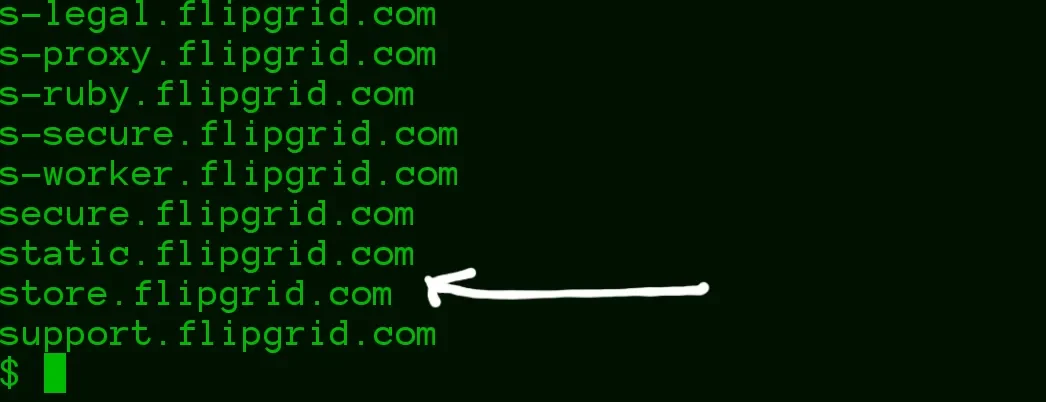
Visiting store.flipgrid.com did not serve a Flipgrid page. It redirected to flipgrid.bigcartel.com, and the destination returned an error page.
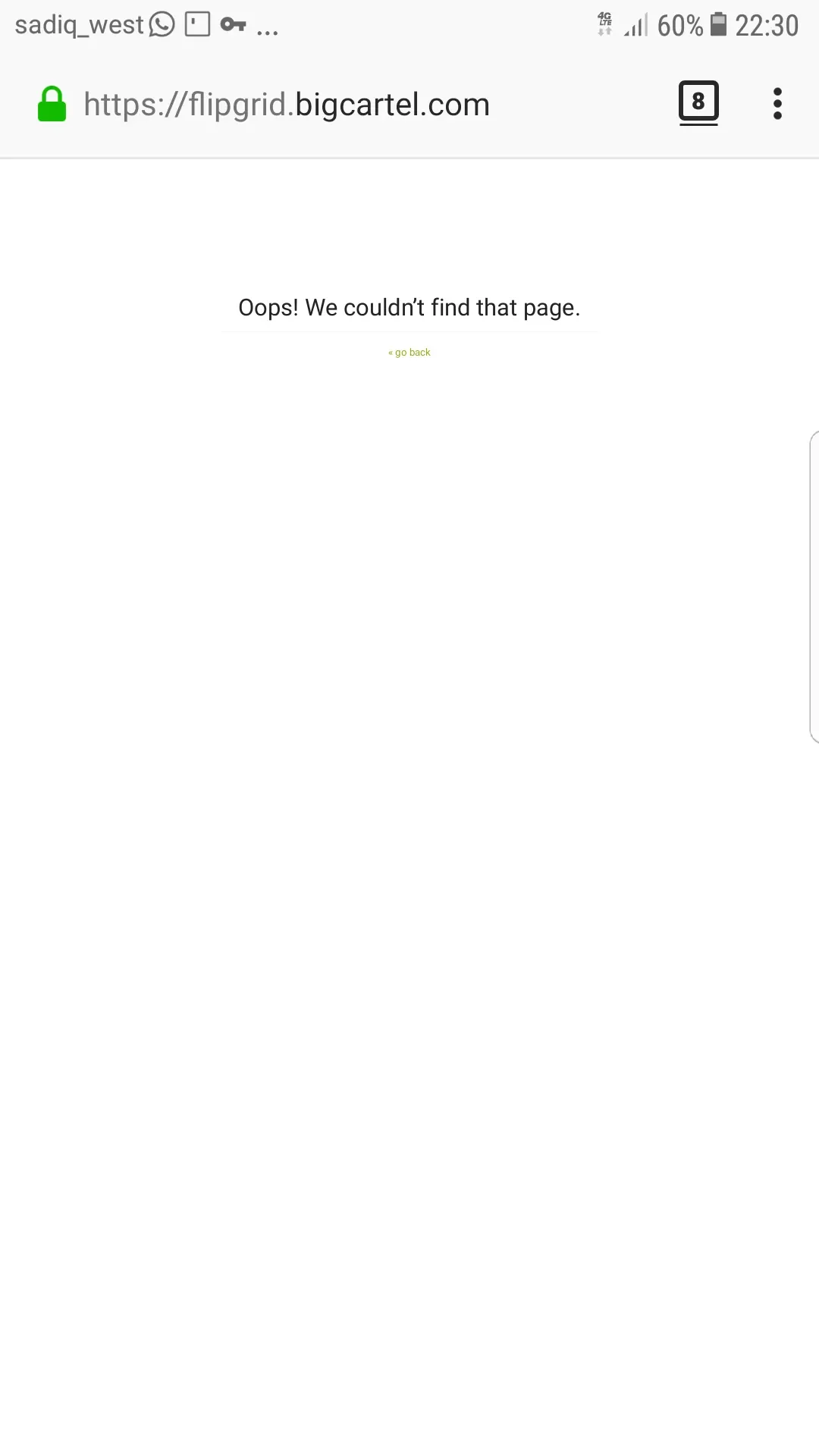
The redirect to a Bigcartel address that returned an error suggested the store name on that service was unclaimed. The author concluded from the error that the store page could be taken over. The author's conclusion at this point was simply that the store page could be taken over.
Exploitation
Step 1: register the dangling store name
The author signed up at Bigcartel and opened a store with the name flipgrid, producing the storefront flipgrid.bigcartel.com. No request or response is shown for this step; it is the ordinary self-service signup flow of the platform.
Step 2: confirm the redirect now lands on the attacker-controlled store
With the store claimed, any visitor to store.flipgrid.com was redirected to the author's newly created store page.
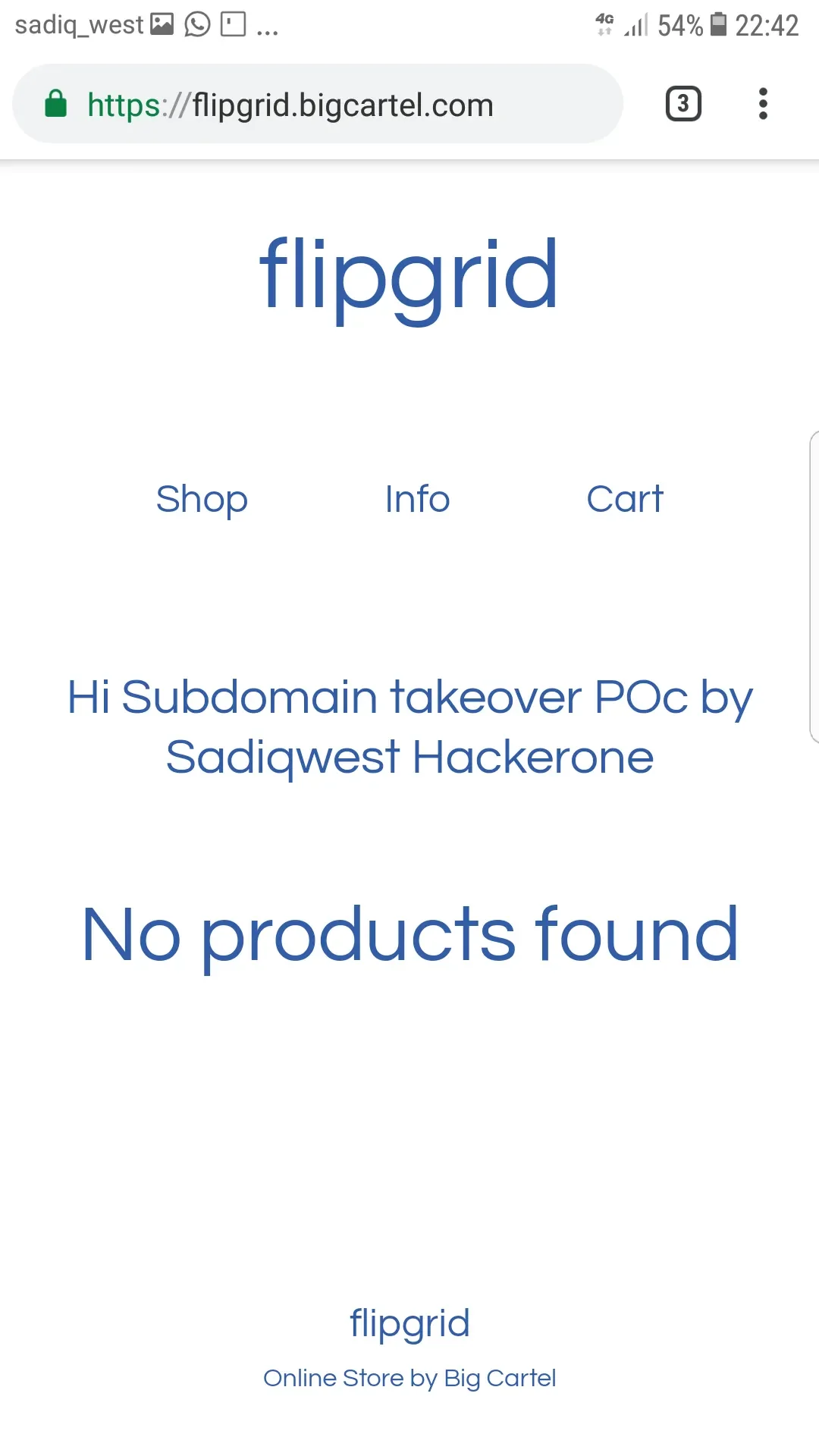
The takeover consisted entirely of claiming the unregistered name on the third-party service that the subdomain already pointed to.
Step 3: report to Microsoft
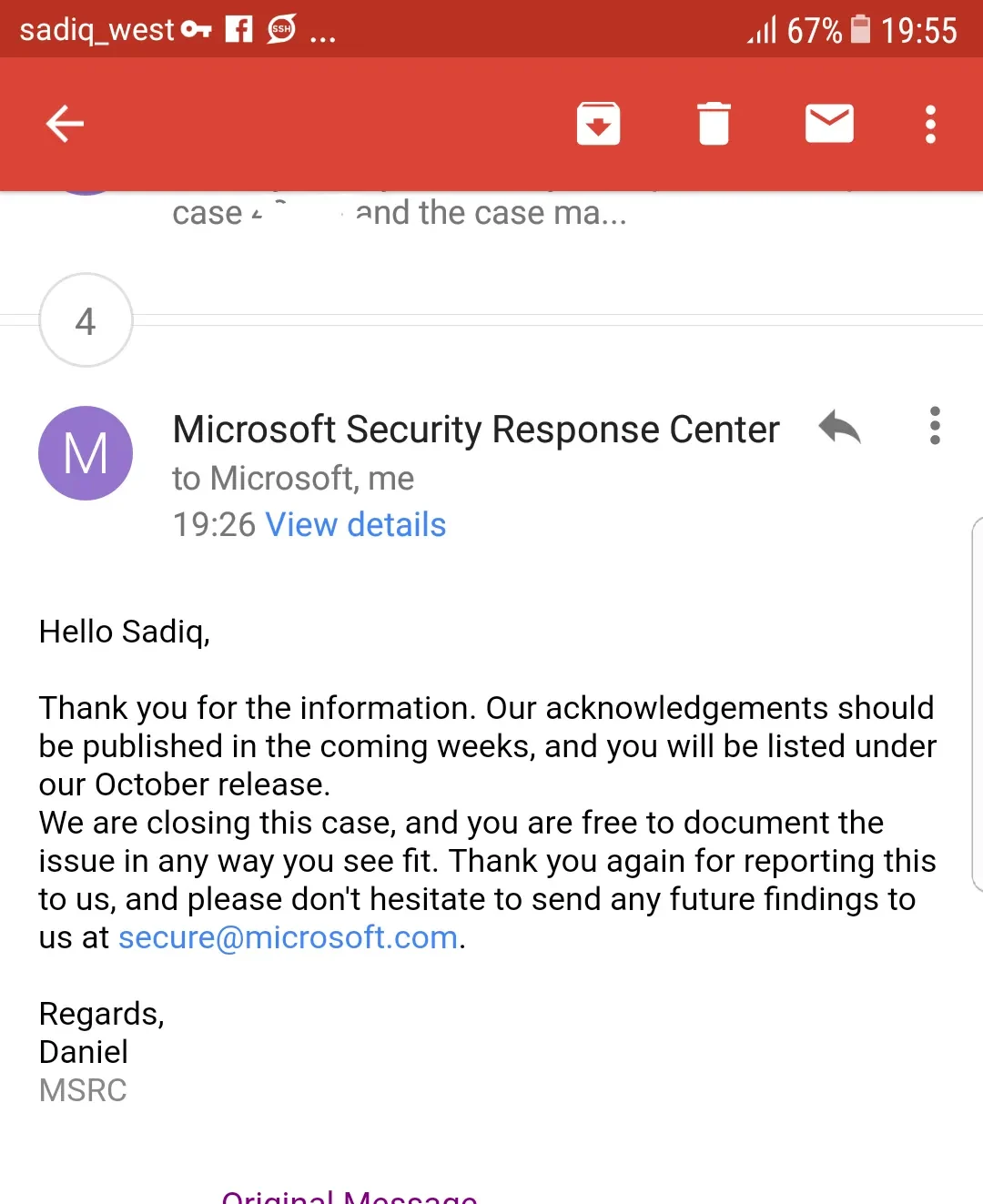
The author wrote the report to Microsoft and received a reply within three hours.
Step 4: outcome
The reward was a place in Microsoft's Hall of Fame; the write-up records no bounty payment.
The author also hoped the technique would be added to EdOverflow's can-i-take-over-xyz repository, which catalogues services vulnerable to this pattern:
https://github.com/EdOverflow/can-i-take-over-xyz/blob/master/README.md
Root cause
The report does not explain why store.flipgrid.com redirected to an unclaimed Bigcartel store.
The redirect is performed by the third-party service based on the requested host, and the service has no reason to check that the requester of a store name is the same party that controls the DNS record pointing at it.
Impact
The author frames this as going "from low impact to store takeover". In practice, for as long as the dangling record existed, anyone following a link to store.flipgrid.com would be sent to a page controlled by the person who claimed the Bigcartel name. That gives the claimant control of the page visitors to store.flipgrid.com are sent to. The report does not describe any capture of credentials, cookies or user data. The severity assigned by the program is not stated.
Fix
The standard fix for this class of issue is to stop pointing the hostname at the third-party storefront and to keep track of third-party service names.
Variants to test
The same pattern applies wherever an organisation's hostname points at a service that allocates names on a first-come basis. Concrete things to try:
- Enumerate subdomains with a tool such as Sublist3r, then request each one and watch for redirects or CNAMEs to hosted platforms (storefronts, site builders, form handlers, documentation hosts, status pages). A positive result is a host that redirects or resolves to a third-party name that is currently unregistered.
- For each candidate, attempt to register the matching name on the third-party service. A positive result is a successful signup under exactly that name, after which the target host serves your content.
- Check for error pages from the third-party service at the target host, as happened here with
flipgrid.bigcartel.com. A service-specific "store not found" or "project not found" page is a strong indicator that the name is free. - Look for stale records left after rebrands or migrations, where the old third-party name was released but the DNS record was kept. A positive result is a host that still points at the old service while the name is available.
- Re-test periodically: a name that is taken today can be released later, so a record that was safe at first review can become claimable.
On the defensive side, the same checks run internally catch these before someone else does: resolve every hostname, identify third-party targets, and confirm that each referenced name is still owned by the organisation.
What happened, in plain words
A security researcher found that a web address belonging to Flipgrid, a video discussion platform used in education, was pointing at an online shop service called Bigcartel. The address redirected to a Bigcartel shop that returned an error, so the researcher signed up for that shop name himself. After that, anyone who visited the Flipgrid address was sent to the researcher's own shop page. He reported it to Microsoft, which ran Flipgrid at the time, and was thanked with a place in Microsoft's Hall of Fame. This kind of bug is called a subdomain takeover. It happens when a company's web address still points at a third-party service, but the specific account or name on that service is no longer owned by the company. Anyone who registers that name can then control what visitors to the company's address see.
Background: Flipgrid and the store
Flipgrid is a platform where students, educators and families record and share short video discussions. According to the write-up, Flipgrid was managed by Microsoft, and the author links to a Microsoft education blog post about the relationship:
https://educationblog.microsoft.com/2018/06/flipgrid-microsoft-education/
This is just a web link to a blog post. It is not an attack; it is evidence that Microsoft was involved with Flipgrid.
The feature involved is the Flipgrid store, which was served from the web address store.flipgrid.com. A store here means an online shop where merchandise might be sold. Normally, visiting that address should show Flipgrid's own store page. Instead, the author found that it redirected visitors to a shop hosted on Bigcartel. Bigcartel is an online storefront service, similar to Shopify, where anyone can create an account and open a shop. The shop's address takes the form <name>.bigcartel.com, where <name> is chosen by the person signing up. If the name is not already taken, anyone can claim it.
Setting up the tools
The author describes himself as not a full-time bug hunter. He worked from an Android phone rather than a computer. The tools he used were:
- Termux, a terminal emulator for Android. A terminal emulator gives you a command-line interface on your phone, like the command prompt on a computer. It lets you run programs by typing commands.
- Sublist3r, a tool for finding subdomains. A subdomain is a prefix added to a domain name. For example,
storeinstore.flipgrid.comis a subdomain offlipgrid.com. Organisations often have many subdomains for different services (shop, blog, support, etc.). Sublist3r searches public sources to discover these subdomains.
No versions of the tools are given. The only precondition for the takeover was the ability to sign up for a free Bigcartel store under a chosen name.
Finding the vulnerable subdomain
The author started reconnaissance on flipgrid.com using Sublist3r from Termux. Reconnaissance (recon) is the information-gathering phase: you look for anything that might be interesting or misconfigured. Running Sublist3r on flipgrid.com produced a list of subdomains, and one of them was store.flipgrid.com.
This image likely shows the output of Sublist3r listing subdomains, including store.flipgrid.com. The author does not describe the image further.
Next, the author visited store.flipgrid.com in a browser. Instead of showing a Flipgrid page, the address redirected to flipgrid.bigcartel.com. A redirect is when one web address automatically sends your browser to a different address. The destination page returned an error.
This image probably shows the error page the author saw after the redirect. That error was the signal the author used: the subdomain redirected to Bigcartel, and the destination returned an error. In other words, the link between the Microsoft-owned hostname and the Bigcartel shop is dangling. The author concluded that the store page could be taken over.
Exploitation
Step 1: register the dangling store name
The author signed up at Bigcartel and created a store with the name flipgrid. This produced the storefront flipgrid.bigcartel.com. No request or response is shown for this step; it is the normal self-service signup process of the platform. By registering the name, the author created the store that store.flipgrid.com redirected to.
Step 2: confirm the redirect now lands on the attacker-controlled store
With the store claimed, any visitor to store.flipgrid.com was redirected to the author's newly created store page.
This image likely shows the author's Bigcartel store page, demonstrating that the redirect now leads there. The takeover consisted entirely of claiming the unregistered name on the third-party service that the subdomain already pointed to.
Step 3: report to Microsoft
The author wrote a report to Microsoft and received a reply within three hours.
This image probably shows the reply the author received from Microsoft. The exact content is not described.
Step 4: outcome
The reward was a place in Microsoft's Hall of Fame (HOF). A Hall of Fame is a public list of researchers who have reported valid security issues; it is a recognition, not a monetary bounty. The write-up records no bounty payment.
The author also hoped the technique would be added to EdOverflow's can-i-take-over-xyz repository, which catalogues services vulnerable to this pattern:
https://github.com/EdOverflow/can-i-take-over-xyz/blob/master/README.md
This is a link to a GitHub repository. GitHub is a website for hosting code and documentation. The repository lists services that are known to be vulnerable to subdomain takeovers.
Root cause
The report does not explain why store.flipgrid.com redirected to an unclaimed Bigcartel store. A DNS record is an entry in that phone book.
The redirect is performed by the third-party service based on the requested host. The service has no reason to check that the person requesting a store name is the same party that controls the DNS record pointing at it.
Impact
The author frames this as going "from low impact to store takeover". In practice, for as long as the dangling record existed, anyone following a link to store.flipgrid.com would be sent to a page controlled by the person who claimed the Bigcartel name. That gives the claimant control of the page visitors to store.flipgrid.com are sent to. The report does not describe any capture of credentials, cookies or user data. The severity assigned by the program is not stated.
Fix
The standard fix for this class of issue is to stop pointing the hostname at the third-party storefront. Additionally, organisations should keep an inventory of third-party service records so that names are reclaimed or records deleted before a store name is released.
Variants to test
The same pattern applies wherever an organisation's hostname points at a service that allocates names on a first-come basis. Here are concrete steps to try:
- Enumerate subdomains with a tool such as Sublist3r, then request each one and watch for redirects or CNAMEs to hosted platforms (storefronts, site builders, form handlers, documentation hosts, status pages). A CNAME is a type of DNS record that points one name to another. A positive result is a host that redirects or resolves to a third-party name that is currently unregistered.
- For each candidate, attempt to register the matching name on the third-party service. A positive result is a successful signup under exactly that name, after which the target host serves your content.
- Check for error pages from the third-party service at the target host, as happened here with
flipgrid.bigcartel.com. A service-specific "store not found" or "project not found" page is a strong indicator that the name is free. - Look for stale records left after rebrands or migrations, where the old third-party name was released but the DNS record was kept. A positive result is a host that still points at the old service while the name is available.
- Re-test periodically: a name that is taken today can be released later, so a record that was safe at first review can become claimable.
On the defensive side, the same checks run internally catch these before someone else does: resolve every hostname, identify third-party targets, and confirm that each referenced name is still owned by the organisation.
Glossary
- Subdomain: A prefix added to a domain name, like
storeinstore.flipgrid.com. It often points to a separate service. - Subdomain takeover: A vulnerability where an attacker claims an unregistered name on a third-party service that a subdomain points to, gaining control over content served at that subdomain.
- DNS (Domain Name System): The system that translates domain names into IP addresses, like a phone book for the internet.
- DNS record: An entry in DNS that maps a domain name to an IP address or another domain name.
- CNAME record: A DNS record that points one domain name to another domain name (an alias).
- Redirect: An automatic forwarding from one web address to another.
- Termux: A terminal emulator app for Android that provides a Linux command-line environment.
- Sublist3r: A tool that enumerates subdomains of a domain by querying public sources.
- Reconnaissance (recon): The information-gathering phase of a security assessment.
- Bigcartel: An online service for creating and hosting online stores, similar to Shopify.
- Shopify: A popular e-commerce platform for building online stores.
- Hall of Fame (HOF): A public list of security researchers who have reported valid vulnerabilities, often used as recognition instead of a monetary reward.
- Phishing: A technique to trick people into revealing sensitive information by impersonating a trusted entity.
- Credentials: Information used to authenticate, such as usernames and passwords.
- Cookies: Small pieces of data stored by a website in your browser, often used to maintain sessions or track users.
- Severity: A rating of how serious a vulnerability is, often based on impact and exploitability.
- Remediation: The process of fixing a vulnerability.
- Inventory: A list of assets or records, here referring to DNS records and third-party service names.
- GitHub: A platform for hosting and collaborating on code and documentation.
- Repository: A storage location for code or files, often on GitHub.


