[h1-2102] FQDN takeover on all Shopify wholesale customer domains by trailing dot (RFC 1034)
Shopify's wholesale domain verification did not account for trailing dots in domain names, allowing an attacker to add a domain with a trailing dot that resolved to the same DNS records as an existing customer domain. This let the attacker serve arbitrary content on the customer's domain, enabling phishing and scams.

- Triaged in 4 days
- Fixed in 57 days
- Paid in 4 days
- Disclosed after 60 days
Summary by the researcher
Check out my show and tell: https://youtu.be/LSwWQPQ5IG8
The report
Summary:
Due to a missing domain format check in Shopify's wholesale functionality, it is possible to serve arbitrary content on the customer's domain through existing DNS records already configured to work with Shopify. I only tested with domains that I own but as far as I understand, this would work with just any domain or subdomain that it set up to work with Shopify wholesale.
This exposes Shopify wholesale customers to several risk, similar to classic subdomain takeovers:
- Loss of domain integrity: attackers could host malicious content on the customer's domain
- Phishing attacks: attackers could use login/sign up page to capture PII and
- Scams: scammers could recreate trusted wholesale shops, host them under the official domain and collect money
Steps To Reproduce:
- For the sake of this proof of concept, we'll take over my test wholesale shop at https://shop.inti.io/accounts/sign_in, which has it's CNAME set to
wholesale-shops.shopifyapps.com(as requested by the documentation):
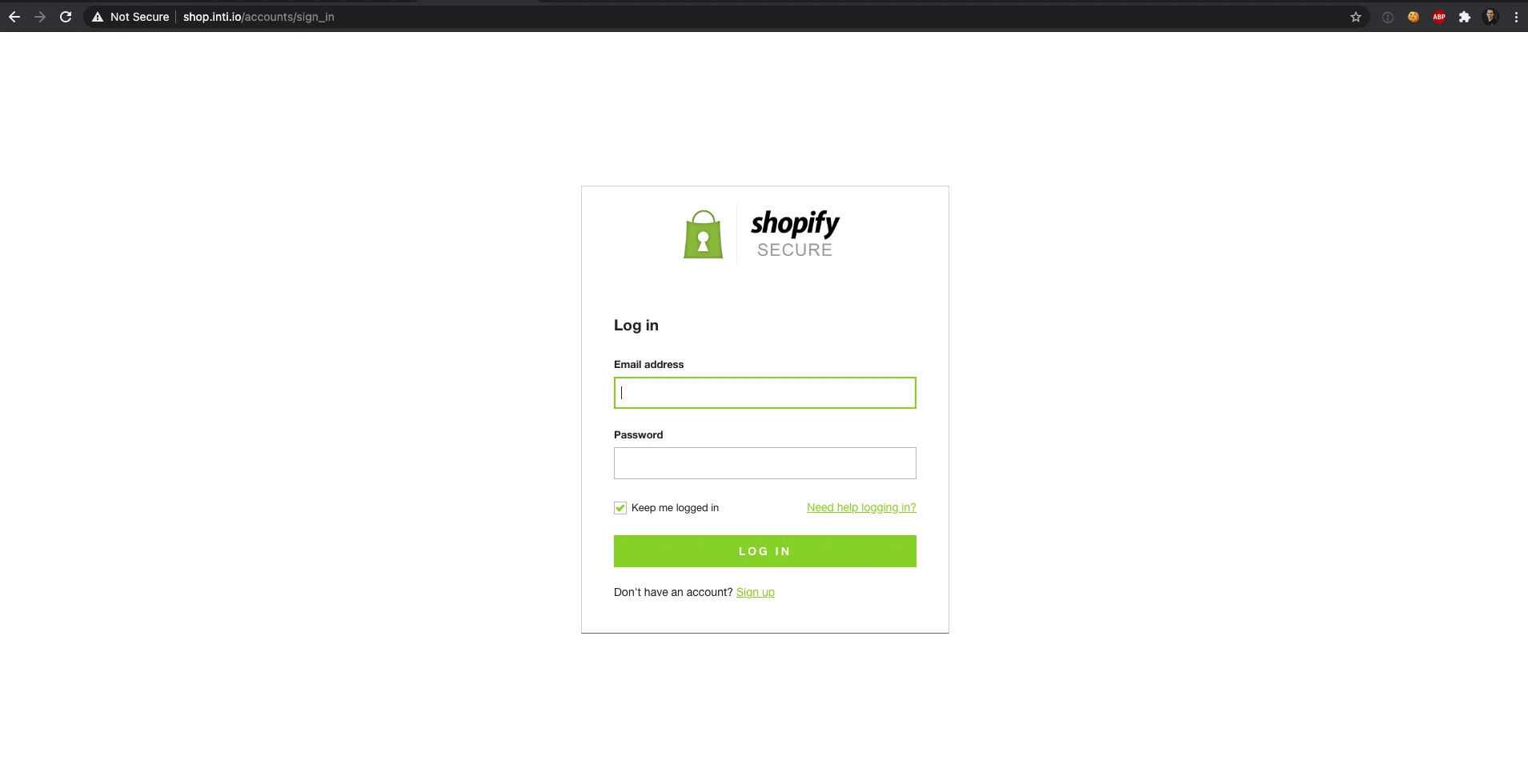
In real-life attacks, attackers could perform reverse CNAME lookups through e.g. Alien Vault's OTX.
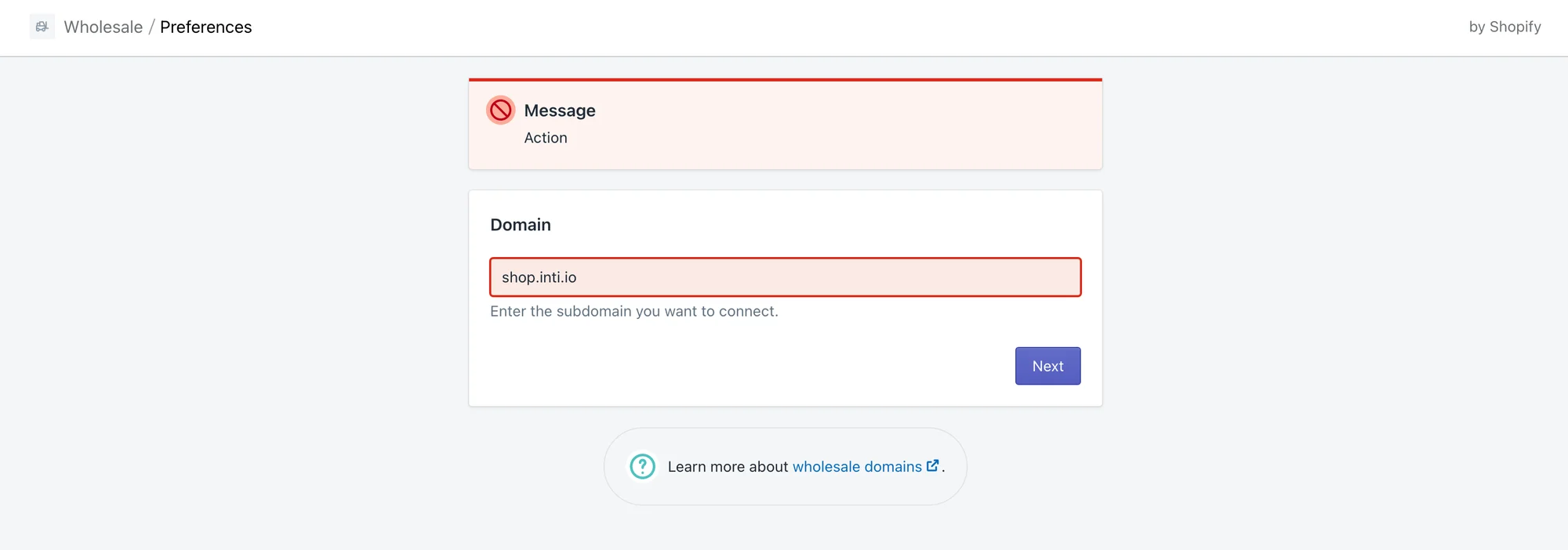
- Now log in as attacker and try to add
shop.inti.ioas a domain name in your preferences. This will not work, because there's already a store attached to it:
- Attacker now sits down, takes a nip of coffee and reads RFC 1034. Attacker notices the following:
Since a complete domain name ends with the root label, this leads to a
printed form which ends in a dot.  We use this property to distinguish between:

   - a character string which represents a complete domain name
     (often called "absolute").  For example, "poneria.ISI.EDU."

   - a character string that represents the starting labels of a
     domain name which is incomplete, and should be completed by
     local software using knowledge of the local domain (often
     called "relative").  For example, "poneria" used in the
     ISI.EDU domain.
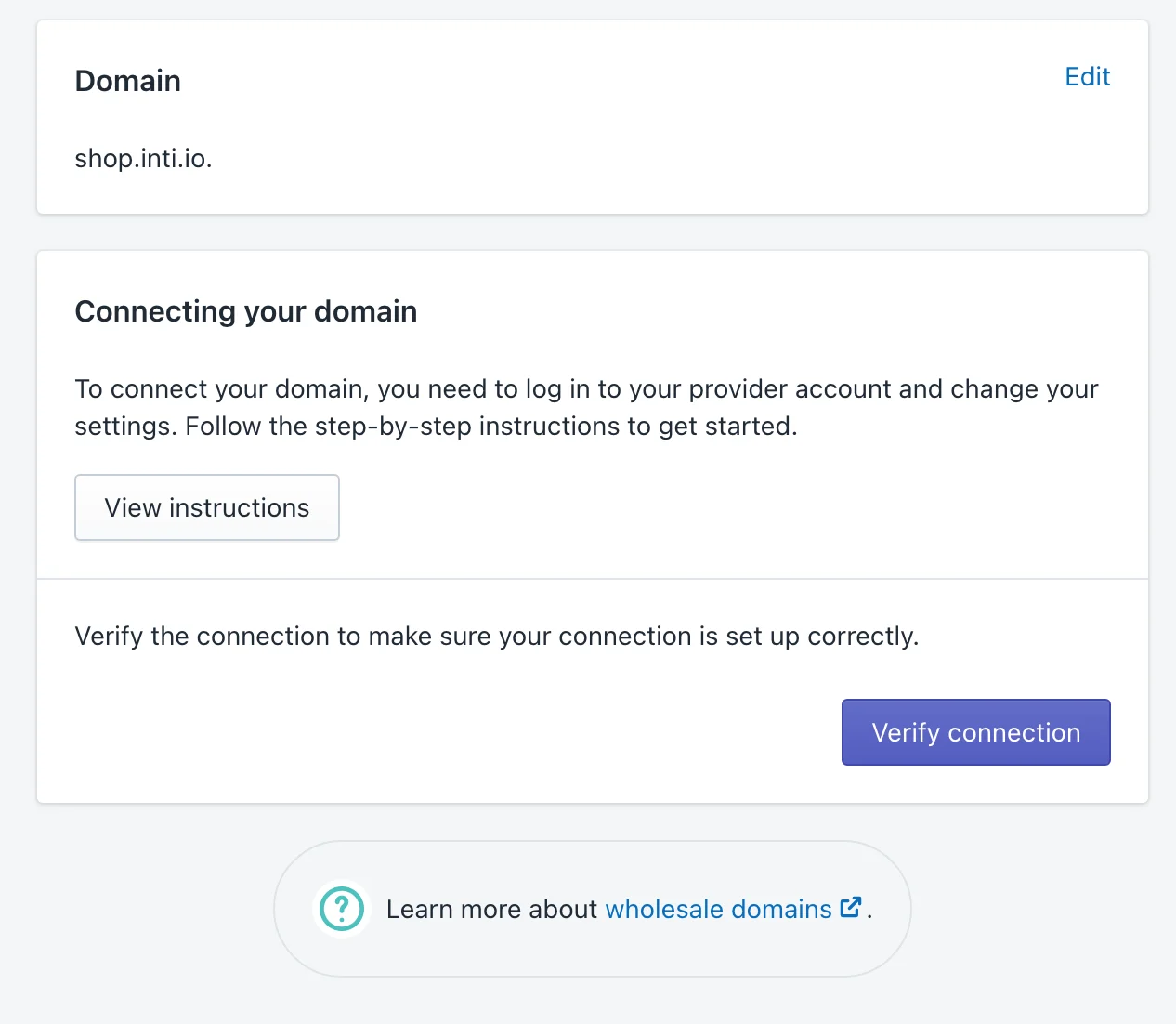
In theory, all domain names should have a trailing dot at the end, but since literally no one does that both a domain name with and without a trailing dot will essentially result in the same records being served. Since Shopify does not implement DNS-based verification and only checks whether the record is already present, we can enter the trailing dot version of the domain name to bypass this check:
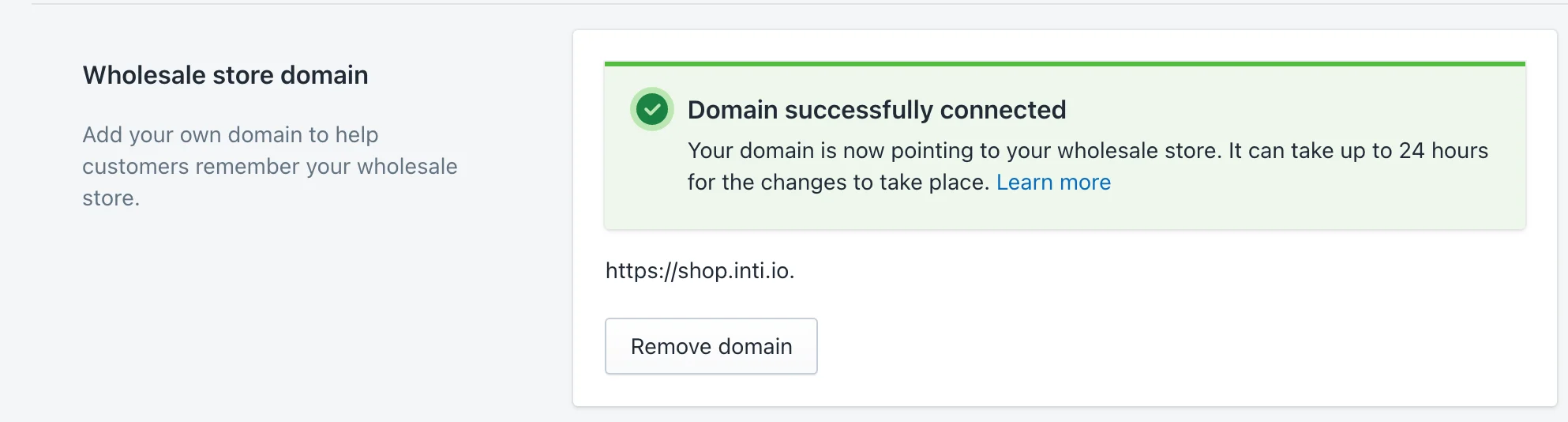
- Now attacker waits for a few minutes to allow the DNS / SSL changes to propagate. Depending on your browser's cache, it can take a while, but normally after a few minutes the malicious shop should pop up at
https://shop.inti.io./accounts/sign_in.
Final results
Real store: https://shop.inti.io/accounts/sign_in
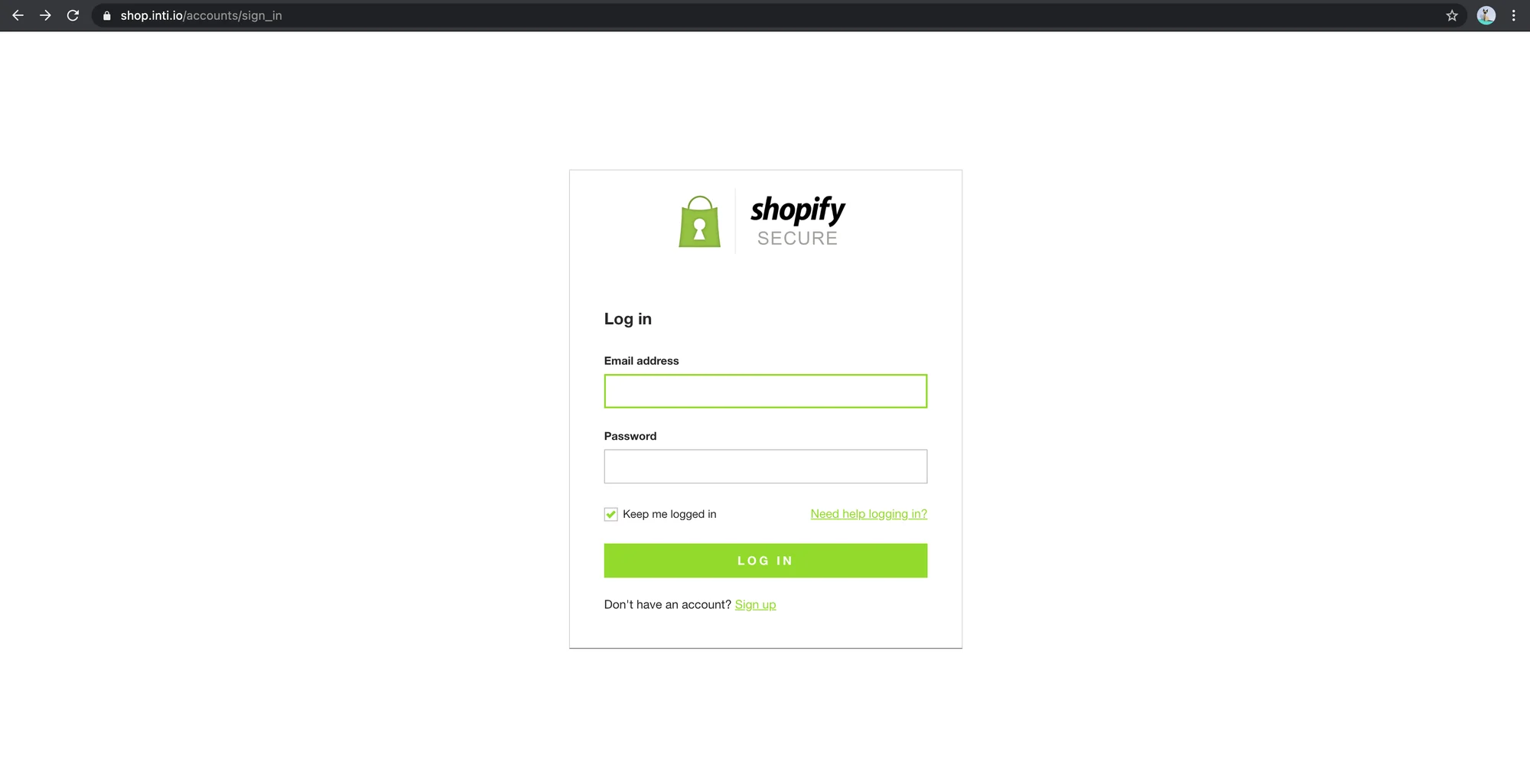
Hijacked store: https://shop.inti.io./accounts/sign_in
##Note to triagers - I have released shop.inti.io. in my shopify so you can claim it and reproduce. This means that the hijacked store is no longer accessible.
This could be done by anyone for any wholesale connected store, without having access to the DNS records.
Recommended fix
Do not consider trailing dots when checking whether domain names already exist on your back-end
Supporting Material/References:
*Trailing Dots in Domain Names, CHESHIRE S., http://www.dns-sd.org/trailingdotsindomainnames.html
- DOMAIN NAMES - CONCEPTS AND FACILITIES (RFC1034), MOCKAPETRIS P (Network Work Group), https://www.ietf.org/rfc/rfc1034.txt
Impact
This exposes Shopify wholesale customers to several risk, similar to classic subdomain takeovers:
- Loss of domain integrity: attackers could host malicious content on the customer's domain
- Phishing attacks: attackers could use login/sign up page to capture PII and
- Scams: scammers could recreate trusted wholesale shops, host them under the official domain and collect money
Context
Shopify's wholesale channel lets a merchant run a separate wholesale storefront, and the merchant points a domain at Shopify for it. According to the documentation the researcher cites, the domain is configured with a CNAME record pointing to wholesale-shops.shopifyapps.com. The wholesale domain is then added in the merchant's wholesale settings, and Shopify serves the wholesale storefront on that hostname.
The report is about the check Shopify performs when a domain is added to a wholesale shop. The researcher found that the check can be bypassed with a trailing dot, the absolute form of a domain name described in RFC 1034, and that the bypass lets an attacker attach a domain that already belongs to another merchant's wholesale shop.
Setup
The researcher used a wholesale shop they own, shop.inti.io, with its CNAME set to wholesale-shops.shopifyapps.com as the documentation requires. The proof of concept uses the researcher's own wholesale shop, which already has the domain attached, and an attempt to add the same domain from another shop.
The screenshot shows the DNS configuration of the researcher's test domain, with the CNAME pointing at wholesale-shops.shopifyapps.com.
The researcher notes that in real attacks an attacker could find candidate domains with reverse CNAME lookups, for example through Alien Vault's OTX, which would reveal hosts pointing at wholesale-shops.shopifyapps.com.
Finding it
The starting point is the domain ownership check. When a domain is added to a wholesale shop, Shopify does not perform DNS-based verification. It only checks whether the domain is already present in its records. If the domain is already attached to a store, the addition is rejected.
The researcher tried to add shop.inti.io to a second shop and the attempt failed because a store was already attached to it.
The screenshot shows the rejected attempt to add the domain that is already in use.
The addition is rejected because a store is already attached to the domain. The researcher then looked at RFC 1034, which describes the printed form of a complete domain name as ending in a dot:
Since a complete domain name ends with the root label, this leads to a
printed form which ends in a dot.  We use this property to distinguish between:

   - a character string which represents a complete domain name
     (often called "absolute").  For example, "poneria.ISI.EDU."

   - a character string that represents the starting labels of a
     domain name which is incomplete, and should be completed by
     local software using knowledge of the local domain (often
     called "relative").  For example, "poneria" used in the
     ISI.EDU domain.
The key observation is that shop.inti.io and shop.inti.io. resolve to the same records, because the trailing dot only marks the name as absolute. In practice almost nobody writes the trailing dot, so both forms behave identically for DNS resolution. The dotted form is accepted where the plain form was rejected.
Exploitation
Step 1: confirm the domain is taken
With the victim's wholesale shop already configured, the attacker tries to add the same hostname in their own preferences:
shop.inti.io
The attempt fails because a store is already attached to that domain. This is the behaviour the bypass has to get around.
Step 2: add the absolute form of the domain
Instead of the plain hostname, the attacker submits the trailing-dot version:
shop.inti.io.
Because Shopify does not verify the domain through DNS and only checks whether the record is already present, the string comparison misses the existing entry and the domain is attached to the attacker's shop.
Step 3: wait for propagation
After the domain is added, the attacker waits a few minutes for the DNS and SSL changes to propagate. The researcher notes that browser caching can make it take longer, but normally after a few minutes the attacker's shop is served at:
https://shop.inti.io./accounts/sign_in
Result
The real store remains at its normal address:
https://shop.inti.io/accounts/sign_in
The hijacked store is served on the absolute form of the same name:
https://shop.inti.io./accounts/sign_in
The two screenshots show the original wholesale storefront and the attacker-controlled one on the dotted hostname. The researcher also released shop.inti.io. in their Shopify account after reporting, so the hijacked store is no longer accessible; this was done so that triagers could claim the name and reproduce.
The researcher stresses that this can be done by anyone for any wholesale-connected store, without access to the DNS records.
Root cause
The check does not account for the trailing dot, so the absolute form is accepted even though it resolves to the same records as the existing domain. The report's recommended fix states the same point: do not consider trailing dots when checking whether domain names already exist on the back end.
Shopify does not implement DNS-based verification and only checks whether the record is already present. The researcher frames the result as similar to classic subdomain takeovers.
Impact
The researcher lists three risks for Shopify wholesale customers:
- Loss of domain integrity: attackers could host malicious content on the customer's domain.
- Phishing attacks: attackers could use the login and sign-up page to capture PII.
- Scams: scammers could recreate trusted wholesale shops, host them under the official domain and collect money.
The researcher only tested with domains they own, and states that as far as they understand it would work with any domain or subdomain set up to work with Shopify wholesale. The attack requires no access to the victim's DNS records. The platform recorded the report as medium severity with a CVSS score of 4.2 and a bounty of 3100.00 USD.
Fix
The report recommends that Shopify ignore trailing dots when checking whether a domain name already exists on the back end. That is the change the researcher asked for; the report does not describe what Shopify actually deployed.
Variants to test
- A positive result is the domain being accepted while the plain form is rejected.
- A positive result is a hostname already attached to another shop being accepted in a second shop.
- Reverse CNAME enumeration. Query a passive DNS source such as Alien Vault's OTX for hosts pointing at
wholesale-shops.shopifyapps.comto build a list of candidate victim domains, then test the dotted form against each. A positive result is a domain that resolves to the victim's storefront but is accepted in the attacker's account.
Hunting notes
Showing the rejected plain attempt next to the accepted dotted attempt, and then the two live storefronts, is what makes the bypass unambiguous. The researcher also released the claimed name so triagers could reproduce it themselves.
What happened, in plain words
Shopify is a platform that lets people run online shops. One of its features is the wholesale channel: a merchant can run a second, separate shop for wholesale customers, and point a web address (a domain) at Shopify so that the wholesale shop appears under that address. To do this, the merchant changes a DNS record for their domain so it points at Shopify's wholesale servers.
When a merchant adds a domain to a wholesale shop, Shopify checks whether that domain is already in use by someone else. If it is, Shopify refuses. The researcher found that this check can be fooled by writing the domain name with a dot at the very end, like shop.inti.io. instead of shop.inti.io. Both forms point to exactly the same place on the internet, but Shopify treated them as two different names. So an attacker could attach a domain that already belonged to another merchant's wholesale shop, and then serve their own content, including a fake login page, on that merchant's address.
The researcher tested this only with domains they own, and says that as far as they understand it would work with any domain or subdomain set up to work with Shopify wholesale. No access to the victim's DNS records is needed. The platform recorded the report as medium severity, with a CVSS score of 4.2 and a bounty of 3100.00 USD.
Background: the pieces involved
Before the steps, here are the ideas you need. Each one is explained from zero.
What a domain name is
A domain name is the readable address you type in a browser, such as shop.inti.io. Computers do not actually use these names; they use numeric addresses. A system called DNS (Domain Name System) translates the readable name into the numeric address, like a phone book translating a name into a phone number. When you visit a site, your browser quietly asks DNS where the name lives, then connects there.
What a CNAME record is
DNS stores different kinds of records. A CNAME record is an alias: it says "this name is really another name, go look there instead". If shop.inti.io has a CNAME pointing at wholesale-shops.shopifyapps.com, then anyone looking up shop.inti.io is sent to whatever wholesale-shops.shopifyapps.com resolves to. This is how a merchant hands their domain over to Shopify without moving the domain itself.
What the wholesale channel does
Shopify's wholesale channel lets a merchant run a separate wholesale storefront. The merchant points a domain at Shopify for it, adds that domain in the wholesale settings, and Shopify then serves the wholesale shop on that hostname. According to the documentation the researcher cites, the domain is configured with a CNAME record pointing to wholesale-shops.shopifyapps.com.
What a subdomain takeover is
A subdomain takeover is a classic problem: a company points a subdomain at some external service, later stops using that service, but leaves the DNS record in place. Someone else can then claim the abandoned spot on the external service and start serving their own content under the company's name. This report is described as similar to that, with one difference: the takeover happens through Shopify's own domain registration rather than through a dangling DNS record.
What the trailing dot means
The domain name system has a formal rule, written in a document called RFC 1034, about how a complete domain name is written. A complete ("absolute") name ends with a dot, which stands for the root of the whole naming tree. Almost nobody types that dot in everyday use, and both forms resolve to the same records. That small difference is the heart of this bug.
Setup
The researcher used a wholesale shop they own, shop.inti.io, with its CNAME set to wholesale-shops.shopifyapps.com as the documentation requires. The proof of concept uses the researcher's own wholesale shop, which already has the domain attached, and an attempt to add the same domain from another shop.
The screenshot shows the DNS configuration of the researcher's test domain, with the CNAME pointing at wholesale-shops.shopifyapps.com.
The researcher notes that in real attacks an attacker could find candidate domains with reverse CNAME lookups, for example through Alien Vault's OTX. A reverse CNAME lookup works the other way round from a normal DNS query: instead of asking "where does this name point?", you ask "which names point at this target?". That would reveal hosts pointing at wholesale-shops.shopifyapps.com, giving an attacker a list of possible victims.
Finding it
The starting point is the domain ownership check. When a domain is added to a wholesale shop, Shopify does not perform DNS-based verification. DNS-based verification means asking the merchant to prove they control the domain, usually by placing a special record in their DNS. Instead, Shopify only checks whether the domain is already present in its records. If the domain is already attached to a store, the addition is rejected.
The researcher tried to add shop.inti.io to a second shop and the attempt failed because a store was already attached to it.
The screenshot shows the rejected attempt to add the domain that is already in use.
The addition is rejected because a store is already attached to the domain. The researcher then looked at RFC 1034, which describes the printed form of a complete domain name as ending in a dot:
Since a complete domain name ends with the root label, this leads to a
printed form which ends in a dot.  We use this property to distinguish between:

   - a character string which represents a complete domain name
     (often called "absolute").  For example, "poneria.ISI.EDU."

   - a character string that represents the starting labels of a
     domain name which is incomplete, and should be completed by
     local software using knowledge of the local domain (often
     called "relative").  For example, "poneria" used in the
     ISI.EDU domain.
Line by line, in plain words:
- The first sentence says that a complete domain name ends with the root label, and that this is written as a dot at the end. The root label is the very top of the naming tree, the thing all names hang from.
- The next lines say this dot is used to tell two kinds of name apart.
- The first kind is "absolute": a full name that needs nothing added, written with the trailing dot, like
poneria.ISI.EDU.. - The second kind is "relative": a partial name that local software must complete using the local domain, like
poneriaused inside theISI.EDUdomain.
The key observation is that shop.inti.io and shop.inti.io. resolve to the same records, because the trailing dot only marks the name as absolute. In practice almost nobody writes the trailing dot, so both forms behave identically for DNS resolution. The dotted form is accepted where the plain form was rejected.
Exploitation
Step 1: confirm the domain is taken
With the victim's wholesale shop already configured, the attacker tries to add the same hostname in their own preferences:
shop.inti.io
This is just the plain domain name, the way anyone would type it. The attempt fails because a store is already attached to that domain. This is the behaviour the bypass has to get around: it confirms that the check exists and that it blocks the obvious attempt.
Step 2: add the absolute form of the domain
Instead of the plain hostname, the attacker submits the trailing-dot version:
shop.inti.io.
This is the same name as before, with one extra dot at the end. To a DNS resolver it means the same thing; to a simple text comparison it is a different string. The attacker is betting that Shopify compares text and not meaning.
Because Shopify does not verify the domain through DNS and only checks whether the record is already present, the string comparison misses the existing entry and the domain is attached to the attacker's shop.
Step 3: wait for propagation
After the domain is added, the attacker waits a few minutes for the DNS and SSL changes to propagate. Propagation means the change spreading out and taking effect across systems; SSL is the encryption that makes the padlock appear in the browser, and a certificate has to be issued for the new name before the site loads securely. The researcher notes that browser caching can make it take longer, but normally after a few minutes the attacker's shop is served at:
https://shop.inti.io./accounts/sign_in
That address is the dotted form of the victim's domain, with the path to the sign-in page. The attacker's shop is now answering there.
Result
The real store remains at its normal address:
https://shop.inti.io/accounts/sign_in
The hijacked store is served on the absolute form of the same name:
https://shop.inti.io./accounts/sign_in
The two screenshots show the original wholesale storefront and the attacker-controlled one on the dotted hostname. The researcher also released shop.inti.io. in their Shopify account after reporting, so the hijacked store is no longer accessible; this was done so that triagers could claim the name and reproduce. A triager is the person on the platform's side who reviews a report and decides whether it is valid.
The researcher stresses that this can be done by anyone for any wholesale-connected store, without access to the DNS records. That last part matters: normally, taking over a domain requires control of its DNS. Here the attacker never touches DNS at all; they only use Shopify's own settings screen.
Root cause
The check does not account for the trailing dot, so the absolute form is accepted even though it resolves to the same records as the existing domain. Normalising means reducing different spellings of the same thing to one standard form before comparing; for example, treating shop.inti.io and shop.inti.io. as the same name. Because it does not do that, the absolute form with a trailing dot is treated as a new, unused domain even though it resolves to the same records as the existing one. The report's recommended fix states the same point: do not consider trailing dots when checking whether domain names already exist on the back end.
Shopify does not implement DNS-based verification and only checks whether the record is already present. The researcher frames the result as similar to classic subdomain takeovers.
Impact
The researcher lists three risks for Shopify wholesale customers:
- Loss of domain integrity: attackers could host malicious content on the customer's domain.
- Phishing attacks: attackers could use the login and sign-up page to capture PII. PII means personally identifiable information, such as names, addresses and contact details.
- Scams: scammers could recreate trusted wholesale shops, host them under the official domain and collect money.
The researcher only tested with domains they own, and states that as far as they understand it would work with any domain or subdomain set up to work with Shopify wholesale. The attack requires no access to the victim's DNS records.
Fix
The report recommends that Shopify ignore trailing dots when checking whether a domain name already exists on the back end. That is the change the researcher asked for; the report does not describe what Shopify actually deployed.
Variants to test
These are directions for testing the same idea further, for anyone hunting similar bugs.
- A positive result is the domain being accepted while the plain form is rejected.
- A positive result is a hostname already attached to another shop being accepted in a second shop.
- Reverse CNAME enumeration. Query a passive DNS source such as Alien Vault's OTX for hosts pointing at
wholesale-shops.shopifyapps.comto build a list of candidate victim domains, then test the dotted form against each. A positive result is a domain that resolves to the victim's storefront but is accepted in the attacker's account.
Hunting notes
A tenant here means one customer's separate space on a shared platform.
Showing the rejected plain attempt next to the accepted dotted attempt, and then the two live storefronts, is what makes the bypass unambiguous. The researcher also released the claimed name so triagers could reproduce it themselves.
Glossary
- DNS (Domain Name System): the internet's phone book, translating readable names like
shop.inti.iointo numeric addresses. - Domain name: the readable address of a site, such as
shop.inti.io. - Subdomain: a name that sits under a larger domain, like
shopunderinti.io. - CNAME record: a DNS record that says one name is an alias for another name.
- Reverse CNAME lookup: a search that asks which names point at a given target, instead of where a name points.
- Passive DNS: a collected history of DNS answers, used to look up past and present mappings.
- RFC 1034: the document that defines how domain names and DNS work, including the trailing dot for absolute names.
- Absolute domain name: a complete domain name written with a trailing dot, marking it as full and needing nothing added.
- Relative domain name: a partial name that local software completes using the local domain.
- Trailing dot: the dot at the end of an absolute domain name, standing for the root of the naming tree.
- Root label: the very top of the domain naming tree, written as a dot.
- DNS-based verification: asking a merchant to prove they control a domain, usually by placing a special DNS record.
- Normalisation: reducing different spellings of the same thing to one standard form before comparing them.
- String comparison: comparing two pieces of text character by character, without understanding their meaning.
- Propagation: the spread of a DNS or certificate change until it takes effect everywhere.
- SSL: the encryption behind the padlock in the browser, which requires a certificate for the name being served.
- Subdomain takeover: claiming an abandoned DNS entry that points at an external service, so your content appears under someone else's name.
- Phishing: tricking people with a fake page, often a login page, to hand over their details.
- PII: personally identifiable information, such as names, addresses and contact details.
- Wholesale channel: Shopify's feature for running a separate wholesale storefront on a merchant's domain.
- Tenant: one customer's separate space on a shared platform.
- Triager: the person on the platform's side who reviews a report and decides whether it is valid.
- CVSS: a standard scoring system for the severity of a security issue.
- Bounty: the money a platform pays a researcher for a valid report.





