Example HackerOne security@ forward domain is not registered
A HackerOne help article listed an example email forwarding domain that was not registered. An attacker could register that domain and receive security reports sent by mistake, exposing sensitive information and lending false credibility to the domain.

- Fixed in 5 days
- Disclosed after 5 days
Description
In this how-to article, @security-h1-forward.com appears as a valid HackerOne domain for forwarding security issues. This domain is not registered. The actual flow does not include this domain, but I think it's confusing enough to consider the risk of someone mistakenly using the domain listed in the article (for example people that do not understand the exempli gratia abbreviation)
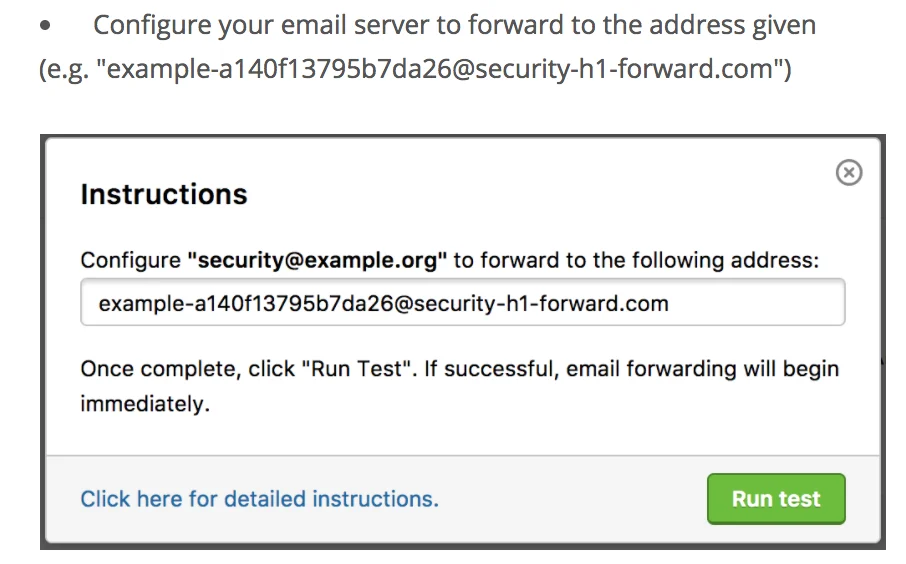
I am not entirely sure whether this would qualify as a security issue but I do think it is something you should consider fixing. The risk is low, but the impact is high (both the exposure of incoming security reports without them being forwarded to the actual vendor and a false credibility for the domain), and a fix would be rather easy to implement.
Steps To Reproduce
- Register
security-h1-forward.comfor $1 - Set up catch all e-mail forwarding to your e-mail address
- Wait for security reports to come in that are mistakenly send to the domain mentioned in the help article
I'm aware of the fact that support.hackerone.com is excluded from the scope, but since it's not a vulnerability is the actual software itself, I thought it'd be OK to report it.
Best regards,
Inti
Not written yet. The AI write-up for this report has not been written yet. The Original tab links to the source.
How it worked
Root cause
Likely the help article used an unregistered example domain, creating a risk that users would send reports to it.
Impact
An attacker could receive security reports sent by mistake, exposing sensitive information and giving false credibility to the domain.
What the attacker needed
Attacker registers the domain; victim mistakenly uses the example domain
The fix
The domain should be registered or the article should be updated to avoid using an unregistered example domain.
How it was found
- Register the domain security-h1-forward.com.
- Set up catch-all email forwarding to your own address.
- Wait for security reports mistakenly sent to that domain.
Explained by bugbounty.wiki with AI from the original and checked against quotes from it; it can still be wrong. Read the original before relying on a detail.
Not written yet. The AI write-up for this report has not been written yet. The Original tab links to the source.
A help page showed an example email address using a domain that nobody owned. If someone followed the example literally, their security report would go to whoever registered that domain. The reporter suggests registering the domain to prevent this.
What is Misconfiguration?
Settings left unsafe: exposed panels, open storage buckets, debug modes, default credentials.





