IDOR: Account Deletion via Session Misbinding – Attacker Can Delete Victim Account
The Firefox Accounts account-destroy endpoint accepted a deletion request carrying the victim's email and password hash while authenticated with a different user's session. An attacker who had obtained those victim values could therefore permanently delete another user's account.

- Triaged in 4 days
- Fixed in 8 days
- Paid in 7 days
- Disclosed after 14 days
Summary by the program
An IDOR vulnerability was identified in the Firefox Accounts API endpoint https://api.accounts.firefox.com/v1/account/destroy that allows an authenticated attacker using SSO (i.e Google login) to delete a user's account using their email address if they are also registered using SSO. The server fails to verify that the session making the deletion request belongs to the account being deleted.
The report
Summary:
A critical vulnerability in the Firefox Accounts API allows an authenticated attacker to permanently delete any user's account by sending a POST /v1/account/destroy request using attacker session, but including the victim’s email and authPW (password hash) in the JSON payload. The server fails to verify that the session making the request belongs to the account being deleted.
Steps To Reproduce:
-
Login to the victim's account.
-
Use Burp Suite to intercept a request to the endpoint https://api.accounts.firefox.com/v1/account/destroy when deleting the account. Capture the JSON body, for example:
{
"email": "[email protected]",
"authPW": "42b4c2940fe2efecce851a2d8e9754d0f1cb1d37e3ccaabb060f9ac21900caff"
}
███████
-
Then cancel the request (don't let it reach the server).
-
Login to the attacker's account.
████████
- Again, use Burp Suite to intercept a request to the same endpoint https://api.accounts.firefox.com/v1/account/destroy when deleting the account. Send it to the Repeater and cancel the request.
██████
- In the attacker's request, replace the JSON body with the victim's harvested data:
{
"email": "[email protected]",
"authPW": "42b4c2940fe2efecce851a2d8e9754d0f1cb1d37e3ccaabb060f9ac21900caff"
}
Send the request.
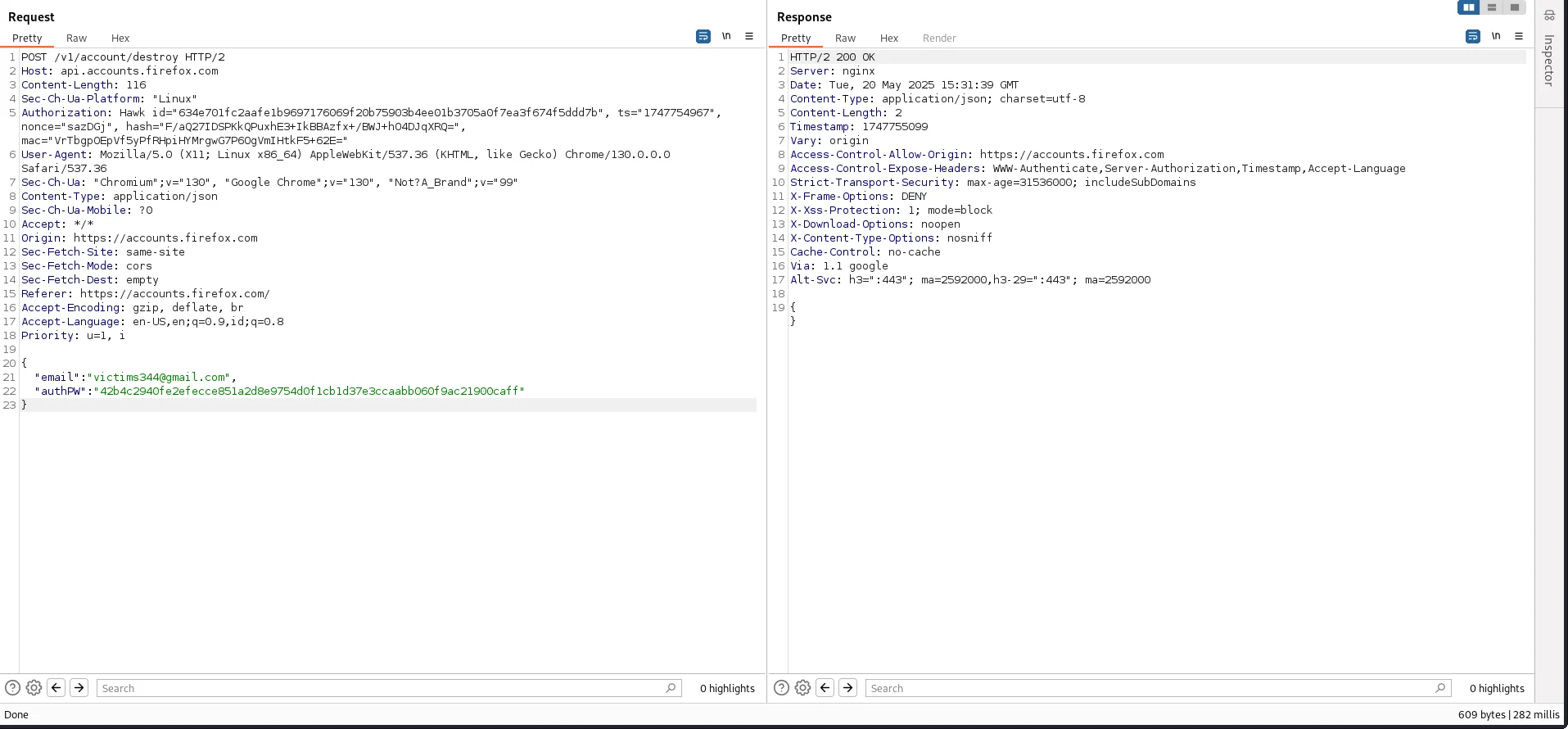
- The server accepts the request and deletes the victim's account, even if it was from the attacker's session.
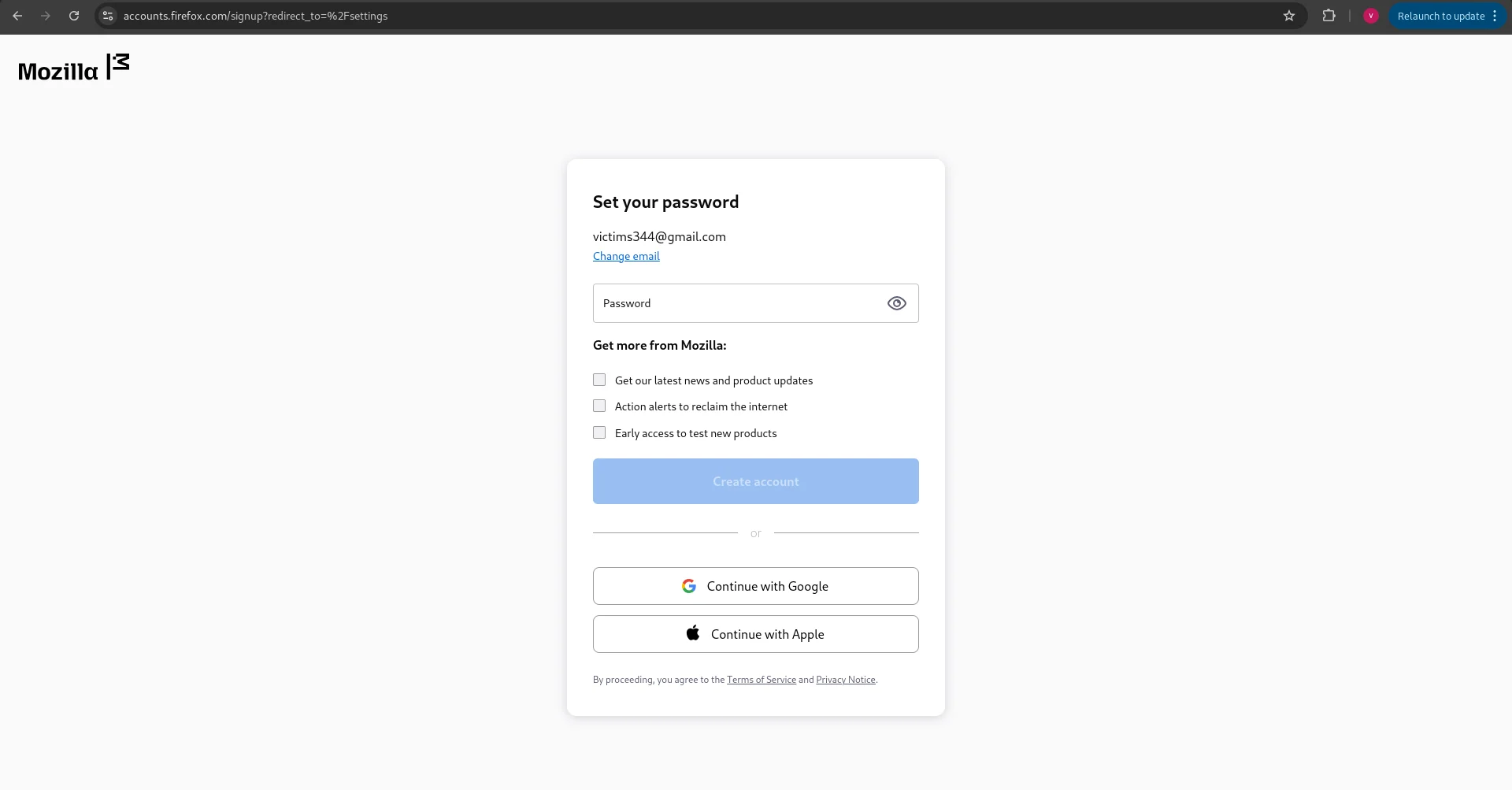
Impact
==Allows attackers to delete victim accounts without permission.==
Attachments
Not written yet. The AI write-up for this report has not been written yet. The Original tab links to the source.
How it worked
Impact
An attacker could delete another user's account without permission, though the report's steps require first obtaining that user's email and password hash.
What the attacker needed
Victim's email and password hash; attacker holds a valid session; victim registered via SSO
How it was found
- Log in to the victim's account and start deleting it while intercepting the request to the destroy endpoint.
- Capture the JSON body containing the victim's email and password hash, then cancel the request.
- Log in to the attacker's account and intercept its own destroy request, sending it to Repeater and cancelling it.
- Replace the attacker's request body with the victim's captured values and send the request.
- The server accepts it and deletes the victim's account from the attacker's session.
Explained by bugbounty.wiki with AI from the original and checked against quotes from it; it can still be wrong. Read the original before relying on a detail.
Not written yet. The AI write-up for this report has not been written yet. The Original tab links to the source.
When you log in, the server gives your browser a session so it knows who you are. This endpoint deleted an account based on details in the request body (an email and a password hash) instead of checking that the logged-in session matched that account. So someone logged in as themselves could ask the server to delete somebody else's account.
What is IDOR?
One user can read or change another user's data, usually by changing an identifier the server trusts without checking who is asking. One of the most paid bug classes on web programs.



