Disclosure of internal information using hidden NTLM authentication leading to an exploit server
A blog server was configured to accept NTLM authentication without a login prompt, so a crafted request with an Authorization header returned an NTLM challenge that leaked internal Windows domain, computer and version details. The reporter then used that information to identify a potentially vulnerable Windows Server 2012 R2 host, but did not actually exploit it.

- Triaged in 32 days
- Fixed in 7 months
- Disclosed after 16 months
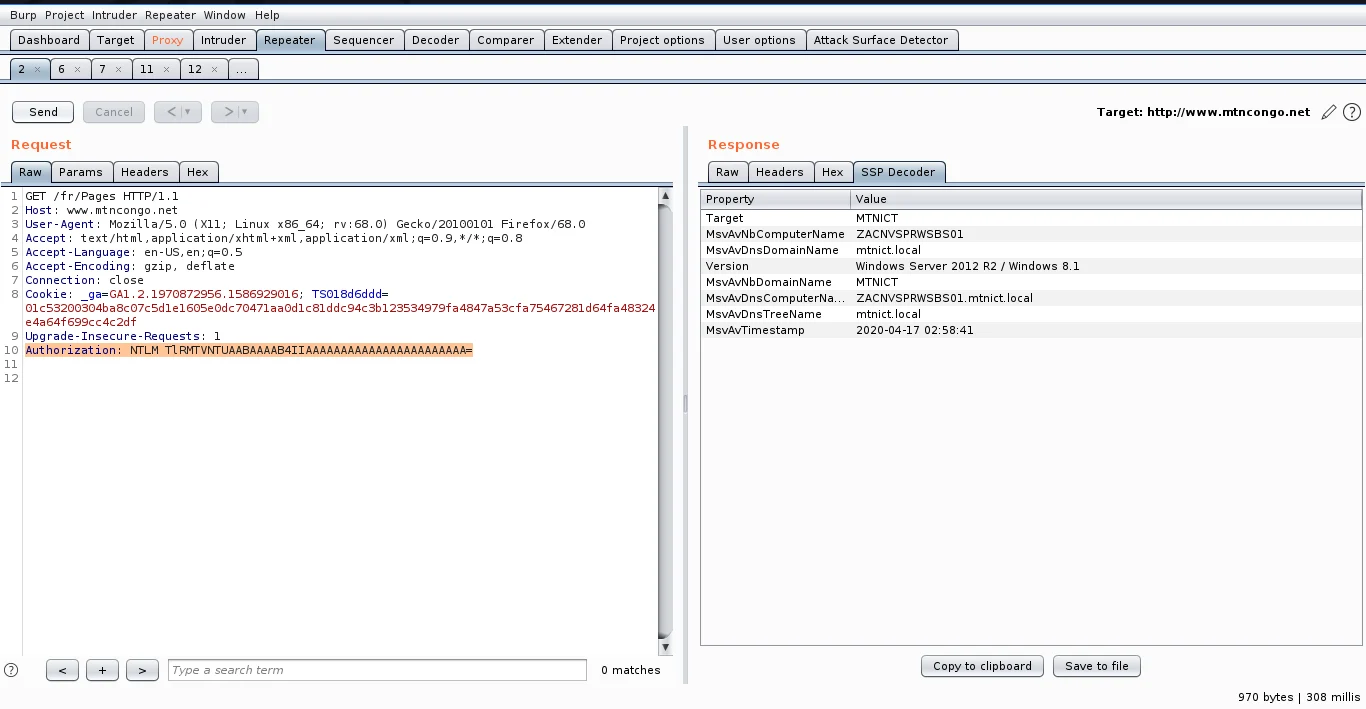
By using a request get on the url ██████████ of the blog. we collect sensitive information from blogs
step
Typically, when visiting a website █████████ or directory ██████ requiring privileged access, the server will initiate a login prompt. This allows the client to send blank username and password values to check for NTLM authentication and receive the encoded response. However, if the target server is configured to allow windowsAuthentication, it may be possible to invoke this response without a login prompt. This can be done by adding “Authorization: ███” to the request headers. Once an NTLM challenge is returned in the “WWW-Authenticate” value of the response headers, it can be decoded to capture internal information. I personally use Burp’s NTLM Challenge Decoder, but multiple other scripts have been written that can perform these actions.
GET /fr/Pages/ HTTP/1.1
Host: ████████
User-Agent: Mozilla/5.0 (X11; Linux x86_64; rv:68.0) Gecko/██████████ Firefox/68.0
Accept: text/html,application/xhtml+xml,application/xml;q=0.9,*/*;q=0.8
Accept-Language: en-US,en;q=0.5
Accept-Encoding: gzip, deflate
Connection: close
Cookie: ███
Upgrade-Insecure-Requests: 1
Authorization: ████████
Target MTNICT
MsvAvNbComputerName ZACNVSPRWSBS01
MsvAvDnsDomainName mtnict.local
Windows Server 2012 R2 / Windows 8.1 version
MsvAvNbDomainName MTNICT
MsvAvDnsComputerName ZACNVSPRWSBS01.mtnict.local
MsvAvDnsTreeName mtnict.local
MsvAvTimestamp ████ ████████
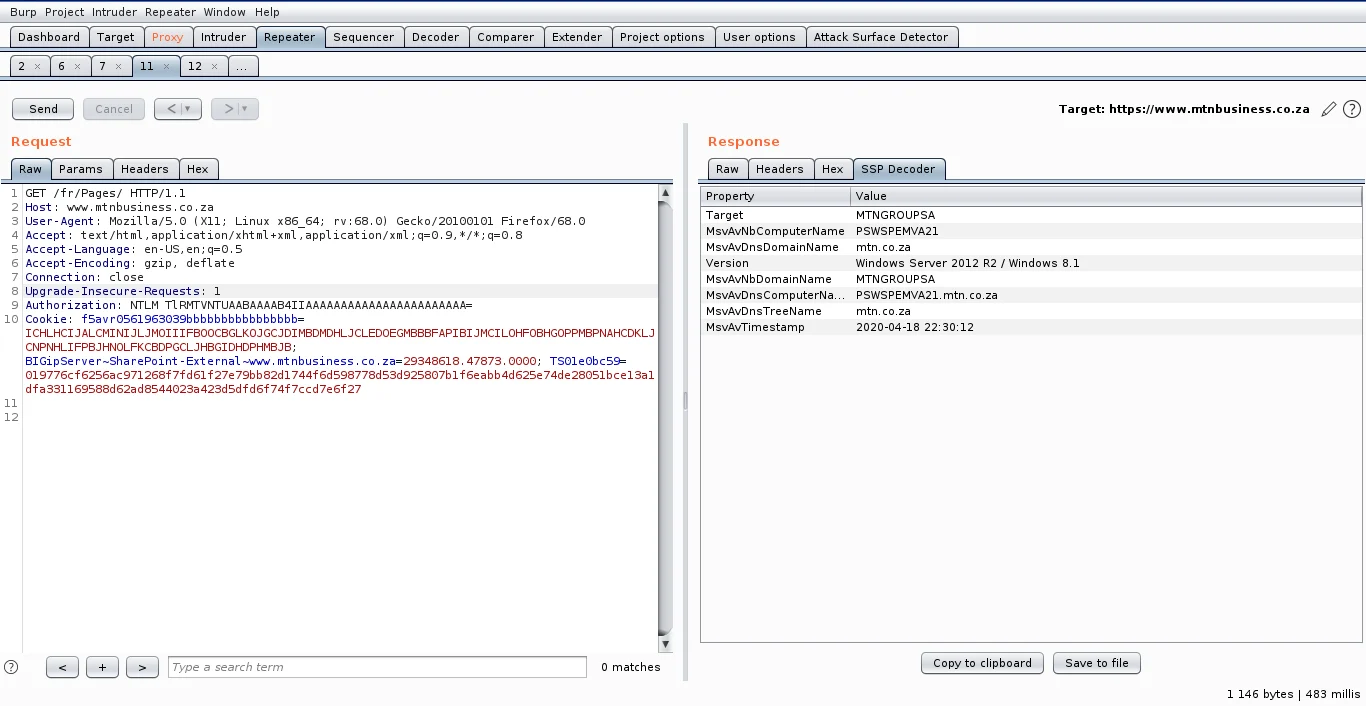
This same vulnerability is present on the blog ███████
Target	MTNGROUPSA
MsvAvNbComputerName	PSWSPEMVA21
MsvAvDnsDomainName	mtn.co.za
Version	Windows Server 2012 R2 / Windows 8.1
MsvAvNbDomainName	MTNGROUPSA
MsvAvDnsComputerName	PSWSPEMVA21.mtn.co.za
MsvAvDnsTreeName	mtn.co.za
MsvAvTimestamp	███████ █████████
Obviously we have a Target name, computer name, and the essential version:
version of Windows Server 2012 R2 / Windows 8.1 vulnerable to a remote attack, MS17-010: CVE: 2017-0144
Let run metasploite with the exploit Microsoft Windows 8/8.1/2012 R2 (x64) - 'EternalBlue' SMB Remote Code Execution (MS17-010)
Exploiting this vulnerability would be going against the rules of politics
I would like to point out that this vulnerability is clearly dangerous and its exploitation would just be a game for an intentional bad attacker.
 -------------------------------------------------------------------------------------------------------------------------------- ----------------------------------------
 Exploit Title                                                                                                                  |  Path
                                                                                                                                | (/usr/share/exploitdb/)
-------------------------------------------------------------------------------------------------------------------------------- ----------------------------------------
Microsoft Windows - 'EternalRomance'/'EternalSynergy'/'EternalChampion' SMB Remote Code Execution (Metasploit) (MS17-010)       | exploits/windows/remote/43970.rb
Microsoft Windows - SMB Remote Code Execution Scanner (MS17-010) (Metasploit)                                                   | exploits/windows/dos/41891.rb
Microsoft Windows 8/8.1/2012 R2 (x64) - 'EternalBlue' SMB Remote Code Execution (MS17-010)                                      | exploits/windows_x86-64/remote/42030.py
-------------------------------------------------------------------------------------------------------------------------------- ----------------------------------------
Impact
-Malicious attackers can add bitcoin mining source code to the site architecture -Modified changes to the database -Collect person information on blog staff
Attachments
Not written yet. The AI write-up for this report has not been written yet. The Original tab links to the source.
How it worked
Root cause
Likely the web server had Windows authentication enabled and returned NTLM challenge details to unauthenticated requests, exposing internal host and domain information.
Impact
An attacker could learn internal Windows computer names, domain names and operating system versions, which could help plan further attacks such as exploiting MS17-010, though the report does not show that exploitation was carried out.
What the attacker needed
Target server allows Windows authentication; ability to send custom HTTP headers
How it was found
- Send a GET request to a blog page with an Authorization header set to an NTLM type 1 message.
- Receive an NTLM challenge in the WWW-Authenticate response header.
- Decode the challenge to extract internal computer name, domain name, DNS tree name and Windows version.
- Repeat the same request against another blog to obtain similar internal details.
- Use the leaked Windows version to identify a known remote code execution vulnerability (MS17-010).
Explained by bugbounty.wiki with AI from the original and checked against quotes from it; it can still be wrong. Read the original before relying on a detail.
Not written yet. The AI write-up for this report has not been written yet. The Original tab links to the source.
Some web servers use a Windows login system called NTLM. If a server is set up to allow NTLM, it may reply to a special request with a challenge message that includes details about the internal Windows network, such as computer names and domain names. Here, the server gave out those details without asking for a password, which helps an attacker map the internal network.
What is Info disclosure?
Data the application should keep private (personal data, internal details, other users' records) reaches someone it should not.




