Reflected XSS in chatbot
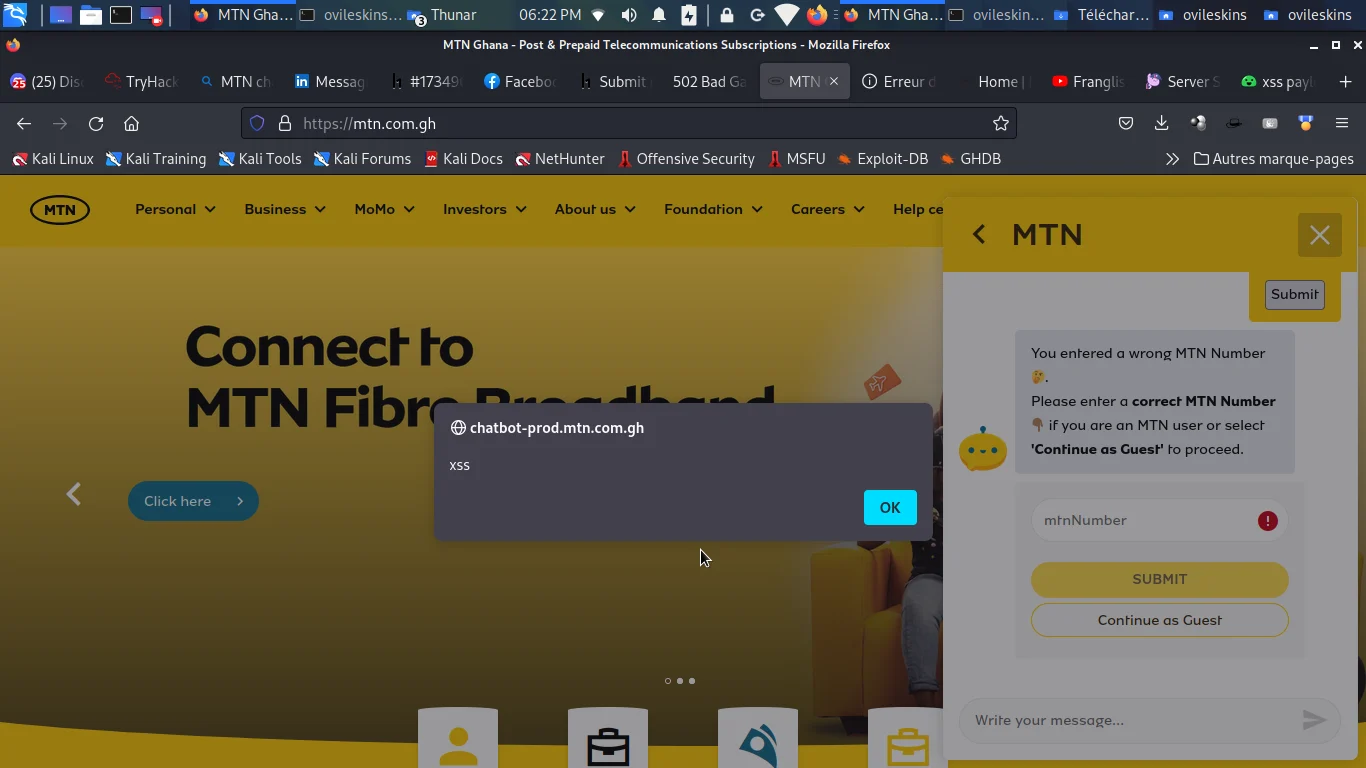
A chatbot on the MTN Ghana website accepted an XSS payload in its number field. If an attacker can run script in a victim's browser, they can usually perform any action the user can.
 Originally disclosed on HackerOne
- Fixed in 6 days
- Disclosed after 36 days
Reflected XSS attacks, also known as non-persistent attacks, occur when a malicious script is reflected off of a web application to the victim's browser. The script is activated through a link, which sends a request to a website with a vulnerability that enables execution of malicious scripts Proof of Concept 1)Go to the website https://mtn.com.gh/ 2)click on the MTN chat and where it asks to enter a number enter an xss payload 3)In my case I put the following payload:<button onClick="alert('xss')">Submit</button>
Impact
If an attacker can control a script running in the victim's browser, they can usually completely compromise that user. Among other things, the attacker can: Perform any action in the application that the user can perform.
Attachments
Not written yet. The AI write-up for this report has not been written yet. The Original tab links to the source.
How it worked
Root cause
Likely the chatbot reflected the user-supplied number input into the page without encoding or sanitising it.
Impact
An attacker could usually run script in a victim's browser and perform any action in the application that the user can perform.
What the attacker needed
Victim clicks a crafted link; victim's browser sends the request to the vulnerable site
How it was found
- Open the MTN Ghana website.
- Open the MTN chat widget.
- Enter an XSS payload in the number field.
- The payload is entered in the number field.
Explained by bugbounty.wiki with AI from the original and checked against quotes from it; it can still be wrong. Read the original before relying on a detail.
Not written yet. The AI write-up for this report has not been written yet. The Original tab links to the source.
Reflected XSS happens when a malicious script is reflected off a web application to the victim's browser, activated through a link. Here, an XSS payload was entered in the chatbot's number field.
What is XSS?
Script an attacker supplies runs in another user's browser, on the target's origin, with that user's session.







