Wordpress users disclosure from json and xml file
The WordPress REST API oEmbed endpoint and the author sitemap expose registered usernames without authentication, even though the users endpoint is protected. An attacker could collect these usernames and use the enabled xmlrpc.php to brute-force passwords.

- Triaged in 13 hours
- Fixed in 8 months
- Disclosed after 9 months
Summary:
It's possible to get information about the users registered (such as: username) without authentication in Wordpress via API on: https://www.mtn.co.sz/wp-json/oembed/1.0/embed?url=https://www.mtn.co.sz/&format=json https://www.mtn.co.sz/author-sitemap.xml
Steps To Reproduce:
The path https://www.mtn.co.sz/wp-json/wp/v2/users/me is configured correctly. Active usernames cannot be displayed and the application responds with code 401, saying that I am not authorized.

But there is this active path, which allows anyone to view active usernames: https://www.mtn.co.sz/wp-json/oembed/1.0/embed?url=https://www.mtn.co.sz/&format=json https://www.mtn.co.sz/author-sitemap.xml


Username found:
- waseem
- nkosivile
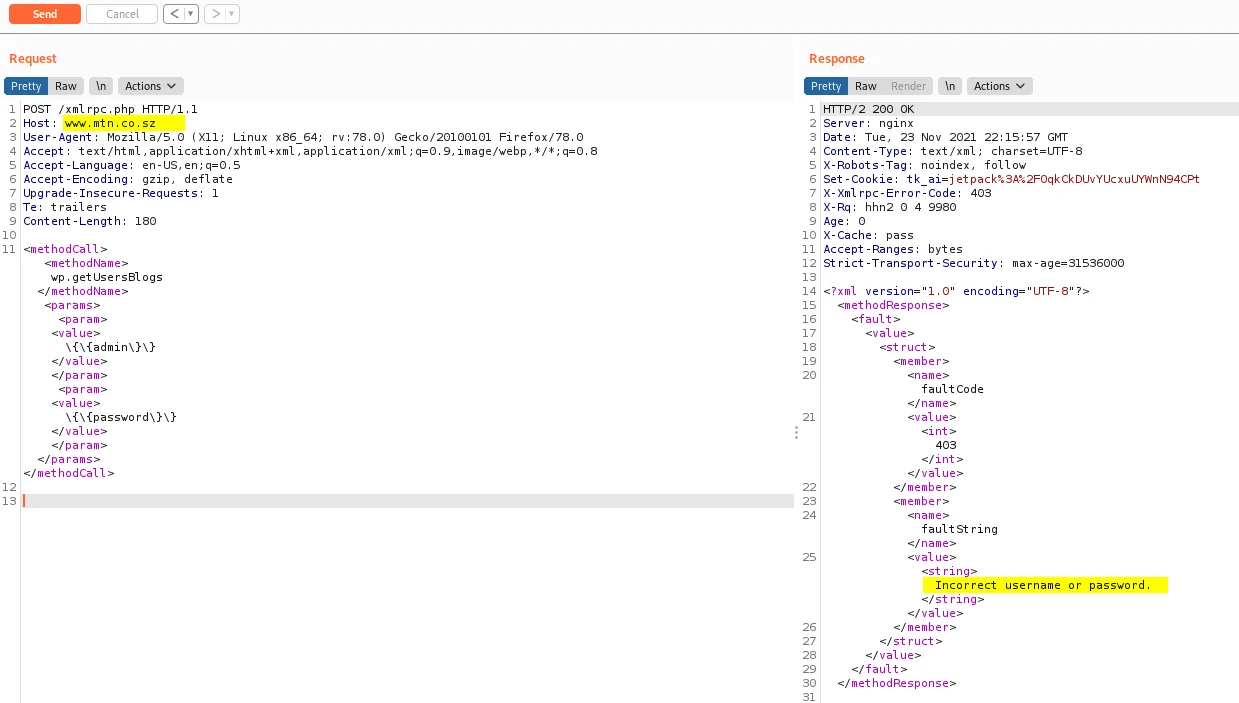
These users can be used to bruteforce, thanks also to the enabled xmlrpc.php file. Perform this request with Burp:
POST /xmlrpc.php HTTP/1.1
Host: www.mtn.co.sz
User-Agent: Mozilla/5.0 (X11; Linux x86_64; rv:78.0) Gecko/20100101 Firefox/78.0
Accept: text/html,application/xhtml+xml,application/xml;q=0.9,image/webp,*/*;q=0.8
Accept-Language: en-US,en;q=0.5
Accept-Encoding: gzip, deflate
Upgrade-Insecure-Requests: 1
Te: trailers
Content-Length: 180

<methodCall> <methodName>wp.getUsersBlogs</methodName> <params> <param><value>\{\{admin\}\}</value></param> <param><value>\{\{password\}\}</value></param></params></methodCall>
You can replace the "admin" parameter with the username.
Impact
It's possible to get all the users registered on the system and create a bruteforce directed to these users.
Suggested Mitigation/Remediation Actions As already done for the "/wp-json/wp/v2/users/" path, I recommend blocking the active path as well. If the XMLRPC.php file is not used, it should be disabled and removed completely to avoid potential risks by bruteforce. Otherwise, it should at least be blocked from outside access.
Not written yet. The AI write-up for this report has not been written yet. The Original tab links to the source.
How it worked
Root cause
Likely the oEmbed REST endpoint and the author sitemap were not restricted in the same way as the users endpoint, so they still return author information.
Impact
An attacker could enumerate all registered users and then brute-force their passwords through xmlrpc.php.
What the attacker needed
No authentication needed; xmlrpc.php enabled for brute force
The fix
The oEmbed and author sitemap paths should be blocked like the users endpoint, and xmlrpc.php should be disabled or blocked from outside access if unused.
How it was found
- Request the oEmbed endpoint with the site URL and JSON format to see usernames.
- Request the author sitemap XML file to see usernames.
- Send a POST request to xmlrpc.php using the wp.getUsersBlogs method with a discovered username and a guessed password.
Explained by bugbounty.wiki with AI from the original and checked against quotes from it; it can still be wrong. Read the original before relying on a detail.
Not written yet. The AI write-up for this report has not been written yet. The Original tab links to the source.
WordPress normally hides the list of registered users, but two other public pages still reveal usernames. Knowing a valid username makes guessing the password easier, especially because a login feature called xmlrpc.php accepts password attempts.
What is Info disclosure?
Data the application should keep private (personal data, internal details, other users' records) reaches someone it should not.



