Content Spoofing/Text Injection in https://demo.nextcloud.com
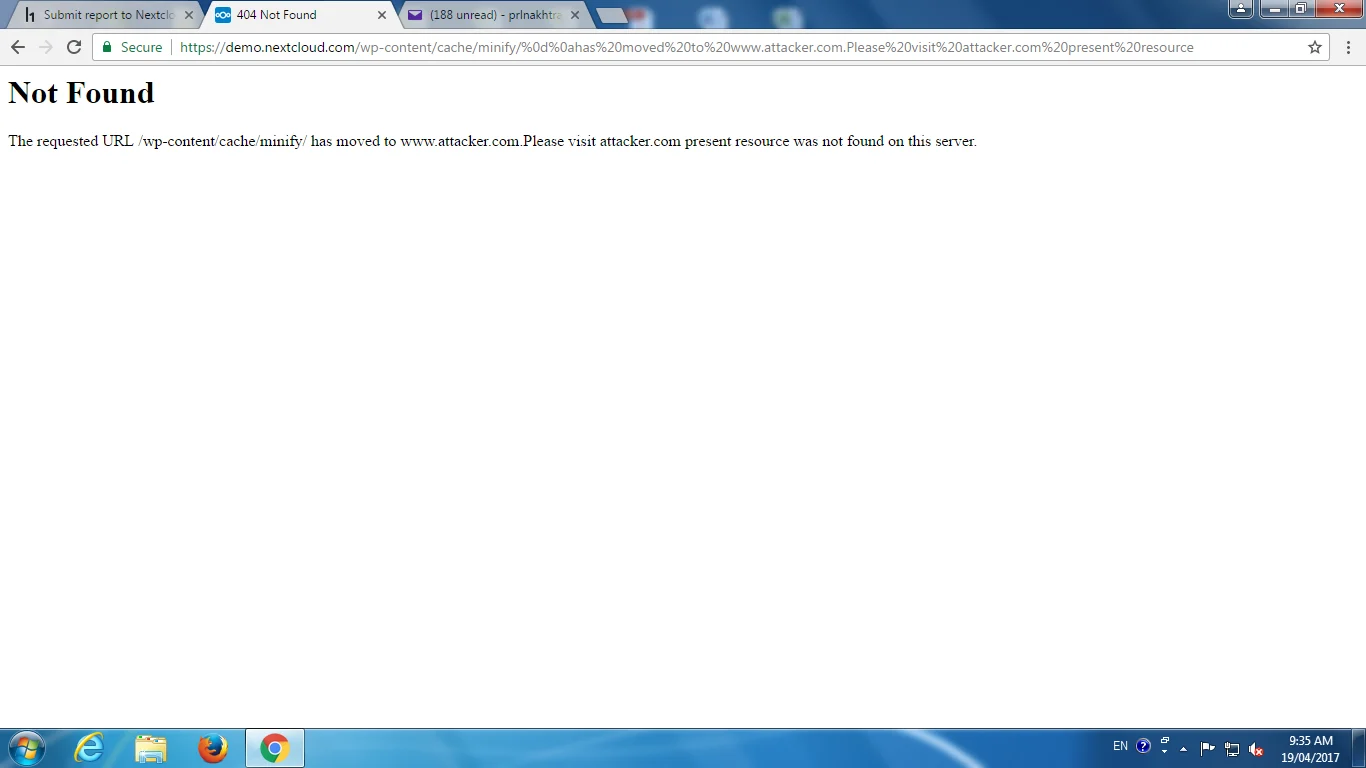
A URL path containing encoded carriage-return and line-feed characters followed by text was used in a content spoofing/text injection proof of concept on the domain.

- Triaged in 3 hours
- Fixed in 36 hours
- Disclosed after 9 days
Greetings,
Hello Team, I have found a Content Spoofing/Text Injection on this domain https://demo.nextcloud.com
PoC URL:https://demo.nextcloud.com/wp-content/cache/minify/%0d%0ahas%20moved%20to%20www.attacker.com.Please%20visit%20attacker.com%20present%20resource
PoC Screen Shot:
Let me know if you need more information.
Cheers!
Regards, @smit
Attachments
Not written yet. The AI write-up for this report has not been written yet. The Original tab links to the source.
How it worked
Root cause
Likely the application reflected part of the URL path into the response without sanitising encoded newline characters, allowing injected text to appear.
Impact
An attacker could potentially make the site display misleading text, which may be used for social engineering.
What the attacker needed
Victim clicks a crafted link
Explained by bugbounty.wiki with AI from the original and checked against quotes from it; it can still be wrong. Read the original before relying on a detail.
Not written yet. The AI write-up for this report has not been written yet. The Original tab links to the source.
Content spoofing means tricking a website into showing text the attacker chose. Here, a web address with encoded newline characters and a message was given as a proof of concept.
What is XSS?
Script an attacker supplies runs in another user's browser, on the target's origin, with that user's session.