Missing Rate Limiting protection leading to mass triggering of e-mails
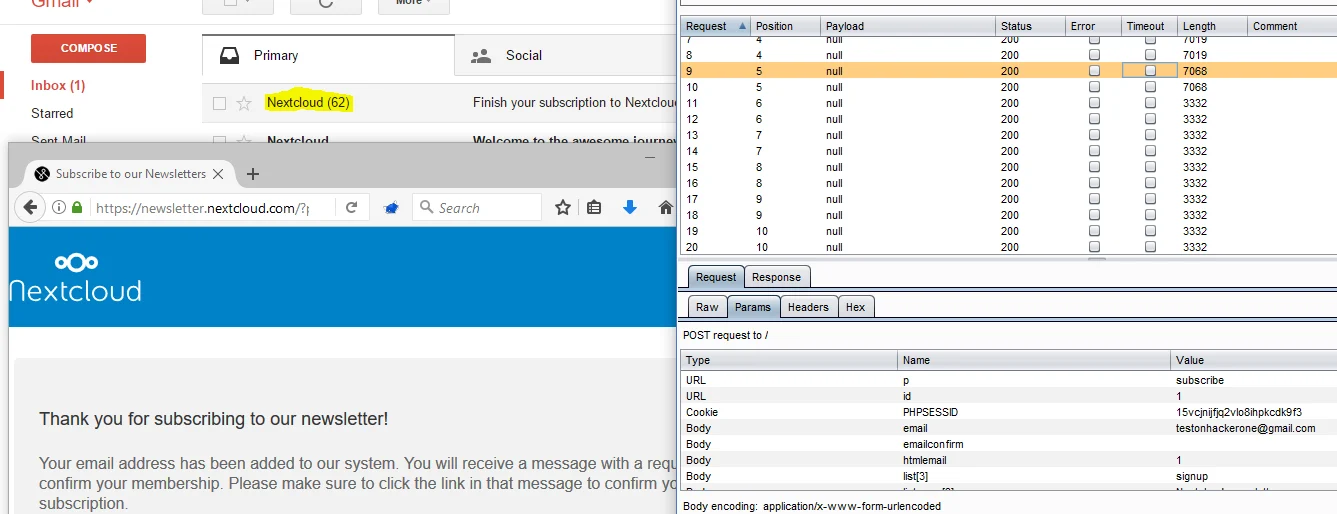
The newsletter subscription endpoint lacked rate limiting, so an attacker could repeatedly submit the same subscription request to send many confirmation emails to any address. This could exhaust the organisation's email sending quota and flood a user's inbox.

- Triaged in 23 hours
- Fixed in 7 days
- Disclosed after 37 days
The issue is that there is a speed bump missing in the subscription of e-mail for a user. This would eventually let the attacker spam to any random e-mail resulting in exhaustion of resources on your side and I see that you are using Amazon AWS's SES where you are charged per e-mail. If a dedicated attacker wants to, he/she create significant loss at his/her whim and fancy.
The mails can be triggered to a specific user , post his/her confirmation to subscription thereby causing frustration to users due to flooded inbox, consequently forcing users to classify emails from your application as SPAM .
This poses a significant threat to the integrity and reputation of your organisation.
The request which when captured triggers mails. POST /?p=subscribe&id=1 HTTP/1.1 Host: newsletter.nextcloud.com Host: google.com User-Agent: Mozilla/5.0 (Windows NT 10.0; WOW64; rv:53.0) Gecko/20100101 Firefox/53.0 Accept: text/html,application/xhtml+xml,application/xml;q=0.9,/;q=0.8 Accept-Language: en-GB,en;q=0.5 Referer: https://newsletter.nextcloud.com/?p=subscribe&id=1 Content-Type: application/x-www-form-urlencoded Content-Length: 199 Cookie: PHPSESSID=15vcjnijfjq2vlo8ihpkcdk9f3 Connection: close Upgrade-Insecure-Requests: 1
email=testonhackerone%40gmail.com&emailconfirm=testonhackerone%40gmail.com&htmlemail=1&list%5B3%5D=signup&listname%5B3%5D=Nextcloud+newsletter&VerificationCodeX=&subscribe=Subscribe+to+the+newsletter
Proof of Concept / Steps to reproduce:
- Copy the request to the Burp Intruder
- Now, paste the target and the request and set the options to Null Payloads.
- Intrude the request say 10 times to the target email.
- You can see the e-mails being spammed to your inbox.
Attached is the screenshot showing count of mails triggered post confirmation of subscription(61) due to the capture of request.
Also, confirming the e-mail doesn't make that confirmed user immune to this attack. The e-mail spam attack can be performed even if the user has previously confirmed.
POC:
- Confirm the subscription once and try the same again.
I'd be more than happy to assist you with anything regarding the issue.
Look forward to hear from you.
Have a happy day.
Attachments
Not written yet. The AI write-up for this report has not been written yet. The Original tab links to the source.
How it worked
Impact
An attacker could cause financial loss through the paid email service and flood users' inboxes, potentially leading them to mark the organisation's emails as spam.
What the attacker needed
No account needed; ability to send HTTP requests
How it was found
- Capture the subscription request.
- Send it to an intruder tool with null payloads.
- Repeat the request about ten times to the target email.
- Observe the emails being sent repeatedly to the inbox.
Explained by bugbounty.wiki with AI from the original and checked against quotes from it; it can still be wrong. Read the original before relying on a detail.
Not written yet. The AI write-up for this report has not been written yet. The Original tab links to the source.
A website that sends confirmation emails should limit how often the same request can be made. Here it did not, so someone could automate the request and make the site send many emails to one address. That wastes the company's paid email service and annoys the recipient.
What is Business logic?
The application works as coded but not as intended: a negative price, a skipped payment step, a limit that can be crossed.




