No rate limiting on sinup page
The login endpoint on a Nextcloud instance did not limit repeated password submissions, so many attempts could be sent in a row. The reporter claims an attacker could brute-force credentials and take over accounts.

- Triaged in 14 days
- Fixed in 21 days
- Disclosed after 3 months
Hi Team,
Summary: As a best practice a login page should have a rate limiting. Below is the captured request of respective login page of nextcloud.com
POST /index.php/apps/preferred_providers/password/submit/D4oCzV7LrgyTtULRXsOp2 HTTP/1.1 Host: efss.qloud.my User-Agent: Mozilla/5.0 (Windows NT 10.0; Win64; x64; rv:78.0) Gecko/20100101 Firefox/78.0 Accept: text/html,application/xhtml+xml,application/xml;q=0.9,image/webp,/;q=0.8 Accept-Language: en-US,en;q=0.5 Accept-Encoding: gzip, deflate Content-Type: application/x-www-form-urlencoded Content-Length: 65 Origin: null Connection: close Cookie: ocn6e46ay0uf=g5gaufmdvaa2ab480rl3m3e2fp; oc_sessionPassphrase=rXsGoXrFnFNmXjG7wqHo25XUJ75w4gCINgeLpQ6nUy8GJQel2%2F14gFzIIhagLg7o8uuIcNuNiWKdhzxUtdyDoPaPPsqsSqHk6xbJYMK1U0DuVvM%2BJ%2Bz8rB6%2B9j25LcYT; __Host-nc_sameSiteCookielax=true; __Host-nc_sameSiteCookiestrict=true Upgrade-Insecure-Requests: 1 Cache-Control: max-age=0
ocsapirequest=&email=<targer username>&password=<target password>
Steps to reproduce :
- Tamper login page and send the request to Burp Intruder.
- Configure the payloads
- Start the Burp Intruder
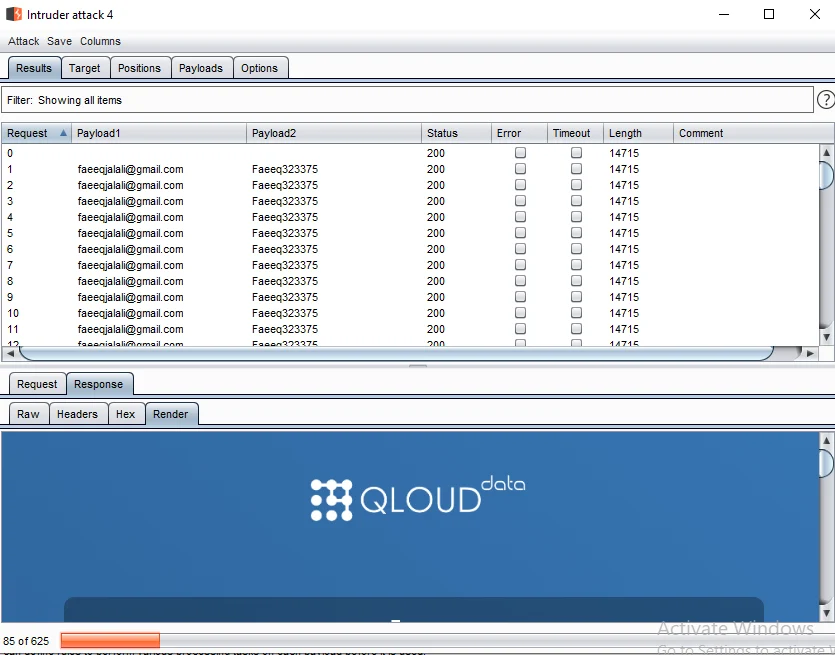
POC: in the attached image.
As you can see i have sent more than 85 requests , Therefore all the requests are being exexuted with response code 200
Impact
Impact: An attacker can freely bruteforce any username and can takeover any account.
Attachments
Not written yet. The AI write-up for this report has not been written yet. The Original tab links to the source.
How it worked
Root cause
Likely the login endpoint had no rate limiting or lockout after repeated failed password attempts.
Impact
An attacker could freely brute-force any username and potentially take over an account, though the report only shows that requests returned a normal status code.
What the attacker needed
Network access to the login page; a valid username to target
How it was found
- Capture the login request and send it to an intrusion tool.
- Set up the payloads for the repeated attempts.
- Run the tool and observe the responses.
Explained by bugbounty.wiki with AI from the original and checked against quotes from it; it can still be wrong. Read the original before relying on a detail.
Not written yet. The AI write-up for this report has not been written yet. The Original tab links to the source.
A login page should slow down or block someone who keeps guessing passwords. Here the server answered every guess normally, so a script could try many passwords quickly. That is called brute-forcing, and if one guess is right the attacker gets into the account.
What is Business logic?
The application works as coded but not as intended: a negative price, a skipped payment step, a limit that can be crossed.




