Password authentication at newsletter.nextcloud.com discloses username list
The OpenSSH server on newsletter.nextcloud.com responded more slowly to authentication attempts for existing usernames than for non-existent ones when a large password was supplied. An attacker could use this timing difference to enumerate valid usernames remotely without authentication.

- Triaged in under an hour
- Fixed in 11 months
- Disclosed after 14 months
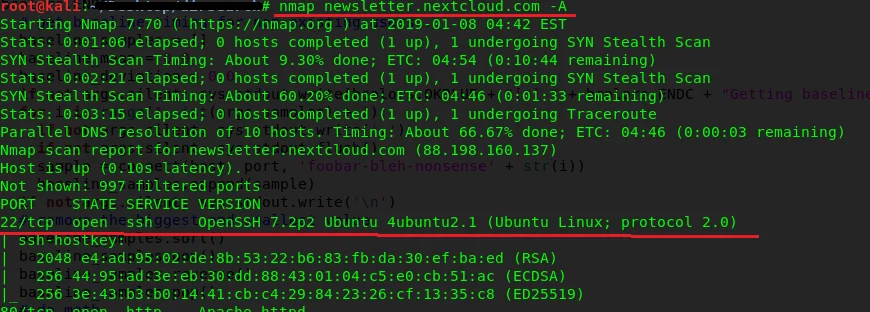
summary: A vulnerability classified as problematic has been found in OpenSSH 7.2p2. check (INFO.png)Affected is an unknown function of the component Authentication. The manipulation of the argument Password with an unknown input leads to a information disclosure vulnerability (Username). CWE is classifying the issue as CWE-200. This is going to have an impact on confidentiality. The weakness was disclosed 07/14/2016 by Eddie Harari as opensshd - user enumeration as confirmed mailinglist post (Full-Disclosure). The advisory is available at seclists.org. The vendor was not involved in the coordination of the public release. This vulnerability is traded as CVE-2016-6210 since 07/13/2016. It is possible to launch the attack remotely. The exploitation doesn't require any form of authentication. Technical details and a public exploit are known.
POC download POC.py and write the next command. (you can try with any word-list or just use some random names like I did)
- LINK: https://www.exploit-db.com/exploits/40136
- CODE: python
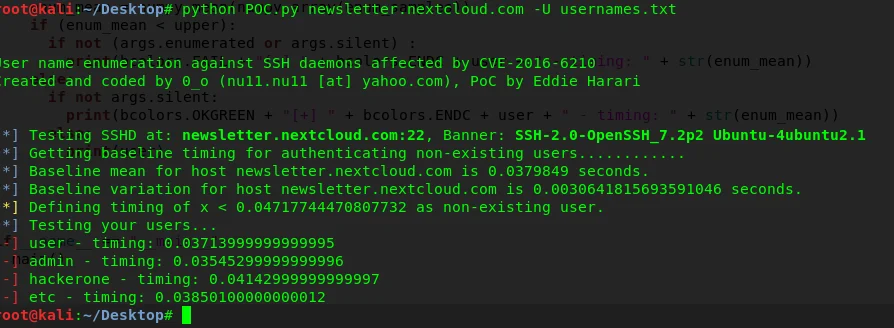
Command: python POC.py newsletter.nextcloud.com -U usernames.txt
OUTPUT: check (POC.png)
in this case user whose time < 0.04717744470807732 is non existing user I tried with a small usernames list for POC, attacker will use a big list like rockyou.txt that on Kali Linux by default.
Impact
Allows remote attackers to enumerate users by leveraging the timing difference between responses when a large password is provided.
Attachments
Not written yet. The AI write-up for this report has not been written yet. The Original tab links to the source.
How it worked
Root cause
Likely the SSH server performs password hashing only for valid usernames, causing a measurable timing difference between valid and invalid usernames.
What the attacker needed
Network access to the SSH service; a list of candidate usernames
How it was found
- Download the proof-of-concept script.
- Run the script against the target host with a list of usernames.
- Compare response times; usernames with times below a threshold are non-existent.
Explained by bugbounty.wiki with AI from the original and checked against quotes from it; it can still be wrong. Read the original before relying on a detail.
Not written yet. The AI write-up for this report has not been written yet. The Original tab links to the source.
When you try to log in with a large password, the server takes slightly longer for real usernames than for fake ones. By measuring these delays, an attacker can work out which usernames exist, without guessing passwords.
What is Info disclosure?
Data the application should keep private (personal data, internal details, other users' records) reaches someone it should not.




