My Journey to Nokia Hall of Fame in just 10 minutes
The author found three DOM XSS vulnerabilities and five open redirects on Nokia subdomains using automated scanning. The DOM XSS issues were triaged, while the open redirects were duplicates.

Hi, this is Rajdip, and I hope all of you are doing well. As a cybersecurity enthusiast, I am always on the lookout for opportunities to find vulnerabilities and report them to companies.
The full write-up lives on its author's site
It belongs to its author, so we link to it rather than copy it. The other two tabs are our own rewrites, checked against it.
Context
Nokia runs a public bug bounty programme, and this write-up describes how I reached its Honorary Hall of Fame. The target was Nokia's external attack surface: a large set of subdomains, all of which were in scope. The report does not describe any single product or feature in detail; the findings were open redirects and DOM XSS on Nokia subdomains, discovered through broad reconnaissance rather than through analysis of one application.
Setup
The only precondition was scope: with Nokia being a huge target, all subdomains were in scope. I used the following tools for subdomain enumeration and scanning:
- sublister (written as
sublist3rin the commands) - subfinder
- assetfinder
- knockpy
- httpx, for probing and capturing status codes and titles
- nuclei, for vulnerability scanning
The report does not give tool versions or any account or role requirements.
Finding it
My first step was to enumerate all subdomains with sublister, subfinder, assetfinder and knockpy, then sort them to find unique subdomains. Once I had the list of unique domains, I ran nuclei on each one to scan for vulnerabilities. After a short break I reviewed the results and found 5 open redirects and 3 DOM XSS vulnerabilities. I made reports and took proof-of-concept captures for each vulnerability and reported them to Nokia.
Exploitation
Step 1: Enumerate subdomains
I ran each enumerator and piped its output through httpx to record status codes and page titles, appending to separate files:
// enumerate subdomainssubfinder -d domain.txt | httpx -sc --title | tee -a sub1.txtassetfinder -subs-only -d domain.txt | httpx -sc --title | tee -a sub2.txt\python3 knockpy.py domain.txtsublist3r -d domain.txt | httpx -sc --title | tee -a sub4.txt
Each line feeds a host list into httpx, which probes the hosts and prints the status code (-sc) and page title (--title); tee -a writes the results to a file while showing them on screen. The block is reproduced exactly as it appears in the report, including the line breaks that were lost when it was pasted.
Step 2: Deduplicate the host list
// sort domains cat sub1 sub2 sub3 sub4 | sort -u | tee -a unique.txt
This concatenates the per-tool result files, keeps only unique lines with sort -u, and saves the combined list to unique.txt.
Step 3: Scan the unique hosts with nuclei
// nucleinuclei -l unique.txt -o nuclei_result.txt
nuclei reads the deduplicated host list from unique.txt and writes its findings to nuclei_result.txt. Reviewing that output is what surfaced the 5 open redirects and 3 DOM XSS issues.
Step 4: Report with proof of concept
For each of the eight findings I prepared a report and a proof of concept and submitted them to Nokia. The report does not include the individual payloads, URLs or responses.
Response from Nokia
Within a day Nokia responded, thanking me for the submission. Of the five open redirects and three DOM XSS vulnerabilities, the five open redirects were found to be duplicates, while the three DOM XSS vulnerabilities were triaged. Nokia also said it would address all similar findings and add my name to its Hall of Fame. A few days later my name appeared on Nokia's Honorary Hall of Fame list.
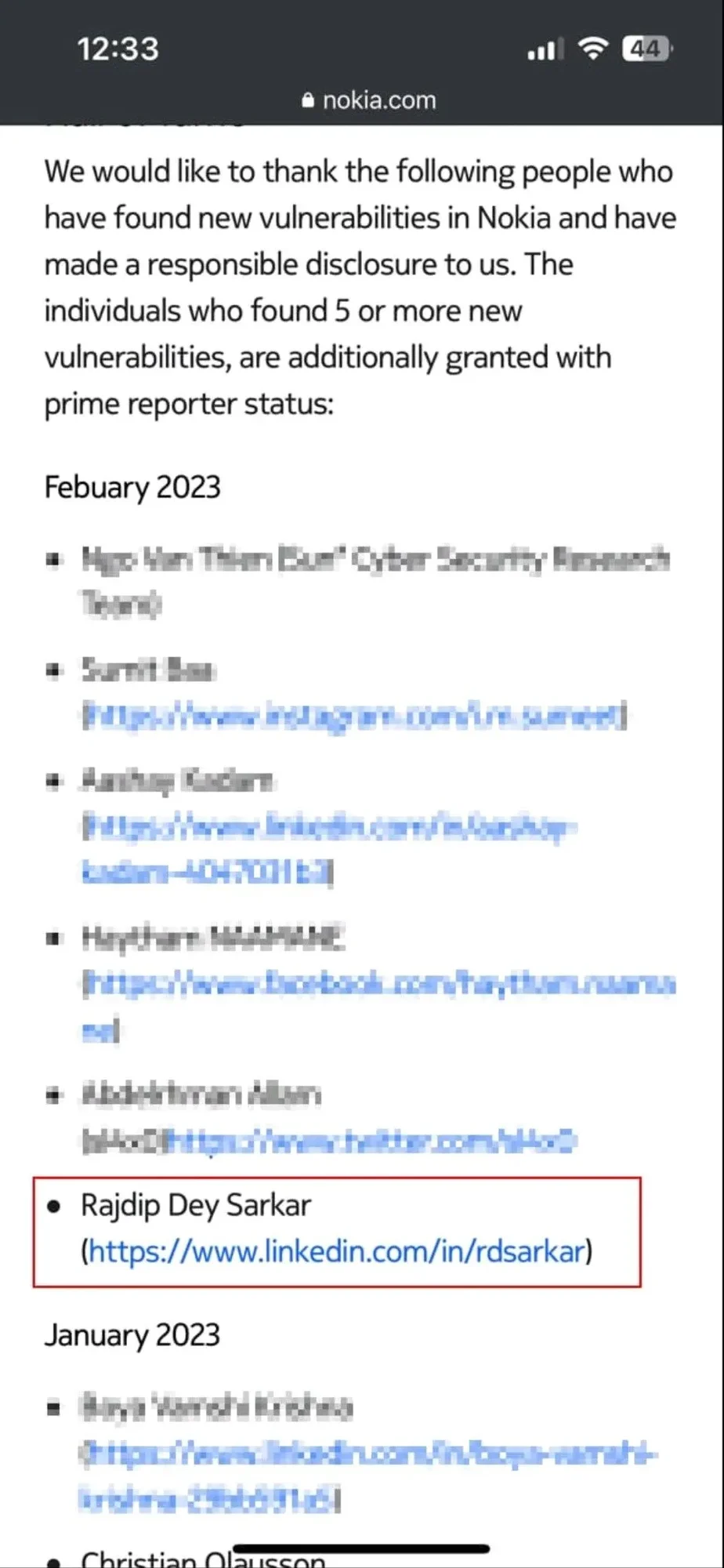
The image is captioned HOF-Nokia in the report.
Root cause
The report does not analyse the code behind any of the findings, so the underlying defect is not described. At the level the report works at, the result came from running an automated scanner across a large, fully in-scope subdomain estate: the result came from running an automated scanner across a large, fully in-scope subdomain estate.. Why existing defences did not stop those patterns is not stated.
Impact
The three DOM XSS issues were accepted and triaged by Nokia; the five open redirects were closed as duplicates, meaning they had already been reported by someone else.
Fix
Nokia stated that it would address all similar findings, and the accepted DOM XSS reports were triaged.
Variants to test
- Run the same pipeline against another large programme: enumerate with several sources, deduplicate, probe with httpx, then scan with nuclei. A positive result is scanner output pointing at concrete hosts and parameters worth manual confirmation.
- Treat duplicate open redirects as a signal: five of eight findings were duplicates, so the same redirect patterns had already been reported elsewhere.
- Prioritise DOM XSS findings, since in this case they were the ones that survived triage while the redirects did not.
- Do not rely on the scanner alone: as the final thought of the report puts it, thorough reconnaissance to identify attack surfaces increases the chance of finding vulnerabilities that scanners may not detect.
What happened, in plain words
Nokia runs a public bug bounty programme: a scheme where companies invite outside researchers to look for security weaknesses in their systems and report them, sometimes for a reward or public recognition. This article is about how I found several such weaknesses in Nokia's systems in about ten minutes of searching and ended up on Nokia's Honorary Hall of Fame, a public list of people who have reported valid issues.
The target was Nokia's external attack surface: the collection of all the web servers and services that Nokia exposes to the internet. Nokia owns many subdomains, and the programme allowed testing on all of them. I did not study one particular product in depth. Instead, I used automated tools to discover as many subdomains as possible and then ran a scanner across them. The scanner reported five open redirects and three DOM XSS issues. An open redirect is a link on a website that takes you to another site you did not intend to visit; DOM XSS is a way of making a web page run malicious code in your browser. I reported all eight findings with proof-of-concept evidence. Nokia accepted the three DOM XSS issues and closed the five open redirects as duplicates, meaning someone else had already reported them. Nokia said it would fix all similar issues and added my name to its Hall of Fame.
Setup
The only precondition was scope: Nokia's programme covered all subdomains, so I could test any Nokia subdomain I could find. I used these tools:
- sublister (written as
sublist3rin the commands): a tool that searches public sources for subdomains. - subfinder: another subdomain discovery tool.
- assetfinder: a tool that finds domains and subdomains related to a given domain.
- knockpy: a tool that tries to discover subdomains by guessing names and checking DNS.
- httpx: a tool that takes a list of hosts and probes each one over HTTP, printing information such as the status code and page title.
- nuclei: a scanner that runs a large set of pre-written checks (templates) against hosts to detect known patterns of vulnerabilities.
The report does not give tool versions or any account or role requirements.
Finding it
My first step was to enumerate all subdomains with sublister, subfinder, assetfinder and knockpy, then sort them to find unique subdomains. Enumerating means making a list of all the names that exist under a domain. Once I had the list of unique domains, I ran nuclei on each one to scan for vulnerabilities. After a short break I reviewed the results and found 5 open redirects and 3 DOM XSS vulnerabilities. I made reports and took proof-of-concept captures for each vulnerability and reported them to Nokia.
Exploitation
Step 1: Enumerate subdomains
I ran each enumerator and piped its output through httpx to record status codes and page titles, appending to separate files:
// enumerate subdomainssubfinder -d domain.txt | httpx -sc --title | tee -a sub1.txtassetfinder -subs-only -d domain.txt | httpx -sc --title | tee -a sub2.txt\python3 knockpy.py domain.txtsublist3r -d domain.txt | httpx -sc --title | tee -a sub4.txt
This block is reproduced exactly as it appears in the report, including the line breaks that were lost when it was pasted. In plain terms, each line runs a subdomain discovery tool and sends its output to httpx. httpx then visits each host and prints the HTTP status code (-sc) and the page title (--title). The tee -a part writes the results to a file while also showing them on screen. The status code tells you whether the page exists and is reachable (for example, 200 means OK, 404 means not found), and the title gives a hint about what the page is. This step is like walking around a large building and noting which doors open and what is written on them.
Step 2: Deduplicate the host list
// sort domains cat sub1 sub2 sub3 sub4 | sort -u | tee -a unique.txt
This concatenates the per-tool result files, keeps only unique lines with sort -u, and saves the combined list to unique.txt. Different tools often find the same subdomain, so removing duplicates gives a clean list and avoids scanning the same host twice.
Step 3: Scan the unique hosts with nuclei
// nucleinuclei -l unique.txt -o nuclei_result.txt
nuclei reads the deduplicated host list from unique.txt and writes its findings to nuclei_result.txt. Reviewing that output is what surfaced the 5 open redirects and 3 DOM XSS issues. Think of nuclei as a checklist robot: it tries many known patterns on each host and notes the ones that match.
Step 4: Report with proof of concept
For each of the eight findings I prepared a report and a proof of concept and submitted them to Nokia. A proof of concept is a concrete demonstration that the issue is real. The report does not include the individual payloads, URLs or responses.
Response from Nokia
Within a day Nokia responded, thanking me for the submission. Of the five open redirects and three DOM XSS vulnerabilities, the five open redirects were found to be duplicates, while the three DOM XSS vulnerabilities were triaged. Triaged means the security team reviewed them and accepted them as valid issues to work on. Nokia also said it would address all similar findings and add my name to its Hall of Fame. A few days later my name appeared on Nokia's Honorary Hall of Fame list.
The image is captioned HOF-Nokia in the report.
Root cause
The report does not analyse the code behind any of the findings, so the underlying defect is not described. At the level the report works at, the result came from running an automated scanner across a large, fully in-scope subdomain estate: the result came from running an automated scanner across a large, fully in-scope subdomain estate.. Why existing defences did not stop those patterns is not stated.
Impact
The report does not describe the impact of the individual findings. The three DOM XSS issues were accepted and triaged by Nokia; the five open redirects were closed as duplicates, meaning they had already been reported by someone else.
Fix
Nokia stated that it would address all similar findings, and the accepted DOM XSS reports were triaged.
Variants to test
- Run the same pipeline against another large programme: enumerate with several sources, deduplicate, probe with httpx, then scan with nuclei. A positive result is scanner output pointing at concrete hosts and parameters worth manual confirmation.
- Treat duplicate open redirects as a signal: five of eight findings were duplicates, so the same redirect patterns had already been reported elsewhere.
- Prioritise DOM XSS findings, since in this case they were the ones that survived triage while the redirects did not.
- Do not rely on the scanner alone: as the final thought of the report puts it, thorough reconnaissance to identify attack surfaces increases the chance of finding vulnerabilities that scanners may not detect.
Glossary
- Bug bounty programme: a scheme where a company invites outside researchers to report security weaknesses, often with rewards or recognition.
- Hall of Fame: a public list of people who have reported valid security issues to a company.
- Subdomain: a name that sits under a main domain, like
shop.example.comunderexample.com. - Attack surface: all the points where an outsider could try to interact with a system, such as web pages, APIs and login forms.
- Enumeration: the process of listing things, here subdomains, by querying public sources or guessing names.
- DNS: the system that translates domain names into the addresses computers use to find each other.
- HTTP status code: a number a web server returns to say what happened, such as 200 for OK or 404 for not found.
- Page title: the text shown in the browser tab, taken from the HTML
<title>element. - httpx: a command-line tool that probes web hosts and prints information like status codes and titles.
- nuclei: a scanner that runs many pre-written checks (templates) against hosts to find known vulnerability patterns.
- Template: a pre-written check used by nuclei to detect a specific issue.
- Open redirect: a link on a website that sends you to another site you did not intend to visit, often used in phishing.
- DOM XSS: a type of cross-site scripting where malicious code runs in the browser because the page's own JavaScript handles user input unsafely.
- Cross-site scripting (XSS): a weakness that lets an attacker run their own code in another user's browser.
- Proof of concept (PoC): a concrete demonstration that a vulnerability is real, such as a URL or screenshot.
- Duplicate: a report for an issue that someone else has already reported.
- Triaged: reviewed and accepted by the security team as a valid issue to work on.
- Payload: the specific piece of input or code used to trigger a vulnerability.
- Reconnaissance: the information-gathering phase before testing, such as finding subdomains.



