Reflected XSS in pubg.com
The pubg.com website reflected the value of a GET parameter into the page without sanitising it, so an attacker could craft a link that runs JavaScript in a victim's browser. With user interaction, the attacker could execute arbitrary script in the victim's session.
 Originally disclosed on HackerOne
- Triaged in under an hour
- Fixed in 4 days
- Disclosed after 4 days
Summary by the program
The researcher found an XSS vulnerability caused by query parameters not being properly sanitized before being displayed on the page.
The report
Summary:
PUBG's main website https://www.pubg.com has an endpoint that is vulnerable to an injection vulnerability - namely a reflected injection of JavaScript, also known as Reflected Cross Site Scripting (XSS). As per OWASP's definition: "Cross-Site Scripting (XSS) attacks are a type of injection, in which malicious scripts are injected into otherwise benign and trusted websites. " This happens because one of the GET parameters "p" does not properly sanitize/escape user input, allowing an injection to occur.
Steps To Reproduce:
To reproduce this, an attacker has to:
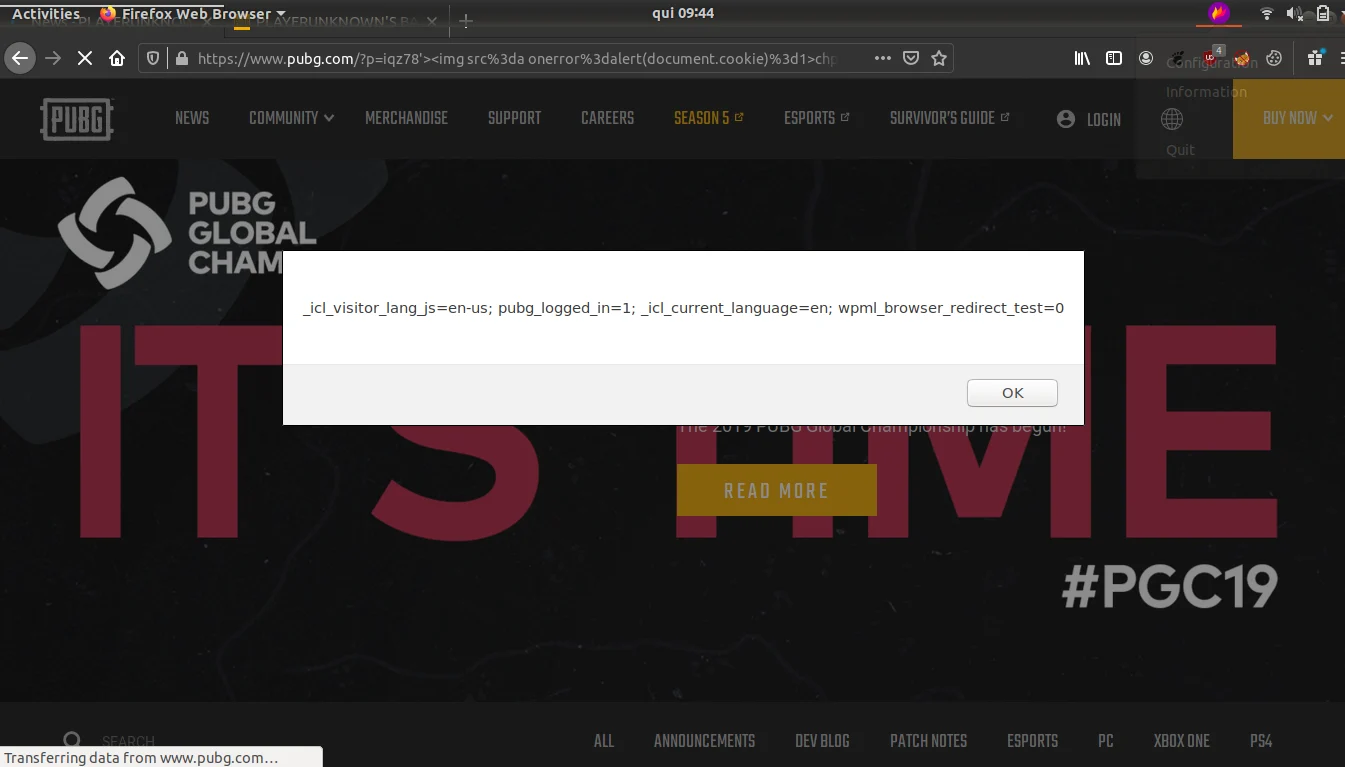
- Prepare a Javascript payload that it wants the victim to execute. In this case, for Proof of Concept purposes, our Javascript code will prompt an alert showing the users' cookies.
alert(document.cookie);
- Inject this Javascript code properly into the vulnerable parameter, creating thus a crafted future GET request that will inject the payload.
GET /?p=iqz78'%3e%3cimg%20src%3da%20onerror%3dalert(document.cookie)%3d1%3echplq HTTP/1.1
Host: www.pubg.com
Accept-Encoding: gzip, deflate
Accept: */*
Accept-Language: en
User-Agent: Mozilla/5.0 (compatible; MSIE 9.0; Windows NT 6.1; Win64; x64; Trident/5.0)
Connection: close
Referer: https://www.pubg.com/es/feed/
Cookie: _icl_current_language=en; _icl_visitor_lang_js=en-us; wpml_browser_redirect_test=0; __cfduid=de74423d435717d651b1c9e2c63f4acc21575460678
Request PoC
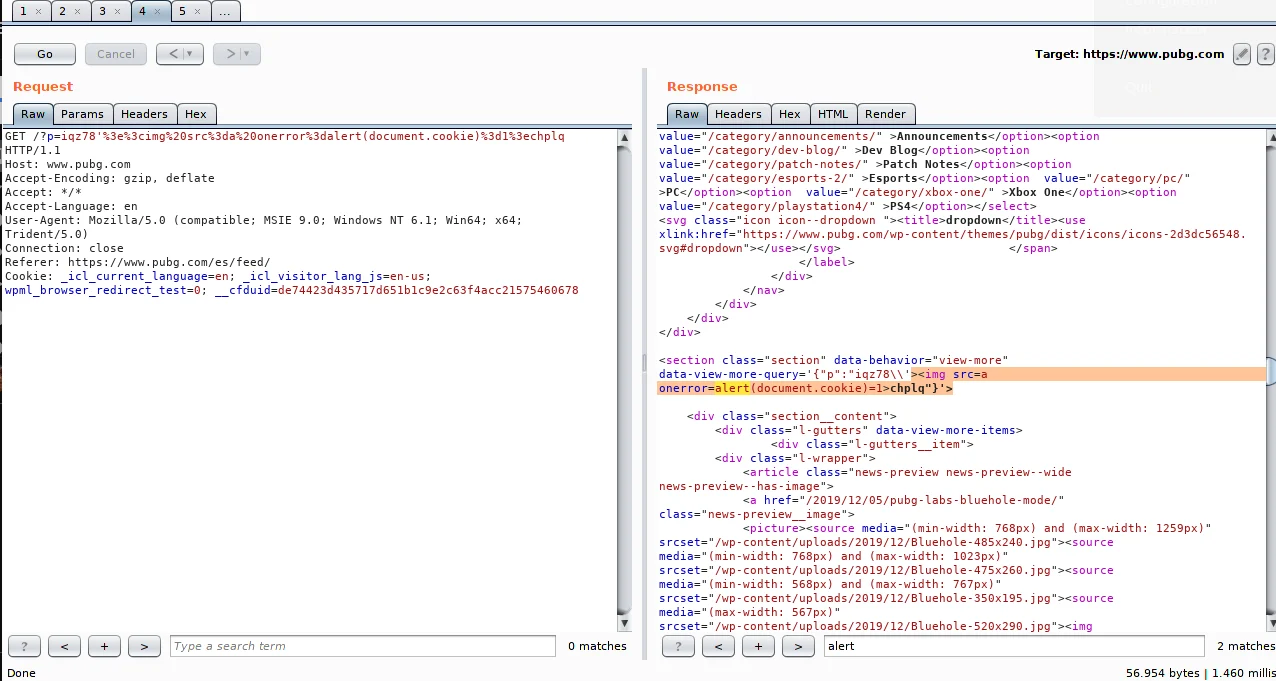
- As this injection happens in a GET parameter, the attacker simply needs to send the crafted Link that produces this GET request to the victim and have the victim click it.
Injection Demonstration
Supporting Material/References:
- Video Demonstration
Impact
With user interaction, an attacker could execute arbitrary Javascript code in a victim's browser. This would allow an attacker to unwillingly make a victim:
- Perform any action in the identified endpoint
- View any information that the user is able to view
- Modify any information that the user is able to modify (not sure if applicable in this case)
- Interact with other application users as if it were him - impersonation (not sure if applicable in this case)
Not written yet. The AI write-up for this report has not been written yet. The Original tab links to the source.
How it worked
Root cause
The application reflected the GET parameter 'p' into the HTML response without escaping or sanitising it.
Impact
With user interaction, an attacker could execute arbitrary JavaScript code in a victim's browser, potentially performing actions, viewing information, or modifying data as the victim.
What the attacker needed
Victim clicks a crafted link
How it was found
- Prepare a JavaScript payload that the victim should execute.
- Inject the JavaScript into the vulnerable GET parameter to create a crafted request.
- Send the crafted link to the victim and have them click it.
Explained by bugbounty.wiki with AI from the original and checked against quotes from it; it can still be wrong. Read the original before relying on a detail.
Not written yet. The AI write-up for this report has not been written yet. The Original tab links to the source.
When a website takes something from the address bar and puts it straight into the page without cleaning it, an attacker can put code in the link instead of normal text. If a victim clicks that link, the code runs in the victim's browser as if the website itself had written it. This is called reflected cross-site scripting because the malicious input is bounced straight back to the user.
What is XSS?
Script an attacker supplies runs in another user's browser, on the target's origin, with that user's session.




